Solve Problems Like a Detective

Solve Problems Like a Detective


In CLIFF DIVER, Detective Emilia Cruz starts piecing together a police investigation by using a timeline. Emilia’s love of timelines will be an element of her crime-solving skills in every book in the Emilia Cruz mystery series. It’s her go-to problem-solving device and the best way she knows to start organizing the many disparate threads running through every case.

Off the pages of a mystery series and into real life, however, a timeline is a better planning device than a decision-making tool, in my view. Alone, it can’t help you narrow down solutions or predict consequences.  But pair it with one of the tools below and you have a powerful way to resolve issues:

Pros and Cons

I once bought paper pre-printed with two columns, one reading PRO and the other reading CON. I actually pulled it out when a friend could not choose between a new job that was a risk and the current, safe, job where he felt stale. We literally brainstormed both sides of going vs staying. It was a simple exercise but helped him see solutions through an unemotional lens.

Plot the pros and cons on a timeline to know the time frame each will require. In my friend's case he took the higher risk job because when he counted up all the pros of the new opportunity, they far outweighed not only the cons, but also the limited pros of staying where he was.

Action items

For years when I felt blue, worried, or stuck, I’d make a list of what was going wrong on the left side of a legal pad. On the right side I’d list all possible action items for changing the situation and achieving a solution.  I'd timeline the actions to see how long they'd take or if I could do them immediately, in the next few days, or in the distant future. Inevitably I’d find something I could do to improve the situation and know when I could do it.

Maybe the list won’t make the problem completely go away but the exercise always leaves me with a feeling of greater control and that is half the battle.

Related: The Ultimate Secret to Productivity

Linear Thinking

A lot of problems feel bigger than they are because we are afraid of unknown consequences. So diagram the linear logic thread and figure out what and when some of those consequences might be/take place. It's a basic "this action will lead to this outcome" exercise. But in order to work you have to be both realistic and honest.

For example, when we lived in Mexico, friends rarely paid their gardener on time. He stopped showing up and they attributed it to “typical” laziness. A more honest, linear thinking mindset might have recognized that if they wanted a nice yard, they’d have to pay for the work on time. The gardener could not afford transportation to get there on Thursday when he wasn't paid for his work on Monday, even if they were prepared to pay him for both days on Thursday.

These problem solving ideas are likely to make their way into the investigations in the Emilia Cruz mystery series. But will they help her find a solution to her problems with Kurt Rucker? She might have to deal with corrupt politicians, dirty cops, and drug cartels in Acapulco, but Kurt is without a doubt her biggest challenge!

You may also like

solve problems

Book Review: Thursday’s List by V. S. Kemanis

Book Review: Thursday’s List by V. S. Kemanis

The Amazon.com description of legal thriller THURSDAY'S LIST doesn't do justice to what is a revealing dive into the legal tangles involved in catching and convicting foreign money launderers in the US.

Set in 1988, with a pre-cell phone, pre-9/11 and pre-Patriot Act feel, it revolves around an investigation by New York City prosecutors into the flow of drug money by Colombia’s Cali cartel. The 80’s were the heyday of the Colombian drug cartels and the book shines brightest when describing money laundering activities and the agonizing work to find bank accounts, checks, couriers, and other links to the Colombian bad guys. Swept up in the churn is rookie attorney Dana Hargrove. Her best friend not only works in a bank being used by the cartels but is married to a bookish Colombian who thought he’d left his country’s drug mess behind him long ago.

The story starts with action and great atmospherics as Hargrove yawns her way through a shift as prosecutor at a dumpy NYC night court, complete with surly judge in a scene that put me in mind of a darker and more serious episode of the old TV sitcom Night Court. A bad smelling case, however, takes her out of the court rota and into a unit investigating financial crimes.

The financial crimes colleagues are neither forthcoming nor trustworthy and although still young and making mistakes, Hargrove is savvy enough to realize she’s being used. The suspense here isn't the whodunit variety or a complex plot twist but turns on the question of how long the heroine and her best friend can survive being used by the system before the system catches the bad guys.

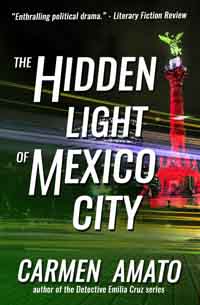
I was particularly struck by how THURSDAY'S LIST is the flip side of the fight against drug cartels that I wrote about in THE HIDDEN LIGHT OF MEXICO CITY. Hargrove is tracking the money trail on the US side of the border (albeit in 1988) and is subject to US laws and restrictions. In HIDDEN LIGHT, Mexican attorney Eddo Cortez Castillo uses whatever legal, military, and ultimately private means he can in today's Mexico to investigate money laundering in an effort to get close enough to a drug cartel to take action. Both books describe the practice known as "layering" that cartels use to move and hide money.

Comparing the two descriptions gave me some sad but universal truths about fighting drug cartels and their violence. This book review isn't about that but the similarities are striking.

FYI--THURSDAY's LIST is a legal thriller that requires the reader’s full attention. The US legal intricacies of tracking money are complex and dominate the first half while the reader lives inside the heads of Hargrove and her friend for much of the second. An added complication is the book’s non-standard way of referring to characters that are variously called by their first names, last names, nicknames, or in some cases merely by job title.

book review

How to Power Up Your Creativity

How to Power Up Your Creativity

For years I thought creativity belonged exclusively to artists, writers and musicians and longed to be part of such a creative elite. Wow, was I wrong. Now that I’m older and wiser (hopefully) I know that we all have the ability to be creative in any part of our lives that we choose.

Creativity is a major component of staying emotionally balanced, finding joy in small things, and boosting self-esteem. Think of creativity like a vitamin supplement. We can exist without it but are healthier and have more energy with it.

Here are my top ways for making creativity happen:

Change your perspective

Seeing things from a different point of view sounds good in theory but is harder to do than it sounds. A great way to enable a change in perspective is to actually see something out of the ordinary.

But while we’d all love to follow in the footsteps of Eat Pray Love, few of us have the funds to take a trip to Italy, India, or Bali. Here’s how to do it on the cheap:

  1. Buy a piece of art that appeals to you on an emotional level. It can be as simple as a art postcard from a museum, a batik fabric from an art fair, or a poster that has an clever or inspirational image. Put it where you’ll see it frequently.
  2. Read a couple of magazines on topics that you don't usually read. I find that my husband’s watch magazines are unique and different sources of inspiration. Read history, crafts, photography, cooking—anything that you don’t normally read.
  3.  Get a book on industrial design. The images and ideas in books such as Creative Workshop by David Sherwin or Logo Design Love by David Airey stretch your mind. Leaf through your book now and then, asking yourself why certain images resonate, what made your linger on that page, what can you apply to your own environment. Start thinking critically.

Inspiration from the experts

A lot of experts in different industries think about creativity a lot more than most of us and happily share their ideas across social media platforms. If you’re on Twitter, once a week search for #creative and/or #design. You’ll be amazed at all the ideas you find and how you can apply them to any task or problem you are trying to solve.

A few links to check out:

  1. The lifehacker.com website is the king of creativity ideas, including this one on--you guessed it--9 ideas for boosting creativity by Gregory Ciotti.
  2. Jonathan Gunston of bestsellerlabs.com writes about coping with writer’s block with great ideas for moving beyond “stuck” that are relevant for everybody, not just writers.
  3.  I ran across a blog post at destination-innovation.com talking about what not to say when you hear a new idea at work. The advice works at home, too.
  4.  Gretchen Rubin’s happiness-project.com blog and related books are full of thoughtful yet fun ideas for boosting happiness, which contain big doses of creativity-boosting ideas as well.

Get Moving

I’m probably not the first one to say that getting the blood flowing will help generate new ideas.

  1. Take a walk to gain a fresh perspective both by boosting endorphins and making your eyes focus on something new.
  2. Swimming in a pool creates a rhythm without being hard on your feet while a beach swim is a feast for the senses—the sound of waves, the grit of sand, the smell of coconut oil. I always get new ideas while water walking.
  3. Stretching is amazingly underrated. Yoga is a good time investment but so is just simply stretching at home. Dr. Mehmet Oz has a wonderful website with stretching videos and instructions.

As the writer of the Emilia Cruz mystery series I can always use more ideas for boosting creativity. Do you have a tip to share?

creativity


MORE INSIGHTS


Inside my CIA Career: The Point of It All

Inside my CIA Career: The Point of It All

Before retiring, I took a seminar about transitioning to the private sector. All the students were fellow CIA intelligence officers. At one point, somebody raised a hand and said what everybody was thinking: “I’ve been an intelligence officer my entire professional...

read more
Inside my CIA Career: Variety and the Spice of Life

Inside my CIA Career: Variety and the Spice of Life

What did I do? Whenever I’m asked, “What did you do in the CIA?” I’m a bit stuck. There’s no good snappy answer. I did a variety of things, many of which can't be defined in layman's terms. One of the reasons for such a varied career was that I was balancing work and...
read more
Inside my CIA Career: Encounter with a Spyplane

Inside my CIA Career: Encounter with a Spyplane

FLYING Several years ago, my husband got his private pilot’s license and we owned a small Piper aircraft. Our son was in kindergarten and promptly fell in love with all things aviation. This rubbed off on me. Our family was soon immersed in flying stories, books about...
read more


Subscribe

FYI: Carmenamato.net uses Amazon Affiliate links.

Book Review: The Lost Ones by Ace Atkins

Book Review: The Lost Ones by Ace Atkins

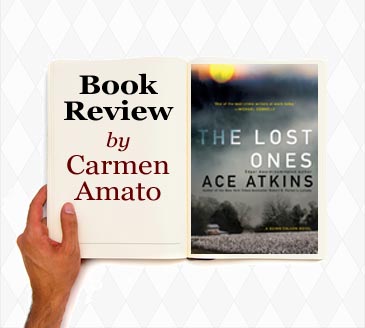
THE LOST ONES by Ace Atkins is a well-crafted police procedural featuring the new sheriff of a small Mississippi county. Quinn Colson is back in his home town, fresh from war, and his old high school buddies are, too. Not everyone has come back to gainful employment, however, and Quinn has his hands full as an old crony gets into a gun-running scheme and another turns to drink as a way of escaping the misery of being left with only one arm. Quinn himself has ghosts to lay to rest that include a messed-up sister whose backstory is entwined with Quinn's--and skillfully explained in a series of flashbacks--as well as the legacy of his uncle, the former sheriff whose last days were marred by scandal.

Perfect-pitch voices

Ace Atkins has a gift for capturing the voices of his characters and is able to assemble a cast who speak to each other--and the reader--with clearly defined personalities which all perfectly fit the rural Mississippi location and their divergent motives. Quinn is clearly the good guy, trying to do the right thing while keeping his own vulnerabilities under wraps. He's the star of the ensemble but the gun-runner is painted the perfect shade of gray--a once likable small-time guy who went to the show and now finds the small town too confining--but isn't smart enough to see very far beyond it. By the same token the women in Quinn's life--notably his mother and his best deputy--have fit themselves into the small town and are trying to make the best of it.

Although the personalities take top honors in this mystery, the action moves  along at a fair pace as Quinn hunts for a couple who are selling children and mistreating them along the way. Switches between Quinn's investigation through the wilds of rural Mississippi and the crony who is selling weapons to a Mexican gang keeps the suspense going.

Ace Atkins as Spenser

The two plotlines converge nicely and the book wraps up cleanly, making for a classic police procedural mystery. Quinn and the supporting cast make for an excellent read and a series with all the hallmarks of the very best a reader cold want in this genre. It is clear why Atkins was selected to continue Robert B. Parker's Spenser series--he has the same tempo, gift for authentic dialogue and ability to create compelling characters.

Ace Atkins

How Mexico’s Union Boss “La Maestra” Inspired a Mystery

How Mexico’s Union Boss “La Maestra” Inspired a Mystery

When fellow fiction writers ask where to find inspiration for characters I usually reply “minor league politicians.” There is always something to be found in the actions and words of those hungry for political power. In the same spirit, I channeled Elba Esther Gordillo, head of Mexico’s national teacher’s union, the Sindicato Nacional de Trabajadores de la Educación (SNTE), when creating the character of Victor Obregon Sosa, head of the police union for the state of Guerrero in the Emilia Cruz mystery series.

Here’s how Obregon is introduced in CLIFF DIVER, the first book in the series:

The two newcomers surveyed the room. One of them looked vaguely familiar, as if he’d been in the newspaper lately. He was in his late thirties, with longish dark hair slicked back from a high forehead and the sort of angular cheekbones that spoke of a strong indio heritage. He wore a black leather blazer over a black tee shirt and cuffed pants. There was a slight bulge under the left arm. He looked around as if he owned the place. Emilia stopped typing. The man exuded power.

La Maestra

Elba Esther Gordillo, nicknamed “La Maestra,” (The Teacher) has been head of the teacher’s union for more than 20 years; wheeling, dealing, passing out favors, burying bodies, and living on the national stage. Obregon, a continuing character throughout the Emilia Cruz mystery series, borrows much from her:

  • Expensive trappings of office—cars, clothes, attitude
  • Enough money and political power to manipulate politicians and keep them in his pocket
  • Able to effectively block reform and initiatives that could threaten his kingdom
  • Rewards loyalty with best jobs, gifts, favors
  • Likes power and isn’t shy about showing it off
Mexico's union boss

Elba Esther Gordillo photo courtesy of guardian.co.uk

Imagine my surprise—the imagination reels at what I can do with this via fiction--when Elba Esther was arrested on embezzlement charges last week. The shock wave is still rippling over Mexico where Elba Esther is as famous and powerful as Jimmy Hoffa at the height of his Teamsters power. She is charged with embezzling millions in union funds to support a lifestyle that includes private jets, plastic surgery, luxury homes in San Diego, secret bank accounts in Switzerland and a nearly $3 million credit-card bill at Neiman Marcus. The SNTE has around 1.4 million members and apparently that translates into a lot of dues.

Fictional Education

Of course, it’s not like Elba Esther's profligate lifestyle was only recently discovered but as they say, timing is everything. (See article on La Maestra corruption from April 2011) The day before her arrest, President Peña Nieto signed into law a major education reform that the SNTE had aggressively opposed. It would allow teachers to be evaluated and possibly fired. This is a big blow to the union’s current status quo: teachers don’t have to have a degree, can never be fired, and high rates of absenteeism are tolerated.

While the president may be sending the message that he’s serious about corruption, Elba Ester’s excesses would have been easier to tolerate if Mexico’s education standards were in better shape:

  • Passing grade on the annual test used to award teaching positions in Mexico is only 30%, according to an article by education writer Arjan Shahani in the Americas Quarterly.
  • 5.3 percent of Mexico’s GDP goes to education. That’s more than Canada, Costa Rica and Australia and just under the United States. Over 80% of that amount goes to teacher salaries, shortchanging school infrastructure, scholarships, etc.
  • Only 62% of students who graduate from elementary school go on to attend middle school, and only a quarter of those go on to higher education. Only a primary education is mandatory in Mexico.
  • PISA (Programme for International Student Assessment) places Mexico’s reading comprehension levels second to last among OECD countries.
  • Mexican students perform badly in the OECD tests measuring  standards in 65 industrialized countries. In the last study published in December 2010, Mexican 15-year-olds came 46th in reading, 49th in mathematics and 51st in science.

Looks like Elba Ester has alot to account for and no doubt she's working up a slick defense as she waits in a woman's prison near Mexico City. I'm sure it will be inspiring . . . at least to a mystery writer!

2016 Update

Mexican President Pena Nieto's education reforms have sparked a slew of protests across Mexico, as teachers protest a system overhaul, including evaluation tests every three years. The reforms also include competitive hiring, more control to the federal government, and a salary system to protect against graft and waste.

But in southern Mexico, this past summer protests got violent. Nine people were killed in clashes with police in Oaxaca. Highways were blocked, leading the government to airlift food into rural areas around the city.

While the main union has fallen in line with the reforms, combatative factions are leading the protests and vowing to close Mexico's highway system. This comprehensive NY Times article from June 2016 focuses on the violence and extremism in Oaxaca.

You may also like

Mexico's union boss

Book Review: Over the Shoulder by Jason Beech

Book Review: Over the Shoulder by Jason Beech

Not only do I write thrillers and a mystery series, but I read them, too. I post reviews on amazon and Goodreads as well as on this site.

Over the Shoulder by Jason Beech is a Goodfellas-type crime drama set in Sheffield, England, where a dysfunctional family of small-time thugs is trying to be more than its individual members can manage. In a clever premise, the would-be patriarch Tony Mortimer, has gathered together his motley assortment of half-siblings in an attempt to honor his criminal father, build an empire, and bring local neighborhoods under his “protection.” His efforts put him in competition with Sheffield’s big-time crime boss, for whom Tony works as an enforcer. Add into the mix a series of doomed relationships, tenuous drug and smuggling deals, and a thick streak of Mortimer family mental instability for a fast-paced and engrossing tale of a dog-eat-dog criminal underworld.

The writing is confident, occasionally providing some descriptive gems. Flashbacks are used to good effect, giving the very different backstories of the three main Mortimer brothers. Hidden details are key and the conclusion is built piece by suspenseful piece as Tony and his brothers use each other in a series of nail-biting love-hate moves. The end is a twister and an ultimate Goodfellas moment. For such a well-plotted book, however, the numerous punctuation and spelling errors were an unwelcome surprise. Fortunately, they did not detract from the suspense or character development of this raw gem of a book.


book review

Comparing Crime Rates: Acapulco vs Points North

Comparing Crime Rates: Acapulco vs Points North

In mid-February, prompted by a spate of news reports on crime for 2012--including a list of the top 10 most violent cities in the world, discussions of violence in Chicago and Detroit, and school closings in Acapulco due to security problems--I posted this picture and the following question on my Facebook fan page:

Acapulco nightAcapulco, setting for my EMILIA CRUZ mystery series, has been named the 2nd most DANGEROUS city in the world! Have you been to Acapulco? Do you agree?

The Facebook Response

At present I have 1898 Facebook fans, spread across 7 countries. More than half are in Mexico. 291 fans “liked” the post. Responses included:

  • “Beautiful paradise turned into hell.. where teachers are being extorted . . taxi drivers are decapitated, where many women have been raped, but only when happened [sic] to foreigners the authorities reacted as if the lives of poor, common Guerrero women were worthless.”
  • “Acapulco is violent and dangerous yes, indeed!”
  • “I think people over [exaggerate] things ‘cause look what happened to those kids in school. It’s always dangerous people make it that way in Mexico everywhere not just Acapulco.” (translation)
  • “I love the photo. Just . . . Perhaps . . . this is now the motherland of Mexicans. And you have to love her as such. First, individuals must be better in order to first form a society.” (translation)
  • “The whole world has violence not only Acapulco.”

Related post: Chain of Fools

Comparing Crime

The “it’s not just Acapulco” comments made me wonder. Were Acapulco’s homicide numbers really so much worse than Chicago or Detroit? Moving further north, what about Canada? What does high crime there look like? I had more questions than ever after that simple Facebook post.

Here is what I found when I compared the homicide rates in key cities in North America:

                           Winnipeg       Chicago         Detroit          Acapulco

Population:           700,000           2,851,265         700,000          880,000

2012 homicides              39                 500                 411                 1170

Percentage        1 in 17,948           1 in 5,702        1 in 1,703         1 in 752

I was looking for context and what I got was a shocker. Unless math has changed since I went to school, Acapulco is far and away the winner of this gruesome challenge. Winnipeg has the worst homicide rate of all Canadian cities but is incredibly low in comparison.

Are Local Gangs the Key?

What will it take to make a dangerous city less violent? Gangs fuel the homicide rates in Chicago and Detroit, according to many news reports, and it is well known that Acapulco’s gangs feed drug cartel violence. Mexican President Enrique Peña Nieto recently announced a new $9 billion crime prevention strategy to combat the rise of gangs in 57 poor neighborhoods and hotspots including Acapulco. Will it work? While homicide rates never tell the whole story, let’s hope next year the numbers are smaller.

You may also like

crime rates

The Friday Fiesta: Travel with a Filmmaker, A Camera, Disappearing Destinations, and Titanic II

husky with suitcaseAs a fiction and mystery author I draw on my own world travels and experiences living in Mexico and Central America. But online travel is also a  terrific way to discover news and places worth celebrating. Let this review turn your Friday into a fiesta!

Life Tips from a Director

Director of Oscar-nominated film Beasts of the Southern Wild Benh Zeitlin talked to Filmmaker Magazine and while you might think this doesn’t have any relevance for you—especially if you didn’t see the movie which didn’t star any Hollywood big names. But the thoughtful interview, in which Zeitlin “proves that to make a powerful film today, you don’t need gimmicks, a convoluted strategy, or even connections in the business” is a lesson in what success should mean for each of us. Zeitlin believes that “all you really need is a story so strong that it’s impossible not to make.” Read the interview with this thought in mind—if your life was a movie, what story would you believe in so strongly that you’d have to make it come true?

50 Photos From an Airplane Window

It takes time to load but this gallery of photos from twistersifter.com is worth the wait. The photos have all been taken from the window of an airplane and are simply the most arresting collection I’ve seen lately. Mt. Rainer, San Francisco, Rio, Mexico City, Greenland, Miami—they are all gorgeous. Two or three don’t show but don’t let that stop you from being amazed by this stunning virtual photography exhibit.

Disappearing Destinations

Gadling.com blogger Reena Ganga offers a review of travel destinations that are focused on preservation efforts or groups that can use your help to spur preservation efforts. My favorite idea from this post is to volunteer at a World Heritage center. “There are volunteer projects across the globe, including diving along the Great Barrier Reef to help threatened coral, conserving the Medina of Fez in Morocco, and restoring archaeological sites in Tanzania.” Many countries don’t have the resources to take care of historic sites. Travel with heart and your next vacation could be anything but ordinary.

Related post: 5 Ways Historic Preservation Scares Us and Why That’s a Good Thing

Iceberg Beware

The new and improved Titanic will sail again, according to AOL’s travel site. A perfect replica of the ship is being built by Australian zillionaire Clive Palmer. If things go according to plan, the Titanic II will cross the Atlantic in 2016. Passengers will wear period costumes to mimic the original Titanic’s 1912 cruise. What won’t be imitated is the original brush with that fatal iceberg. Palmer reportedly told a UK newspaper that due to climate change “There are not so many icebergs in the North Atlantic these days." Titanic II will, however, have enough lifeboat and life rafts to accommodate all 2,435 passengers and 900 crew members. Cue Celine Dion!


About the time I went to Fiji

About the time I went to Fiji

Arriving in Fiji alone at 1:00 am after a 12-hour flight was unnerving but that’s the way the flights went so there I was, in the middle of the Pacific, with a heavy suitcase, an even heavier bag of scuba gear, and reservations for a hotel that was 20 miles away. I’d never been in Fiji before.

The Fiji You Don't Know

A nation of islands, Fiji was a former British colony. When the Brits found out that it was the ideal climate for sugar cane, Indian workers from the subcontinent were brought in the raise the crop. Sugar cane passport and shellsbecame Fiji’s main export, sweetening British candy and giving rise to local rum production as well. But land in Fiji--and accompanying political power--is reserved for native-born Fijians, disenfranchising the Indian population. As the Indian population grew to rival that of native-born Fijians, the unequal status was more apparent. The Indian population’s economic and political power grew with the population, until an Indian was elected prime minister. A racially-motivated coup by a native Fijian army officer was swift and bloodless. It returned the former native Fijian prime minister to an interim status but a second coup occurred when the army ringleader took power himself.

The second coup had occurred two weeks before my arrival.

The Taxi Driver I Didn't Know

I was wary but determined as I hauled my heavy bags outside the terminal to be directed into a taxi driven by a turbaned Indian gentleman. We headed off in the pitch-black Pacific night for Suva, the capital. The taxi was tooling along nicely until we came to an army roadblock. A single Fijian soldier stood guard, wearing a military uniform shirt tucked into a traditional Fijian sulu, or kilt, and sandals. He had an assault rifle, a flashlight, and a long wooden barrier.

Related: Talking money in Papua New Guinea

The Soldier I Wish I Knew

Let me digress here and say that Fijian men are the most handsome men on earth. Apologies to singer Ricky Martin; Karl Urban--the New Zealander who played Eomer in the Lord of the Rings movies; and my husband (whom I hadn't yet met.) Fijian men are Pacific gods. All are about seven feet tall, muscular to the point of sculpture, and have deliciously dark hair and eyes.

So back to the car. The driver stopped the vehicle in front of the barrier. From my vantage point in the back seat I saw him sweat and shake as the soldier and his nice gun approached. The driver stared ahead, steering wheel locked in a death grip, and didn't acknowledge the soldier.

For whatever reason I rolled down my window, smiled shakily, and held out my American passport.

The soldier bent down to peer at me through the open window. Up close he was gorgeous; dark mustache  lose-yourself-in-them brown eyes, perfect teeth. “Hello,” he said, making it sound as if I was the woman he’d been waiting for all his life.

“Hello,” I replied, now confused as well as nervous.

He stepped away from the car and studied my passport in the beam of his flashlight. There were no streetlights, no other cars, the airport far behind, the empty road unspooling in front of us only to disappear into the darkness. The taxi driver continued to shake like soupy gelatin.

The soldier came back to the car and leaned down to look at me again through the window. He handed back the passport. “Goodbye,” he said, infusing his voice with Casablanca-like drama.

“Goodbye,” I said, matching his emotional tone.

He moved the barrier, the taxi driver gave a little sob, and we sped off, leaving Sergeant Fiji by the side of the road.

Related: Open Letter to Readers about Sex

In Retrospect

I was reminded of this episode  when I recently unpacked a box of souvenirs. I’d made the first move in a tense situation by offering my passport to the soldier. He was alone in the dark and probably as nervous as that taxi driver. Would things have gone differently if I’d waited for the taxi driver to do something or for the soldier to demand some identification or payment?

You may also like

Fiji

Matching Books with Museums in Mexico City

Matching Books with Museums in Mexico City

There you are, strolling through amazing exhibits and you know something’s missing.

Like the backstory.

Wish you'd known more before going? But there wasn't time. Besides,  research before going to a museum sounds too much like work.

So prep with a little fiction! Have fun and get the backstory before you go by pairing a good book with a counterpart museum. It’s like pairing white wine with fish or a cabernet with a good steak; each tastes better with the other.

Here are some suggestions for pairing fiction books with museums in Mexico City. Just like Corona with carnitas!

Chapultepec Castle and The Last Prince of the Mexican Empire by C.M. Mayo

Chapultepec castle

Chapultepec Castle photo courtesy wikipedia

The museum: Perched on top of a hill, with sweeping views over Mexico City’s western sprawl, the fortress-style castle was home to the ill-fated Emperor Maxmillian I and his empress, Carlota, during the Second Mexican Empire from 1864 to 1867. You can walk through the rooms, which are arranged shotgun fashion--each leading into the other--insuring that no one at the court had much privacy. The gilded, delicate French-style furniture is an indication just how out of touch the royal court was from real life in Mexico. Take the trolley from street level up the hill, otherwise you’ll be too exhausted from the climb to appreciate the museum.

The book: The Last Prince of the Mexican Empire is a fictionalized account of the Second Mexican Empire seen mostly through the eyes of the American woman whose son was adopted (or seized depending on your point of view) by the childless Maxmillian and Carlota in the vain attempt to establish an heir to the Mexican throne. The book is a real gem and shows off both amazingly detailed research into the life and times of the Second Mexican Empire and the author’s ability to create wholly believable historical characters. Get it here.

The Palacio Nacional and The Eagle’s Throne by Carlos Fuentes

Palacio Nacional Mexico City

Palacio Nacional photo courtesy wikipedia

The museum: This long, stately building rises impressively along one side of Mexico City’s enormous Zócalo central square. It is a working government building but visitors flock there to see the famous murals by Diego Rivera that adorn the main stairwell and the walls of the second floor. Grandly titled "The Epic of the Mexican People," the murals were painted between 1929 and 1935 and tell Mexico’s story from the Aztecs to the worker of Rivera’s times. Above the building’s central doorway, facing the Zócalo, is the main balcony where just before 11:00 pm every 15 September, the president of Mexico gives el Grito de Dolores, the infamous cry for independence from Spain originally made by national hero Miguel Hidalgo. Hidalgo’s church bell from the church of Dolores Hidalgo, Guanajuato, hangs above the balcony.

The book: The murals and the el grito commemoration are integral parts of Mexio’s turbulent and at times visceral political rivalries and history. The Eagle’s Throne, written as a series of letters by a tangled net of political players, is a masterfully crafted inside look at that game. The letters reveal the story bit by tantalizing bit, with allegiances, conflicts, brinkmanship, and manipulation driving the narrative. An amazingly complex and skillful book, there is nothing else that so perfectly takes the reader inside Mexico’s political world. Get it here.

La Casa Azul (Frida Kahlo’s house) and The Lacuna by Barbara Kingsolver

Casa Azul

la Casa Azul photo courtesy wikipedia

The museum: This cobalt blue house in the artsy Coyoacán suburb of Mexico City was the family home to iconic painter Frida Kahlo and where muralist Diego Rivera also lived during his stormy marriage to her. Kahlo and Rivera were socialist sympathizers and la Casa Azul was an intermittant refuge for Leon Trotsky 1937-39 when he fled Stalin’s Russia. The house contains numerous Kahlo artifacts and pieces of artwork. An outdoor room built by Rivera and encrusted with shells shows just how unrestricted the two were in their creativity.

The book: The Lacuna traces the life of a troubled young American man who was raised (by a free spirit mother) in Mexico City and becomes assistant, chef, and secretary to Kahlo and Rivera. Rich in imagery, poetic prose, and character development, we see the conflict and intimate life of the two artists through his own troubled eyes. Their commitment to Trotsky and the latter's exile in Mexico City is the real centerpiece of the book. I didn’t love the end, but the novel is a dense, lavish telling of the story of Kahlo and Rivera—and all that had happened in that house. Get it here.

The Rufino Tamayo Museum and The Hidden Light of Mexico City by Carmen Amato

Tamayo Museum

Tamayo Museum photo courtesy vernissage.tv

The museum: The Tamayo Museum is the queen of contemporary art in Mexico, drawing A-list international artists and fearlessly promoting new ideas and installations in the art world. A huge curved sign occupies prime real estate on Paseo de la Reforma, Mexico City’s main drag, advertising the museum's ever-changing array of exhibits. The building itself is a piece of sculpture, a nice contrast to its neighbor, the more stolid Anthropology Museum. Well curated, it is rarely crowded and always gives fresh perspectives. Also, the small restaurant has very good coffee.

The book: In The Hidden Light of Mexico City, anti-corruption attorney Eddo Cortez Castillo talks to housemaid Luz de Maria Alba Mora in front of the museum and mistakes her for an art teacher. Their tour of the museum brings the reader right along, showing the variety of things one is likely to see in the Tamayo, from video installations, to 3-D objects of startling variety and materials, to classics like actual paint on canvas. Like it does to everybody, the Tamayo startled Eddo and Luz but also hugely entertained, leading to an unforgettable conversation about life, history, and love. Of course more happens after that—Eddo’s hunting a corrupt Minister of Public Security and an elusive cartel leader while Luz’s family implodes—but you’ll have to read the book to see how it all works out. The book takes on Mexico's rigid social system as well as government corruption. Get it here.

Check out tripfiction.com for more ideas.

You may also like

Mexico City

A Friday Fiesta of Close Encounters: Maps, Murano, Mississippi and Designing Vietnam

dog with suitcaseAs a fiction and mystery author I draw on my own world travels and experiences living in Mexico and Central America. But every week there is something new to encounter--who knows where I’ll find myself next as long as every Friday is a fiesta! Subscribe to this blog and come along for the ride.

How to Make a Map of Yourself

Skillshare.com is a website that offers tutorials on a wide range of quirky subjects ( average price for an online class $20.) This upcoming class is a series of video lessons that teach you how to make a variety of maps from photo-based maps to “you are here” graphics. Learn a unique skill and have some fun at the same time! A good mental exercise as well, for anyone who loves travel or simply wants to know where they are in life.

Shards of Murano

I’ve been reading Donna Leon’s mystery series set in Venice and one of the books takes Commisario Guido Brunetti to the island of Murano (won’t give it away but bad things happen) which is known around the world for its glassmaking. But as cheaper Chinese glass floods the souvenir market in Italy, are skilled Murano glassmakers going to lose their livelihood? The answer lies in fighting volume with quality and true artistry. A fascinating read from online magazine The Cultureist.

Believe it or Not in Mississippi

Right on the heels of the movie Lincoln, which focused on the passage of the US 13th Amendment banning slavery, Mississippi has ratified the amendment!  Only 148 years after it became law, Mississippi has corrected a clerical error which prevented the state from officially ratifying the amendment, according to the Politico website. Better late than never. Oh, and the movie was great. Daniel Day-Lewis for Best Actor for sure

Designing Vietnam

We don’t usually think of Vietnam as a spark for creative design; India, China, and Japan generally get top honors for Asian motifs and inspiration. But the folks at fav website creativeroots.org have gathered together a passel of design ideas related to the small country; iconic photos to the packaging for Mekong Red Dragon rice to the results of a collaboration between Swedish designers and Vietnamese craftsmen. It’s a thought-provoking visual menu of design ideas, rather than war images (although some are there.) Maybe times really are a-changing.

I hope you were intrigued by this week’s close encounters. I’m always looking for new ideas to encounter for my mystery and thriller books. Share yours with a comment!

The Case of the Mysterious Immigration Debate

I’m a mystery and thriller author, not a political pundit or a news commentator. My books so far have been set in Mexico, however, and if you think/talk/enjoy things Mexico the US immigration debate is never far behind.

From my optic, here’s how the debate is shaping up:

Guest worker vs brainiacs vs 11 million undocumented

Most folks want to lump things together in an effort to make the simplest news story possible for an attention-deficit audience but the phrase “immigration reform” can mean a lot of diverse things. The three deal-breakers appear to be:

  • A guest worker program (such as the Bracero program during WWII)
  • How to attract and retain skilled labor to help US economic competitiveness
  • What to do with the estimated 11 million undocumented currently living in the US

Cobbling these diverse issues together into immigration reform is a means for crafty politicians and pundits to manipulate public opinion or stymie their opposition. Or even achieve success! Now if we only knew what success would look like . . .

The economic arguments

The cost of US entitlements (food stamps, public education, etc) going to undocumented residents of the US vs contributions to the US economy being made by that same group at present and in future. For example, according to the independent National Foundation for American Policy (NFAP), immigrants will contribute $611 billion to the Social Security system over the next 75 years. A path to citizenship would bring more people--who might otherwise be long-term undocumented--into the formal economy, ensuring their contributions such as taxes and payroll deductions. Yay! Become a citizen, learn what FICA is and why it eats your paycheck!

The competitiveness angle

New York Mayor Michael Bloomberg has the lead on this, calling the current US immigration policy “national suicide.” At a conference to promote STEM leadership in New York at the end of 2012, Mayor Bloomberg declared “Our economy depends on immigrants, and currently our immigration policy is what I call national suicide.” His personal website says: “A vocal champion of comprehensive immigration reform, Mike recognizes that fixing our broken immigration policies is essential to our country’s future - and to our ability to remain the world's economic superpower.” Agreed--if for no other reason the lack of reform is a huge drain on our national energy.

My way or the highway

The US is not the only country dealing with the issues of immigration,  economic growth and balancing new cultural inputs with current resources. Does Canada hold a key for the US with its new plan to give priority to immigrants with critical skills? Are we looking at Singapore, which manages to do many things right? Many other countries have had guest worker programs; what worked, what didn't?

Forgetting the past

I learned in grade school about the great American “melting pot,” which by definition is a messy thing. Not every person who comes from somewhere else to the US will make a stellar contribution. But their offspring might. My own family certainly had a black sheep of an immigrant but his descendants are engineers, architects, teachers, builders, doctors, and a US Navy officer. None of us has ever been on welfare, food stamps, or other forms of public assistance.

Well, that’s my take on the immigration reform swirl. Let the adult conversation begin.

You may also like

immigration reform

Pin It on Pinterest