



Book Review: Blood of the Wicked by Leighton Gage

Book Review: Blood of the Wicked by Leighton Gage

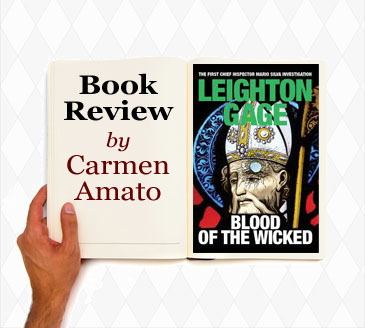
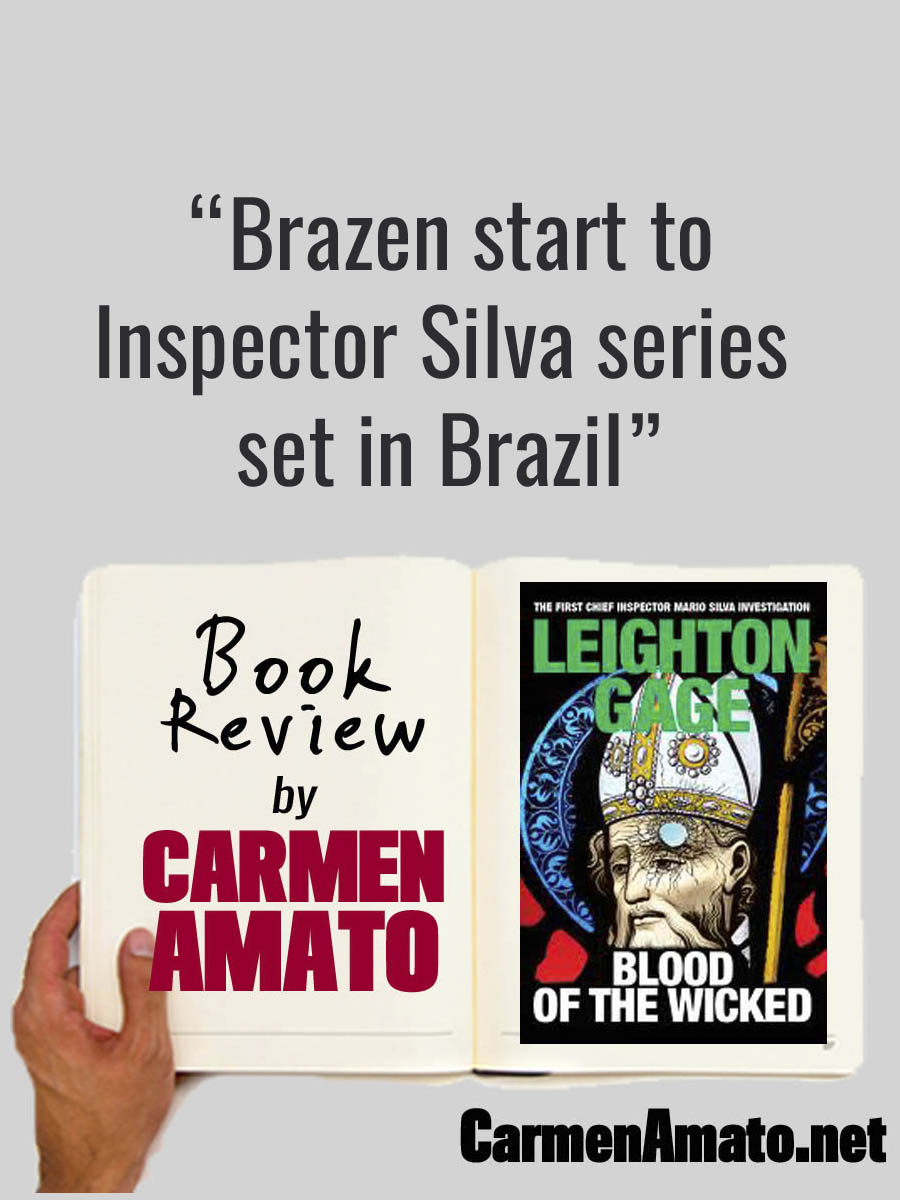
BLOOD OF THE WICKED is the first book in the Chief Inspector Mario Silva series by Leighton Gage. I’d never heard of the series before stumbling upon a reference to it in a Goodreads group. I was trying to see if I was the only one writing a mystery series set in the Americas and a fellow mystery lover had listed it in a thread. In addition to discovering the Mario Silva series, I also discovered that besides myself, Leighton Gage, and Jerry Last, there aren't many writing mysteries set in the Americas for the English-speaking audience.

Related post: In Memorium: The Unsung Influence of Mystery Author Leighton Gage

Goodreads didn’t steer me wrong. Silva is an enigmatic protagonist with a disturbing but understandable backstory. I liked the way Gage wove in the backstory but didn’t try and force-fit it into the plot. The story starts as a whodunit murder mystery that Silva and his federal police team has to solve but they quickly find out that there are underlying problems in the smallish town where the murder occurred. Local civil authority is totally corrupt, however, and resent the intrusion by Silva and his small team of federales.

The prize in this book is the absolute authenticity. From the descriptions of the locations to the issues that create much of the drama to the characters who are so truly Brazilian, you’ll be surprised at the end that the book wasn’t in Portuguese.  Gage’s style comes right at you, nothing flowery or extraneous. Good plotting, pacing and characters. But there is violence and gore and the disregard for human life that hemisphere-watchers read about in the newspapers or see on Blog del Narco. I would have liked more of Silva’s personal life; he’s not as well-rounded as he might have been. But overall this is a book written with grit, talent and an insider’s view of Brazil. If you like mysteries, this is a series to investigate.

leighton gage

Book Review: The Hangman’s Daughter by Oliver Pötzsch

Book Review: The Hangman’s Daughter by Oliver Pötzsch

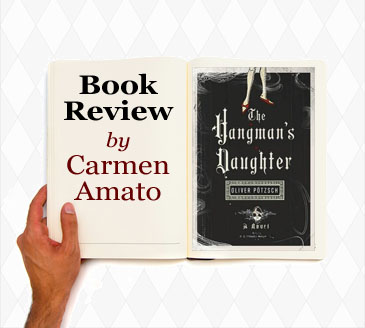
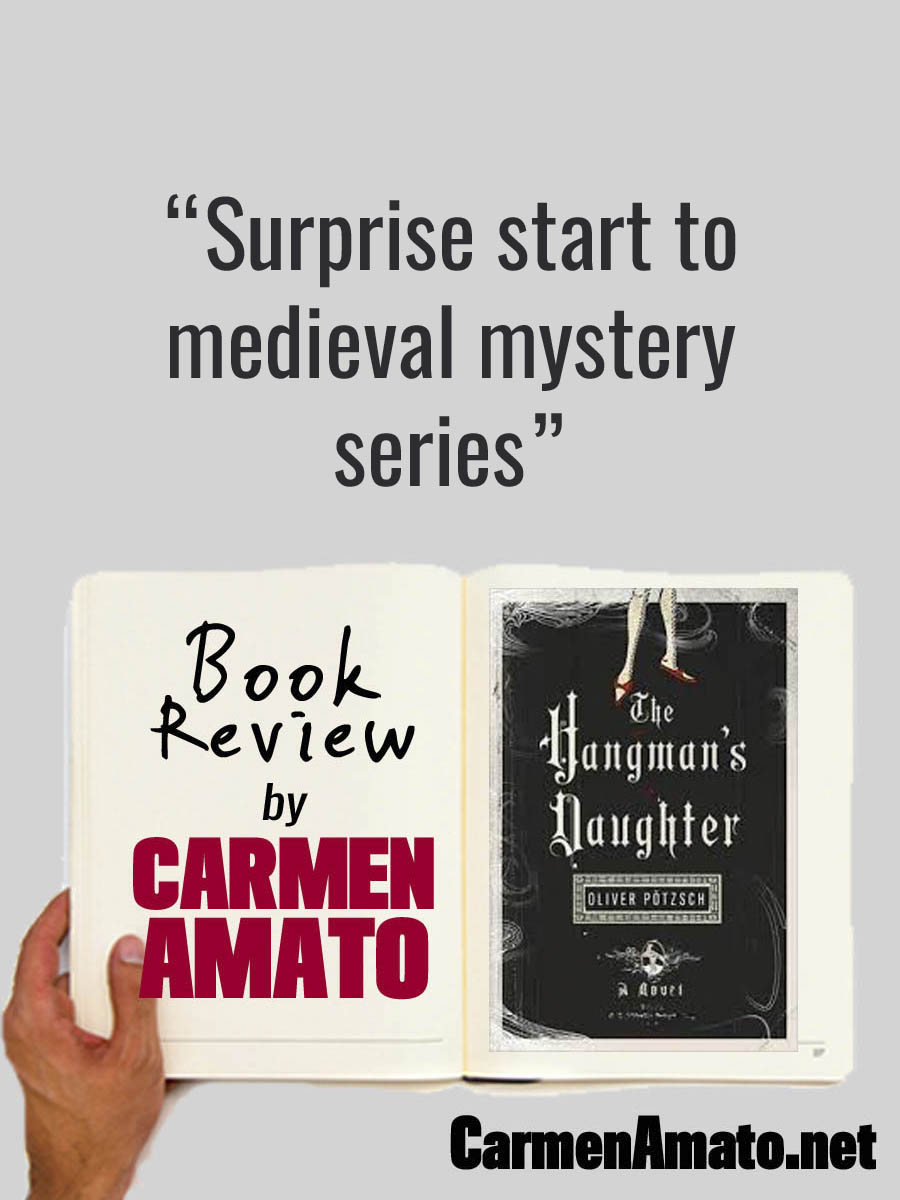
THE HANGMAN’s DAUGHTER by Oliver Pötzsch is a medieval murder mystery set in Germany. It is post-plague 1659, a few years after the end of the Thirty Years War, and children are being murdered in the small village of Schongau.

It's the first in a series by the author, all dark, medieval mysteries with deep plots, authentic atmosphere, and touches of superstition.

The local hangman—responsible for carrying out civil punishments like executions and torture as well as trash pickup—is Jacob Kuisl. He’s a self-educated man shunned by the town’s respectable folk, all except the young doctor in town who is smart enough to realize that Kuisl knows more about the human body than the so-called educators at the university who are prevented by religion and superstition from knowing the true healing arts. The doctor is also in love with Kuisl’s daughter, who despite the title of the book is a secondary character.

This isn’t my usual reading fare but I was given the book by a friend and intrigued enough to finish reading to the end.  To the author’s credit, the descriptions of medieval Germany were excellent; you are really dropped into the setting and it is wholly believable. The townspeople think that the children are dying as the result of witchcraft and that the devil is walking about. The bad guys are stinking bad, an innocent   woman accused of witchcraft is caught in the middle, Kuisl is determined to avoid having to kill her as part of his job, and a couple of secondary characters are sufficiently painted gray to get you wondering if they aren't somehow involved.

And then we have the end. There is a great climax which pits Kuisl against the worst bad guy. Then there’s a mopping up of small details that serve as a warning for authors not to get too caught up in the arcane. Supposedly a tapestry was a clue but it showed someone pooping gold? The bad guy’s mentor was a virtually invisible character? My apologies to the author if I didn't understand all the nuances along the way but I might have gotten bogged down in the constant reminders that Kuisl is the hangman, that he’s shunned by other villagers, that the townspeople are simple and superstitious, and that everyone is afraid of the devil.  Every once in a while I was reminded of the scene in Young Frankenstein where the villagers come to the castle . . . Did you make a yummy noise?

For all that, it is a unique book and gives a great sense of life in medieval Germany. It is based on the author’s own family history, which gives it an added element of interest.

the hangman's daughter

A Lesson from The Great Gatsby

A Lesson from The Great Gatsby

I never gave much thought to how families talk. How different conversations might be from house to house until we had this little episode in ours.

The argument grew heated. I wanted no part of it.

Theories were picked apart. Voices were raised. Sneers were more than implied.

The Aha Topic

The participants in this discussion were my husband and my daughter. The topic of debate was whether or not THE GREAT GATSBY should be considered one of the iconic books of the 20th century.

I carried the dirty dinner dishes into the kitchen and listened to them talk. I was glad my high school daughter could hold her own in the discussion. My husband, a fairly brilliant man, made no allowances for her age.

They called it a draw, agreeing to disagree, although my husband was less than chivalrous when my daughter and I came home after seeing the new Gatsby movie.

“Aha! You see my point,” he said, or words to that effect. This was a reference to his view that the boy-meets-girl, boy-loses-girl, boy-moons-after-her-for-five-years-and gets-shot-for-his-trouble plot was nothing new. My daughter’s defense of the book was undimmed but our opinion of the movie was that there was too much CGI, too much stylized imagery. It was like too much sickly sweet icing on a good cake.

In short, we agreed with Philip French's review that appeared in the UK Observer online newspaper.

Back Talk

The Gatsby episode made me think about the way we talk to each other.

Growing up, my extended Italian family talked about people, many of whom were related. It was a mostly closed loop of family gossip and interdependence. We talked about each other, we helped each other, and we talked about helping each other. To this day if my mother has a computer problem she  waits for the family member who works in the IT field to come help and then gives me the details over the phone. No Geek Squad for her.

My husband’s family, on the other hand, talks about neutral externals. Presidential campaigns, the local school district, property prices.

Talking Our Own Talk

Somehow my husband and I have come up with our own family norm: in our household we talk Analysis.  Even when my kids were small, there was an emphasis on seeing things from different angles, thinking about a breadth of issues, and being able to support opinions.  For example, we’d get them to see how a news story is presented differently on CNN, on Fox News, or on BBC World.

It’s a constant steam of critique and debate on any topic. We all have a wide range of interests. More than once I've lamented that I live with a house full of lawyers and fact-checkers.

Related post: The Power of Daddy

Will my kids be more prepared than I was for the real world? Undoubtedly. My undergraduate college was full of people with similar backgrounds and college talk was mostly about each other. It wasn't until I hit graduate school that I realized how exciting it was to be able to sift through information, create my own truly informed ideas and be able to support them.  That analytic bent has allowed me to become a mystery author; I can put myself in the shoes of a detective faced with a seemingly unrelated set of clues and do something with them.

If only Gatsby had figured that out. He might have lived to enjoy more cake and less icing.

You may also like

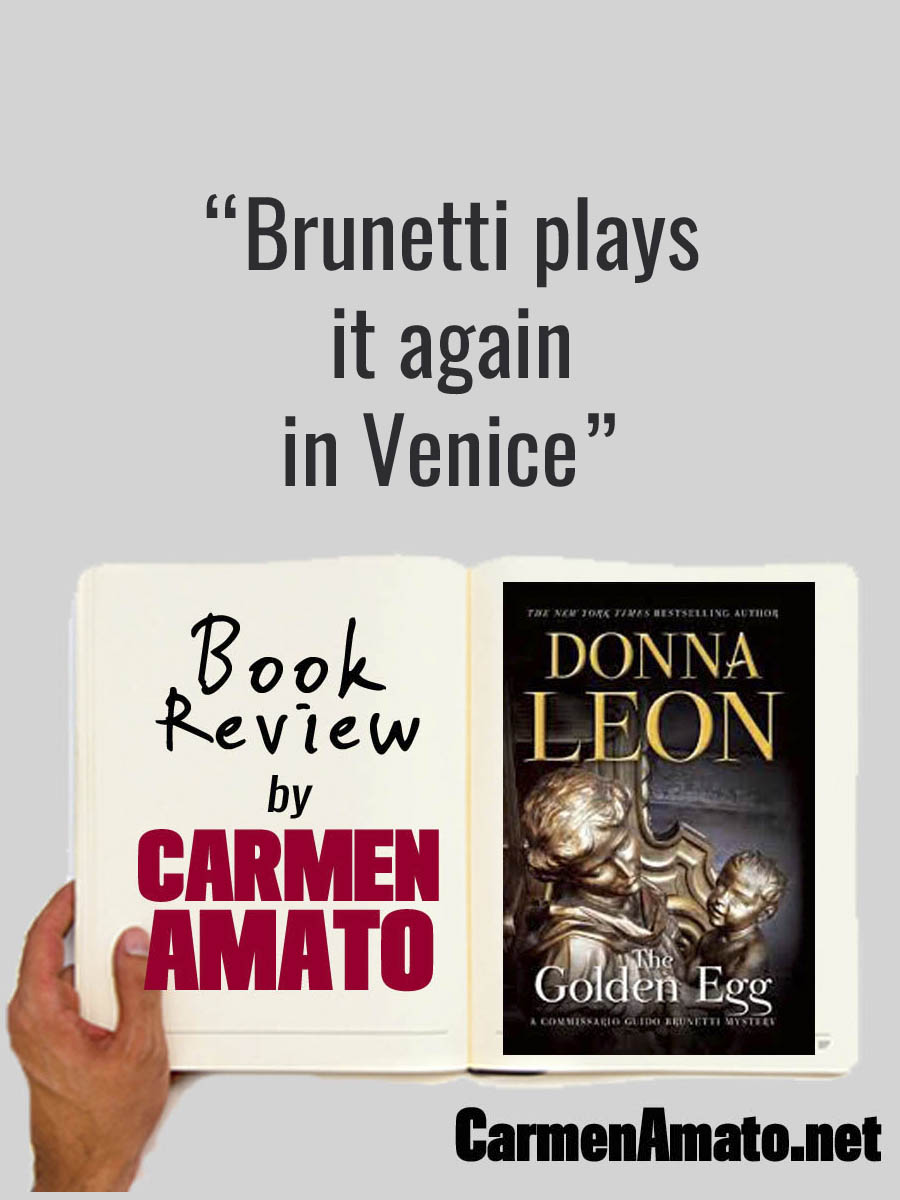
Book Review: The Golden Egg by Donna Leon

Book Review: The Golden Egg by Donna Leon

If ever there was a mystery author who I consider a role model, Donna Leon is it. Her Commisario Guido Brunetti series set in Venice has all the elements of a great mystery series:

  • a perfect cast of characters starring Brunetti himself--the thinking man’s detective who reads the classics
  • his sharp-tongued wife Paola who teaches English literature at the university and is a great cook
  • the boss who swings according to the day’s political wind
  • stout-hearted but highly individual colleagues
  • the police department’s beautiful hacker/secretary.

Add to this cast the food and wine of Italy, the sights and sounds of Venice, twisty plots, and you have an intellectual series rooted in Italian culture.

THE GOLDEN EGG brings together all these elements as Brunetti probes into the death of a deaf man who seems to have lived totally outside of Italian officialdom, something almost impossible to do. Brunetti pulls gossamer threads, one after the other, to try and find out the basics about him, despite the fact that his death looks fairly accidental. The book is peppered with his queries of various people in Venice as he takes to the streets and canals in search of answers. Paola and his children form a bulwark against the sadness of the situation (Brunetti is one of the few international mystery characters who is neither an alcoholic nor divorced.)

Italy’s political mire and hopeless bureaucracy is on display in the book, mirroring the country’s real problems.  It seems to be as much of the culture as the water lapping at the riva of the canal or the tramezzini that Brunetti has for lunch.

The ending, as in so many of Leon’s novels, is a satisfying twist you don’t see coming. The "egg" of the title means "nest egg" but other than that I won't give it away. Anyone who likes the international mystery genre or Italy will love this book, as well as the others in the series.

Donna Leon

Book Review: False Impressions by Sandra Nikolai

Book Review: False Impressions by Sandra Nikolai

FALSE IMPRESSIONS by Canadian author Sandra Nikolai was a real gem, a nicely composed whodunit that shies away from gore and violence in favor of a dialogue-driven narrative in which the characters’ brainstorming sessions take center stage. Am I mixing metaphors? Maybe. Go buy the book.

I always like reading mysteries that are set in different places and Nikolai puts the reader right in downtown Montreal, giving us a sense of the French influence as well as the shops, restaurants, subway system, etc. She uses snippets of the French language accurately and to solid effect. Her writing style is strong on description and dialogue and is easy to read.

The plot doesn’t have bizarre twists and turns—it goes straight at the central theme which is Megan Scott’s discovery that her husband--for whom the word “cad” was coined--has been cheating on her with friends and strangers alike and suddenly ends up dead far from where he said he was going to be. She is the most likely suspect and nicely introduced details that Megan didn’t realize meant anything suddenly do.  There is a love interest who is handled adroitly, Megan’s husband is recently dead after all, and a nicely wrapped up ending.

I wondered if I would categorize this as a “cozy” mystery, a category that for me usually involves a cat and something knitted. Nikolai gives us more of a clean thriller and one which many should enjoy.

Sandra Nikolai

On The Occasion of My First Anniversary of Being a Published Author

On The Occasion of My First Anniversary of Being a Published Author

In addition to being a celebration of the Mexican army's unlikely victory over French forces at the Battle of Puebla on 5 May 1862—which has morphed into a popular celebration of Mexican culture and food--Cinco de Mayo was my first anniversary of being a published author.

For some reason, Amazon lists the publication date as April but THE HIDDEN LIGHT OF MEXICO CITY was officially released 5 May 2012. Here’s the press release.

Was it only a year ago

The week that it was published I texted myself a wishlist of what I would consider to be success as a published author after 1 year.   Written on the trusty notepad feature of my antique Blackberry here is the complete text:

Success as a writer after a year:

  • Sold 100 copies of  HIDDEN LIGHT
  • 2 books listed on amazon.com
  • 100 visitors to my blog
  • Got published on Huffpost
  • Got mentioned in a blog or other online venue I don’t own

Reality Isn't so bad

So how does reality stack up?

  • Sold nearly 400 copies of  HIDDEN LIGHT (and received real checks!)
  • 2 books, HIDDEN LIGHT and CLIFF DIVER, are listed on Amazon. Thenext book, HAT DANCE, is scheduled for a late July release
  • This blog has received some 6000 visitors
  • I’ve done guest posts and interviews which are listed here
  • Every reviewer on amazon has given my books a 4 or 5 star rating and 61 percent of CLIFF DIVER reviewers said they wanted to read more in the series.

Sadly, I have not been published on Huffpost but I also didn’t submit anything except a short story last week for Rita Wilson’s project to see what women over 50 are writing. I assume my effort is lost in the slush pile but it was good incentive to write an Emilia Cruz story which I'll soon make available from this website as a free download.

What I Learned Along The Way

So have I been a huge commercial success in my first year of being a published author? Of course not. This is a marathon, not a sprint. But here is what I did do:

  • Exceeded expectations that I thought a year ago were virtually unachievable
  • Recognized that my goals should be those that I can control and  reasonable for the resources available to me
  • Embraced the fact that I am engaged in a massive learning process to master new skills (blog design, marketing, etc) because there is more to this author business than just writing
  • Realized that I am providing readers with both a quality entertainment experience and a learning experience, just as I had always intended to do

Related post: Why Read a Book About Mexico

Related post: Be Angry and Pray Hard

Looking Ahead

So what will my second year as a published author bring? Here’s the next wishlist. We’ll check the progress on 5 May 1014. In the meantime, wish me luck!

  • 5 books listed on amazon (yes, 5)
  • Redesigned website with free download of Emilia Cruz mini-anthology
  • Re-release of HIDDEN LIGHT with new cover, lower price, and at least 1 promotion

Are you a goal-setter too? Let me know what your goals are and how you stick to them.

You may also like

3 Latino Reads with Universal Appeal

3 Latino Reads with Universal Appeal

Each of these 3 exceptional books has universal appeal that transcends its roots, but for different reasons.

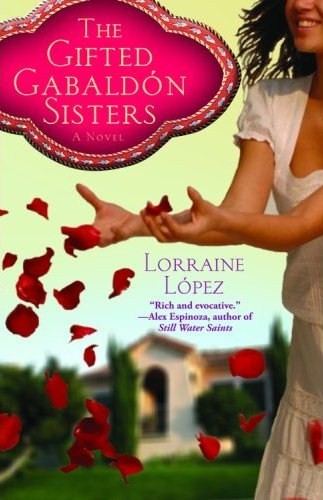
The Gifted Gabaldón Sisters by Lorraine M. López

the gifted sisters coverIn all honesty, I picked up The Gifted Gabaldón Sisters because it has an eye-catching cover. Luckily, the story inside was just as mesmerizing.

It traces the lives of four sisters, who each seem endowed with a magical ability or “gift.” But it’s not fairy tale magic and it shapes their lives in unexpected ways. The story swings between the lives of the sisters, and the official account of government research into the Puebla tribe. At first I didn't understand the connection but after a few chapters realized that the research was the background story of Fermina, the girls’ caretaker after the death of their mother. Fermina is the one who gives the girls their “gifts.”

The sisters are all named after Hollywood stars from the 40’s and 50’s, which not only made it easy to keep track of the different sisters and their gifts, but also gave a rich feeling of the family's atmosphere and the legacy of their dead mother.  My favorite character was Bette Davis Gabaldón, who believes her “gift” is the ability to persuade people to do what she wants.  The gifts are both burdens and things to celebrate. This isn't a pulse-pounder that races to a climax but a gentle story of women who believe themselves bound by their gifts. It is that belief that ultimately shapes their lives and draws the reader along on the journey.

This book is recommended for anyone who likes contemporary literature, stories with a bit of magic in them, as well as those who like fiction that draws on history.

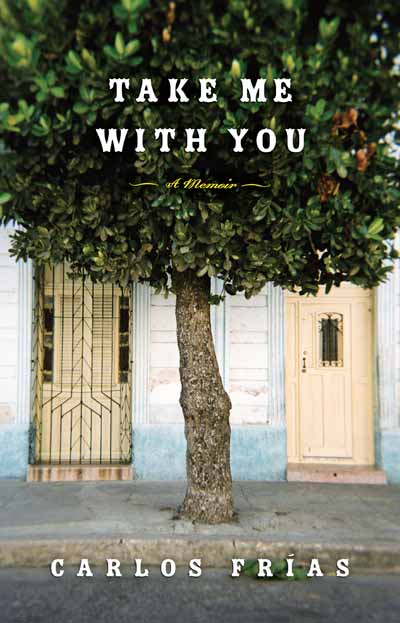
Take Me With You by Carlos Frías

take_me_with_youMy basis of understanding Cuba comes from a grad school friend whose parents fled Castro's revolution, leaving behind everything. The mother, who was pregnant at the time, never really got over what had happened and her later years were full of emotional pain. So it was with this family in mind that I picked up the book during a memoir phase and it turned out to be one of the best contemporary memoirs I have read.

A Miami-based journalist, Frías recounts his own 2006 trip to Cuba to cover the political scene, which allowed him to trace his father’s life there before the revolution. Frías writes simply and smoothly and his descriptions put the reader right into today’s Cuba, with its decayed buildings, endless scrabbling for the basics, and sense of waiting for it all to end. Although the book moves around between the author’s family in Miami, his father’s middle-class life in pre-revolution Cuba, and the author’s own experiences in today’s Cuba, the reader never gets confused.  Frías is able to show us real people and how their lives were damaged by Cuba’s revolution, including that of his father and the family members who stayed behind and are now trapped in Cuba's poverty.

This book is recommended for anyone interested in Cuba, for those who like to read memoirs, or anyone contemplating writing a memoir. This is how it is done.

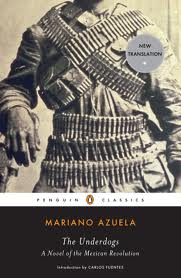
The Underdogs by Mariano Azuela

the underdogs coverA couple of years ago I walked through a display of Mexican Revolution photographs in a museum in Rome, Italy. Meant primarily to showcase the era's photographers, the exhibit was a sepia-toned illustration of the brutality and confusion of the times. All of the images we association with early 20th century Mexico were there--horsemen with crossed bandoliers and wide palm sombreros, women in white dresses with ruffled bodices, ragged laborers in white cotton rags, soldiers in short jackets with brass buttons and pistols strapped to their legs. The captions told of indiscriminate killings, rapes of camp followers, the political double-crosses that made the presidency into an institution of corruption, coups, and murder for many years. I walked away sad and confused.

Written in 1915, literally on the front lines of the revolution, The Underdogs describes with a powerful narrative the images I carried away from that museum. Author Mariano Azuela was a doctor who traveled with several of the revolutionary armies. His main character is an illiterate farmer, Demetrio Macías, who becomes the leader of a small group of fighters aligned with Pancho Villa. He feeds his men by taking from the countryside, uses innocent citizens as human shields, collects women along the way, and hardly understands the political situation and the swings of allegiances. He just knows that fighting is better than scraping by as a farmer.

Through dialogue, the various characters shine through, rivalries are made immediate and the story moves quickly. Over and over, I marveled at the authenticity, at how Azuela was able to paint such a realistic picture in so few words, and how so much was packed into the story. Basically, anything I’d seen or heard about the Mexican Revolution was distilled into one short novel. The imagery and vignettes of brutality and rivalry truly resonated and were better than any history book.

Recommended for those interested in Mexican history, historical novels, and for students of literary construction.

Latino reads

Why Navigation With a Map Still Matters

Why Navigation With a Map Still Matters

Love your GPS? Love how easy it makes getting from Point A to Point B? If you’re like me, your GPS saves travel time, keeps you from getting lost, and provides an Australian or British voice so you can get directions from Ned Kelly or James Bond, depending on your mood.

But while GPS is a great tool, I think we’re losing the skill of navigation. And basic navigation is one of those skills we need to possess in order to be confident that we can find our way, no matter where we happen to be. Navigating with a real map means--

  • You’re self-reliant. Not wholly dependent on electricity, satellites or the phone company.
  • You’re in control over where you are going and willing to learn new skills along the way.
  • Personal achievement! Another deposit into the emotional bank account!

Plus you get a really cool souvenir.

Related Post: The Art of Travel Without a Camera

In the Ice Age, before internet and GPS, I traveled with (gasp) paper maps! Newer maps, like the laminated Streetwise series by streetwisemaps.com are compact accordions that fold to the size of a business envelope. The older maps are Technicolor murals that led me across Europe, the South Pacific and Down Under.

Revelation time

I recently sifted through the box where I keep those old paper maps and had a revelation:

I probably wouldn't be writing books or this blog if I hadn't had those formative experiences, if I had never learned that I could do things and go places on my own with just the help of a map.

Where I've been

map of Florence, italy

 Tourist map of Florence, Italy, circa 1981. A friend studied there during my year in Paris.  We met up several times in Florence and made the rounds of the museums. I learned about male anatomy staring at Michelangelo's David

Venice

Map of Venice, circa 1981. The paper is stiff. the muted colors are those of the sea beyond San Marco's square. Of all my maps, this one is the closest to artwork.

Biarritz

 Map of Biarritz in the south of France where I lived for a month, taking and failing an intensive French course prior to the school year in Paris.

Related post: Girl Meets Paris

Amsterdam mapMap of Amsterdam by streetwisemaps.com. Amsterdam is not big but it is incredibly picturesque and very walkable. The Anne Frank House was more than moving; it was a powerful lesson in history. And humanity instead of hate.

BrusselsBrussels is a lovely blend of big metropolitan city and old Europe. French fries are served with mayonnaise. Still getting over that.

Oslo city

 Oslo is one of my favorite places. The sky is bluer in Oslo than anywhere else on earth. The seafaring tradition + Scandinavian design + the legacy and legends of polar exploration make it a fascinating place to visit. Travel by ferry to the Fram and Kon-Tiki Museums was a highlight.

Pot MoresbyThe map of Port Moresby, Papua New Guinea, is a huge affair from the country's National Mapping Bureau. The thick paper is only printed on one side.

Related post: Land of the Unexpected

map of PompeiiI walked around Pompeii in August and the temperature was around 100 F. I felt like I was inside a volcano not viewing the ruins of one. Sweaty hands nearly turned the map (came with admission) to mush. This is the eastern side of the site.

Rome italy subwayRome, Italy is noisy, chaotic, crazy, amazing. Every street is full of clothes I want to buy, food I want to eat, and books, art, & pharmacies with unique lotions and potions. The city is compact enough to walk nearly everywhere but Streetwise's metro map was very handy.

Mexico City street mapMexico City is so big you need a whole book, called the Guia Roji, to navigate. My copy was falling apart after three years there! This page is the Lomas de Chapultepec area where THE HIDDEN LIGHT OF MEXICO CITY is set.

Sydney, AustraliaIf you ever get a chance to visit Sydney, Australia, take it! Sydney is a beautiful city with lots of things to do and friendly people. This map helped me navigate to the first Virgin Records store I'd ever seen, where I bought Midnight Oil LPs for a friend and Man of Colors by Icehouse ("Had a little accident, nothing too serious") for myself.

Fremantle, AustraliaThis map of Fremantle, Australia, on the country's west coast, was created by the Western Australian Tourism Commission. Below the seal it says William C. Brown, Government Printer, Western Australia. The map itself is about six square inches; the rest of the big foldout (both sides) lists things to do such as the America's Cup Museum or the Royal Australian Navy Corvettes Association Memorial Monument Hill.

As a final inducement to brush up on your navigation skills, here’s what author and Jeopardy champ Ken Jennings had to say in his great book, MAPHEADS:

“Almost every map, whether of a shopping mall, a city, or a continent, will show us two kinds of places: places where we've been and places we've never been . . . We can understand, at a glance, our place in the universe, our potential to go and see new things, and the way to get back home afterward.”

You may also like

navigation with a map

World Malaria Day: Song of the Mosquito

picture of mosquitoI’m tiny, innocuous. Driven by instinct.

I’m tiny, innocuous. I hum as I go.

I’m tiny, innocuous, and I killed over 22,000 foolish Frenchmen who thought they could build a canal in Panama. I gave them malaria and yellow fever and they went away.

I’m tiny, innocuous, and I still roam at will, spreading malaria across the world, debilitating millions, giving them fevers, keeping them from working, killing when I can.

There are people out to get me. More than 100 years ago, an army doctor named Colonel William C. Gorgas showed what it took to keep me away.

As American engineers cut through Panama in a renewed attempt to build a canal, Gorgas galvanized a medical corps. They burned sulfur or pyrethrum, sprayed insect-breeding areas with oil and pesticide, draped mosquito netting over beds and screened windows, and implemented measures to reduce stagnant water where mosquitos breed. Over 5000 still died from disease before the canal opened in 1914 but today Panama is malaria-free and the canal is undergoing a second huge excavation that will more than double the global shipping capacity going through it.

Today is World Malaria Day–or rather anti-malaria day!– and we need to get more communities doing what Gorgas did. Everyone from Shaquille O’Neal to Compassion.com’s Bite Back initiative Bloggers is raising awareness. If we knew how to get rid of malaria over 100 years ago, why does it still exist today?

Check out more about countering malaria on the Huffington Post’s The Big Push page.

Fast-moving plot . . . consistently exciting . . . A clever Mexican detective tale that will leave readers eager for the series’ next installment.–Kirkus Review

Cover of Cliff DiverGet Cliff Diver today on amazon.com

$2.99 Kindle $12.99 paperback


Book Review:  Cold Service by Robert B. Parker

Book Review: Cold Service by Robert B. Parker

This review is dedicated to the people of Boston.

I'm still surprised when I run across someone who is a mystery novel fan but who has never read a book by Robert B. Parker, creator of the Spenser novels that have come to define the mystery genre. His tough-as-nail-with-heart-of-gold private detective, whose first name we never know, is as much a part of the Boston landscape for me as Copley Square or Harvard Yard. The hardback editions of the books--and there around 40 in the series--include a map on the flyleaf with all of Spenser's haunts labelled on it. Locke-Ober's Restaurant, Faneuil Hall, his apartment on Marlborough Street and the oft-mentioned swan boats in Boston's Public Gardens.

But we don't just read Spenser mysteries for the Boston scenery. We read them for great characters, perfect plots, the crisp sparse language.  And Spenser's firmly rooted code of ethics. He may be a private eye and a self-admitted thug, but he's got a clear and believable moral compass and expresses it in a way we don't see very often any more. COLD SERVICE is the Spenser novel that best sets out that code which includes loyalty to friends, standing your ground, but never striking without provocation.

In COLD SERVICE (the title is derived from the saying that revenge is a dish best served cold) his friend Hawk is shot and left for dead. Hawk was protecting a Boston bookie from a Ukrainian mob trying to muscle into the area. Needless to say the bookie and family are dead. With Spenser's help, Hawk recovers, infiltrates the mob, and stops it from gaining a foothold in Boston.

Not many of the Spenser books revolve so closely around Hawk, although the enigmatic thug/hitman/bodyguard/boxer who plays wingman in almost all the books. Dialogue between them is nearly a work of art:

  • "They tell me I ain't gonna die."
  • "That's what I heard."
  • There were hard things being discussed, and not all of them aloud.

Without giving away the plot twists, let's just say this is one of the best of the Spenser series, which is one of the best mystery series out there. The Ukrainian mob is opaque and brutish. Help comes but cannot be trusted.  Strange alliances must be forged to get at the mob, but they are tenuous at best.

The mayor of a small town near Boston holds the key; his administration is synonymous with corruption. Hawk's quest for vengeance distances him from the surgeon he's dating and his refusal to adjust his own code eventually pushes her away. Spenser understands Hawk's code but will not pursue revenge in the same brute force way.

The end is a terrific nail-biter.

robert b. parker

Book Review: A Sunless Sea by Anne Perry

Book Review: A Sunless Sea by Anne Perry

William Monk is back and better than ever in A SUNLESS SEAthe latest novel by Anne Perry about the amnesiac cop-turned private detective-turned head of law enforcement on the Thames River in 1860’s London. As always, Perry’s vivid descriptions put us right there--aboard the river police boats, turning up our collar as Monk shivers and water plays about his feet, or on the streets of old London with a wide variety of the city’s denizens from high society spoiled girls to the prostitutes who ply their pathetic trade along the city’s wharves.

Plot + Twist

The book starts with a bang as Monk is drawn to the edge of the river by screams and discovers the body of a woman who has literally been gutted. His investigation into her identity and murderer leads to a curious set of circumstances and a perfect plot twist along the way that made me read the discovery twice. Like so many Monk books, the ending weaves together careful clues and secondary characters whose motive makes you curl your lip in dismay.

Pitch-Perfect Characters

All of the series regular characters get a part to play as Monk tries to unravel the mystery, as usual racing against time to provide evidence at a trial. Oliver Rathbone, the lawyer who defends the accused has his moments in the book as he copes with a dissolving marriage, his still unresolved feelings for Monk’s wife Hester, and damning evidence from a previous case he has inherited. Hester, who had more prominence in earlier Monk books but who still stands tall here as the crusading nurse, helps Monk, further defining her role as an independent woman in contrast to London high society’s gawd-help-us types.

Monk himself has gentled a bit from when we first met him in MAN WITHOUT A FACE. Perry demonstrates his emotional journey quite brilliantly. Read the Monk books with Daniel Day-Lewis in mind; I'm quite sure if the author had a movie dreamcast he'd be her pick for the role.

Bottom Line

Like some of Perry’s books, there is some repetition in A SUNLESS SEA as characters spend time mentally rehashing known facts, as if the author wants to keep reminding us of the action so far. But like all the Monk books, it is full of great characters, a well-done historical setting, and an outcome that leaves you wondering when the next book is coming out. A great addition to the series.

Sunless Sea

The Girl on the Cutting Room Floor

The Girl on the Cutting Room Floor

Book editing is a ruthless business. How much of a book gets rewritten when an author comes back to an old manuscript?

In the book editing case of HAT DANCE, the second Emilia Cruz novel coming 30 July, it looks like about 50% of what I wrote 18 months ago will hit the cutting room floor. Included in the discard party is female arson investigator Betty Estefan.

Bye bye, Betty

Betty uses her sexuality to get ahead; a direct contrast to Emilia whose approach is to fight her way through. But with a fully-loaded book plot (Fire! Hookers! Missing girl!) Betty's antics  quickly became excess baggage.

But even mean girls need their 15 minutes of fame so I’m sharing Betty before I hit “delete” on her brief and troubled virtual life.

The set-up

  • An upscale Acapulco restaurant was set on fire, just as Emilia and her date were leaving. Acapulco’s famous mayor was in the restaurant at the time.
  • Chief Salazar is Acapulco’s chief of police
  • Rufino is the new chief of detectives
  • Obregon is head of the police union for the state of Guerrero
  • Silvio is the senior detective who’d actively opposed Emilia coming into the squadroom as the first and only female detective in Acapulco but now has to work closely with her

What got cut

Chief Salazar looked grim. His bald dome shone faintly yellow under the squadroom's weak florescent lights. “Everything's by the book this time, with our visiting arson expert showing the way."  

The woman next to him stepped forward.  “Betty Estefan will be with us for a few weeks," Salazar went on. "She’ll be leading the investigation and teaching arson investigation techniques to the rest of you. Betty’s from Mexico City, an instructor from the national bomberos training school.”

"Thank you, Chief Salazar," Betty said without hesitation. "I'm looking forward to the challenge of this investigation and getting to know the detective team here in Acapulco."

She was a curvaceous woman whose figure was contained by a plain white blouse and well-fitting but not tight jeans. Betty wore pale brown work boots, which Emilia figured were useful for walking through ashy fire scenes but which would be hellishly hot on Acapulco’s beaches and superheated tarmac. Blonde hair—dyed but it suited her well—was pulled back and wound into a bun at the nape of her neck. She was older than Emilia by a few years at least, probably in her mid-thirties. The look in her eyes as she scanned the detectives in the squadroom said she’d seen their types before.

“Betty will need some local expertise to assist in the investigation,” Obregon said. The union boss let his eyes sweep the squadroom and Emilia resisted the urge to hide under her desk. Obregon almost certainly had been involved in the drug smuggling mess that had gotten Rico killed. She had no proof, just her gut instinct. And Obregon knew it. Their last encounter some months ago had staked out the distance between them.

“Cruz was at the scene,” Chief Salazar stepped in front of Obregon and the unspoken power battle between the two men flared. Emilia could almost smell a gust of anger. Chief Salazar went on. “Silvio, you and Cruz help Betty settle in and take her over to El Tigre today.”

“Maybe that should be Lieutenant Rufino’s call,” Obregon said smoothly. Emilia had only ever seen him wear black and today was no exception; black leather coat, black jeans, a v-necked shirt that forced the eye up to his face and those high indio cheekbones.

Chief Salazar’s face tightened. He gestured at Rufino. “Get her situated. Make sure the front desk sergeant knows her phone number.”

Gomez, never one to feel the tension in the room, raised a hand. “Does Betty replace the two detectives we’re missing?” he drawled around the gum in his mouth.

Salazar pressed his lips together in annoyance. “No,” he said. “She’s only here temporarily.”

“But those positions are going to be filled, right?” Castro asked.

“Lieutenant Rufino--,” Salazar started.

“Chief Salazar's recommendations will be reviewed by the union as soon as they're available," said Obregon.

The meeting ended on that knife-edge, the pressure they'd started with now cranked to fever pitch by the tension between Salazar and Obregon. Both left, Obregon ahead of Salazar who feigned a conversation with Rufino and Betty in order to loiter while the detectives all feigned busywork at their computers.

When Salazar left, Rufino and Betty went into the lieutenant’s office. As soon as the door closed behind them Gomez and Castro bolted up and started acting like idiots, talking about how Betty looked like she knew her way around, how they were going to make it with her.

“Shut the fuck up,” Silvio growled.

“Cruz pulling on your leash, Silvio?” Castro jeered.

Silvio half rose out of his chair and Castro and Gomez crashed their way out of the squadroom. They were going to mangle the El Pharaoh casino money laundering case, Emilia knew, and there was nothing she could do about it.

Ten minutes later, Betty came out of Lt.  Rufino’s office. She touched her hair, smoothing it back toward the blonde bun, then fingered the buttons running down the front of her blouse.

“I’m ready whenever you are,” she said to Silvio.

“Great,” Emilia said. She got her shoulder bag out of her desk drawer and stood up.

Betty ignored her. The woman’s attention was fixed on Silvio, a fuck you smile curving her lips. The top of the demure white blouse gaped wider than when Chief Salazar was in the room and Emilia saw the edge of a pink lace camisole.

Silvio stared back, his mouth tight.

Emilia permitted herself a tiny grin. This was going to be good.

If you liked "The Girl on the Cutting Room Floor" about book editing, please sign up to join me on this mystery writing journey! We'll pick apart motive, catch a few killers, have a margarita or two. And if you are worried about privacy, rest assured your email will never be shared.

You may also like

cutting room

Pin It on Pinterest