
You are here: Detective Emilia Cruz series > 43 MISSING > Research behind the book
RESEARCH NOTES: 43 MISSING
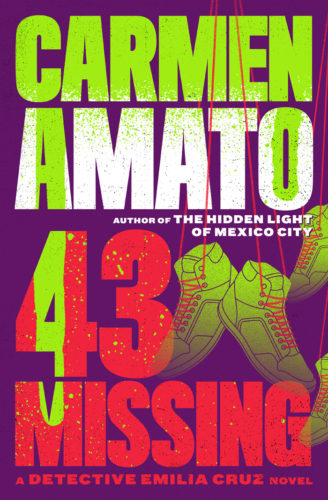
43 MISSING is based on Mexico’s most notorious true crime.
On September 26, 2014, 43 male students from the Ayotzinapa Rural Teachers' College disappeared after being kidnapped in the city of Iguala, not far from Acapulco in the Mexican state of Guerrero.
For a crime fiction writer, tragedy presents a profound moral responsibility. I didn’t write about the Ayotzinapa case to sensationalize it, but to expose the corruption that made such a shocking event possible, show how badly justice failed the families, and because stories of resilience need a place to live aside from the increasingly feckless news cycle.
Besides researching the true crime, a real narco provided inspiration for a fictional villain.
MASS DISAPPEARANCE
The students went from their school to the city of Iguala in order to commandeer buses to take them to a rally in Mexico City. This wasn’t unprecedented; the rally is an annual event and so was “borrowing” buses from Iguala.
The students boarded random buses, which were stopped by local police. Supposedly they were taken into custody, then turned over to a drug gang.
Exactly what happened after that is murky. Bottom line is that 43 young men were never seen again.
As conflicting stories emerged and multiple investigations went sideways, rumors grew that the random buses the students commandeered were being used to transport drugs in a scheme that involved city officials, local cops, the Army and a local cartel.
Years later, there are still so many open questions. The families are left without closure and continue to pressure the government for action and answers.
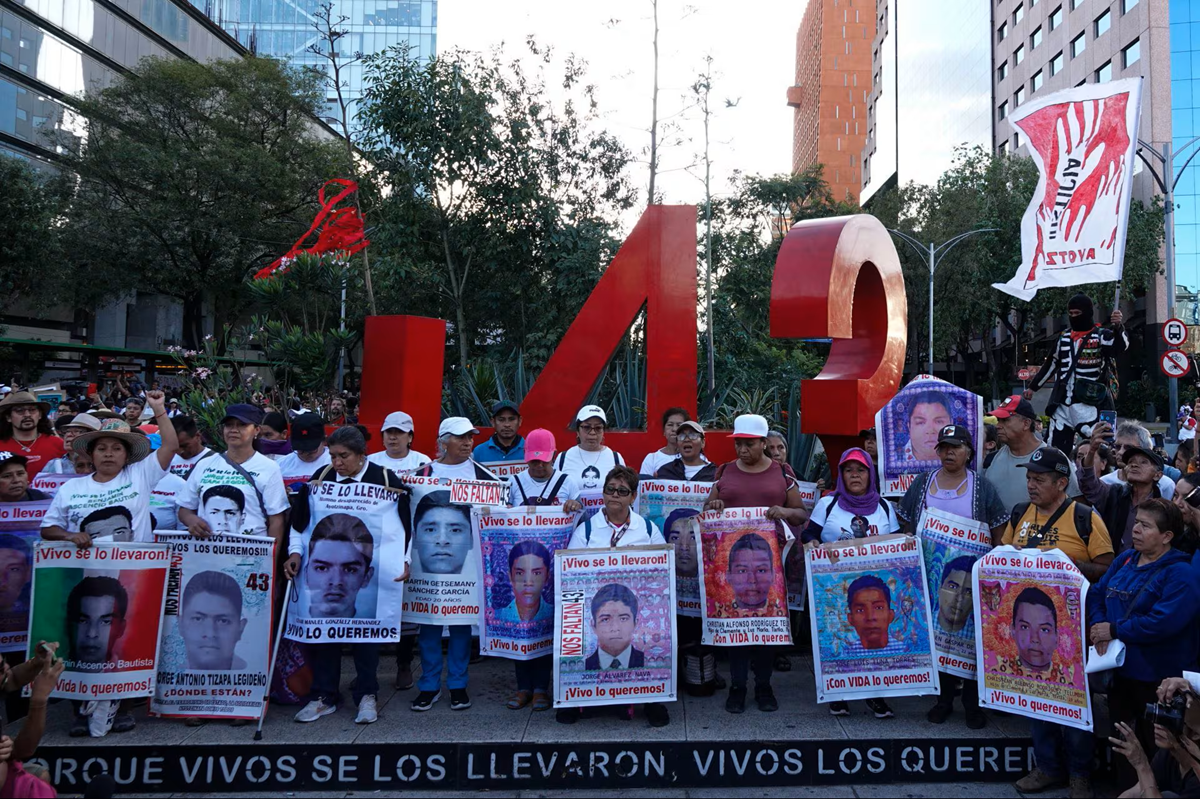
PHOTO: Rallies throughout Mexico demand answers. Graciela López Herrera / Cuartoscuro, via sdpnoticias.com
Four months after the mass disappearance, Mexico’s Attorney General at the time, Jesús Murillo Karam, claimed in a press conference that the students were “kidnapped, killed, burned and thrown into the river.” He included preliminary evidence such as photographs of charred remains, snippets of videotaped confessions and images of the alleged crime scene.
But the bodies were not found.
Two years later, an investigative panel reported that most of the confessions were obtained under torture. An Argentine forensic experts investigated the supposed burn site and found no evidence that the government’s version of events is true.
Mass graves with hundreds of remains were found during the search for the 43 students, but those remains were not those of the 43 missing students.
Francisco Goldman’s reporting in The New Yorker was the spark that got me thinking about the role of the commandeered buses. This became the means to give fictional closure to an unresolved true crime.
EL CHAPO
43 MISSING introduces Diego Barrielos Luna, a jailed narco kingpin modeled after Joachim “El Chapo” Guzmán.
Like El Chapo, DBL has built a violent drug cartel, has previously escaped from a Mexican prison, and wants to avoid extradition to the US. Also, like El Chapo, he’s interested in beautiful young women.

PHOTO: El Chapo being escorted by US law enforcement, courtesy museum.dea.gov
In the movie Facing El Chapo, which is also based on true events, the uniformed cop holding fugitive El Chapo in a hotel room while waiting for reinforcements tells his boss to hurry, saying that being with El Chapo is like “babysitting the devil.”
Chapo preys on the cop’s vulnerability as they wait. The narco keeps up a running patter, offering a huge payment for release while threatening the cop and his family at the same time.
That’s the dual edge of DBL as well. From the first moment that he and Emilia Cruz meet, his voice drips with honey while he's calculating how to use her to his advantage.