The Friday Fiesta: A Ride, A Book, Olives and Remembrance

Party tootsAs a fiction author I love to weave unique cultural gems into the plot. Most of the time I draw on my own world travels and experiences living in Mexico and Central America.

In these Friday Fiesta posts I highlight cultural stories worth celebrating. The unique, the odd, the thought-provoking. Enjoy and share to make the world a little smaller today.

Would You Ride?

The world’s longest and highest cable car service will reopen early next year in Merida, Venezuela, according to a BBC report. The cable system is more than 7 miles long, rising to more than 15,330 feet above sea level at the summit of Pico Espejo — one of the highest peaks in Venezuela’s Andean mountains. Originally built in 1960, the trip of around 2 hours takes intrepid travelers from Merida to the magnificent scenery of the Andes. From the report: “On a clear day, the craggy outcrop of Pico Espejo — where the resident Virgin Mary statue is sometimes covered in ice — provides panoramic views of the surrounding range, as well as a bird’s-eye view of Merida in the distant valley below.” Equal parts amazing and scary.

War and Remembrance

TheWorldisWaiting.com blog gave us a unique take on war museums this week, including some little known museums that capture events and places that are all too easily forgotten. I’ve been to three museums on the list: the Imperial War Museum and the HMS Belfast, both in the UK, and the Checkpoint Charlie Museum in Berlin and recommend them all. But of special note is the JEATH Museum, Kachanburi, Thailand. “JEATH stands for Japan, England, America, Australia, Thailand and Holland, which represent the nationalities of the prisoners of war forced to work on the construction of the famous Bridge on the River Kwai.” It wasn’t just a movie.

In the same vein, here’s my blog post on resistance museums.

The Olive Harvest

Did you know how olives are gathered to make olive oil? Check out the blog post by @ItalianNotes for beautiful photographs and a video on how “In our part of Puglia the old contardini swears by the scopetta. With an old organic broom they sweep a circle around every single olive tree making the red earth hard, smooth and clean, so that olives can easily be gathered, when they are ripe and ready to fall off the tree.” The post is lovely—a simple snapshot of a an industry that reminds us of the value of tradition and the calm that comes from living close to the earth.

The First Book and it’s Not the Bible. 

John Wainwright, a computer specialist, ordered the first book from amazon.com in 1995. Do you remember amazon’s radio ads from that time? They were in an interview format, with the interviewee claiming amazon had enough books to fill an aircraft carrier and other huge spaces.But I digress.

According to The Atlantic online magazine, which has a photo of the book and the original packing slip, the book Wainwright ordered was Douglas Hofstadter’s Fluid Concepts And Creative Analogies: Computer Models Of The Fundamental Mechanisms Of Thought. A bit of light reading. But that first book illustrates that amazon has been so successful (the website sells my books so of course it is successful!) because it carries something for every interest.

Book cover The Hidden Light of Mexico City“Romantic and suspenseful! A great mix!”
Get THE HIDDEN LIGHT OF MEXICO CITY on amazon.com today.

The Day of the Dead Disordered Dictionary

The Day of the Dead Disordered Dictionary

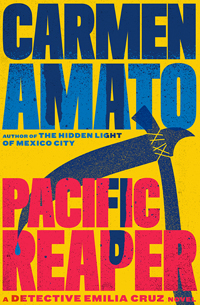
Mexico’s Day of the Dead traditions figure prominently in PACIFIC REAPER, Detective Emilia Cruz Book 5. The holiday focuses on gatherings to pray for and remember friends and family members who have died.

Pacific Reaper

Emilia investigates a voodoo-like cult dedicated to Santa Muerte, Mexico's forbidden saint of death.


People visit cemeteries to be with the souls of the departed and build private altars commemorating those who have passed away. If the souls return, they will hear the prayers of the living and perhaps offer comfort.

So in no particular order, here’s a guide to celebrating death—and life.

Muertos

These skeleton figurines symbolize the departed and the Day of the Dead but have become part of the mainstream Mexican art world as well. Muertos wear different clothes to represent specific people and occupations. Markets across Mexico sell them, dressed as virtually anything you can think of, from mermaids to aliens and everything in between.

People even dress in muerto costumes.

Adults dressed as muertos for the Day of the Dead

Photo by Alonzo Reyes via Unsplash

In PACIFIC REAPER, muerto figurines left as a gang's signature during a grisly turf war help Emilia track down a killer.

La Catrina

The Catrina, popularized by artist and cartoonist José Guadalupe Posada (1852-1913), is a muerto of a high society woman and one of the most popular figures of the Day of the Dead celebrations in Mexico.

Catrina figurines in fancy hats

Traditional Mexican catrinas, dressed to kill.

Ofrendas

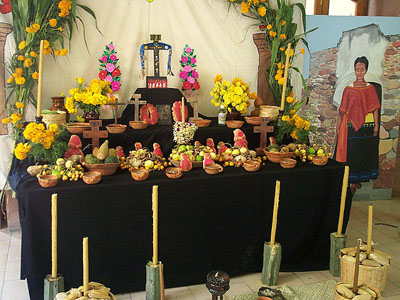
This is the offering left to attract the souls of the dead, notably in the form of altars. There are guidelines as to how the items should be set out and what is to be used such as toys for children, bottles of alcohol, food, candy, etc. They can range from a simple home tabletop to hugely elaborate displays in schools, churches, and shopping malls.

Altar photo by Steve Bridger

Calavera

Literally, “skull.” Sweets, notably chocolate, in the shape of skulls are sold everywhere for Day of the Dead festivities. In October, the city of Toluca hosts a sugar market that dominates the main plaza with vendors selling every size and shape of candy calavera imaginable. I was there a few years ago. The city center was transformed into an outdoor market, with thousands of sugar skulls.

Los angelitos

Children who have died and are remembered in a special way with altars decorated with toys and candy. I knew a woman in Mexico City who set out an elaborate altar for a child she'd lost several years previously as a way of coming to terms with the child's death. She told me that as she placed the last item on the altar she felt the child's spirit and knew that she shouldn't mourn any more.

Pan de muerto

Sweet bread made with eggs, usually baked into a round or oval shape and decorated with white sugar icing to symbolize bones. I use the same recipe for basic sweet rolls.

Marigolds photo by Juan Scott

Flor de muerto

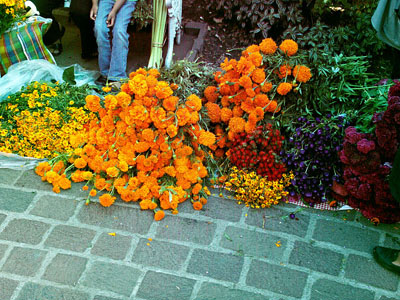
Marigolds are most often used to decorate altars, graves, etc. Sometimes masses of marigolds are shaped into skulls for parades and other events. The flower is thought to summon the spirits of the dead.

La Llorona

A legend throughout Latin America of a woman who lost her children. Grief turned her into a banshee and her screaming can be heard at night. The story is a little different in each place but in Mexico the tale is a star-crossed drama of spurned love tangled up with the Spanish conquest.

Don't forget to pick up your copy of PACIFIC REAPER. The Kindle edition is just $1.99 through October.

What McDonald’s Taught Me And It’s Not About The Food

What McDonald’s Taught Me And It’s Not About The Food

In my quest to find connections across cultures I've been thinking about how different cultures influence what we eat (salsa, anyone?) But if we turn that around to look at how a food influenced different cultures we come to one inescapable word: McDonald's

Yep. The fast food giant has had its share of cultural impact.

After all, the Soviet Union was formally dissolved less than 2 years after McDonald's opened in Moscow in early 1990. Maybe it was just a coincidence but maybe not . . .

So not to be outdone by the end of the Cold War, here are my top culture-meets-McDonald's moments:

Vienna

In the weeks after Romanian Communist dictator Nikolai Ceausescu was overthrown, Romanians came by the busload to Vienna, the closest big Western city, to see how the rest of the world lived. They all looked as if they'd suddenly got out of prison. Their clothes were drab, they were all thin, and they looked fearful and excited at the same time.

My husband and I were in Vienna's two-story McDonald's. We each tucked into a substantial fast food meal; Big Macs, fries, the works. A Romanian couple our age was in the booth across the aisle, sharing the equivalent of a hamburger Happy Meal. They each took small bites, savoring the strange food, still in their coats as if they expected to be chased out at any moment.

Mexico City

It was my housekeeper's anniversary and I took her to the big mall in Santa Fe to pick out a king sized bed for her and her husband. After arranging to have it delivered to their house, we went to the food court. She said she wanted to eat at McDonald's but would not say what she wanted to order.

After a strange and frustrating exchange about the menu she finally said she'd have whatever I had. It turned out that she'd never eaten at a McDonald's before.

She was 28.

Wellington

New Zealand's capital is a bit more lively these days but when I was there 20 years ago it was a sleepy town, especially on the weekend. There was shopping and a city tour on Saturday but most things were closed on Sunday. Except the one McDonald's a couple of miles from my hotel. I walked there for lunch, then went to the movies, then walked back to McDonald's for dinner.

Without McD's I would have starved. Or had the hotel's cold mutton buffet for all 3 meals.

Athens

The Olympic stadium in Athens housed the biggest McDonald's we'd ever seen and my kids were as fascinated by the restaurant as by the Olympic events. No mix-and-match fast food here, you could only order from a short list of preset meals, including the first salad any of us had ever eaten at a McD's. We sat in the middle of the huge space listening to the babble of  languages and watching the array of national costumes.

My kids got it then--the fact that not everybody is like them. Meeting people who aren't is exciting. The Frenchman in the skinny white capri pants and Puma flats is still remembered fondly.

You may also like

McDonalds

5 Talents You Didn’t Know You Had

5 Talents You Didn’t Know You Had

Right now it is storming outside and my dog is going nuts. Trying to wriggle under the desk when thunder booms, scurrying into the bathroom shower stall when lightning flashes, running between me and the door as if to blame me for the rain. She’s gotten eccentric as she has gotten older, not that she was ever a normal dog to begin with, and I seem to have no talent for soothing her. Nor do I have any website editing talent and cannot figure out the mystery of robot.txt files, how to download wordpress themes properly, or why the search term “Mexico” never hits my website when all my books to date are set in that country and the word is splashed all over my pages.

Micro vs Macro

I could choose to bemoan the fact that I am wholly without talent today. Or I could see the situation as a temporary lack of “micro-talents” and remember that I still possess the “macro-talents” that will allow me to achieve my own definition of successful. You have these macro-talents, too. It’s just a matter of reminding ourselves now and then what they are:

The power to listen powerfully

We can all harness our attention and focus on one thing. Good politicians often look as if they are doing this when talking to Anderson Cooper or Wolf Blitzer and I suppose they are. This means listening with your full attention, making sure the other person knows you are listening and responding to what you have heard. Powerful listening forms a bond.

The ability to persevere

Winston Churchill said it best: “Never, ever, ever quit.” If attaining a certain goal is important to you, simply keep at it. Find a way to go around obstacles. Ignore the doubtful noises and simply keep at it. Churchill had to save the British Empire. Chances are your goals are more manageable.

 A creative streak

No one is wholly without creativity. But we often think of creativity in a narrow way. Someone is creative if they are a painter, a ballet dancer, a poet. Expand that to include the mom who finds an original way to stop her toddler’s meltdown, the teacher who gets a class discussion going, the homeowner who fixed their own toilet. There is a big element of creativity in attaining small goals that should never be discounted.

The ability to see the opposite point of view

In her book FINDING YOUR WAY IN A WILD NEW WORLD, Martha Beck talks about the power of examining opposites. I can say that today I hate rain but what possibilities open up if I say I love rain? My thoughts go in an entirely different direction—I like the green of Central America’s rainy season, the rain will bring cooler temperatures, and a lunatic dog that thinks I have the power to stop rain is sort of heartwarming. Huh. The dynamic of my day just changed for the better.

The recognition of priorities

We prioritize every day. Food, clothing, work, school, caregiving. We prioritize without even thinking about it. Taking it to the next level is more conscious and should begin with a list. Write down 3 things to get done today that are related to a goal. Get them done and you will have harnessed that macro-talent you didn't know you had.

You may also like

talents

Chain of Fools

Chain of Fools

The little church in Mexico City was decorated for Christmas with 100 red poinsettias. Every pew was filled, many with sleepy but excited children, for a special Christmas Eve midnight mass. Father Richard was leading us in the Prayer of the Faithful when a man staggered up the center aisle, his limbs jerking as he alternately murmured and shouted incomprehensible words. We all shrank back as he made his way towards the altar, an unexpected and volatile presence.

As the congregation looked on in growing panic, the man accosted Father Richard on the altar. The priest didn’t move or stop the prayer, just dug through his robes for a pocket. He pulled out a few pesos and pressed them into the man’s hand.

By that time several of the male congregants had come onto the altar as well and they gently propelled the drug-addled man down the altar steps and through the church to the rear door.

We continued Christmas mass and the addict remained nameless to the shaken congregation. But he was evidence that Mexico’s own drug problem was growing as more and more drugs transited the country en route to the United States.

So the question of the day is what does this anonymous addict, Charlie Sheen, Lindsay Lohan, slain border agent Brian Terry, and 17 mutilated bodies found this month in the Mexican state of Jalisco all have in common?

The answer is that they are all part of the chain of American demand and Mexican supply of illegal drugs. The links are forged by the unthinkable amounts of cash and pop-culture icon status to be made in Mexico from satisfying that American demand. And until that demand is eliminated, the rewards will always be greater than the risks for many Mexicans who have little upward mobility in their country’s formal economy.

But is reducing American demand a real possibility? Although President Obama discussed it in a recent interview with Univision, drug policy isn't a deal-breaker in the US presidential elections.  Hollywood--the arbiter of too many things deemed cool in US pop culture--is hardly a force against drug use.

But CNN reported this week that the term "war on drugs" is giving way to "prevention."

I hope there is something tangible behind that word. It's a very strong chain.

You may also like

A Little Taste of CLIFF DIVER

A Little Taste of CLIFF DIVER

Just to whet your imagination here's a snippet of CLIFF DIVER, the first Emilia Cruz novel . . .

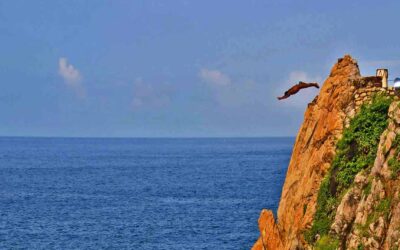
The diver stretched to his full extension then pushed off. His back arched and his arms stretched wide and he looked like a crucifix as he sailed over the rocks. His arms raised up over his head and his hands came together right before he impacted with the water. A spume of froth shot skywards and he disappeared into the depth as the crowd on the plaza gasped and applauded.

The diver popped out of the water beyond the rocks and the crowd applauded again. It took a few minutes before the next diver climbed onto the tiny platform on the cliff face. He was older, with a black suit and a heavy torso, and a less athletic look than the younger man. When he carefully turned his back to the ocean the crowd murmured excitedly.

“He’s got balls,” Kurt said. The back of his hand brushed against Emilia's.

The diver launched backwards off the cliff face and twisted in the air. As his body rotated close to the cliff the crowd gasped, but he made a clean entry into the ocean, the water rippling out around him. The applause was wild.

As the sun set, they watched the other men laboriously climb up the cliff face to the small natural platform, stretch and limber their muscles and dive past the rocks to the perfect spot in the ocean far below.

“That’s me,” Emilia said as the youngest diver in the red suit stood poised on the platform, the spectacular sunset behind him.

“What do you mean?” Kurt asked. His hand turned and a finger stroked the inside of Emilia’s thumb and forefinger.

“That’s me.” Emilia’s hand turned of its own accord and gently played with Kurt’s. He was looking at her, not at the cliff divers, and Emilia heard herself babble nervously. “Falling off a cliff, not ready for it. Not knowing if I’m going to hit the rocks and be smashed to pieces or not.”

Emilia watched as the young diver swung his arms and rolled his neck and she wondered if he was doing it for the crowd’s benefit or if it was a release for his fear and nervousness. He hunched his shoulders forward, then pulled them back. His knees bent and his thigh muscles rippled and then he launched himself into the air. For a moment he was silhouetted against the blue sky and then he curled himself into a somersault. The crowd gasped as one as his body rotated and his hair seemed to kiss the cliff face. Then he stretched out, straining for distance, and completed a soaring arc that plunged him into the water like an arrow shot from a bow and Emilia felt the strain and the pain and the rush of cold water.

Cliff DiverGet it today on Amazon!

You may also like

Like Glass in the Belly

Like Glass in the Belly

Whenever I’ve landed in a new place, I’ve tried to understand the local culture as if it was a system. Mexico was one of my first experiences and there I learned that a cultural system is underpinned by a network of stories and narratives—Bruce Chatwin’s songlines--that run through cultural cornerstones such as language, food, architecture, and the feast day of the Virgin of Guadalupe. But last Sunday, in an interview with CNN’s Fareed Zakharia, author Salman Rushdie sent my thoughts in a different direction when he referred to a “culture of insecurity.”

Rushdie posited that the “rage machine” we’ve seen reacting to a cheap independent film trailer and cartoons unflattering to the prophet Mohammad—which most of those in the Arab street have probably never seen--is easily cranked up in cultures that are built on insecurity. A culture secure in its identity can dismiss criticism and stupid films.

But if the songlines of a particular culture are defined by what is lacking and resentment toward what others have, then there can be little cultural confidence and emotional security.

To define one’s culture only in terms of what it lacks is a large and disturbing concept. Is a culture built on negativity and rage sustainable?

Well, rage is cheap. Cheaper than fast food, nice cars, sports franchises and higher education. Cheaper than running water and reliable electricity. If rage stems from what a culture is thought not to have—and alternative ideas are weak and no one moves to tamper the rage—it probably can be sustained through several generations, especially if education rates stay low.

But rage on a cultural scale is a huge loss in terms of productivity, economic growth, educational development—the list is endless. Unless someone is profiting by it, common sense would say that profound efforts would be made to reverse the culture of insecurity.

So who profits from a culture of insecurity and the rage it can promote?

Unfortunately this isn’t a hard question to answer and Rushdie noted that the deliberate use of rage is a “political act.” Throughout history we’ve seen people attain and retain power by manipulating populations with negative messages of external threats. Iran. North Korea. East Europe during the Cold War.

I didn’t realize this was ultimately what I was writing about in this conversation about a presidential candidate from THE HIDDEN LIGHT OF MEXICO CITY:

“This country’s entire social system is predicated on the majority of the people being tolerant. Educated people find things out and aren’t quite so tolerant after that . . . “

Luz blinked at him, struck by the intellect behind his words. “So how do we change that? Make the country . . . healthy.”

“Reform is hard.” He seemed about to say something else, but stopped.

“But if nothing changes,” Luz said, thinking about the dwindling opportunities for Juan Pablo. There would be even less for Martina and Sophia. “What will happen?”

Eddo shrugged. “The leftovers will remember Lorena’s catchphrases. That’s all she wants them to do.”

He was saying such hard things. Luz leaned forward. “Do you mean to tell me Lorena is happy to cry for the pain of the people if it means they’ll stay uneducated enough to vote for her?”

And as for those trapped in a culture of insecurity, to paraphrase a poem by the late Mexican writer Carlos Fuentes; the children in the street will eat glass if there is nothing else to fill their empty bellies.

You may also like

About the Time I was Absolutely and Terrifyingly Lost in Panama

About the Time I was Absolutely and Terrifyingly Lost in Panama

A year ago I was Lost.

No-cell-phone-service Lost. The-road-is-a-gravel-track-through-cane-fields Lost.

Set Sail One Day

Five girlfriends had set out from Panama City to go to El Valle, about two hours away. We’d go to the Sunday crafts market there and have lunch at a boutique hotel afterwards.

A quick stop for cheese empanadas and gas and we were on the road. The miles sped by as we talked and laughed and it was well over an hour before we started to look for the turnoff to El Valle. There wasn’t a sign, but the intersection was the one with the pink shrine to Our Lady of Guadalupe.

More talk. More laughter. More miles. Eventually we turned on the GPS and it signaled a turn. Not the road with the shrine, but it was the right direction.

At Road's End

About half a mile down the new road, tarmac gave way to gravel. With deep ruts. Then worse ruts. We passed a small village and asked if that was the right road to El Valle. Yes, we were assured. One person said El Valle was just 10 minutes. Another said 30 minutes. The GPS seemed to split the difference.

always turn right

Bad ruts turned into a dry stream bed weaving through Panama’s low mountains. The doughty SUV slid downhill, the tires unable to grip the loose stones. We jolted in the car like peanuts in a tin can. A dashboard light turned on—overheated transmission. We stopped on a rocky plateau and scouted ahead only to find that the gravel track narrowed ahead. The five of us were quite alone in the hot rustling jungle.

The SUV cooled and we started off again, now having discovered that we were all Catholic and that two of us carried rosaries. The jungle gave way to cane fields. Hard green stalks as high as the car roof rattled against the windows.

Two Hours Later . . .

After two hours off-road we broke through the cane field and clambered onto tarmac again. We were on the eastern edge of El Valle. Never were five women more ready to buy souvenirs.

I learned a few things that day.

About being lost. And knowing when to turn at the shrine.

  1. Don’t be so distracted by peripherals—entertainment, Twitter, mooning over the wrong guy—that you forget to look for the shrine that points the way to where you really want to go.
  2. If you’re lost, keep going. Take a break to rethink the situation, take care of problems, or give yourself a pep talk, but don’t confuse “taking a break” with “breaking down.” Cheerlead as you go—you’re handling the uncertainty well, you’re learning about yourself and wherever this “lost” place is—even if it is inside you.
  3. The shrine doesn’t have to be the pink altar on the side of the road. A shrine can be any pointer that helps you travel where you want to go. A shrine can be the project you handled well—you can use it as inspiration for managing a bigger one. A shrine can be a passing grade in a tough subject—you know you can master the next class, too. A shrine can be a hard decision, a recovery from an illness, the day you stood up for yourself, the time when you were scared but did it anyway.
  4. Maybe today’s the day you build a shrine. The day you make a decision and carry it out. The day that you see new possibilities. Believe an inspirational quote and translate it into action. Once you build the shrine, it’s yours forever, ready to inspire if you get lost.

You may also like

always turn right

A 9/11 Story

A 9/11 Story

I was sitting in a small auditorium at the Colegio Americano in Mexico City waiting for the meeting to start. The room was full of women and the occasion was the annual meeting of Mexico’s Secretariat of Education with the school’s parents. I knew I wouldn’t understand most of it; my Spanish listening skills were still feeble although I’d temporarily mastered numbers. But the school administration had sent home shrill notes insisting that parents attend, claiming a correlation between continued accreditation/funding with the number of parents that showed up.

9/11We were new at the school that year. I didn’t see anyone I knew from my vantage point near the rear exit. The murmurs around me were all in Spanish.

As I leafed through my Filofax, a soft exclamation in English sounded from the front row. A blonde women turned to someone behind her as she waved a cell phone. “A plane hit the Twin Towers in New York,” she whispered loud enough for me to hear.

A small plane. A Cessna, I thought. A private pilot must have had a heart attack and veered off course. The plane would have splintered into pieces against the skyscraper. How sad.

With great ceremony, some school officials and a large man in a glen plaid suit mounted the stage and crossed to the podium. There were introductory remarks. The glen plaid suit started speaking on behalf of the Secretariat.

The warm air in the auditorium thickened with a mixture of boredom and expensive perfume. The speaker’s face was moist above the microphone. I had no idea what he was saying.

Whispers again rippled out from the front row in a language I could understand. A second plane had struck the Twin Towers.

No one left. The sweaty Secretariat man droned on for another 30 minutes until finally the school officials thanked him and dismissed the meeting. Maybe he took questions. I don’t remember.

I drove home and turned on the television. It was 11:30 am. At 11:32 I realized the world had fundamentally changed.

And that’s my 9/11 story.

Click here for the 9/11 digital archive. The Archive contains more than 150,000 digital items, a tally that includes more than 40,000 emails and other electronic communications, more than 40,000 first-hand stories, and more than 15,000 digital images.

Click here for the 9/11 memorial website.

You may also like

9/11

The Power of Daddy

The Power of Daddy

Once upon a time, when we lived in Panama, I was walking the dog and passed a construction site where the workers were engaged in a furious argument. The Spanish flew too fast for me to catch every word but anger came through in every red-faced yell and hostile gesture. The whole block rang with the shouts between a worker on the would-be second floor of the roofless structure and another on the ground below.

As we passed I wondered if bad karma was being transferred from the workers’ anger to the house. Would it silently bleed over into the lives of the people who would one day live in that place?

It made me think of an opposite scene I’d witnessed in Greece, when a family gathered at a construction site in our Athens neighborhood to have their new home blessed. The Greek Orthodox priest, resplendent in his embroidered robes and gray beard, solemnly intoned a blessing while swinging a huge golden incense brazier over the cement foundation. The extended family, all in their Sunday best, stood proudly together in the mud of the construction site, responding to the prayers. They would have a good life in that house, I thought at the time, living in a place infused with God’s blessing.

I grew up in such a house, a long duplex that my grandfather built. My family lived in one side and my maternal grandparents in the other. As a very small girl, I recall being frightened by a school presentation about fire and asked my mother what would we do if the house burned down. Nothing bad could ever happen to the house, my mother informed me, because when he poured the foundation my grandfather had dropped religious medals into the cement. Mary and Joseph were part of the house and would always protect it.

Years later, my husband and I were raising small children. There were no blessings or religious medals factored into the construction of suburban builder homes to keep us safe. We were on our own.

My toddler daughter was scared, she told me one night as I tucked her into bed. There could be monsters in her room that came out when the lights were off. Maybe in the closet.

“Daddy doesn’t allow monsters in the house,” I replied.

And such was the Power of Daddy that the issue was never raised again.

To this day, it remains the smartest thing I ever said as a mother.

You may also like

power

The Hidden Lovers of San Miguel

The Hidden Lovers of San Miguel

In the political thriller THE HIDDEN LIGHT OF MEXICO CITY, Luz and Eddo briefly escape a political scheme to buy the Mexican presidency with drug money, and spend time away from the world in the lovely Mexican town of San Miguel de Allende.  A 4-hour drive northwest of Mexico City, San Miguel is a UNESCO World Heritage site known for its creative atmosphere.  The historic streets are lined with shops full of Mexico's best handicrafts and artwork, the architecture is a wonderful mix of European inspiration and Mexican flare, and it is home to the annual San Miguel Writers Conference and Literary Festival.

Related: Read HIDDEN LIGHT'S First 2 Chapters

Creative mecca

The conference website says it all: The cradle of Mexican Independence, San Miguel de Allende has long been a mecca for social creatives – writers, painters, musicians, poets, philosophers, liberation theology clergy. Maybe it’s the crisp mountain air. Maybe it’s the thermal pools infused with natural lithium. Maybe it’s the Dalai Lama’s blessing. Maybe it’s you.

Several years ago our family joined two others for a wonderful and memorable trip to the city.

We stayed at a "villa," which was really a long, low house near a hotel. Perfect for a group as big as ours, the location was secluded yet within walking distance of the hotel where we went for breakfast. There was a big field in front where the kids ran around with toys we bought in the square called El Jardin: balls on a string outfitted with long flashing streamers.

The villa and the field would create a pivotal setting for the novel. Two people from opposite ends of the social spectrum in Mexico--and it is an unforgiving fact of life there--in a place where no one knows them.

No one knows who they are or what they have been through.

No one to approve or disapprove of what they want.

Photo journal

I was experimenting with art and photography at the time, and the resulting pictures inspired the trip that Luz and Eddo take in the book.

San Miguel de Allende

Antique lanterns in San Miguel de Allende


San Miguel de Allende

View of La Parroquia from the villa


El Jardin

El Jardin bustling with people and energy


San Miguel de Allende

The cathedral of La Parroquia


San Miguel de Allende

The front entrance of San Miguel's famous cathedral, thought to be designed by a local stoneworker after seeing pictures of European cathedrals

You may also like

San Miguel de Allende

5 Ways to Save What Matters

5 Ways to Save What Matters

historic preservation

A recent walk through Panama's Casco Viejo--with its alternately sad and hopeful mix of gutted buildings, slumdog shacks, churches, and newly restored upscale shops and hotels--reminded me of the importance of cultural preservation.  While this historic district goes through a transformation that will ultimately preserve the best of it, other cultural legacies have disappeared and those are sad stories, as if cultural practices and language and architecture are endangered species.

So, based on a wholly uninformed point of view, here are some ideas for preserving what matters:

Repurpose

The world is full of examples, notably of buildings, that get converted to another use in order to preserve them. When I was in college, we converted a local firehouse into a theater and the highlight of the season was the lead actor sliding down the firepole to make a grand entrance in Scappino. I was the stage manager for the production and still have scars on my right hand from the scene in which the pole was transformed into a flagpole with a series of distress flags hooked to a rope. As I worked the mechanism on the top floor above the stage, the hooks snagged my hand when the actor yanked too hard on the rope.

Example: The Hardware Store in Charlottesville, VA is a former Depression-era hardware store transformed into a restaurant. The original fittings have been preserved and the ambiance is right out of the 1930's. The concept was so successful that the restaurant anchors the modernized downtown area of the city. Oh, and my main characters eat there in a thriller I've been working on set in Charlottesville.

Symbolize

historic preservationUse the item we want to preserve as a logo or symbol to prompt interest and identification. While this may sound like a test for graphic designers, it is a good way to place the reminder of the thing to be preserved in alot of places, including social media pages, brochures, etc.

Example: Canning Across America is a clever website dedicated to preserving (sorry, just was too perfect) the art of home canning. The site uses a logo of a canning jar that manages to be edgy and hip even as the site showcases homey pictures of gorgeous jams and veggies and such.


Pedestrians Only

Many spaces we want to preserve have narrow streets. Stop putting cars through the area and convert to pedestrian use only to prevent damage to buildings and facilitate tourism so people can stop and linger. Put parking and access to public transportation nearby.  This is what I hope is eventually done to Panama's Casco Viejo, where both streets and sidewalks are narrow. Pedestrians frequently end up walking in the sreet, endangering life and limb. Buildings are so close that drivers can't see around them as they approach intersections. Driving through can really be a game of chicken.

Example: Most old European cities were smart enough not to stuff historic plazas full of cars. There are many beautiful open spaces that invite folks to walk through and find treasures in restaurants and shops. Brussels's Grand Place main square is a great example. In Italy, a pedestrian square is an isola pedonale and Piazza Navona is my favorite (there's a Furla store there, so not hard to see why I like it.)

Hall of Fame

Create a showcase of the best examples of culture in certain categories. There's the Country Music Hall of Fame, the Baseball Hall of Fame, the Rock and Roll Hall of Fame, Hollywood's Walk of Fame, the Pro Football Hall of Fame, the Nascar Hall of Fame, the National Air and Space Museum, etc. Obviously, this is a versatile concept.

Example: The Library of Congress has a National Recording Registry that functions as a sound-based hall of fame. As recently reported by Huffington Post, they inducted  "25 sounds that shaped the American cultural landscape." How cool is that?!

Make it personal

Often, people don't respond to a concept unless it becomes personal to them. Preservationists have to find a way to tie preservation to something that is personal to the audience in order to build interest and support and even participation.

Example: The endlessly creative website yesterday.sg is devoted to preserving Singapore's cultural heritage. A campaign in January to raise awareness was a call for people to submit wedding photos taken at Singapore's 64 national monuments.  People who sent in wedding photos would qualify to win diamond jewelry from a local store.

You may also like

historic preservation

Pin It on Pinterest