Like Glass in the Belly

Like Glass in the Belly

Whenever I’ve landed in a new place, I’ve tried to understand the local culture as if it was a system. Mexico was one of my first experiences and there I learned that a cultural system is underpinned by a network of stories and narratives—Bruce Chatwin’s songlines–that run through cultural cornerstones such as language, food, architecture, and the feast day of the Virgin of Guadalupe. But last Sunday, in an interview with CNN’s Fareed Zakharia, author Salman Rushdie sent my thoughts in a different direction when he referred to a “culture of insecurity.”

Rushdie posited that the “rage machine” we’ve seen reacting to a cheap independent film trailer and cartoons unflattering to the prophet Mohammad—which most of those in the Arab street have probably never seen–is easily cranked up in cultures that are built on insecurity. A culture secure in its identity can dismiss criticism and stupid films.

But if the songlines of a particular culture are defined by what is lacking and resentment toward what others have, then there can be little cultural confidence and emotional security.

To define one’s culture only in terms of what it lacks is a large and disturbing concept. Is a culture built on negativity and rage sustainable?

Well, rage is cheap. Cheaper than fast food, nice cars, sports franchises and higher education. Cheaper than running water and reliable electricity. If rage stems from what a culture is thought not to have—and alternative ideas are weak and no one moves to tamper the rage—it probably can be sustained through several generations, especially if education rates stay low.

But rage on a cultural scale is a huge loss in terms of productivity, economic growth, educational development—the list is endless. Unless someone is profiting by it, common sense would say that profound efforts would be made to reverse the culture of insecurity.

So who profits from a culture of insecurity and the rage it can promote?

Unfortunately this isn’t a hard question to answer and Rushdie noted that the deliberate use of rage is a “political act.” Throughout history we’ve seen people attain and retain power by manipulating populations with negative messages of external threats. Iran. North Korea. East Europe during the Cold War.

I didn’t realize this was ultimately what I was writing about in this conversation about a presidential candidate from THE HIDDEN LIGHT OF MEXICO CITY:

“This country’s entire social system is predicated on the majority of the people being tolerant. Educated people find things out and aren’t quite so tolerant after that . . . “

Luz blinked at him, struck by the intellect behind his words. “So how do we change that? Make the country . . . healthy.”

“Reform is hard.” He seemed about to say something else, but stopped.

“But if nothing changes,” Luz said, thinking about the dwindling opportunities for Juan Pablo. There would be even less for Martina and Sophia. “What will happen?”

Eddo shrugged. “The leftovers will remember Lorena’s catchphrases. That’s all she wants them to do.”

He was saying such hard things. Luz leaned forward. “Do you mean to tell me Lorena is happy to cry for the pain of the people if it means they’ll stay uneducated enough to vote for her?”

And as for those trapped in a culture of insecurity, to paraphrase a poem by the late Mexican writer Carlos Fuentes; the children in the street will eat glass if there is nothing else to fill their empty bellies.

You may also like

About the Time I was Absolutely and Terrifyingly Lost in Panama

About the Time I was Absolutely and Terrifyingly Lost in Panama

A year ago I was Lost.

No-cell-phone-service Lost. The-road-is-a-gravel-track-through-cane-fields Lost.

Set Sail One Day

Five girlfriends had set out from Panama City to go to El Valle, about two hours away. We’d go to the Sunday crafts market there and have lunch at a boutique hotel afterwards.

A quick stop for cheese empanadas and gas and we were on the road. The miles sped by as we talked and laughed and it was well over an hour before we started to look for the turnoff to El Valle. There wasn’t a sign, but the intersection was the one with the pink shrine to Our Lady of Guadalupe.

More talk. More laughter. More miles. Eventually we turned on the GPS and it signaled a turn. Not the road with the shrine, but it was the right direction.

At Road’s End

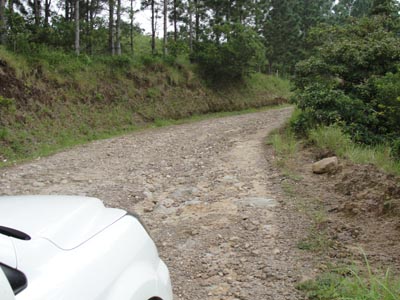
About half a mile down the new road, tarmac gave way to gravel. With deep ruts. Then worse ruts. We passed a small village and asked if that was the right road to El Valle. Yes, we were assured. One person said El Valle was just 10 minutes. Another said 30 minutes. The GPS seemed to split the difference.

always turn right

Bad ruts turned into a dry stream bed weaving through Panama’s low mountains. The doughty SUV slid downhill, the tires unable to grip the loose stones. We jolted in the car like peanuts in a tin can. A dashboard light turned on—overheated transmission. We stopped on a rocky plateau and scouted ahead only to find that the gravel track narrowed ahead. The five of us were quite alone in the hot rustling jungle.

The SUV cooled and we started off again, now having discovered that we were all Catholic and that two of us carried rosaries. The jungle gave way to cane fields. Hard green stalks as high as the car roof rattled against the windows.

Two Hours Later . . .

After two hours off-road we broke through the cane field and clambered onto tarmac again. We were on the eastern edge of El Valle. Never were five women more ready to buy souvenirs.

I learned a few things that day.

About being lost. And knowing when to turn at the shrine.

  1. Don’t be so distracted by peripherals—entertainment, Twitter, mooning over the wrong guy—that you forget to look for the shrine that points the way to where you really want to go.
  2. If you’re lost, keep going. Take a break to rethink the situation, take care of problems, or give yourself a pep talk, but don’t confuse “taking a break” with “breaking down.” Cheerlead as you go—you’re handling the uncertainty well, you’re learning about yourself and wherever this “lost” place is—even if it is inside you.
  3. The shrine doesn’t have to be the pink altar on the side of the road. A shrine can be any pointer that helps you travel where you want to go. A shrine can be the project you handled well—you can use it as inspiration for managing a bigger one. A shrine can be a passing grade in a tough subject—you know you can master the next class, too. A shrine can be a hard decision, a recovery from an illness, the day you stood up for yourself, the time when you were scared but did it anyway.
  4. Maybe today’s the day you build a shrine. The day you make a decision and carry it out. The day that you see new possibilities. Believe an inspirational quote and translate it into action. Once you build the shrine, it’s yours forever, ready to inspire if you get lost.

You may also like

always turn right

A 9/11 Story

A 9/11 Story

I was sitting in a small auditorium at the Colegio Americano in Mexico City waiting for the meeting to start. The room was full of women and the occasion was the annual meeting of Mexico’s Secretariat of Education with the school’s parents. I knew I wouldn’t understand most of it; my Spanish listening skills were still feeble although I’d temporarily mastered numbers. But the school administration had sent home shrill notes insisting that parents attend, claiming a correlation between continued accreditation/funding with the number of parents that showed up.

9/11We were new at the school that year. I didn’t see anyone I knew from my vantage point near the rear exit. The murmurs around me were all in Spanish.

As I leafed through my Filofax, a soft exclamation in English sounded from the front row. A blonde women turned to someone behind her as she waved a cell phone. “A plane hit the Twin Towers in New York,” she whispered loud enough for me to hear.

A small plane. A Cessna, I thought. A private pilot must have had a heart attack and veered off course. The plane would have splintered into pieces against the skyscraper. How sad.

With great ceremony, some school officials and a large man in a glen plaid suit mounted the stage and crossed to the podium. There were introductory remarks. The glen plaid suit started speaking on behalf of the Secretariat.

The warm air in the auditorium thickened with a mixture of boredom and expensive perfume. The speaker’s face was moist above the microphone. I had no idea what he was saying.

Whispers again rippled out from the front row in a language I could understand. A second plane had struck the Twin Towers.

No one left. The sweaty Secretariat man droned on for another 30 minutes until finally the school officials thanked him and dismissed the meeting. Maybe he took questions. I don’t remember.

I drove home and turned on the television. It was 11:30 am. At 11:32 I realized the world had fundamentally changed.

And that’s my 9/11 story.

Click here for the 9/11 digital archive. The Archive contains more than 150,000 digital items, a tally that includes more than 40,000 emails and other electronic communications, more than 40,000 first-hand stories, and more than 15,000 digital images.

Click here for the 9/11 memorial website.

You may also like

9/11

The Power of Daddy

The Power of Daddy

Once upon a time, when we lived in Panama, I was walking the dog and passed a construction site where the workers were engaged in a furious argument. The Spanish flew too fast for me to catch every word but anger came through in every red-faced yell and hostile gesture. The whole block rang with the shouts between a worker on the would-be second floor of the roofless structure and another on the ground below.

As we passed I wondered if bad karma was being transferred from the workers’ anger to the house. Would it silently bleed over into the lives of the people who would one day live in that place?

It made me think of an opposite scene I’d witnessed in Greece, when a family gathered at a construction site in our Athens neighborhood to have their new home blessed. The Greek Orthodox priest, resplendent in his embroidered robes and gray beard, solemnly intoned a blessing while swinging a huge golden incense brazier over the cement foundation. The extended family, all in their Sunday best, stood proudly together in the mud of the construction site, responding to the prayers. They would have a good life in that house, I thought at the time, living in a place infused with God’s blessing.

I grew up in such a house, a long duplex that my grandfather built. My family lived in one side and my maternal grandparents in the other. As a very small girl, I recall being frightened by a school presentation about fire and asked my mother what would we do if the house burned down. Nothing bad could ever happen to the house, my mother informed me, because when he poured the foundation my grandfather had dropped religious medals into the cement. Mary and Joseph were part of the house and would always protect it.

Years later, my husband and I were raising small children. There were no blessings or religious medals factored into the construction of suburban builder homes to keep us safe. We were on our own.

My toddler daughter was scared, she told me one night as I tucked her into bed. There could be monsters in her room that came out when the lights were off. Maybe in the closet.

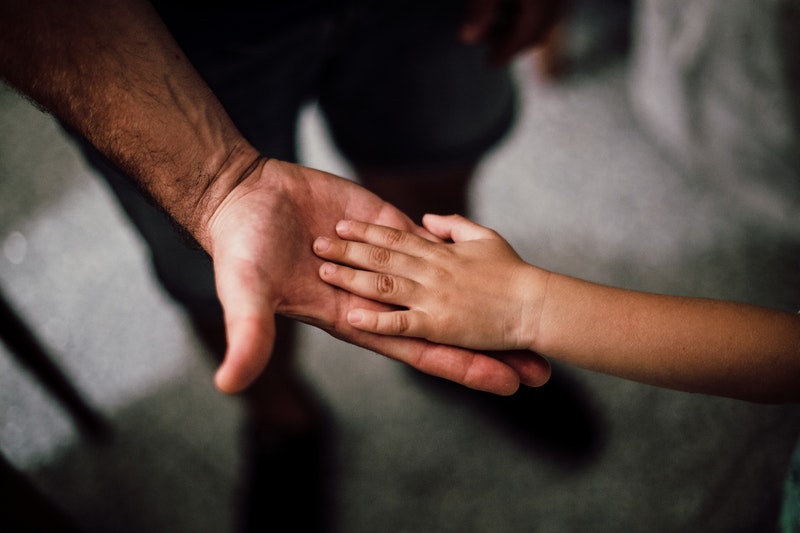
“Daddy doesn’t allow monsters in the house,” I replied.

And such was the Power of Daddy that the issue was never raised again.

To this day, it remains the smartest thing I ever said as a mother.

You may also like

power

The Hidden Lovers of San Miguel

The Hidden Lovers of San Miguel

In the political thriller THE HIDDEN LIGHT OF MEXICO CITY, Luz and Eddo briefly escape a political scheme to buy the Mexican presidency with drug money, and spend time away from the world in the lovely Mexican town of San Miguel de Allende.  A 4-hour drive northwest of Mexico City, San Miguel is a UNESCO World Heritage site known for its creative atmosphere.  The historic streets are lined with shops full of Mexico’s best handicrafts and artwork, the architecture is a wonderful mix of European inspiration and Mexican flare, and it is home to the annual San Miguel Writers Conference and Literary Festival.

Related: Read HIDDEN LIGHT’S First 2 Chapters

Creative mecca

The conference website says it all: The cradle of Mexican Independence, San Miguel de Allende has long been a mecca for social creatives – writers, painters, musicians, poets, philosophers, liberation theology clergy. Maybe it’s the crisp mountain air. Maybe it’s the thermal pools infused with natural lithium. Maybe it’s the Dalai Lama’s blessing. Maybe it’s you.

Several years ago our family joined two others for a wonderful and memorable trip to the city.

We stayed at a “villa,” which was really a long, low house near a hotel. Perfect for a group as big as ours, the location was secluded yet within walking distance of the hotel where we went for breakfast. There was a big field in front where the kids ran around with toys we bought in the square called El Jardin: balls on a string outfitted with long flashing streamers.

The villa and the field would create a pivotal setting for the novel. Two people from opposite ends of the social spectrum in Mexico–and it is an unforgiving fact of life there–in a place where no one knows them.

No one knows who they are or what they have been through.

No one to approve or disapprove of what they want.

Photo journal

I was experimenting with art and photography at the time, and the resulting pictures inspired the trip that Luz and Eddo take in the book.

San Miguel de Allende

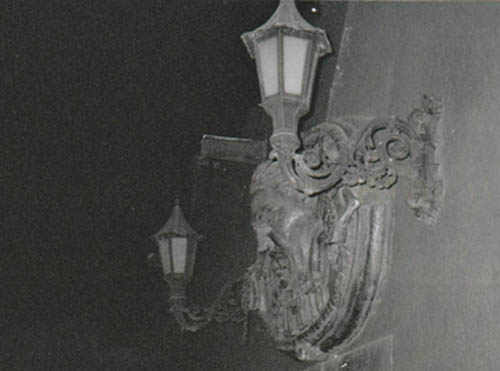
Antique lanterns in San Miguel de Allende


San Miguel de Allende

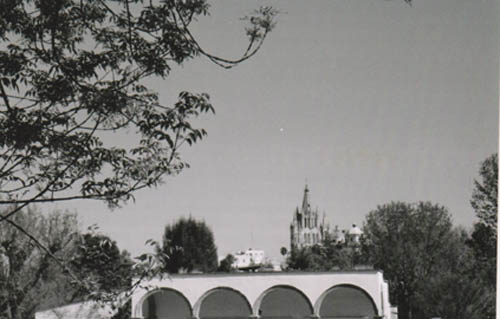
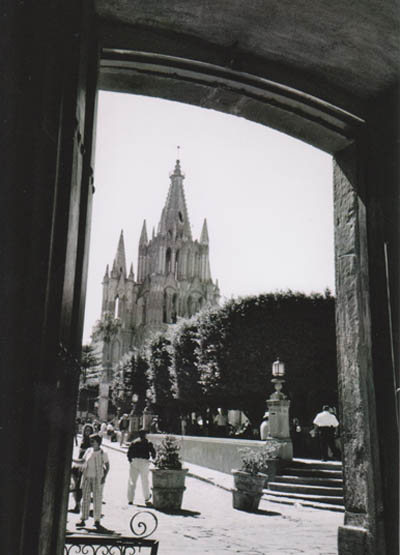
View of La Parroquia from the villa


El Jardin

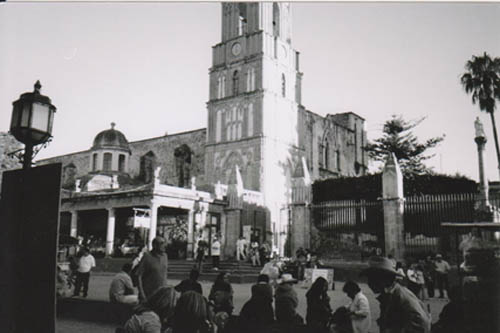
El Jardin bustling with people and energy


San Miguel de Allende

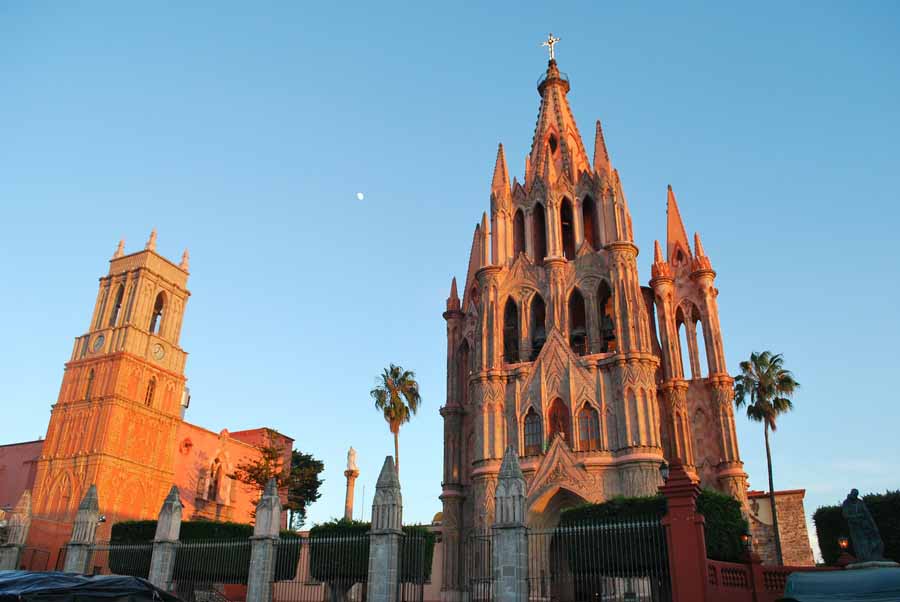
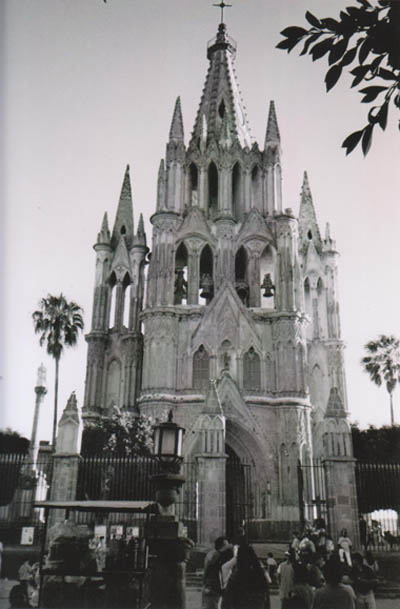
The cathedral of La Parroquia


San Miguel de Allende

The front entrance of San Miguel’s famous cathedral, thought to be designed by a local stoneworker after seeing pictures of European cathedrals

You may also like

San Miguel de Allende

5 Ways to Save What Matters

5 Ways to Save What Matters

historic preservation

A recent walk through Panama’s Casco Viejo–with its alternately sad and hopeful mix of gutted buildings, slumdog shacks, churches, and newly restored upscale shops and hotels–reminded me of the importance of cultural preservation.  While this historic district goes through a transformation that will ultimately preserve the best of it, other cultural legacies have disappeared and those are sad stories, as if cultural practices and language and architecture are endangered species.

So, based on a wholly uninformed point of view, here are some ideas for preserving what matters:

Repurpose

The world is full of examples, notably of buildings, that get converted to another use in order to preserve them. When I was in college, we converted a local firehouse into a theater and the highlight of the season was the lead actor sliding down the firepole to make a grand entrance in Scappino. I was the stage manager for the production and still have scars on my right hand from the scene in which the pole was transformed into a flagpole with a series of distress flags hooked to a rope. As I worked the mechanism on the top floor above the stage, the hooks snagged my hand when the actor yanked too hard on the rope.

Example: The Hardware Store in Charlottesville, VA is a former Depression-era hardware store transformed into a restaurant. The original fittings have been preserved and the ambiance is right out of the 1930’s. The concept was so successful that the restaurant anchors the modernized downtown area of the city. Oh, and my main characters eat there in a thriller I’ve been working on set in Charlottesville.

Symbolize

historic preservationUse the item we want to preserve as a logo or symbol to prompt interest and identification. While this may sound like a test for graphic designers, it is a good way to place the reminder of the thing to be preserved in alot of places, including social media pages, brochures, etc.

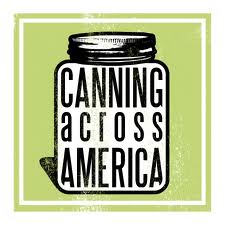
Example: Canning Across America is a clever website dedicated to preserving (sorry, just was too perfect) the art of home canning. The site uses a logo of a canning jar that manages to be edgy and hip even as the site showcases homey pictures of gorgeous jams and veggies and such.


Pedestrians Only

Many spaces we want to preserve have narrow streets. Stop putting cars through the area and convert to pedestrian use only to prevent damage to buildings and facilitate tourism so people can stop and linger. Put parking and access to public transportation nearby.  This is what I hope is eventually done to Panama’s Casco Viejo, where both streets and sidewalks are narrow. Pedestrians frequently end up walking in the sreet, endangering life and limb. Buildings are so close that drivers can’t see around them as they approach intersections. Driving through can really be a game of chicken.

Example: Most old European cities were smart enough not to stuff historic plazas full of cars. There are many beautiful open spaces that invite folks to walk through and find treasures in restaurants and shops. Brussels’s Grand Place main square is a great example. In Italy, a pedestrian square is an isola pedonale and Piazza Navona is my favorite (there’s a Furla store there, so not hard to see why I like it.)

Hall of Fame

Create a showcase of the best examples of culture in certain categories. There’s the Country Music Hall of Fame, the Baseball Hall of Fame, the Rock and Roll Hall of Fame, Hollywood’s Walk of Fame, the Pro Football Hall of Fame, the Nascar Hall of Fame, the National Air and Space Museum, etc. Obviously, this is a versatile concept.

Example: The Library of Congress has a National Recording Registry that functions as a sound-based hall of fame. As recently reported by Huffington Post, they inducted  “25 sounds that shaped the American cultural landscape.” How cool is that?!

Make it personal

Often, people don’t respond to a concept unless it becomes personal to them. Preservationists have to find a way to tie preservation to something that is personal to the audience in order to build interest and support and even participation.

Example: The endlessly creative website yesterday.sg is devoted to preserving Singapore’s cultural heritage. A campaign in January to raise awareness was a call for people to submit wedding photos taken at Singapore’s 64 national monuments.  People who sent in wedding photos would qualify to win diamond jewelry from a local store.

You may also like

historic preservation

How to Find Love at Mexico City’s Markets

How to Find Love at Mexico City’s Markets

Love to find that perfect travel memory? Love authentic handcrafts? Head for Mexico City’s markets.

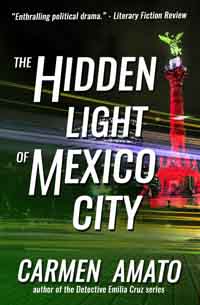
Markets inspired much of the atmostphere I wrote into THE HIDDEN LIGHT OF MEXICO CITY, the romantic thriller and modern Cinderella story. The sights, sounds, and temptations of Mexico City’s markets helped drive the novel’s authenticity.
Mexico City's markets

Get it today on Amazon

Find more than souvenirs

Mexico City’s markets are where you can fall in love with the country’s culture, people-watch both buyers and sellers, and find some of the best street food, too. Just watch your purse/backpack/wallet. Like every big city, Mexico City has its share of clever pickpockets, even in the best markets.

Related: The Lost Chapter of THE HIDDEN LIGHT OF MEXICO CITY

Each market has its own flavor and specialty items and everyone I know has their favorites. These are mine.

Bazaar Sabado
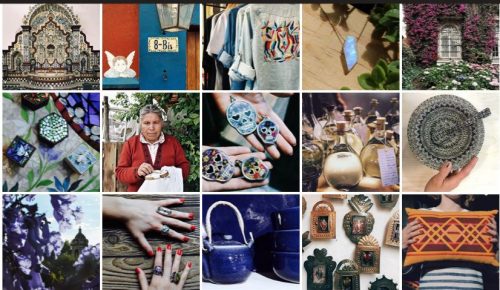
Bazaar Sabado art

Samples of handicrafts available at Bazaar Sabado. Courtesy http://elbazaarsabado.com/mx/#expositores

A straight shot down the big Periferico highway from the upscale Lomas de Chapultepec area, San Angel is the most colonial of all the Mexico City neighborhoods, with old Spanish architecture and a charm that makes you want to stay and explore. The market—Saturdays only–is located on the edge of the Plaza San Jacinto and spills outside the building, making it an interesting but fairly well contained exploration. This is the place for very high quality (prices reflect that, too) glassware, metalcrafts, mosaics, artwork, etc. There are several restaurants nearby with great food, too. The market’s website gives more information.

The main building is organized like a US antiques mall, with vendors in stalls surrounding the building’s courtyard. My favorite purchases there have been beautiful laquerware and cedar carvings of a village, including different churches. Alas, the dog ate the carvings (no kidding) and when I went back the vendor wasn’t there. The rule here, as with all Mexican markets: if you see it and like it, buy it NOW. You probably won’t see it again. These are pieces of art, not mass market products.

I’m also kicking myself for never having bought any of the glass mosaic pieces—candle hurricane lamps, bowls, etc– that are a feature of this market, so if you go, let me know.

Jardin del Arte
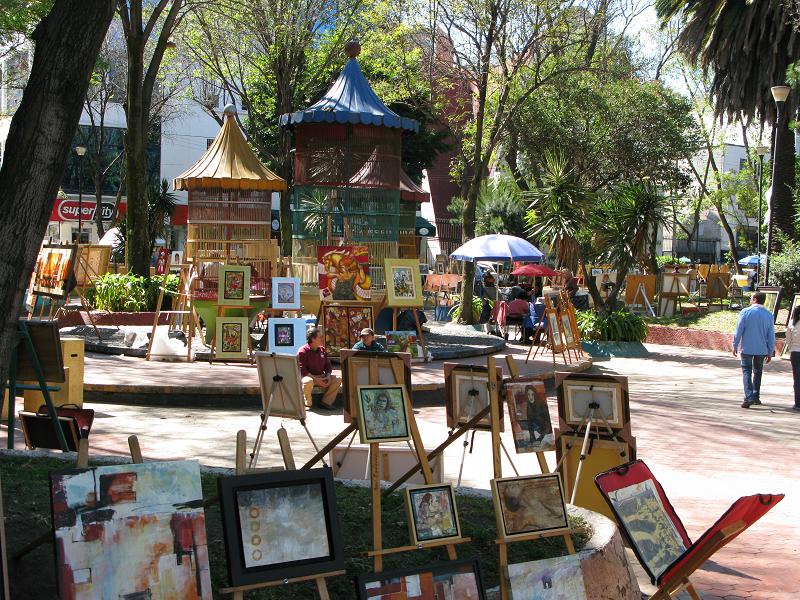
Jardin del Arte Mexico City

Photo by Agustin Valero – Own work, CC BY-SA 3.0, https://commons.wikimedia.org/w/index.php?curid=9070692

“They waded into the sea of paintings that was Jardin del Arte.”

This quote from THE HIDDEN LIGHT OF MEXICO CITY says it all. This Sunday market is devoted to paintings of all sizes and shapes and is one of my favorite weekend places. It is held in a park at the northeast end of Rio Lerma (on Saturdays there are ballroom dancing events where older couples come out and dance to big band sounds.) Artists whose paintings are sold for thousands in galleries come with the lesser pieces which you can buy for a fraction of their worth.

Then there are the unknown artists with one or two unique items, the artists who make a living selling the predictable Mexican village scene of a house, a girl, and a donkey, and the rest who make this a feast for the art lover.

On the fringes of the park there are vendors who sell art supplies—every size and shape of canvas and type of paint and pastel. I knew one American woman who bought several paintings every weekend for a year and opened a gallery in the US with them. No doubt she jump-started many a Mexican artist’s career.

Related: Read Chapters 1 & 2 of THE HIDDEN LIGHT OF MEXICO CITY

Mercado de Jamaica
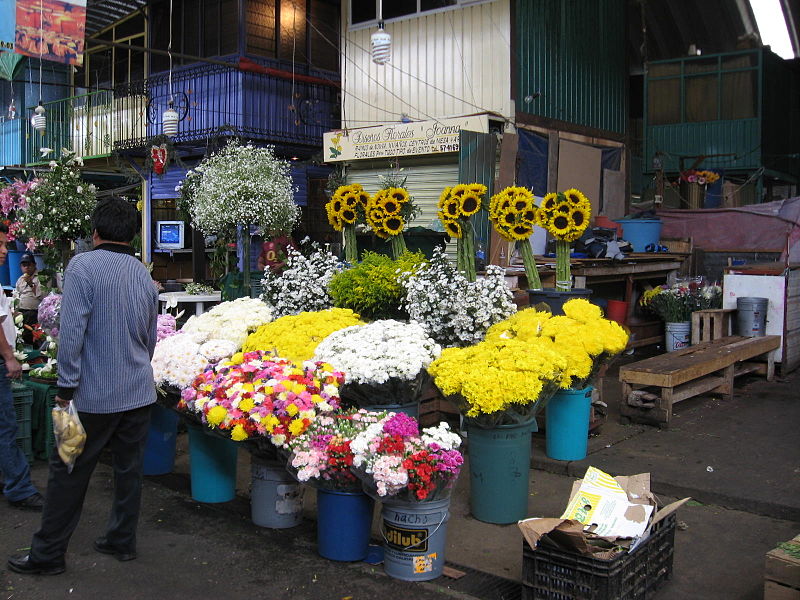
Photo courtesy Leigh Thelmadatter, https://creativehandsofmexicodotorg.wordpress.com/

This is where people buy their voodoo stuff, I was told. Be careful if you go.

And yes, I saw the voodoo candles and statues of Santa Muerto, the saint of death idolized by drug cartels. Bottles of herbs and pamphlets with incantations. I bought a candle with special coins guaranteed to enhance the wealth of my family . . . still waiting to see the results.

Bu this sprawling market is also where the best Halloween/Day of the Dead costumes are sold, as well as flowers, food, pets, fabrics, household pots and pans, and just about anything else you can expect a Mexico City householder to use. Here’s a wonderful description of the market by Mexico City-based artist Jim Johnston.

Don’t miss out! Get your free copy of the Insider’s Guide to the Best of Mexico. Free download here.

Cuidadela
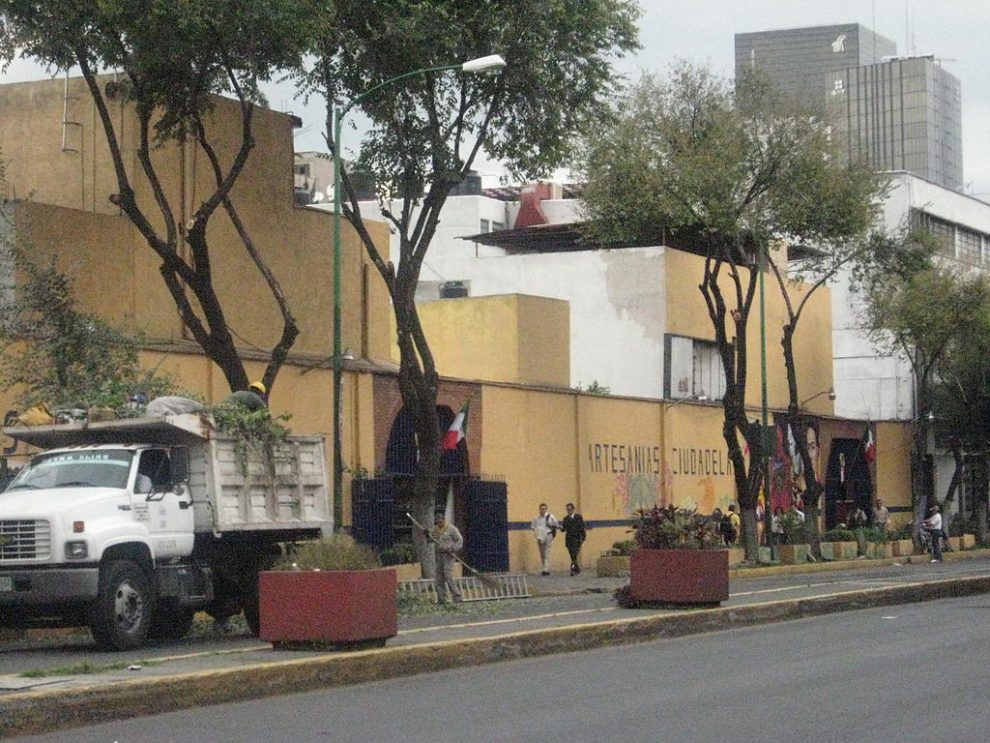
The market at Balderas

Photo courtesy Leigh Thelmadatter, https://creativehandsofmexicodotorg.wordpress.com/

This downtown city market is a warren of vendor stalls with a big selection of handicrafts and household goods. It is big but the quality is a notch below Bazaar Sabado and the pickpockets are more in evidence. Expect more aggressive vendors, too.

My best purchase there was a ¾ size guitar for $40 that was well-crafted with a nice solid sound, perfect for a son learning a new instrument. We still have it, many years later.

I also got a Bruce the shark piñata for my daughter’s Nemo-themed birthday party that was nearly impossible to break (Daddy had to cut it open with a penknife before the kids could get the candy inside!)

This is a great place for embroidered tablecloths and talavera, the heavy painted pottery from Puebla. Many vendors will take custom orders and deliver the finished tableware to your house. If you aren’t ready to buy, ask for the vendor’s card (tarjeta) so you’ll know how to find them when you are.

Insurgentes
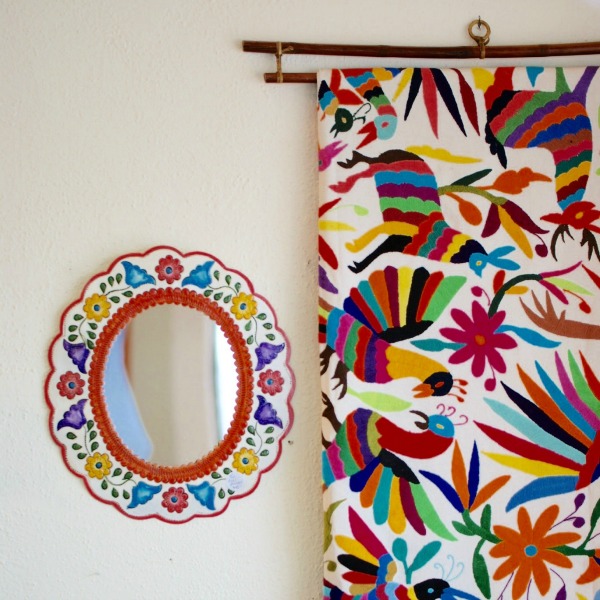
Otomi embroidered cloth

Photo courtesy Anne Damon, Zinnia Folk Arts, www.ZinniaFolkArts.com

This upscale market on the Reforma side of the Zona Rosa is the best place for jewelry and the beautiful embroidered cloth by the Otomi Indians. It is near the Plaza des Angeles, a wonderful (and pricey) antiques mall with Spanish Colonial china, furniture, and artwork. (I have a soft spot in my heart for this place because I once left my car unlocked all day in front of it and the car was wholly untouched when I returned. A small urban miracle.)

The Insurgentes market can be a tight crawl; the vendors are squeezed together and the aisles between the rows of stalls are narrow. Most sell sterling silver jewelry and weigh an item before giving you a price. Stall owners can usually be found with a cloth polishing their silver inventory and will want to show you more items than what is on display. Lots of good copies of Tiffany, Louis Vuitton and TOUS jewelry but the Mexican-designed necklaces, rings, and bracelets can be breath-taking, especially those with semi-precious stones.

The Otomi cloth is unique, embroidered with big animals, many of which are imaginary. The thread is often one color, making a big statement that looks very modern, although some are multicolored. Vendors at the market generally sell pieces big enough to be a bedspread—for $300 and up—as well as pillow covers, table runners, and place mat-sized pieces. Ask to see more than what is displayed; almost all fabric vendors will have more folded up and stacked somewhere. So You Think You Can Dance TV host Cat Deeley had a pile of Otomi pillows on her patio in InStyle magazine. If you can’t get to the market, find these beautiful textiles at Zinnia Folk Art, which always has a wonderful selection.

Coyoacan
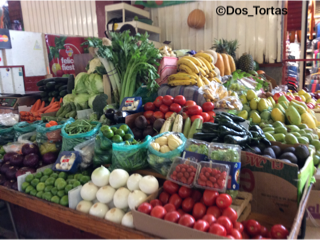
Photo courtesy Alex Fisher
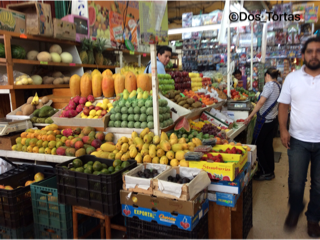
Photo courtesy Alex Fisher

Photo courtesy Alex Fisher

Photo courtesy Alex Fisher

The market in Coyoacan, near the bright blue Frida Khalo museum, is worth a stop if you are in the area. Coyoacan was among the first of the Mexico City’s neighborhoods to rbe named as one of Mexico’s Barrios Magicos (Magic Neighborhoods) due to its  tree-lined cobblestone streets, colonial-era homes, and rich cultural history. It’s got great local produce, as well as as a carnival of street food, including chapulines (fried grasshoppers.)

You may also like

Mexico City's markets

The Girl on the Other Side of the Earth

The Girl on the Other Side of the Earth

When my daughter was little I wanted to give her a sense of her place in the world. We got a globe and calculated the exact opposite spot if one drew a straight line through the center of the earth from where we were.  We hit China.

We started to tell each other stories about a Chinese girl who lived across the earth from us.  She would be my daughter’s exact age, of course, and we wondered what she’d be doing. What clothes would she wear? What season was it for her? What food would she like to eat? If it was bedtime for my daughter was it morning for the girl in China?

Each time our family moved, we imagined a new girl on the other side of the earth from wherever we found ourselves. The globe has some pen marks on it now and we weren’t terribly geographically precise, but we still talk about where is the girl on the other side of the earth from us and what she is doing that is the same or different. Which was the whole point of the exercise, I think.

Right now, she’s a girl in Indonesia.

Where is that girl across the earth from you?

You may also like

other side

Wicked Culture

A stroll through an outdoor book fair lining Mexico City’s Paseo de la Reforma boulevard a few months ago gave me the inspiration for the third novel in the Emilia Cruz mystery series. Most of the vendor stalls offered beautiful art books but what caught my eye was a cheaply printed pamphlet adorned with a drawing of a muerte skeleton figure wearing a long robe and holding a set of scales and a globe.

The dark side is alive and well . . .

Mexico’s Santa Muerte

Santa Muerte has become a cult figure in Mexico and is increasingly hailed as the patron saint of drug gangs, cartels, and violence. The saint is always a muerte, or skeleton figure, in a long robe with a hood. Sometimes Santa Muerte has a halo or a crown and carries either scales or a long scythe akin to the Grim Reaper. There are also images that meld Santa Muerte with the Virgin of Guadalupe. Murders associated with the cult of Santa Muerte made headlines last month when three people were killed in a ritual dedicated to the saint in northern Mexico.

The little pamphlet that I found was a collection of prayers to the Saint of Death, including a prayer to bring in money, a curse against jealous people and a prayer to dominate a husband, an invocation for a man not to look at any other woman, and a prayer to make a man forget another woman. In the next book,  Emilia will read the wrong prayer, of course . .

Papua New Guinea’s Sanguma

A spiritualism known as sanguma in this remote Pacific nation is widespread and most homicides in the country are thought to be related to it. 85% of the population lives in rural communities where belief in black magic is especially strong and passed down through generations through storytelling. Illnesses, sudden death by natural causes and other unexpected developments are often thought to be the result of sanguma. As a result, to erase the black magic, villagers often kill someone accused of being a sorcerer. Check out this report from ISP for more.

Haiti’s voodoo

Voodoo was acclaimed as a real religion in Haiti and revolves around in a distant and unknowable creator god, Bondyè. According to Wikipedia, Bondyè doesn’t intercede in human affairs but has a set of lesser dieties called Iwa who direct specific aspects of life.  Adherents to voodoo “cultivate personal relationships” with the lwa through offerings, personal altars and devotional objects, and elaborate ceremonies of music and dance, which are the means for possession by an Iwa. Supposedly being possessed by a diety is something to be desired.

Hmm. Creepy stuff. Time to go to church and light a candle.

Rude in Any Culture

Back when I started this blog, I talked about what it means to be a World Citizen, someone who can go anywhere because they understand and embrace the culture in which they find themselves. I identified a few things that go into the making of a World Citizen and Manners was one of them.

Related: The Right Fork

Manners differ considerably from place to place. Often rudeness is one culture is the norm in another. Differing views of standing in a line, for example. But some things are universal.

If you’re a World Citizen, you shouldn’t find yourself doing any of the following:  6 things that are Rude in Any Culture.

  •  Defacing national monuments or historic sites, including taking “souvenirs” which could prove to be significant artifacts, like, oh, the Elgin Marbles.
  •  Performing acts of personal hygiene in public, including urinating, picking one’s nose, clipping fingernails with the teeth, etc. One can never explain such actions in a way that is flattering.
  •  Talking in a theater, unless the movie is Ricky Horror Picture Show.
  •  Putting feet up on a table or other furniture unless invited. It implies disdain for others’ possessions.
  •  Smoking in areas where signs are posted that say–in any language–“No Smoking.”
  •  Overreliance on the word “fuck,” which is now a virtually global swear word, except possibly in France which is rude enough to stick to the time-honored merde.
rude in any culture

Finding my Audience

Who do I write for?

This was a simple question posed to me a couple of months before The Hidden Light of Mexico City was released and it was simple to answer.

Me.

Well, not just a readership of one! But when I started writing, it was for myself and all my girlfriends in Mexico City who watched the dance of Mexico’s social classes and wondered what would happen to the country in which we’d invested so much of ourselves.

We were smart, educated, and capable women from different countries: the US, UK, Germany, Switzerland, Portugal, Australia, etc. Although we had different nationalities, we had one thing in common: we were all from cultures that embraced and practiced gender equality.

All of us found that wasn’t the case in Mexico, although I hope things have improved since then. But at the time, we often found ourselves talking about people and situations we encountered in Mexico City that made us uncomfortable because inequality was so tolerated.

These conversations really inspired me, at first to write a non-fiction book, and then later to change it to a novel that would entertain as it informed.

My readers are

  • Interested in current events
  • Curious about the rest of the world, especially Mexico
  • Appreciative of a good action story
  • Likes a bit of spice, too

Does that describe you?


Pin It on Pinterest