Comparing Crime Rates: Acapulco vs Points North

Comparing Crime Rates: Acapulco vs Points North

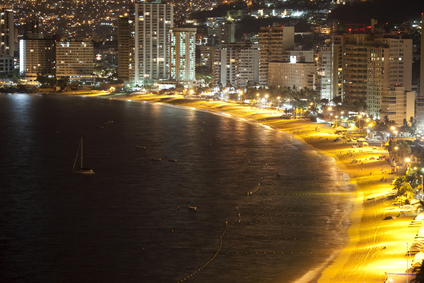
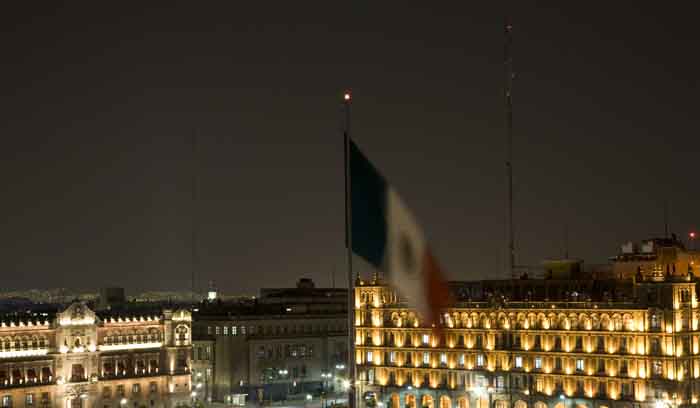
In mid-February, prompted by a spate of news reports on crime for 2012–including a list of the top 10 most violent cities in the world, discussions of violence in Chicago and Detroit, and school closings in Acapulco due to security problems–I posted this picture and the following question on my Facebook fan page:

Acapulco nightAcapulco, setting for my EMILIA CRUZ mystery series, has been named the 2nd most DANGEROUS city in the world! Have you been to Acapulco? Do you agree?

The Facebook Response

At present I have 1898 Facebook fans, spread across 7 countries. More than half are in Mexico. 291 fans “liked” the post. Responses included:

  • “Beautiful paradise turned into hell.. where teachers are being extorted . . taxi drivers are decapitated, where many women have been raped, but only when happened [sic] to foreigners the authorities reacted as if the lives of poor, common Guerrero women were worthless.”
  • “Acapulco is violent and dangerous yes, indeed!”
  • “I think people over [exaggerate] things ‘cause look what happened to those kids in school. It’s always dangerous people make it that way in Mexico everywhere not just Acapulco.” (translation)
  • “I love the photo. Just . . . Perhaps . . . this is now the motherland of Mexicans. And you have to love her as such. First, individuals must be better in order to first form a society.” (translation)
  • “The whole world has violence not only Acapulco.”

Related post: Chain of Fools

Comparing Crime

The “it’s not just Acapulco” comments made me wonder. Were Acapulco’s homicide numbers really so much worse than Chicago or Detroit? Moving further north, what about Canada? What does high crime there look like? I had more questions than ever after that simple Facebook post.

Here is what I found when I compared the homicide rates in key cities in North America:

                           Winnipeg       Chicago         Detroit          Acapulco

Population:           700,000           2,851,265         700,000          880,000

2012 homicides              39                 500                 411                 1170

Percentage        1 in 17,948           1 in 5,702        1 in 1,703         1 in 752

I was looking for context and what I got was a shocker. Unless math has changed since I went to school, Acapulco is far and away the winner of this gruesome challenge. Winnipeg has the worst homicide rate of all Canadian cities but is incredibly low in comparison.

Are Local Gangs the Key?

What will it take to make a dangerous city less violent? Gangs fuel the homicide rates in Chicago and Detroit, according to many news reports, and it is well known that Acapulco’s gangs feed drug cartel violence. Mexican President Enrique Peña Nieto recently announced a new $9 billion crime prevention strategy to combat the rise of gangs in 57 poor neighborhoods and hotspots including Acapulco. Will it work? While homicide rates never tell the whole story, let’s hope next year the numbers are smaller.

You may also like

crime rates

The Friday Fiesta: Travel with a Filmmaker, A Camera, Disappearing Destinations, and Titanic II

husky with suitcaseAs a fiction and mystery author I draw on my own world travels and experiences living in Mexico and Central America. But online travel is also a  terrific way to discover news and places worth celebrating. Let this review turn your Friday into a fiesta!

Life Tips from a Director

Director of Oscar-nominated film Beasts of the Southern Wild Benh Zeitlin talked to Filmmaker Magazine and while you might think this doesn’t have any relevance for you—especially if you didn’t see the movie which didn’t star any Hollywood big names. But the thoughtful interview, in which Zeitlin “proves that to make a powerful film today, you don’t need gimmicks, a convoluted strategy, or even connections in the business” is a lesson in what success should mean for each of us. Zeitlin believes that “all you really need is a story so strong that it’s impossible not to make.” Read the interview with this thought in mind—if your life was a movie, what story would you believe in so strongly that you’d have to make it come true?

50 Photos From an Airplane Window

It takes time to load but this gallery of photos from twistersifter.com is worth the wait. The photos have all been taken from the window of an airplane and are simply the most arresting collection I’ve seen lately. Mt. Rainer, San Francisco, Rio, Mexico City, Greenland, Miami—they are all gorgeous. Two or three don’t show but don’t let that stop you from being amazed by this stunning virtual photography exhibit.

Disappearing Destinations

Gadling.com blogger Reena Ganga offers a review of travel destinations that are focused on preservation efforts or groups that can use your help to spur preservation efforts. My favorite idea from this post is to volunteer at a World Heritage center. “There are volunteer projects across the globe, including diving along the Great Barrier Reef to help threatened coral, conserving the Medina of Fez in Morocco, and restoring archaeological sites in Tanzania.” Many countries don’t have the resources to take care of historic sites. Travel with heart and your next vacation could be anything but ordinary.

Related post: 5 Ways Historic Preservation Scares Us and Why That’s a Good Thing

Iceberg Beware

The new and improved Titanic will sail again, according to AOL’s travel site. A perfect replica of the ship is being built by Australian zillionaire Clive Palmer. If things go according to plan, the Titanic II will cross the Atlantic in 2016. Passengers will wear period costumes to mimic the original Titanic’s 1912 cruise. What won’t be imitated is the original brush with that fatal iceberg. Palmer reportedly told a UK newspaper that due to climate change “There are not so many icebergs in the North Atlantic these days.” Titanic II will, however, have enough lifeboat and life rafts to accommodate all 2,435 passengers and 900 crew members. Cue Celine Dion!


About the time I went to Fiji

About the time I went to Fiji

Arriving in Fiji alone at 1:00 am after a 12-hour flight was unnerving but that’s the way the flights went so there I was, in the middle of the Pacific, with a heavy suitcase, an even heavier bag of scuba gear, and reservations for a hotel that was 20 miles away. I’d never been in Fiji before.

The Fiji You Don’t Know

A nation of islands, Fiji was a former British colony. When the Brits found out that it was the ideal climate for sugar cane, Indian workers from the subcontinent were brought in the raise the crop. Sugar cane passport and shellsbecame Fiji’s main export, sweetening British candy and giving rise to local rum production as well. But land in Fiji–and accompanying political power–is reserved for native-born Fijians, disenfranchising the Indian population. As the Indian population grew to rival that of native-born Fijians, the unequal status was more apparent. The Indian population’s economic and political power grew with the population, until an Indian was elected prime minister. A racially-motivated coup by a native Fijian army officer was swift and bloodless. It returned the former native Fijian prime minister to an interim status but a second coup occurred when the army ringleader took power himself.

The second coup had occurred two weeks before my arrival.

The Taxi Driver I Didn’t Know

I was wary but determined as I hauled my heavy bags outside the terminal to be directed into a taxi driven by a turbaned Indian gentleman. We headed off in the pitch-black Pacific night for Suva, the capital. The taxi was tooling along nicely until we came to an army roadblock. A single Fijian soldier stood guard, wearing a military uniform shirt tucked into a traditional Fijian sulu, or kilt, and sandals. He had an assault rifle, a flashlight, and a long wooden barrier.

Related: Talking money in Papua New Guinea

The Soldier I Wish I Knew

Let me digress here and say that Fijian men are the most handsome men on earth. Apologies to singer Ricky Martin; Karl Urban–the New Zealander who played Eomer in the Lord of the Rings movies; and my husband (whom I hadn’t yet met.) Fijian men are Pacific gods. All are about seven feet tall, muscular to the point of sculpture, and have deliciously dark hair and eyes.

So back to the car. The driver stopped the vehicle in front of the barrier. From my vantage point in the back seat I saw him sweat and shake as the soldier and his nice gun approached. The driver stared ahead, steering wheel locked in a death grip, and didn’t acknowledge the soldier.

For whatever reason I rolled down my window, smiled shakily, and held out my American passport.

The soldier bent down to peer at me through the open window. Up close he was gorgeous; dark mustache  lose-yourself-in-them brown eyes, perfect teeth. “Hello,” he said, making it sound as if I was the woman he’d been waiting for all his life.

“Hello,” I replied, now confused as well as nervous.

He stepped away from the car and studied my passport in the beam of his flashlight. There were no streetlights, no other cars, the airport far behind, the empty road unspooling in front of us only to disappear into the darkness. The taxi driver continued to shake like soupy gelatin.

The soldier came back to the car and leaned down to look at me again through the window. He handed back the passport. “Goodbye,” he said, infusing his voice with Casablanca-like drama.

“Goodbye,” I said, matching his emotional tone.

He moved the barrier, the taxi driver gave a little sob, and we sped off, leaving Sergeant Fiji by the side of the road.

Related: Open Letter to Readers about Sex

In Retrospect

I was reminded of this episode  when I recently unpacked a box of souvenirs. I’d made the first move in a tense situation by offering my passport to the soldier. He was alone in the dark and probably as nervous as that taxi driver. Would things have gone differently if I’d waited for the taxi driver to do something or for the soldier to demand some identification or payment?

You may also like

Fiji

Matching Books with Museums in Mexico City

Matching Books with Museums in Mexico City

There you are, strolling through amazing exhibits and you know something’s missing.

Like the backstory.

Wish you’d known more before going? But there wasn’t time. Besides,  research before going to a museum sounds too much like work.

So prep with a little fiction! Have fun and get the backstory before you go by pairing a good book with a counterpart museum. It’s like pairing white wine with fish or a cabernet with a good steak; each tastes better with the other.

Here are some suggestions for pairing fiction books with museums in Mexico City. Just like Corona with carnitas!

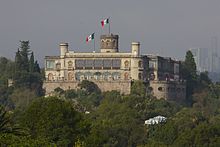
Chapultepec Castle and The Last Prince of the Mexican Empire by C.M. Mayo

Chapultepec castle

Chapultepec Castle photo courtesy wikipedia

The museum: Perched on top of a hill, with sweeping views over Mexico City’s western sprawl, the fortress-style castle was home to the ill-fated Emperor Maxmillian I and his empress, Carlota, during the Second Mexican Empire from 1864 to 1867. You can walk through the rooms, which are arranged shotgun fashion–each leading into the other–insuring that no one at the court had much privacy. The gilded, delicate French-style furniture is an indication just how out of touch the royal court was from real life in Mexico. Take the trolley from street level up the hill, otherwise you’ll be too exhausted from the climb to appreciate the museum.

The book: The Last Prince of the Mexican Empire is a fictionalized account of the Second Mexican Empire seen mostly through the eyes of the American woman whose son was adopted (or seized depending on your point of view) by the childless Maxmillian and Carlota in the vain attempt to establish an heir to the Mexican throne. The book is a real gem and shows off both amazingly detailed research into the life and times of the Second Mexican Empire and the author’s ability to create wholly believable historical characters. Get it here.

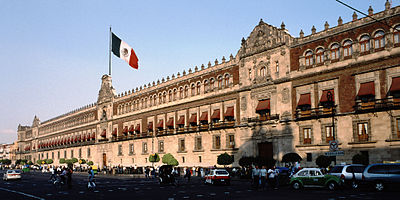
The Palacio Nacional and The Eagle’s Throne by Carlos Fuentes

Palacio Nacional Mexico City

Palacio Nacional photo courtesy wikipedia

The museum: This long, stately building rises impressively along one side of Mexico City’s enormous Zócalo central square. It is a working government building but visitors flock there to see the famous murals by Diego Rivera that adorn the main stairwell and the walls of the second floor. Grandly titled “The Epic of the Mexican People,” the murals were painted between 1929 and 1935 and tell Mexico’s story from the Aztecs to the worker of Rivera’s times. Above the building’s central doorway, facing the Zócalo, is the main balcony where just before 11:00 pm every 15 September, the president of Mexico gives el Grito de Dolores, the infamous cry for independence from Spain originally made by national hero Miguel Hidalgo. Hidalgo’s church bell from the church of Dolores Hidalgo, Guanajuato, hangs above the balcony.

The book: The murals and the el grito commemoration are integral parts of Mexio’s turbulent and at times visceral political rivalries and history. The Eagle’s Throne, written as a series of letters by a tangled net of political players, is a masterfully crafted inside look at that game. The letters reveal the story bit by tantalizing bit, with allegiances, conflicts, brinkmanship, and manipulation driving the narrative. An amazingly complex and skillful book, there is nothing else that so perfectly takes the reader inside Mexico’s political world. Get it here.

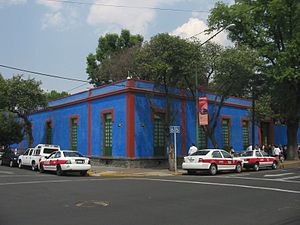
La Casa Azul (Frida Kahlo’s house) and The Lacuna by Barbara Kingsolver

Casa Azul

la Casa Azul photo courtesy wikipedia

The museum: This cobalt blue house in the artsy Coyoacán suburb of Mexico City was the family home to iconic painter Frida Kahlo and where muralist Diego Rivera also lived during his stormy marriage to her. Kahlo and Rivera were socialist sympathizers and la Casa Azul was an intermittant refuge for Leon Trotsky 1937-39 when he fled Stalin’s Russia. The house contains numerous Kahlo artifacts and pieces of artwork. An outdoor room built by Rivera and encrusted with shells shows just how unrestricted the two were in their creativity.

The book: The Lacuna traces the life of a troubled young American man who was raised (by a free spirit mother) in Mexico City and becomes assistant, chef, and secretary to Kahlo and Rivera. Rich in imagery, poetic prose, and character development, we see the conflict and intimate life of the two artists through his own troubled eyes. Their commitment to Trotsky and the latter’s exile in Mexico City is the real centerpiece of the book. I didn’t love the end, but the novel is a dense, lavish telling of the story of Kahlo and Rivera—and all that had happened in that house. Get it here.

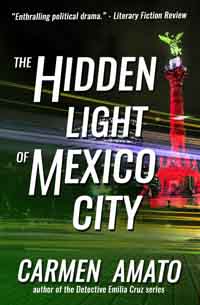
The Rufino Tamayo Museum and The Hidden Light of Mexico City by Carmen Amato

Tamayo Museum

Tamayo Museum photo courtesy vernissage.tv

The museum: The Tamayo Museum is the queen of contemporary art in Mexico, drawing A-list international artists and fearlessly promoting new ideas and installations in the art world. A huge curved sign occupies prime real estate on Paseo de la Reforma, Mexico City’s main drag, advertising the museum’s ever-changing array of exhibits. The building itself is a piece of sculpture, a nice contrast to its neighbor, the more stolid Anthropology Museum. Well curated, it is rarely crowded and always gives fresh perspectives. Also, the small restaurant has very good coffee.

The book: In The Hidden Light of Mexico City, anti-corruption attorney Eddo Cortez Castillo talks to housemaid Luz de Maria Alba Mora in front of the museum and mistakes her for an art teacher. Their tour of the museum brings the reader right along, showing the variety of things one is likely to see in the Tamayo, from video installations, to 3-D objects of startling variety and materials, to classics like actual paint on canvas. Like it does to everybody, the Tamayo startled Eddo and Luz but also hugely entertained, leading to an unforgettable conversation about life, history, and love. Of course more happens after that—Eddo’s hunting a corrupt Minister of Public Security and an elusive cartel leader while Luz’s family implodes—but you’ll have to read the book to see how it all works out. The book takes on Mexico’s rigid social system as well as government corruption. Get it here.

Check out tripfiction.com for more ideas.

You may also like

Mexico City

A Friday Fiesta of Close Encounters: Maps, Murano, Mississippi and Designing Vietnam

dog with suitcaseAs a fiction and mystery author I draw on my own world travels and experiences living in Mexico and Central America. But every week there is something new to encounter–who knows where I’ll find myself next as long as every Friday is a fiesta! Subscribe to this blog and come along for the ride.

How to Make a Map of Yourself

Skillshare.com is a website that offers tutorials on a wide range of quirky subjects ( average price for an online class $20.) This upcoming class is a series of video lessons that teach you how to make a variety of maps from photo-based maps to “you are here” graphics. Learn a unique skill and have some fun at the same time! A good mental exercise as well, for anyone who loves travel or simply wants to know where they are in life.

Shards of Murano

I’ve been reading Donna Leon’s mystery series set in Venice and one of the books takes Commisario Guido Brunetti to the island of Murano (won’t give it away but bad things happen) which is known around the world for its glassmaking. But as cheaper Chinese glass floods the souvenir market in Italy, are skilled Murano glassmakers going to lose their livelihood? The answer lies in fighting volume with quality and true artistry. A fascinating read from online magazine The Cultureist.

Believe it or Not in Mississippi

Right on the heels of the movie Lincoln, which focused on the passage of the US 13th Amendment banning slavery, Mississippi has ratified the amendment!  Only 148 years after it became law, Mississippi has corrected a clerical error which prevented the state from officially ratifying the amendment, according to the Politico website. Better late than never. Oh, and the movie was great. Daniel Day-Lewis for Best Actor for sure

Designing Vietnam

We don’t usually think of Vietnam as a spark for creative design; India, China, and Japan generally get top honors for Asian motifs and inspiration. But the folks at fav website creativeroots.org have gathered together a passel of design ideas related to the small country; iconic photos to the packaging for Mekong Red Dragon rice to the results of a collaboration between Swedish designers and Vietnamese craftsmen. It’s a thought-provoking visual menu of design ideas, rather than war images (although some are there.) Maybe times really are a-changing.

I hope you were intrigued by this week’s close encounters. I’m always looking for new ideas to encounter for my mystery and thriller books. Share yours with a comment!

The Case of the Mysterious Immigration Debate

I’m a mystery and thriller author, not a political pundit or a news commentator. My books so far have been set in Mexico, however, and if you think/talk/enjoy things Mexico the US immigration debate is never far behind.

From my optic, here’s how the debate is shaping up:

Guest worker vs brainiacs vs 11 million undocumented

Most folks want to lump things together in an effort to make the simplest news story possible for an attention-deficit audience but the phrase “immigration reform” can mean a lot of diverse things. The three deal-breakers appear to be:

  • A guest worker program (such as the Bracero program during WWII)
  • How to attract and retain skilled labor to help US economic competitiveness
  • What to do with the estimated 11 million undocumented currently living in the US

Cobbling these diverse issues together into immigration reform is a means for crafty politicians and pundits to manipulate public opinion or stymie their opposition. Or even achieve success! Now if we only knew what success would look like . . .

The economic arguments

The cost of US entitlements (food stamps, public education, etc) going to undocumented residents of the US vs contributions to the US economy being made by that same group at present and in future. For example, according to the independent National Foundation for American Policy (NFAP), immigrants will contribute $611 billion to the Social Security system over the next 75 years. A path to citizenship would bring more people–who might otherwise be long-term undocumented–into the formal economy, ensuring their contributions such as taxes and payroll deductions. Yay! Become a citizen, learn what FICA is and why it eats your paycheck!

The competitiveness angle

New York Mayor Michael Bloomberg has the lead on this, calling the current US immigration policy “national suicide.” At a conference to promote STEM leadership in New York at the end of 2012, Mayor Bloomberg declared “Our economy depends on immigrants, and currently our immigration policy is what I call national suicide.” His personal website says: “A vocal champion of comprehensive immigration reform, Mike recognizes that fixing our broken immigration policies is essential to our country’s future – and to our ability to remain the world’s economic superpower.” Agreed–if for no other reason the lack of reform is a huge drain on our national energy.

My way or the highway

The US is not the only country dealing with the issues of immigration,  economic growth and balancing new cultural inputs with current resources. Does Canada hold a key for the US with its new plan to give priority to immigrants with critical skills? Are we looking at Singapore, which manages to do many things right? Many other countries have had guest worker programs; what worked, what didn’t?

Forgetting the past

I learned in grade school about the great American “melting pot,” which by definition is a messy thing. Not every person who comes from somewhere else to the US will make a stellar contribution. But their offspring might. My own family certainly had a black sheep of an immigrant but his descendants are engineers, architects, teachers, builders, doctors, and a US Navy officer. None of us has ever been on welfare, food stamps, or other forms of public assistance.

Well, that’s my take on the immigration reform swirl. Let the adult conversation begin.

You may also like

immigration reform

Friday Fiesta: Love, Murder, African Design and the Final Frontier

dog reading paperAs the author of a mystery series I love to weave unique cultural gems into the plot. Most of the time I draw on my own world travels and experiences living in Mexico and Central America.

In these Friday Fiesta posts I highlight cultural stories worth celebrating. The unique, the odd, the thought-provoking. Join the movement and share your stories on Twitter with hashtag #FridayFiesta.

A love list by President Harry Truman

He’s better known for “the buck stops here” than for romance but the Smithsonian recently gave us a fascinating list that President Harry Truman wrote capturing his life with Bess, his wife of 53 years. He made a brief notation beside the date of their anniversary each year. Many entries evoke the time period the Trumans were living through. A really interesting way to capture our milestones. Some examples:

  • June 28, 1922 Broke and in a bad way
  • June 28, 1927 Presiding Judge – eating again
  • June 28, 1944 Talk of V.P. Bad business
  • June 28, 1947 Marshall Plan + Greece + Turkey

Murder in the Library

The British Library has a new exhibit featuring the sound and text of British crime fiction writers. Murder in the Library: An A to Z of Crime Fiction is the British Library’s current free exhibition in the Folio Society Gallery in the Entrance Hall. As reported in the Library’s English and Drama Curators’ blog, the exhibit includes recordings including Edgar Wallace reading his short story ‘The Man in the Ditch’, from a 1928 commercial disc; Arthur Conan Doyle speaking in 1930 about his most famous literary creation, Sherlock Holmes; Agatha Christie in 1955 explaining how she began her career; Raymond Chandler in conversation with Ian Fleming in 1958; and an extract from a 1943 radio version of The Maltese Falcon by Dashiell Hammett.

Maybe I find this fascinating because I write a mystery series, love museums, and appreciate the innovation that goes into a non-standard exhibit, but the British Library has created an intriguing display, especially if visited on a dark and stormy night . . .

House of Kenya

Art and design is taking off in Kenya, according to the ever-fresh thecultureist.com online magazine.  Both London and Los Angeles will host an Africa Fashion Week this year and Berlin’s Fashion Week will include an Africa Fashion Day. A few of the names that are behind this recognition by the tough-nut-to-crack fashion world are Kenyan designer Anna Trzebinski who will open her first U.S. boutique in New York in late 2013 or early 2014, Nigerian-born Adèle Dejak whose workshop in Nairobi focuses on using sustainable materials for her accessories line, and Penny Winter who sells fashion accessories in Bergdorf Goodman and Neiman Marcus, as well in Browns in London. Watch out Dior and Chanel—Kenya’s cultural fashions are creative, colorful, and wearable.

The Final Frontier

The cleverness of some folks! Reddit.com “redditor” boredboarder8 superimposed a map of the continental United States on a comparatively-sized image of the moon. The result? The US covers nearly half of the moon. As Robert Gonzalez, writing for website io9.com, said: “A rough estimate, but it’s certainly good enough for government work when it comes to illustrating the Moon’s relative dinkiness. (Or America’s hulking hugeness, depending on how patriotic you’re feeling.)” Take an eye-opening look at America’s final frontier here.

Historic Preservation That Scares Us and Why That’s a Good Thing

Elsewhere in this blog I’ve talked about historic preservation as a means of taking the temperature of a culture. A healthy culture chooses to preserve both its good and bad: we celebrate the good and learn from the bad. The bad is often scary and it might be preferable not to remember these things but they carry unforgettable universal lessons.

St. Stephen’s Cathedral, Vienna, Austria

historic preservation

photo courtesy wikipedia commons

Background: The beautiful Gothic cathedral in the center of Vienna is home to the Roman Catholic archdiocese of Vienna. It anchors the main Stephensplatz with fantastic architecture, stained glass windows, and graceful spires (445 high at its tallest point.) Dedicated to St. Stephen in 1147, the church underwent the usual Middle Ages rebuilding and fires.  After WWII much of it was rebuilt and the cathedral reopened in 1952.

Preservation: Human remains lie under the church in its catacombs. You can tour the catacombs, passing through a narrow passage to see neatly stacked skulls in one huge chamber, femurs in another and so on. The bones are the remains of the eight cemeteries that used to exist around the church. The cemeteries were closed in 1735 due to bubonic plague and the dead were taken from the cemeteries and stored under the church in what must have been a space-saving and gruesome manner. Bodies were buried in the catacombs until 1783, when most burials within Vienna were outlawed. According to Wikipedia, the catacombs hold over 11,000 remains.

Lesson: The power of disease cannot be forgotten. Those bones symbolize the destructive power of disease and the ignorance of how to cure it. This is why today we have the Center for Disease Control.

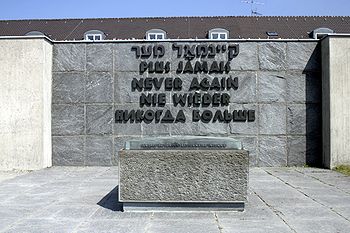
Dachau concentration camp, outside Munich, Germany

Dauchau memorial

“Never Again” memorial, Dachau. Photo courtesy wikipedia commons

Background: Dachau was the first Nazi concentration camp established in Germany, described as a camp for political prisoners. It opened in 1933, 51 days after Hitler came to power. It was in operation for 12 years and recorded 206,206 prisoners and 31,951 deaths–like all the numbers associated with Nazi death camps take these with a grain of salt.  The American forces that liberated the camp were so shocked at what they found–and by local residents’ claim that they knew nothing about the camp—that they made the residents clean it up.

Preservation: A walk through the preserved site is like walking through a cemetery while the spirits call out to you. There is a memorial and a museum. The foundation of the barracks are left. A short walk from the barracks and the parade ground is the crematorium. One oven was sized for children and is a sight I’ll never forget.

Lesson: Man’s inhumanity to man is a sledgehammer blow of a lesson when you see Dachau. Everyone who walks through here understands it at a visceral level. But genocide endures nonetheless.

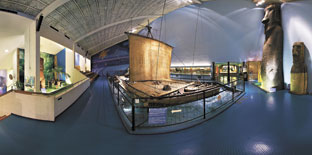
Kon-Tiki Museum, Oslo, Norway

Kon tiki museum photo

The Kon-Tiki raft. Photo courtesy the Kon-Tiki Museum

Background: In 1947, a young Norwegian anthropologist named Thor Heyderdahl set out to prove his theory that ancient pre-Columbian peoples traveled across the Pacific from South America to the Polynesian islands. Using only the materials that would have been available to those ancients, he constructed a balsa raft called the Kon-Tiki. Together with 5 others, he sailed it for 101 days across 4300 miles from Peru to the remote Tuamotu islands, proving his theory that such travel voyages showed that “early man had mastered sailing before the saddle and wheel were invented.”

Preservation: The Kon-Tiki raft is now in a fantastic museum in Oslo, Norway, together with another Heyderdahl raft called Ra. His archives at the Kon-Tiki Museum are part of UNESCO’s Memory of the World registery.

Lesson: This raft and its journey hardly seem to be an example of scary historic preservation until you consider the implications of Heyderdahl’s theory. Ancients travelling the globe in pre-Columbian times, settling and spreading their seeds in far-flung places means that we could all be a lot more related than we think. And that is a scary thought to many.

Arizona Battleship Memorial, Pearl Harbor, Hawaii

Pearl Harbor memorial

Arizona Memorial. Photo courtesy wikipedia commons

Background: On 7 December 1941, the day that will live in infamy, Japanese imperial forces attacked the US naval base at Pearl Harbor. Waves of aircraft bombed battleships sitting at anchor, destroying much of the US’s naval power. On the USS Arizona alone, 1,177 crew members died, making it the greatest loss of life on any U.S. warship in American history.

Preservation: In 1961, a floating monument was erected over the sunken USS Arizona. Visitors can peer through the glass floor and see the mid-portion of the sunken battleship. I remember being embarrassed that I’d worn high heels; it seemed indecent that my feet should click against the watery graves of so many men. The 184-foot long Memorial also has an area called the shrine room, where the names of those killed on the Arizona are engraved on the marble wall.

Lesson: The Memorial is a powerful reminder of the havoc wreaked by war. It cautions us not to forget those who sacrifice.

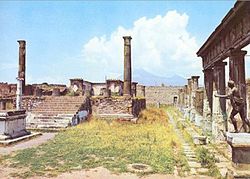
Pompeii, near Naples, Italy

Pompeii in sun

Ruins at Pompeii. Photo courtesy wikipedia commons

Background: In 79 AD, the cities of Pompeii and Herculaneum were destroyed and buried under 13-20 feet of ash and lava when nearby Mount Vesuvius erupted. It is hard to know how many people died that day but Pompeii was thought to have been a large and thriving agricultural town. The eruption, which lasted 12 hours, ironically occurred the day after the feast day of the Roman god of volcanoes.

Preservation: The ruins of Pompeii were discovered in 1748. One of the archaeologists supervising the ash removal devised a way to inject plaster into the bodies found, preserving their death agonies as they were incinerated or died from smoke inhalation. As I walked around the large site in Italy’s August heat, marveling at the amphitheaters and well-constructed homes, it was easy to think of hot ash raining down and to realize how much had been lost.

Lesson: Nature does what it will and we must respect and adapt to it. As the climate change debate goes on and we deal with unexpected droughts, tornados or snow in places that ordinarily don’t see these weather phenomena, perhaps it is a good time to consider that the people of Pompeii probably though they had the god of volcanoes well in hand.

You may also like

historic preservation

Friday Fiesta: Saving the Food Chain, A Language, Literary Thought and Your Self-Esteem

dog with sifesaver

As the author of a mystery series I love to weave unique cultural gems into the plot. Most of the time I draw on my own world travels and experiences living in Mexico and Central America.

In these Friday Fiesta posts I highlight cultural stories worth celebrating. The unique, the odd, the thought-provoking. Join the movement and share your stories on Twitter with hashtag #FridayFiesta.

The Fish at the Bottom of Your Food Chain

The Peruvian anchovy, known as anchoveta, lives at the bottom of a global food chain you probably have never thought about. According to AP, the little silver fish “thrives in the cold, plankton-saturated Humboldt Current along the coast of Peru and Chile and accounts for about a third of the global fishmeal industry used to fatten farmed seafood and livestock, from salmon in Norway to pigs in China.” But due to overfishing, the anchoveta population is about half what it was 10 years ago. That’s a serious concern for people who know what a food chain is and Peru is taking action by setting quotas, levying fines for illegal harvesting, and making the fish more accessible to its own population to combat childhood malnutrition. Paul Phumpiu, Peru’s vice minister of fisheries, framed the situation: “It’s a paradox, having a resource so rich that it feeds other parts of the planet but barely reaches Peruvians.” A little fish with a big job, it seems.

Saving the Language of Jesus

Writer Ariel Sabar recently followed scholar Geoffrey Khan of the University of Cambridge through Chicago in his quest to find speakers of pure Aramaic, the 3,000-year-old language of Jesus. Aramaic, the language in which Jesus uttered his last words, is down to its last generation or two of speakers. Khan looks for “elderly folk who had lived the better part of their lives in mountain enclaves in Iraq, Syria, Iran or Turkey” and records those whose language skills have not been diluted by slang or dialects. His work is “an act of cultural preservation and an investigation into how ancient languages shift and splinter over time.” This terrific article, published in The Smithsonian, is beautifully researched and written.  I loved this line: “the sounds of a language in twilight.

Be Proud, Get a Badge

Lifescouts.org is an online social community of people who share life experiences and get real badges for those experiences. You can join the social community and store the story about how you earned a certain badge like Sky Diving, Haunted House, Swimming With Dolphins, etc. More are added every month. Each Lifescouts badge costs 3.00 BPS and comes as a round enamel pin. I love Lifescouts for two reasons: 1. Find other folks who have similar experiences and 2. My daughter realized that she’s accomplished more than she sometimes gives herself credit for. A couple of little pins is a terrific reminder of our Small Victories. And some big ones, too.

A Literary Festival in Myanmar. Really

Myanmar recently held its first literary festival, the Irrawaddy Literary Festival. As reported by Publishing Perspectives, it drew “thousands of attendees attracted by the opportunity to hear speakers ranging from Vikram Seth, Timothy Garton Ash, William Dalyrmple, to the festival’s patron, Nobel Peace Prize winner and worldwide icon for democracy, Aung San Suu Kyi.” It was organized by the wife of the British ambassador to Myanmar, Jane Heyn who saw opportunity in the country’s recent loosening of censorship. Two years ago, such an event—attended by previously jailed writers and others who once had to hand out their works in secret–would not have been possible. While creatives still must tread carefully in Myanmar, the literary festival was “a platform to exchange ideas,” according to Heyn. That can only be a good sign.


The Best and Other Interview Questions to Ask a Mystery Writer

There are certain interview questions to ask someone who has just published a novel in a mystery series. And other questions that are sort of odd. Here are the ones I’ve been asked lately.

1. Why did you write it?

Cover of Cliff DiverI wrote Cliff Diver: An Emilia Cruz Novel because current events in Mexico don’t make it to the top news stories for big media outlets in the US, despite the fact that over 60,000 people have died there in the past 5 years amid the ongoing violence. US news stories are more concerned with domestic politics, the Middle East, and Lindsay Lohan. And, of course, the Kardashians. If news stories on Mexico do make it to prime time, they are viewed in the context of the US national debate on immigration. The real story—the toll that the drug wars is taking on the people and culture of Mexico—stops at the border.

Oh wait—there was the story about a Mexican snack food company’s trucks being targeted by cartels. That made it to the US news. Danger to snack food manufacturing is important.

Interview questionsBut seriously. Martin Cruz Smith’s Arkady Renko books gave US readers an authentic glimpse inside Russia, creating interest and an awareness that hadn’t been there before. I’m hoping that a contemporary mystery series can do the same for Mexico. The reviews for my 2012 political thriller The Hidden Light of Mexico City–a story from the heart that took on both Mexico’s rigid social system and the corruption that flows from huge drug profits–made me sure that contemporary fiction can ignite popular interest in what is happening in Mexico better than the news.


2. Who should read it?

When I first started writing, I thought my target readers were the women I’d met in Mexico City; smart, educated women who had jumped into the expatriate lifestyle with both feet, ready to learn new things and assessing and adjusting as they did so. But I’ve been happily surprised by the number of men who read The Hidden Light of Mexico City and liked it.

That’s a long way to say that my readers are those who like

  1. Clever, intricate plots
  2. Real characters who experience change and cope with it
  3. Creativity that stems from current events, history, real places
  4. Books that make other cultures accessible to the reader

3. What is it about?

Cliff Diver launches the Emilia Cruz mystery series, introducing an intriguing cast of characters, and putting the reader squarely into the complicated and conflicted world of an honest cop in Mexico. Emilia Cruz is Acapulco’s first and only female police detective so not only do the books have the usual elements of a mystery series—crime, investigations, evidence, clues, etc—but she also has to navigate her way through Mexico’s culture of machismo.

In Cliff Diver Emilia is forced to lead the murder investigation into the death of her shady lieutenant by a union boss with questionable motives. She faces resentment from the other detectives as well as a blood-spattered crime scene, no witnesses, and the shadow of counterfeit ransom money. Missing police files, the lieutenant’s involvement with a past kidnapping, and a possible link to a gang working for a drug cartel further combine to make this a messy case with too many loose ends.

Expecting to become a target herself because of her own brush with the lieutenant’s counterfeit scheme, Emilia must move quickly to find the killer. But as she pieces together the lieutenant’s last hours, she becomes a pawn in an ugly game of corruption, money, and power being played by Acapulco’s mayor (love this character, think a haughty Salma Hayek at her scornful best) and the union boss. Luxury hotel manager Kurt Rucker has some advice for Emilia but the heat between them quickly becomes a complicating factor. He’ll be back in other Emilia Cruz books.

4. I love mystery series. Tell me more.

Cartels and corruption aside, lots of the tension in the Emilia Cruz series stems from relationships between people. Acapulco’s ambitious mayor and the police union boss who complicate the investigation in Cliff Diver will make return appearances. Emilia’s mother, and the strays she takes in, will keep Emilia’s personal life off balance, as will American hotel manager Kurt Rucker. To keep things fresh, Emilia will have a different lieutenant in each novel.

5. I love Mexican food. What do people eat in the Emilia Cruz books?

Er, well. Acapulco is on Mexico’s Pacific coast so seafood is popular. In one scene in Cliff Diver, Emilia and her partner Rico eat at a seafood lunch bar:

Both had plates of rice, salsa, and pescado empapelado; marinated fish wrapped in foil and grilled by the sweaty proprietor. Emilia pulled apart the foil packet, taking care to keep her fingertips away from the billow of lemony steam. The whole fish lay nestled inside the packet, fragrant with citrus and tomato, the fish’s mouth open wide as if in surprise.

In another chapter Emilia eats ceviche—pickled fish–and avocado from a glass jar at a street stand. Her mother makes tamales and Emilia cooks arroz rojo.

6. What are your favorite lines from the book?

 A minute later Rucker was standing by her desk, sweat beaded on his forehead. The starched collar of his shirt was damp.

   “There’s a head,” he said breathlessly. “Someone’s head in a bucket on the hood of my car.”

***

     Silvio fired his gun into the ceiling and everyone went silent. A large overhead fluorescent light made a sizzling noise and went out.

     “No doubt Lieutenant Cruz has something to say to us,” Silvio said mockingly.

***

     “You’re a good cop, Cruz,” Salazar said. “The kind that die young.”

     He stood and turned his back on her to look at something on the other side of his desk.

     A paper shredder ground out a symphony as she left.

7. Do you really know anything about Mexico or Acapulco?

  • Mexico’s new president Enrique Peña Nieto was inaugurated on 1 December 2012 amid charges of  major voting day irregularities, claims of vote buying, and media bias. You can find him on Twitter @EPN.
  • At La Quebrada, Acapulco’s famous cliff divers plunge 136 feet (41.5 meters) into the Pacific and land in water only 9.5 feet (2.9 meters) deep.
  • Mexican government documents estimate that 25,000 people are missing as a result of drug war violence over the past few years.
  • I used to live in Mexico City and blog about my experiences now and then.

8. Tell us some fun factoids about writing a mystery series

  • I read 4 newspapers every day, plus regularly surf 3-5 websites that give me information about Mexico.
  • I use painter’s tape to post notes above my desk. Looks messy. But nothing falls off.
  • Sometimes I take a break and write about my dog.
  • All mystery series writers drink copious amounts of coffee. I am no exception.

9.  Where can I read an excerpt of Cliff Diver?

Here you go. Enjoy!

Cover of Cliff DiverBuy CLIFF DIVER on amazon.com today! 

You may also like

Friday Fiesta: An Artist, An Astronaut and the Unexpected in Nepal and on Kilimanjaro

globe on a plateAs the author of a mystery series I love to weave unique cultural gems into the plot. Most of the time I draw on my own world travels and experiences living in Mexico and Central America.

In these Friday Fiesta posts I highlight cultural stories worth celebrating. The unique, the odd, the thought-provoking. Join the movement and share your own good news stories on Twitter with hashtag #FridayFiesta.

Meet Mr. Fabulous

In a guest post for abduzeedo.com, the avant-garde art site, Brazilian artist Marco Torres interviews a fellow artist known as Mr. Fabulous. The Q&A about his evolution as an artist and sources of inspiration is quirky and fun, as well as surprisingly thoughtful. Mr. Fabulous makes art with simple markers and pencils. The rest of the abduzeedo site is equally fun; it’s a prescription to end the winter blahs and boost creative inspiration.

Art from an astronaut

Canadian astronaut Chris Hadfield photographed Earth from the International Space Station and posted them on Twitter. UK’s The Telegraph pulled a selection of Hadfield’s photos of Earth to create a gallery of Hadfield’s best on the publication’s website. Breathtaking and crisp, these photos of Earth truly give us a new perspective on this place we call home as well as Hadfield’s own experience as an astronaut.

Zipping in Nepal

Backpacker Becki is a self-described “a British solo female traveler and adventure seeker” and her website lives up to the description. She is currently on a two year tour of parts unknown and documents the highlights such as her zipline adventure in Nepal. She writes that the zipline near Pokhara is the world’s longest, fastest and steepest. It is over 1.8km long, with a 600 metre vertical drop that gets riders going at speeds up to 100 miles per hour. Unlike most other ziplines the rider sits in a harness foor the ride which swings over the Seti River. The pictures are great and while Becki admitted to being nervous, she clearly adored the adventure! While I envy Becki the experience, I’m glad it was on her bucket list, not mine!

The Kilimanjaro Restaurant Experience

It you have a bit of time mid-month, join a tour to Tanzania that includes an expedition to Mt. Kilimanjaro, a stop at a gourmet restaurant on the way down the iconic peak, and two days volunteering at a local school. According to website weblogtheworld.com, “Departing February 18, 2013, from Washington, D.C., this one-of-a-kind trek up Africa’s highest mountain boasts an amenity that no other tour provider offers: a gourmet feast prepared by African Chef Pierre Thiam, who will open a temporary restaurant at a base camp at 12,500 feet above sea level exclusively to celebrate the fund-raising climb. After summiting Mount Kilimanjaro via the scenic Machame route, climbers will descend to the base camp restaurant to dine on Chef Thiam’s African regional cuisine.” The core purpose of the expedition is to benefit St. Timothy’s School, a school and children’s home, and the climb and gourmet experience are great ways to generate interest. So if Kilimanjaro is on your bucket list, here’s the best way to do it!

3 Latinas Who Inspired Fiction’s Newest Crimefighter

3 Latinas Who Inspired Fiction’s Newest Crimefighter

Police detective Emilia Cruz is the main character in CLIFF DIVER, the first novel in my new mystery series set in Acapulco. She’s the first and only female police detective in Acapulco, a strong Latina woman who knows the value of family, how to fight for what she wants, and how to hold her own in a squadroom full of male cops who don’t want her and are still trying to break her.

These qualities were inspired by three real-life Latina women whose stories provide inspiration, not only to lovers of mystery series, but for us all.

Marlen Esparza

Marlen Esparza from Vugue magazine

Marlen Esparza photo courtesy of Vogue.com

Known For: Bronze medal winner for women’s boxing at the 2012 London Olympics, as well as 6 US national championships, a gold medal at the 2008 Pan Am Games, and a bronze medal at the 2006 World Championships.

Qualities That Matter: As Esparza’s talents moved her from her Houston neighborhood and into the international spotlight as the first US female Olympic boxer, she hasn’t lost her connection to her roots. In an interview with USA Today’s Hispanic Living magazine she said that when she came home after London, “I realized for me, it was about the gold medal, but for other people it wasn’t about the gold medal. It was how I made something out of nothing.”

Emilia Cruz learned to fight as a young girl as well, tagging along with her male cousins. Her skill lets her defend herself and blow off steam by kickboxing. It also helped her climb the police ranks.

Quote: If you really know…what you want and how to get there, then everything else really falls into place. (Cosmopolitan Magazine)

America Ferrera

America Ferrera 2012

America Ferrera photo courtesy of examiner.com

Known For: Her award-winning role as Betty Suarez in the series Ugly Betty and movies such as The Sisterhood of the Travelling Pants and 2012’s cop thriller End of Watch. In addition to her film work she’s an advocate for Voto Latino.

Qualities That Matter: Onscreen, Ferrera is fierce, able to project true depth of emotion. The scene in the first The Sisterhood of the Travelling Pants in which she sobs out pent-up anger to her father over the phone is a riveting piece of acting. She perfectly captured the gritty cop vibe in End of Watch; the movie’s prep included police academy training and rode with LA cops. Despite her success she comes across in interviews as friendly, normal, and happily resistant to Hollywood elitism.

Emilia Cruz has that same combination of toughness, emotional vulnerability, and frankness.

Quote: On being a producer and creator: It takes you away from that whiny, “Why aren’t there any roles for me?” place to “I’m going to create a path that feels right to me.” (Jezebel magazine, 11 Feb 2010)

Justice Sonia Sotomayor

Judge Sotomayor

Justice Sonia Sotomayor photo courtesy of biography.com

Known For: First Hispanic judge on the US Supreme Court. Author of memoir, My Beloved World.

Qualities That Matter: Justice Sotomayor doesn’t give up when the going gets tough, as she’s described in interviews about her college experience. Not only was she very much a minority at Princeton, but she struggled with college-level writing skills in English, her second language. She attacked the problem directly, asking professors what was wrong with her papers and taking classes with professors who could help—even if they were tough teachers. An admittedly stubborn person, in an interview she recently said that she has a “personal need to persevere, to fight the fight. And if you just try and be stubborn about trying you can do what you set your mind to.” (Interview with Scott Pelley, CBS News, 13 Jan 2013)

Emilia Cruz has to be tough in the same way. If she backs down, she won’t achieve her goals. Or respect herself. But it means she’s often in opposition to powerful forces in Mexico: corruption, cartels, and a culture of machismo.

Quote: Don’t ever stop dreaming, don’t ever stop trying, there’s courage in trying. (Bronx Children’s Museum gala, quoted by CBS News, 11 Jan 2013))

You may also like

Latinas who inspired

Pin It on Pinterest