Every year, I calculate which books in the Mystery Ahead newsletter were most popular with readers. The top books of 2023 were clicked on the most out of the 75 books featured in the newsletter this year.
One of my books claimed the top spot (not always the case!) followed by 2 sensational mysteries that are each part of a series but can be read as standalone novels.
Without further intro, here are the top 3 books Mystery Ahead readers loved this year. (All make great holiday gifts 🙂
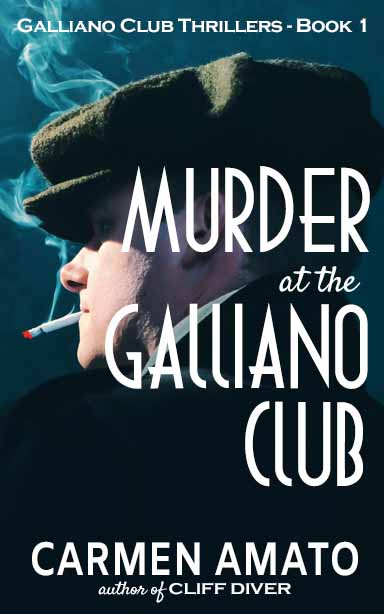
In 1926, thanks to Prohibition, it’s hard to find a beer in Lido, New York. But trouble is always on tap at the Galliano Club in this explosive start to the riveting Prohibition-era historical fiction crime series.
Winner, 2023 Silver Falchion Award for Best Historical
Social hub for the Italian immigrant community, the Galliano Club serves bootleg beer and Luca Lombardo’s signature sandwiches to workers from the city’s copper mills. The club means everything to Luca, who arrived in Lido with nothing left to lose.
He’ll do whatever it takes to keep the club afloat, even staying silent about a murder in the alley behind the building.
From her second-floor window, Ruth Cross witnessed the murder, but a scandalous past keeps her quiet.
Could gangster Benny Rotolo be involved? Run out of Chicago by Al Capone, he fled to Lido with a gun in his pocket and plans to establish his own bootlegging empire. He wants to turn the Galliano Club into his private speakeasy.
It’s hard to review my own books so here’s what Jim Nesbitt, author of the Ed Earl Burch series, had to say:
The book opens with what should be an un-adulterated moment of triumph for the working stiffs crowding the club and their cross-town Polish co-workers at the Lido Premium Copper and Brass Rolling Mill . . . In walks Jimmy Zambrano, mill foreman, shaking hands like a politician. He jumps up on the table to deliver a message from the bosses. The deal was done, the men would get their bonus money. But not all at once. It would be paid out across three days, in alphabetical order.
An uproar ensues . . . Cooler heads prevail and help Zambrano sell the payout schedule, including Luca Lombardo, [Vito] Spinelli’s right-hand man and club manager.
The party cranks back up and keeps rolling until closing time.
Less than an hour later, Lombardo steps outside the back of the club and finds Zambrano’s body partially stuffed under the frame of Vito Spinelli’s Packard. The dead foreman has been garroted with copper wire that bit deeply into his neck.
That shifts the story into overdrive. Murder, blackmail, rum-running, intrigue and double-crossing treachery introduce a cascade of characters, including crooked Irish cops, a Chicago fugitive from Al Capone’s gunsels, a larcenous blue-blood wannabe mill accountant, a fallen Broadway chorus girl with a horrible secret and a vivacious Irish bank employee who steals Lombardo’s heart.
Splicing this all together is Amato’s knowing eye for detail and intuitive feel for the temper of the times, the class divisions and the clannishness of immigrant communities struggling to make it in America.
Earning more than Welcome to Stockholm, Sweden and the outstanding Annika Bengtzon series! I actually picked up this book because of the very cool cover and was immediately hooked, so much so that I found all the rest of the books in the series and absolutely devoured them.
Annika Bengtzon is an investigative reporter for Sweden’s #1 tabloid newspaper. She is a young mom with two kids, a faithless husband (who gets his comeuppance later in the series) and a big load of emotional baggage from having been trapped in a tunnel with a murderer on her last assignment.
Her new assignment is a retrospective on a 20-year-old terror attack on a Swedish air force base near the Arctic Circle. No one was ever found guilty. She heads up there to interview a local journalist who claims to have new information. When she gets there, he’s dead.
More murders follow, including that of a teen who might have seen the man who killed the journalist. Each murder is accompanied by a strange snippet of an essay, which eventually leads Annika to the Communist student clubs that flourished in Sweden in the 1960’s and 70’s. Some of her information comes from Q, the head of Sweden’s national crime squad, a shadowy figure who feeds her tidbits in exchange for what she’s found out.
What I loved about this series is Annika’s deep point of view and the ongoing sense of the character’s life from one book to the next. We are really inside her head, experiencing the highs and (mostly) lows of the investigation, newsroom politics, and her disintegrating marriage. Other points of view function as a supporting cast, including husband Thomas whom we love to hate, and perpetually harried editor Anders. Later in the series, author Marklund introduces a female cop who becomes both rival and friend, and her point of view becomes important as well.
I really got caught up in the series, in which crimes and characters from one book bleed into the next, almost as if Marklund wrote one enormous tome, then cut it into manageable books. You also get a great view of life in Sweden and its social conventions and norms, not to mention the biting cold when the action moves to the Arctic Circle.
For whatever reason, the series is misnumbered on Amazon and the book covers are not cohesive. But don’t let that stop you from enjoying this best-selling Swedish series, which was made into the Swedish-language television show Annika Bengtzon Crime Reporter (Not to be confused with Annika, starring Nicola Walker as head of a UK Marine Homicide Unit). It is exceptional. https://geni.us/redwolf
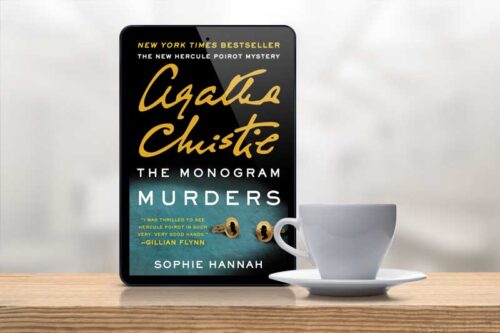
Mystery fans can’t get enough of Agatha Christie’s fussy Belgian detective (cue Kenneth Branagh, please!) and THE MONOGRAM MURDERS shows why. The new Hercule Poirot books by Sophie Hannah are spot-on, capturing the style and personality of the original books right down to Poirot’s tendency to speak of himself in the third person, identify the most obscure clues and solve multi-villain crimes.
Three people are found dead in a swank London hotel. They have all been poisoned. Two women and a man are each found in their respective hotel room, prone body positioned toward the door, and a monogrammed cufflink in the mouth.
What do the initials PIJ stand for?
Edward Catchpool, a young Scotland Yard detective, is assigned to the case. Poirot, who is taking a sabbatical of sorts by staying in the same boarding house, accompanies Catchpool to the scene of the crime. Catchpool, who deals with an inner struggle regarding the bodies of the dead, becomes Poirot’s foil and sounding board. Poirot delights in the role of teacher, making many clever (and correct IMHO) observations about human nature as they investigate.
The crime traces back to an old scandal in little village. As in so many Poirot tales, the final denouement reveals complex connections. Red herrings are ultimately complicit in the crime. The ending was impossible to guess! Only Poirot or an encyclopedia would know the tiny details that lead to certain supporting conclusions.
You almost need to graph out all the twists and turns to make sure you didn’t miss anything.
I loved the way the novel set up the crime, with clues that appear impossible to reconcile. What happened to the room service food? How did the killer escape? Why was one victim’s room key hidden behind a loose tile? Why did the waiter lie? The crime is tantalizing and the pages flew by.
Yet after so much brilliance, the last quarter of the novel moves at a glacial pace, with chunky dialogue in which the crime is picked apart and Poirot explains far too many extraneous bits of investigative genius.
But if you love Agatha Christie, Poirot’s return is “can’t miss” reading. So far there are 5 Poirot mysteries by Sophie Hannah, all incredible brainteasers like THE MONOGRAM MURDERS.
When it comes to online shopping, it can be hard to find that unique something special for someone special. But I’ve done the hard part, scrolling and sifting to find gifts for the mystery book lover in your life.
With winds of up to 165 mph, Category 5 Hurricane Otis tore through Acapulco in late October, leaving a trail of unprecedented devastation.
It strengthened so quickly there was little time to prepare for the strongest storm to ever hit Mexico’s Pacific coast. In just a few hours, Otis left Acapulco in shambles, changing the iconic tourist destination into a water-logged war zone. At last count, 39 people are dead.
Before the storm, Acapulco was already staggering under the weight of one of the highest homicide rates in the Western Hemisphere, high poverty, and a sagging tourism industry.
Can it recover from Hurricane Otis?
Maybe the bigger question is what will the region’s powerful organized crime cartels do now?
I chose Acapulco as the setting for the series for three reasons:
Stunning backdrop:Acapulco is undeniably one of the most beautiful places on earth, with its horseshoe-shaped bay and mountain backdrop.
Familiarity: Most readers instantly recognize the name of the city. It’s been an iconic destination for generations.
Have vs have-nots:I knew that social and economic factors could be a source of tension (something you always want to build in a mystery) for the character of Emilia Cruz.
The series explores the two faces of Acapulco; the one that tourists see made up of glittering water, white skyscrapers, luxury hotels and fabulous nightclubs. Then there’s the other face of Acapulco–street gangs, endemic poverty, crooked cops. The port is a drop zone for incoming shipments of fentanyl precursors from China and a drug distribution route into the United States.
The Detective Emilia Cruz series doesn’t flinch when addressing the impact of organized crime in Acapulco including missing persons, cartel rivalries, and widespread official corruption.
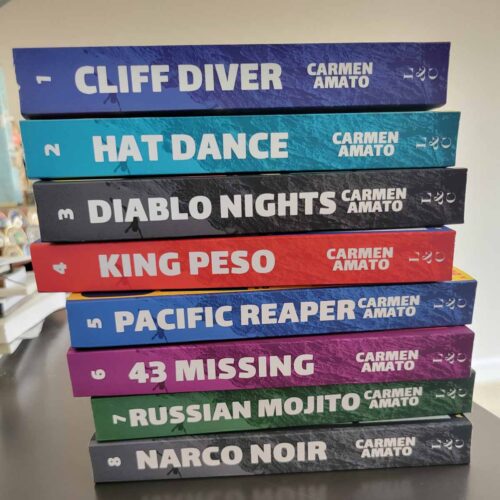
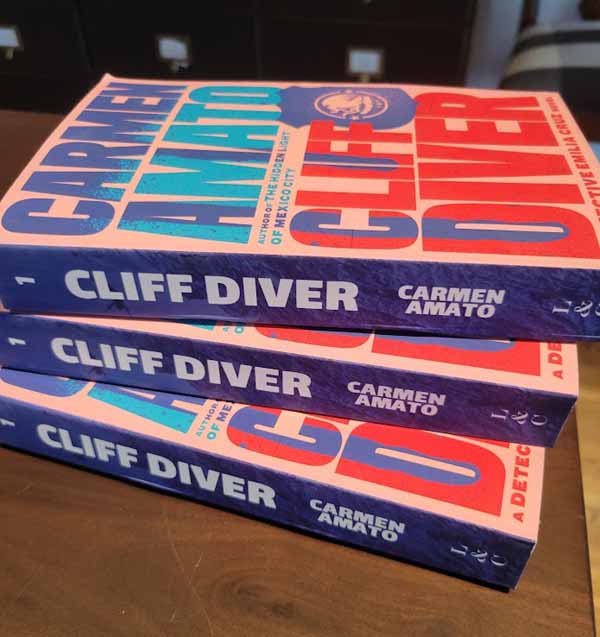
Detective Emilia Cruz mystery series set in Acapulco, books 1-8
Sometimes the series can be a little too authentic, but I’m following the old adage of write what you know.
The picture-postcard row of iconic white beachfront skyscrapers were flayed; their skeletal framework exposed after walls and windows were torn away. Mexican President Andrés Manuel López Obrador lamented the loss of every electrical pole. The main highway along the Pacific coast was battered. The Acapulco airport closed. The Mexican National Guard is there now. and about 10,000 members of the military have been sent to help.
An initial estimate put total losses at $15 billion, according to the Reuters report. Yes, billions.
The famed view of Acapulco’s skyline around the bay, before Hurricane Otis.
The aftermath (and opportunities) for organized crime
The aftermath of Hurricane Otis almost certainly will provide violent plot lines for the Detective Emilia Cruz series.
Organized crime has a history of exploiting vulnerabilities and crises. The aftermath of Hurricane Otis is unlikely to be the exception.
Here’s how criminal entities could use the chaos and destruction left by the hurricane to extend control:
Disrupt Law Enforcement
As military and law enforcement prioritizes disaster response and recovery, organized crime elements will be working overtime to reestablish their own supply routes and communication links. The two opposing forces will be after the same resources in short supply, potentially leading to violent clashes when the city can least afford it. Criminal alliances may shift as deals are made to oppose law enforcement and access supplies.
Exploit New Vulnerabilities
Despite the glitz of Acapulco’s waterfront, the state of Guerrero (where Acapulco is located) is Mexico’s second poorest. https://www.worldatlas.com/articles/the-poorest-states-in-mexico.html
Neighborhoods that were already home to grinding poverty and rival street gangs are now even more ripe for exploitation. Organized crime organizations, flush with money from drug sales, extortion, kidnappings and other illegal operations, can extend their territory and influence by offering financial support. They may offer aid in exchange for protection, cooperation, and information.
Recruit
The destruction of so many hotels and residences mean thousands are without shelter in Acapulco. Cartels can infiltrate these displaced communities, offering security and services that the government or private charities don’t provide. New members join because they see the government as ineffective, understand that working for a cartel means their family can eat, or need the sense of belonging offered as a way out of the chaos. Basically, by offering economic incentives or promises of protection, organized crime groups can swell their ranks during times of crisis. They might use these communities as cover for their operations, too.
Corruption and Infiltration
The uncertainty following a hurricane can provide an opportunity for cartels to corrupt local officials or even infiltrate emergency response organizations. This allows them to manipulate relief efforts to their advantage and further their control and potentially even seize control of vital resources such as food, water, and medicine. By controlling distribution, they can manipulate and exert influence, possibly even making deals with officials to allow vital resources to get through to populations in dire straits in return for favors, influence, territorial access, the proverbial blind eye, etc.
Exploit Rebuilding
As Acapulco rebuilds in the hurricane’s aftermath, cartels will want to influence construction and development projects. By controlling contracts and decisions related to reconstruction, they can launder money, invest in legal businesses, and expand their economic assets. The construction business is a known vehicle for money laundering and it will be interesting to see how, when and to whom such contracts to rebuild are awarded.
Bottom line
The factors that led to Acapulco’s high poverty, homicide and violent crime rate will all intensify in the aftermath of Hurricane Otis. Organized crime will seek to exploit the situation and will probably be successful, depending on the government’s effectiveness in restoring services and supporting the city.
It’s crucial for the Mexican government and international organizations to provide swift and effective disaster relief, enhance security measures, and address the socioeconomic factors that make communities susceptible to cartel influence.
Unfortunately, with claims that the destruction is being overestimated by his political rivals, President López Obrador is already being accused of gaslighting the public.
New favorite series alert! Sheriff Ty Dawson solves murder and corruption cases in must-read police procedural RECKONING by Baron Birtcher.
Dawson joins Walt Longmire and Cork O’Connor as lawmen whose investigations are driven by a personal code of honor and the strength it takes to live and prosper in rural places. RECKONING is the long-awaited next book in Baron Birtcher’s police procedural series that takes place in Oregon in the 1970’s.
With author Baron Birtcher at the Killer Nashville international writer’s conference.
A rancher as well as a lawman, the suspicious death of a city cop in an abandoned resort puts Dawson at odds with power players in Portland. Meanwhile, a federal agency attempts to block a fellow rancher’s access to water. Both high-velocity issues take Dawson down roads littered with deception and false friends.
As the two investigations converge, Dawson finds himself practicing shuttle diplomacy, yet cannot trust anyone at the table.
The story moves briskly, propelled by crackling dialogue and descriptions that engage every one of the reader’s senses. More than any other writer I’ve read, Birtcher delivers a powerful sense of smell; it’s uncanny how this draws the reader into the scene.
There’s more corruption in 1970’s Oregon than you expect, and RECKONING delivers multiple shades of gray when it comes to those looking to grab what they can get, including a couple of really grasping cops you can’t wait for Dawson to outsmart.
Like Longmire and O’Connor, Dawson cannot prevent bad things from happening, but he can coax justice out of hiding.
Evocative writing, a human-sized hero, and a well-told story full of intrigue.
Now and then, you stumble across a series that is simply captivating and you have to inhale one book right after the other.
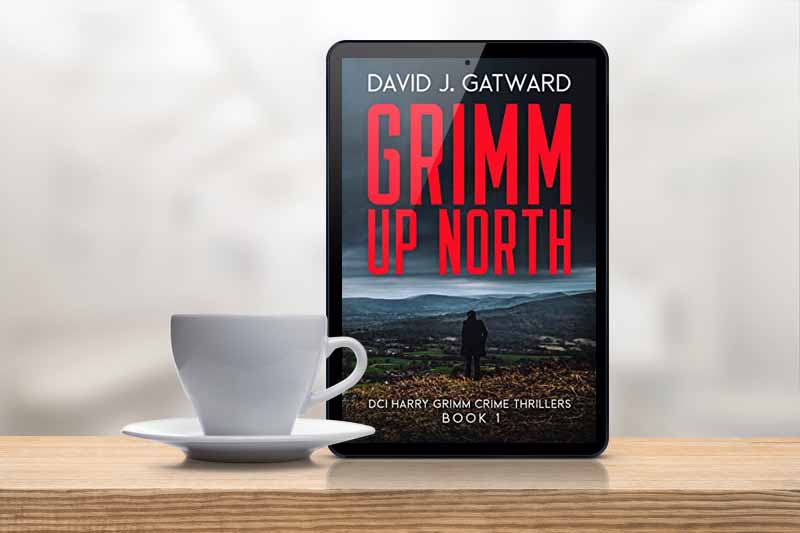
The DCI Harry Grimm series set in the Yorkshire dales, is that kind of addictive series. GRIMM UP NORTH is the first and a terrific introduction to the character as well as the place.
Harry Grimm’s face was rearranged by an IED in Afghanistan when he was an elite British paratrooper. Years later, he’s a senior detective in Bristol, his hometown, handling investigations his own way. Not only is he a bit heavy-handed, he’s bent on showing every criminal he comes across a photograph of his father who 20 years ago killed Harry’s mother and messed up his baby brother. The dad was never caught but Harry’s determined to bring him to justice any way he can.
Irritated by his latest escapade, Harry’s boss bundles him north temporarily to Wensleydale, land of All Creatures Great and Small and Last of the Summer Wine. Culture shock ensues.
Part of the magic of the series is seeing the undulating rural landscape through Harry’s eyes.
Photo by Illiya Vjestica on Unsplash
His first task is to deal with reports of a missing teen girl. Of course a body turns up, half submerged in a lake popular for nighttime swimming. But the body is not the girl.
It’s up to Harry to find the connections and expose the liars, of which there are many, all while getting to know his new team and come to grips with the fact he could be stuck in the hinterlands for an extended period.
The descriptions of the landscape are so evocative, you’ll feel almost there. All the books primarily focus on the central crime, without too many distractions. While Harry’s family situation is a running subplot through this book and the ones to come, it’s not a looming presence. As a result, the books move fairly quickly, punctuated by strong dialogue, expertly drawn characters, and Harry’s growing attachment to the dales.
Highly recommended. Get GRIMM UP NORTH and all the Harry Grimm books on Amazon.
If you want more Yorkshire landscape, check out the latest film adaptation of All Creatures Great and Small starring Samuel West and Nicholas Ralph as vets Siegfried Farnan and James Herriot. The series has been on PBS, with the 4th season coming in January. https://www.pbs.org/wgbh/masterpiece/shows/all-creatures-great-and-small/
I guess he won’t have time to star in the film adaptation of my book.
Eduardo Verástegui, the impossibly handsome Mexican actor and film producer, announced 8 September on Instagram that he’s running for president of Mexico as an independent candidate. His platform is simple: “Mi lucha es por la vida, la familia y la Libertad. Neustro camino la comenzado.”
My fight is for life, family and liberty. Our journey begins.
Instagram announcement @eduardoverastegui
As of 12 September, the Instagram announcement has more than 89,000 likes and over 8280 comments, many of which call on God to bless his efforts. He’s got 905,000 followers on Instagram, 320,000 on X and 2 million on Facebook. Dedicated fans have multiple accounts across all platforms. The Milenio media group’s YouTube report of his candidacy got 37,000 views in 3 days. The Spanish-language edition of People magazine, which has followed him for years, jumped on the story, too. https://peopleenespanol.com/celebridades/eduardo-verastegui-candidato-presidente-mexico/
Perhaps not exceptional attention, but Eduardo Verástegui is just getting started on an uphill battle to be elected president of Mexico as an indie candidate from outside the political system.
His new logo is a stylized “V” against an orange background, using the colors of the Mexican flag. The V riffs on his name but also Verástegui’s signature “V for Victory” gesture, which of course reminds us of Winston Churchill. In motion, the letter cleverly twirls like clock hands, as if counting down the days to the election. His signature hashtag #junotsomosmas (together we are more) is catching on.
Squarely in the conservative camp, Verástegui was a featured speaker at CPAC events in the US, Japan and Hungary over the past year, burnishing his bona fides with global leaders. He’s credited with bringing the CPAC brand to Mexico. He is a Roman Catholic who has made a return to religious worship a cornerstone of his platform. His move follows the Mexican courts’ decriminalization of abortion, according to the Human Events blog. https://humanevents.com/2023/09/08/breaking-sound-of-freedom-producer-eduardo-verastegui-registers-to-run-for-president-of-mexico
Over the past two years, his Instagram feed has shown him with a parade of notables such as former president Donald Trump, Speaker Kevin McCarthy, the presidents of Central American countries, Pope Francis, Tom Cruise, and Spanish politician Santi Abascal. In July, he joined Donald Trump and friends for a private screening of Sound of Freedom at the former president’s golf club in Bedminster, New Jersey.
He’s traveled extensively, speaking passionately against pedophilia, human trafficking, and abortion. He champions a return to faith-based values as well as combating poverty and corruption. Crowds have gotten progressively larger and his team is doing a good job of capturing presidential-like moments when he is speaking to packed stadium-sized venues or signing pledges like the “Carta de Compromiso” against trafficking with the mayor of Lima, Peru. The Catholic faithful flock to prayer events with him, such as during a May visit to Aguascalientes.
English-language media isn’t going to make too much of his quest for the Mexican presidency and probably wouldn’t have noticed at all if Verástegui wasn’t affiliated with the Sound of Freedom movie. Of course, The Guardian couldn’t resist referencing QAnon when reporting his candidacy, resorting to clickbait keywords before discussing political dynamics in Mexico. https://www.theguardian.com/world/2023/sep/08/mexico-president-sound-of-freedom-film-producer
In outlook and personal appeal, Verástegui has much in common with Republican presidential contender Vivek Ramaswamy. Although Verástegui is more than 10 years older, both candidates have an appealing youthful energy. They’re both good looking, well spoken, comfortable before the camera or the big crowd, are motivated by religious faith, family values, and espouse strong conservative views. They both have significant grassroots support.
With Ramaswamy in the White House and Verástegui in Los Pinos, US-Mexican relations would certainly enter a new phase.
Los Pinos, the presidential residence in Mexico City. Photo via https://www.journeymexico.com/
While Ramaswamy has an outside shot at winning the Republican nomination, Verástegui is shut out of the two major parties in Mexico, both of which have selected female candidates.
Yet at the very least, Verástegui can force the major parties to address his message about human trafficking and rampant corruption. Perfectly bilingual, Verastegui’s message will resonate with Mexicans living in the US who agree with his views, especially about corruption, and wish to vote in their country’s election. The Catholic vote could also prove pivotal for him. According to The Daily Caller, “Verástegui is supported by several religious groups and the Republican Mexico party.” https://dailycaller.com/2023/09/08/eduardo-verastegui-sound-of-freedom-producer-announces-running-president-mexico/
Culture and business law commentator James Hirsen dives into Verastegui’s background and sources of support in a thoughtful essay, saying “In Mexico, Eduardo Verástegui is a household name. He’s a musical entertainer and telenovelas superstar . . . An amazing arc of success surrounds Verástegui’s life. A providential win of the presidency could be forthcoming.” https://jameshirsen.com/2023/09/11/sound-of-freedom-producer-eduardo-verastegui-offers-mexico-a-presidential-choice/
Even if he doesn’t win Mexico’s presidency this time around, it could be the start of an extended political career for the photogenic conservative.
The Mexican election is 2 June 2024. Between now and then, I expect to see the pace of Verástegui’s public appearances skyrocket. More global conservatives and Spanish-language media outlets will take notice as his campaign builds up steam.
In a curious coincidence, the book is about an upcoming presidential election in Mexico. Find it on Amazon.
Meanwhile, my dream of having Eduardo Verástegui play crime-fighting attorney Eduardo Cortez Castillo in the movie adaptation of political thriller The Hidden Light of Mexico City is on hold. Of course, maybe he’ll be available later next year.
And why shouldn’t they? His sandwiches are heaped full of tasty Italian meats and cheeses and topped with an array of mouth-watering condiments like pesto, roasted peppers and more.
You can make Luca’s creations at home, too, with the directions below!
Layer prosciutto, capicola ham, and provolone on focaccia bread split lengthwise. Add marinated artichoke hearts, thinly shaved fresh garlic, and roasted red peppers.
The Genoa
Spread a generous dollop of pesto on crusty rolls. Layer on Genoa salami and provolone cheese. Top with roasted red peppers and oil-cured pitted black olives.
The Roma
Layer sliced turkey, mozzarella and arugula on crusty bread. Top with sundried tomatoes, fresh basil, squeeze of lemon, salt, pepper.
The Palermo
Layer soppressata salami and thick slices of beefsteak tomato on crusty bread. Top with mozzarella cheese and onions pickled in red wine vinegar. Drizzle with olive oil.
The Verona
Spread a generous layer of fig jam on crusty bread. Top with slices of asiago cheese, razor-thin slices of prosciutto ham and arugula lettuce, drizzle with balsamic vinegar.
The Milano
Slice leftover meatballs; layer with pepperoni and asiago cheese on crusty bread. Top with arugula lettuce. Drizzle with oil and vinegar.
If you’d like a free PDF download of these instructions, plus more sandwich ideas, click here.
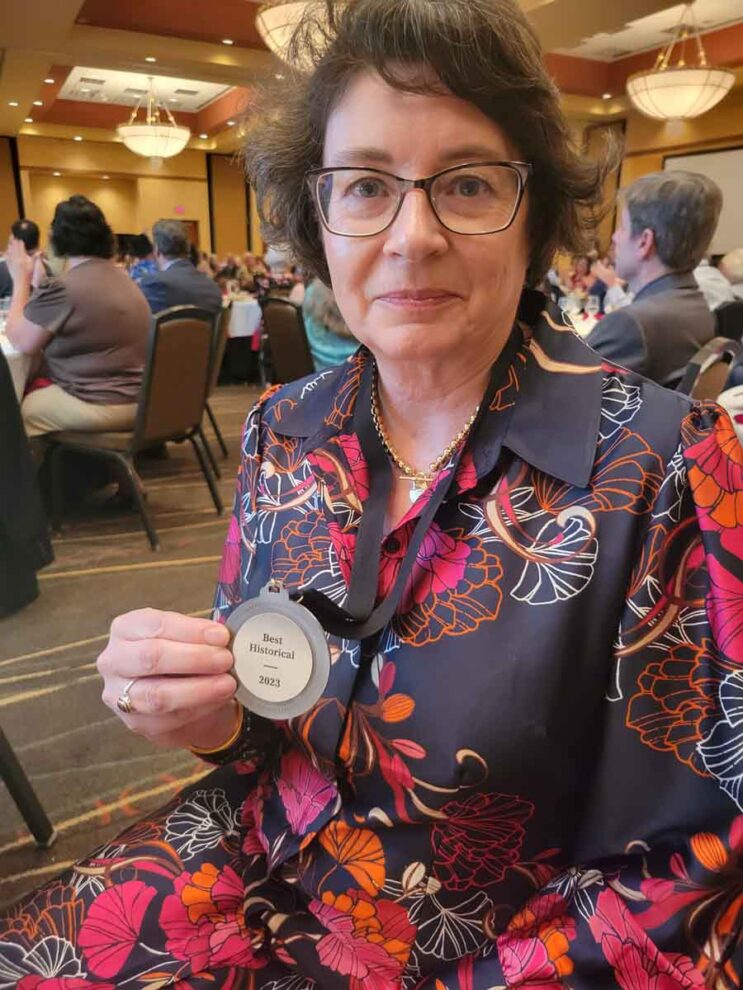
Murder at the Galliano Club, the first novel in the Galliano Club historical fiction thriller series won the Silver Falchion Award for Best Historical at the 2023 Killer Nashville International Writer’s Conference.
I’m still shell-shocked.
Wearing my Silver Falchion medal at the Killer Nashville awards dinner.
The Galliano Club series wasn’t supposed to be a major project. Just something to keep my mother Jean entertained as we endured lockdowns in 2019 and 2020.
My mother had just moved into a lovely, assisted living facility in upstate New York about 90 minutes from my three siblings. Suddenly she was confined to her apartment, no longer enjoying three-course meals in the beautiful dining room with chandeliers and cloth napkins. Gone were the group activities. No more outdoor walks, movie nights, duplicate bridge, or spirited political discussions in the library.
An extrovert, my mother has always had a morbid fear of being alone. Far too many times after my stepfather passed, she ended up in the emergency room in the throes of a panic attack. The decision to move out of her own home and to the assisted living facility was driven in good measure by that fear.
For a time, it was a good decision.
Lockdown
As New York state locked itself into panic mode, she spent hours by herself, agitated and crying. Days went by when she saw no one besides a harried staffer in a mask delivering a box of food.
As my mother’s world shrank, so did her cognitive abilities. She forgot how to operate the television remote control, often confusing it with her cell phone. She re-read the same book over and over. She mixed up her medication.
“There’s something wrong with my brain,” she’d cry angrily.
When my siblings visited, they stood below her window for a shouted conversation. But I live in Tennessee, hardly within shouting distance. The miles between us stretched into an unknown infinity of time.
I’d write historical fiction inspired by my hometown of Rome in upstate New York and the stories my grandfather told of the days when he was a deputy sheriff of Oneida County during Prohibition. To give my mother something to think about besides her lonesomeness, she could give me authentic details.
My mother Jean, circa 1965, when she was working for RCA at Griffiss Air Force Base in Rome NY.
And so every evening as she sat alone in her apartment, we had long telephone calls about her childhood. The Italian community in East Rome revolved around Saint John’s Catholic Church, the convent, and festivals. Men worked at the Revere Copper and Brass Rolling Mill, Rome Cable, and other large manufacturers. There was a handball court behind the house when she was growing up.
Her grandfather moonlighted as the bartender at the Liberty Club, his faithful black dog at his feet. Rival to the real Galliano Club across the street which had a dance studio above it, the men-only social club was an impressive sight at parades when members formed a phalanx of tricolor sashes and banners.
I asked her what the men did at the club every evening. “Drink,” she said with a sniff of derision. “And play cards.”
Making Lido
As weeks turned into months and the evening ritual went on, my mother provided the details that would build the fictional city of Lido in the Galliano Club books. Details such as Nelson’s department store where ladies’ silk stockings were sold in flat boxes. The cleanliness of Red’s Meat Market. Madonia’s fruit stand smelling like citrus and bananas. Civic band concerts. Bocce tournaments. Pastries, habits, shops, friends.
“You should put this in,” she’d say, then proceed to tell me about her grandfather butchering a pig and making blood sausage.
Eventually the pandemic lockdowns lifted but the damage was done. My mother, now 94, suffers from dementia that has robbed her of the ability to do everyday things like read, turn on her television, or remember to brush her teeth. She lives in the memory care wing of a different assisted living facility. Given that she no longer answers her telephone or will call me, we rarely speak.
My mother Jean and I on my wedding day in 1989. Poofy sleeves were in. Don’t judge. Also my bouquet looks like it is trying to eat her.
She doesn’t know that all 4 of the Galliano Club books have been published, each a gripping thriller novel in its own right. She doesn’t know that publishing distributor Ingram liked the cover of Revenge at the Galliano Club so much that the book topped a display in the company’s lobby. She doesn’t know that author, poet and educator Michael Hogan compared the writing to that of E.L. Doctorow.
She doesn’t know that Murder at the Galliano Club won a prestigious literary award.
Yet the award belongs as much to her as it does to me.
Find Murder at the Galliano Club on Amazon or your favorite online bookstore.
A CLIFF DIVER scene from Franco Silvio’s Point of View
The Detective Emilia Cruz series is written from Emilia’s point of view as the first female police detective in Acapulco. She’s got some tricky geography to navigate in that position. Not only has Acapulco become Mexico’s deadliest city for those tracking homicide statistics, due to rival cartels fighting over routes north into the US and port facilities for incoming shipments of fentanyl ingredients for China, but the lucrative drug trade has spawned official corruption and human trafficking.
Basically, Emilia lives in a pressure cooker.
But what about those who inhabit Emilia’s world with her? What about their pressures, triumphs and despairs?
Let’s go inside the head of Franco Silvio and the first major confrontation between him and Emilia. It sets the tone for their future relationship as crime fiction’s odd couple.
Enjoy!
_______________
Silvio’s thoughts punched and jabbed at random theories as he drove back to the police station. He was a boxer in the ring with a ghost. Whoever bludgeoned Lieutenant Inocente to death, then sent the body out to sea in the man’s own speedboat, was a more elusive opponent than anyone Silvio fought during his championship years.
This late in the day, traffic on la Costera was a mess. Tour buses and hotel vans lumbered in the fast lane, spewing fumes and garish advertisements to See Acapulcoby Night or rent fleabag shacks along the coast at Punta el Pesquero. Silvio swore as he rode the brake, unable to get around them.
Next to him, Fuentes sat slumped against the passenger door and kept his mouth shut, the smartest thing he’d done all day. Silvio’s young partner hadn’t exactly covered himself with glory in the abandoned water bottling plant.
Silvio glanced in the rearview mirror. In the back seat, both Cruz and Portillo were mindlessly staring outside. As if she was telepathic, Cruz glanced up and saw him watching her.
The sluggish traffic immediately had Silvio’s full attention again.
Cruz made him uneasy. Too smart. Too curious.
Too pretty. When Portillo took her on as partner, the rest of the detectives assumed he was doing her. Portillo once said that sex with Cruz would be like wrestling a bag of cats and he’d prefer not to bleed to death, but the rumors persisted, gleefully linking her with any man who wasn’t dead or on fire.
By the time they got back to the police station, the sun was a ball of fire sinking behind the stucco walls of the building. Twilight spread a purple haze over the parking lot. Silvio lifted his hand to the guard at the entry gate, drove through when the barrier lifted and swerved into his assigned spot.
Portillo and Fuentes bailed out.
A moment later, Silvio was crowding Cruz in the back seat. Before she could scramble away, he pressed the button on his key fob. The sedan doors locked with a beep.
“We need to talk,” he growled. “Why did you go to my house?”
Cruz tensed but she didn’t pull any panicky girl shit. “Who says I went to your house?”
“My wife is pretty accurate in her descriptions.” As soon as Isabel told him about the lovely young woman in skinny jeans and a denim jacket asking questions, Silvio knew it was Cruz.
Sneaking around his own neighborhood of El Roble. Looking for a weakness, something to exploit. He would have done the same.
“You called Lt. Inocente the night of his death.” Cruz gave him a hard look. “From your cell phone. Twice.”
“You think I killed him?” Silvio asked with a snort.
“You were his last known contact. Takes your call, walks out and never comes back. Dead the next morning. You don’t mention it to anybody, just let us run around trying to figure it out, knowing that we’d see the phone records sooner or later.”
“Did you tell Obregon?” It wasn’t the question Silvio intended to ask, but her answer would make all the difference.
He and Obregon had been sworn enemies for a long, long time. Was the union boss using Cruz as a proxy to take him down?
“Tell me what happened,” Cruz said, her tone hinting that she was ready to trade information.
Silvio decided to play. “I called Inocente,” he said. “Went to his place and we talked. He owned me money. He said he’d pay up in a day or so. I saw him go back into the building. He unlocked the door and went in. I went home.”
“He owed you? For what?”
“Nothing to do with you, Morelos da Gama or this water business.”
Cruz narrowed her eyes at him. “Was it a money scam? Trading drugs for counterfeit?”
“What?”
“I think you two were running a money scam. Involving counterfeit dollars.” Cruz shoved a handful of bills in his face.
Silvio stared at the money in surprise. “Where’d you get that?”
“The ransom for the Morelos da Gama kidnapping was paid in counterfeit dollars,” Cruz said. “Just like these.”
“What?” Counterfeit was a punch from outside the ring that he never saw coming.
“Is that what you were talking to el teniente about?” Cruz pressed, her voice loud and harsh inside the sedan.
“You’re accusing me of killing Inocente over some money laundering scheme?” Silvio leaned closer to her and fury pulled his lips into a snarl. “Go ahead, Cruz. Try to pin a murder on me and I’ll put you in the ground.”
A piercing siren filled the air. Silvio jolted back as he realized that Cruz had pressed the panic button on her own key fob. Two spaces away, her big white Suburban honked and flashed like a carnival ride.
The gate guard galloped up to the big SUV. Inside the sedan, Cruz banged on the window to get his attention.
Silvio hit the unlock button on his fob.
The guard wrenched open the rear passenger side door. Cruz flung herself out before silencing the Suburban. Silvio got out, too. The normal sounds of traffic beyond the razor wire-topped perimeter wall replaced the clanging in his ears.
He spoke to the guard over the roof of the sedan. “Sorry. Technical problem.”
Cruz backed against the side of the Suburban as the guard hustled back to his shack. One hand was on the driver’s door handle and she was breathing hard. “Answer my question. Why did Lieutenant Inocente owe you money?”
“I run a book,” Silvio said. It was a poorly kept secret; cops throughout the department placed bets with him. “Did it when I was suspended and just kept going. Inocente put down a bet, lost, and paid up with counterfeit norteamericano dollars. Fake, same as those.”
“When?”
“The week before. Tried to trace it with a couple of my informants but nobody knew anything. I didn’t know what to do and finally decided we had to have it out. I needed the money.” He was torn between telling Cruz to mind her own fucking business and making her understand why he needed Inocente to pay his debts.
“You needed it for Monday,” Cruz said slowly. “If you don’t get the accounts settled on Monday the kids don’t eat on Tuesday.”
So she knew his weak spot after all.
“My wife is a good woman,” Silvio said. He jabbed a finger at Cruz as she stood there by the Suburban, her face revealing nothing. “This means a lot to her. Things haven’t always been easy. She . . . she lost a lot of babies over the years. So these kids on the street . . . they’re like hers.”
“I want to believe you but you should have said something. You were the last person to see el teniente alive.”
Silvio wanted to shake the woman until that ponytail slapped her face. “I didn’t kill Inocente. You can call Obregon if you want and he’ll ruin my career but he won’t find any evidence that I killed him. I knew you wouldn’t believe me about the phone call so I just kept my mouth shut figuring we’d find the killer before the records came. Rayos, when was the last time we got phone records that fast?”
“Your story better check out,” Cruz warned.
“I just wanted what he owed me,” Silvio said. He was about to walk away when one of those phantom jabs rattled his brain. “Before you start chasing your tail, what did you say about a ransom?”
“Do you remember the day Rico and I got a reward for saving the kidnapped kid? Morelos da Gama’s kid?”
Silvio nodded.
“Counterfeit. Same as what I showed you.” Cruz fished out another fake bill.
A world of bad possibilities opened in front of Silvio. “Inocente gave it to you.”
“This hulk was full of it and somebody knew,” Cruz cocked her head toward the Suburban. “You remember that el teniente told me to take Kurt Rucker back to his hotel after he made his statement? Well, the army checkpoint was gone and we were ambushed by a truck full of shooters. We never made it to the hotel but I got us to my uncle’s garage. We took the car apart and found the money. A bank told us it was fake. So we left the vehicle on the side of the road and the next day the money was gone and the child was there.”
“Morelos da Gama paid his kid’s ransom with counterfeit? That’s this water company crap’s all about?”
“I don’t know exactly what happened,” she admitted. “The Pinkerton agent who worked for the family turned the ransom over to somebody who claimed to be Lt. Inocente. An accomplice, I guess. He was supposed to do the actual handoff to pay the kidnappers. The Pinkerton agent turned over pesos. But the ransom the kidnappers got in exchange for the child was in counterfeit dollars.”
Silvio took the fluttering counterfeit bill from her hand but his thoughts went back to the first day Fausto Inocente took charge of the squadroom. Suspicions that the smooth talker was on the take were soon confirmed. From the selective way Inocente assigned cases to his constant gambling, the signs were easy to spot. Not to mention the swank apartment, the speedboat, and expensive wife.
“So Inocente and his pal switched the money,” he said and gave back the bill. “They knew where they could get counterfeit at a discount, did a switch, and kept the real.”
Cruz gasped like she just took a right cross to the jaw. “Of course, el teniente kept the real money. Took it from the person claiming to be him, switched it for the counterfeit to pay off the kidnappers. Kept both the real ransom and some of the counterfeit to cover his gambling debts.”
Silvio enjoyed a spurt of satisfaction that he was the one to fill in the puzzle piece instead of her. “Who do you like for the accomplice? Or maybe that’s not important. Maybe Morelos da Gama found out that he was tricked and killed Inocente.”
“His alibi checks,” Cruz pointed out. “He was in Chicago with his wife and child at some hospital for amputees.”
“Maybe he contracted for the kill,” Silvio surmised. “Or maybe the kidnappers took out Inocente because they know he delivered fake cash.”
“But what about Lt. Inocente having had sex right before he died?” Cruz asked.
“Well, I didn’t bang him,” Silvio scowled.
Cruz’s mouth twitched.
“So what have we got?” Silvio decided to ignore both her almost-laugh as well as the sex angle. “Morelos da Gama’s kid got snatched because papa is dealing drugs in somebody else’s territory. The kidnapping sends a message to either cut them in or get out. Let’s assume Inocente was his partner. A way to get gambling money that he can’t squeeze out of his brother. Inocente isn’t worried about the message, he’s too busy seeing the kidnapping as an opportunity to get something for himself. He switches the ransom with the help of a friend, but never tells Morelos da Gama. Takes the real money but also pockets a little of the fake stuff thinking it will come in handy at some point. Like paying his detectives a reward. He probably kept the real reward cash, too, you know.”
“What if el teniente was actually one of the kidnappers?” Cruz countered. “Morelos da Gama doesn’t know. Just thinks Fausto Inocente will help because he’s Bruno Inocente’s brother and all.”
“Maybe.” Silvio was back in the ring again, testing theories with short, swift feints. “But why ask the police to deal with a kidnapper when Pinkerton was already on the case? No, I think they were partners. Morelos da Gama trusted him and Inocente double-crossed him.”
“What happened to your partner?”
The question caught him off guard. “My partner? As far as I can tell, Fuentes is a calculating rat out to get what he can.”
“I meant Garcia,” Cruz said quietly.
Silvio didn’t answer right away. The brainstorming evaporated and he remembered why he never wanted to work with a woman. Too interested in poking fingers in things that were nobody’s business.
A couple of uniforms barreled out of the rear door to the station, their laughter competing with the steady sounds of traffic beyond the gate.
The sun had completely set, leaving behind a crimson tinge in the darkening sky. Cruz leaned against the door of the Suburban, letting him know she had all the time in the world.
Too smart. Too curious.
“Besides my wife, he was my best friend,” Silvio said finally. “He was just in the wrong place at the wrong time.”
“Inocente questioned your judgment pretty strongly,” Cruz said.
Inocente wasn’t in Silvio’s corner when Garcia was killed. Silvio always wondered if Obregon paid Inocente to step aside and let the police union mete out punishment. “Inocente was a fucking asshole,” he told Cruz. “If I was going to kill him, I’d have done it then.”
That was enough heart-to-heart crap for one day. He turned around, dismissing her with a flick of the hand over his shoulder.
“El teniente was interested in tunnel construction,” Cruz called after him. “He’d talked to some specialist in hydraulic concrete. Built a strange prototype tunnel with these ventilation holes. I think it’s got something to do with the Maxitunel and the El Machete gang.”
Silvio stopped. “The Maxitunel is the main artery into Zetas territory.”
“The Maxitunel is Zetas territory. Every kid who sells candy by the tunnel toll booths knows it.”
“You think Morelos da Gama and Inocente were using it to distribute?”
“I know that El Machete is a feeder gang for the Zetas.”
“Lots of connections,” Silvio said.
The mercury lights on the top of the perimeter wall flicked on. The parking lot got busier as the day shift headed home, relieved to have made it through another day. The evening shift arrived, walking into the station with the hunched tension and worried faces of cops who knew that Acapulco’s streets were dangerously different in the dark.
Silvio walked back to the Suburban where Cruz waited, one hand on the door handle.
As the mercury lights hissed high above their heads, they crafted a workable theory. The kidnapping, the counterfeit, the tunnel, the water company. To Silvio’s aggravation, they worked well together, taking turns pulling threads and weaving them into a narrative that finally made sense.
Inocente and Morelos da Gama were pushing drugs into Zeta territory using the water company as cover. El Machete gang members kidnapped the child, then killed Inocente over the counterfeit for their Zetas overlords who were now doubly angry.
“Big question now,” Silvio summed up. “Did Morelos da Gama keep the business going alone? Or did the kidnapping scare him into closing it down?”
“He took his wife and child out of the country,” Cruz pointed out. “They’re safe. The thing is too big and profitable to shut down.”
“I want to see Inocente’s tunnel project. Compare it to the Maxitunel construction. You remember how to get there?”
“You’d better be playing straight with me.”
The chica still suspected him! Their momentary rapport burst like a bubble. “You can believe whatever the fuck you want to, Cruz,” he said angrily and turned on his heel.
“I’m not supposed to make any arrests in the case,” she said, stopping Silvio in his tracks. “Just let Obregon know when I’m close to the killer. He’s supposed to take it from there. Gave me some bullshit story about cleaning up Guerrero.”
Too smart.
Smart enough to put two and two together and conclude that Obregon had an angle on Inocente’s murder that he needed to protect. But Silvio couldn’t discount the rumors that stuck to Cruz like a second skin.
He pivoted back to her. “Are you sleeping with Obregon? Is that why he put you in charge?”
“No, you pendejo.” Cruz rolled her eyes. “Along with you, he’s the last man on earth I’d ever sleep with.”
Silvio snorted. Either she’d never been Obregon’s proxy or she’d just chosen sides.
At first, I was skeptical of a book made entirely of audio transcripts. No, let me back up. At first, I assumed that the audio transcripts were a clever introduction and then the rest of the book would be standard fiction prose.
But in fact, The Twyford Code is entirely made up of fictional audio transcripts. And it is fabulous. Basically, it is a mystery within a mystery within a mystery. There may be more. I’ve lost count.
Most of the transcripts, supposedly given by law enforcement to a professor who is an expert in codes, are the transcribed recordings made by Steven “Little Smithy” Smith, upon his release from prison. Smith was a member of the Harrison family gang and spent 11 years behind bars for murder of one of the Harrison brothers.
Related: Get my free book review cheatsheet
He learned to read in prison, which also gave him ample time to reflect on the strange disappearance of his favorite teacher. Miss Iles taught remedial reading to a small class when Smith was 14. After she disappeared, he never went back to school but embarked on life as a driver, enforcer and all-around criminal henchman for the Harrisons.
Smith is convinced that the teacher’s disappearance is connected to a book that Miss Iles confiscated from him, written by long-forgotten children’s author Edith Twyford. He begins to record his search for clues to the teacher’s disappearance using an old phone given to him by his estranged son. The recordings document Smith’s efforts to contact old school friends, strange clues in Twyford’s books, and a search for World War II treasure.
Not only is this an absorbing mystery for the reader to puzzle out with our ex-con, but there are clues planted throughout the book that point to a completely different mystery involving Smith’s sad past, the missing teacher, and the estranged son. And a third story twist. And then there is an actual code you can solve.
No spoilers, but this is an amazingly clever book on so many different levels. You may have to read it twice.
I saw Sound of Freedom on the 4th of July, grabbing the last seat for the first showing. I knew that it was based on a true story of Tim Ballard (played by Jim Caviezel) and the start of ourrescue.org. The mission of Operation Underground Railroad (OUR) is “We exist to rescue children from sex trafficking and sexual exploitation.”
As a former intelligence officer who worked issues throughout the Western Hemisphere, and now as a mystery author writing about drug smuggling and human trafficking in the Detective Emilia Cruz mystery series, I went into the theater with certain expectations.
And was surprised.
Surprise #1
This is a stylish movie
Sound of Freedom is a stylish, visually arresting movie.
We’re treated to sweeping aerial shots of remote Colombian terrain and lights winking against the nighttime view of hilly Tegucigalpa, Honduras. The tight, crowded streets of Central America. A white SUV navigating a twisting mountain road until it disappears into the jungle.
Or the fight scene cutting between blackout and the young trafficking victim’s face as she watches.
Or when a small boy’s captor offers food, but only if the boy obeys. Or the confession of criminal-turned-helper Vampiro (Bill Camp) who used a prostitute, then found out she was 14 years old and a “working girl” since age 6.
Or the way we see a child routed from Honduras to Columbia to the United States, there to be sold to the next pedophile.
Cristal Aparicio as Rocio and Lucás Ávila as Miguel in Sound of Freedom.
Surprise #2
The audience reaction
Not only was the theater packed, but the anticipation was palpable. No cell phone conversations as we waited for the movie to start, no loud chattering.
Right from the start, I heard gasps, especially when genuine surveillance video spooled across the screen in the grainy black and white that reminded me of my days as an intelligence officer running a surveillance platform. Each short clip showed a child being snatched, many forcibly, others surreptitiously.
I can’t tell you how much grainy surveillance footage I’ve seen like that.
Big applause filled the theater at the end, and again after the special message from actor Jim Caviezel.
My expectation was that Mexican heartthrob Eduardo Verástegui would play the Colombian cop who helps Tim Ballard (Caviezel) take down the traffickers. Instead, Verástegui plays Pablo Delgado, a wealthy property owner whom Ballard knows from his Homeland Security days and convinces to bankroll Ballard’s first big sting operation.
BTW, Verástegui is also the producer of the film.
Why am I so fixated on Eduardo Verástegui? Because if anyone ever makes a film of The Hidden Light of Mexico City, he is my choice to play Eduardo Cortez Castillo, the corruption-hunting ex-cop who discovers a plot to buy the Mexican presidency with cartel money made via child trafficking.
Also, he liked my reel on Instagram.
Eduardo Verastegui (left) and Jim Caviezel in Sound of Freedom
Surprise #4
Bilingual role model
Sound of Freedom is a lesson in how to make a bilingual movie with international appeal. The film uses both Spanish and English, with subtitles, but so deftly that it enhances rather than detracts from the action. After a fantastic first week in US theaters, no doubt it will do as well globally.
It’s a mark of excellence when Variety’s Owen Glieberman reviews it as a thriller and never refers to the bilingual element, saying “When the deliverance we’ve been seeking arrives, it feels earned . . . We’ve seen something about our world that makes the desire to “take action” seem more than an action-movie gesture.”
Director and co-writer Alejandro Monteverde deserves credit. Yes, I’m hoping his next project is the movie version of The Hidden Light of Mexico City and that it follows the same bilingual trajectory.
If you know him, please send him my way.
The big question
Will this lesson in good bilingual filmmaking be lost in the churn about the faith behind the movie?
Sound of Freedom is a major hit for Angel Studios, best known for the biblical series The Chosen. Caviezel has spoken openly about his Christian faith and of course played Jesus in Mel Gibson’s Passion of the Christ. Verástegui is fervently Catholic, routinely praying the Rosary in Spanish live on Facebook and Instagram, and a rising political star who has been urged to run for president of Mexico. Monteverde admitted to the Christian Post that Sound of Freedom was a project he felt “called to do” by God.
And then there’s that line of dialogue about “God’s children” that has some media pundit heads spinning. Hollywood generally shrinks from Christian themes.
Speaking of Hollywood, Sound of Freedom was originally a 21st Century Fox project. Disney shelved the movie when it acquired 21st Century Fox in 2019. Wearing his producer hat, Verástegui had to unravel legal issues and find another distributor. Ironically, Sound of Freedom trounced Disney’s new Indiana Jones film on opening day. https://www.indiewire.com/news/box-office/sound-of-freedom-box-office-1234881239/
Surprised, not surprised
Who can object to a movie about rescuing children from human traffickers and pedophiles?
Obviously, movie reviewers like those at Rolling Stone and The Guardian haven’t read those reports.
Instead of acknowledging that Sound of Freedom is based on a true story, they’re trying to smear it as supporting conspiracy theories or attempting to create a “cause célèbre.”
Hmmm.
Final thoughts
I’ll leave you with the key takeaway from Sound of Freedom.
As Ballard attempts to convince Delgado to bankroll his sting concept (a remote members-only resort for pedophiles in Colombia, inspired by a place in Thailand), he says (and I paraphrase)
“You can only sell a bag of cocaine once. But a child you can sell 5 or 6 times a day. For 10 years.”
Having missed Limoncello Day, which was 22 June (also National Kissing Day here in the US) today we have an opportunity to repair our collective reputation regarding celebrate-an-Italian-liquor holidays.
For those who are not familiar with Anisette, it’s a clear anise-based liqueur that tastes like licorice. Drink it, pour it over ice cream, or bake it into cookies.
When I was growing up, we always went to my grandparents’ house after Sunday Mass for coffee and doughnuts. Sometimes my grandfather would take down a bottle of anisette and pour the syrupy liqueur into tiny, stemmed glasses holding less than a bartender’s shot. I didn’t particularly love the sharp, stinging smell but watched in envy as the adults added the glassful into black coffee.
A deputy sheriff of Oneida County in the 1920’s, my grandfather, Joe Sestitio, made a cameo in the last Galliano Club thriller, REVENGE AT THE GALLIANO CLUB. Yes, he really played the saxophone.
Joe Sestito wasn’t a member of the Galliano Club, but they knew each other by name. Luca played first base for the Galliano Club baseball team and Sestito played saxophone in the Lido Civic Band, so was always on hand to start Lido Industrial League games with the Star-Spangled Banner and play Take Me out to the Ball Game at halftime.
The only Italian in law enforcement in the county, Sestito had been appointed to his position by the sheriff himself and had the reputation of being the toughest man in the entire department. He had dark blonde hair and a big-bladed Calabrian beak of a nose. As tall as Luca, it was rumored that he could twist a horseshoe. Luca had never seen it done, but if anyone could do it, his money was on the deputy sheriff.
Today, whenever I smell licorice, I think of those Sunday mornings and my grandfather’s anisette.
Cento di questi giorni. May you have a hundred of these days.
P.S. If you really want to dive into Anisette Day, try this recipe for traditional anise biscotti from shelovesbiscotti.com. These are the crunchy “toast” type cookies that pair so well with coffee. They are baked twice, which you might think makes for extra work but this is an easy recipe.
CIA veteran Carmen Amato is the award-winning author of the Detective Emilia Cruz police series, the Galliano Club historical fiction thrillers and standalone suspense.
I lived spy fiction. Now I write police procedurals. The newest Detective Emilia Cruz thriller, DRAGON CARTEL, bridges the gap between the two. Think police detective mystery meets spy novel… Read more: Spy vs spy vs spy vs cop
Audiobooks on Spotify Listen to these thrillers today! All of the Detective Emilia Cruz books narrated by Leanne Maksin and the Galliano Club books voiced by James Froemel are now… Read more: Listen up! Latest audiobooks and audio drama news
Detective Emilia Cruz is now an audio drama from Pocket Entertainment. You can listen on the PocketFM app, with 250 million global listeners, which you can get here: https://listen.pocketfm.com/2IE7/8lkbyac5 It’s amazing… Read more: Detective Emilia Cruz audio drama series on PocketFM