Jul 1, 2023 | #booknews
The Detective Emilia Cruz novels are getting a facelift!!
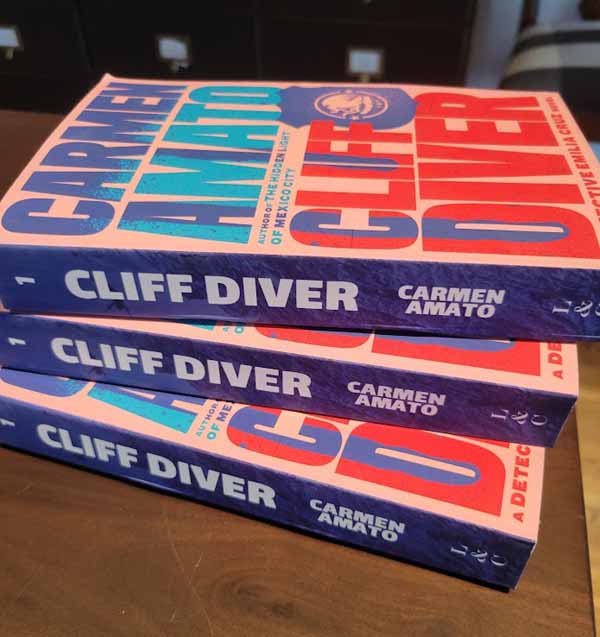
Starting with CLIFF DIVER, new (2nd) paperback editions of books 1-8 in the Detective Emilia Cruz police procedural mystery series are being released this summer by Laurel & Croton.
While retaining the iconic Matt Chase front cover art, the 2nd paperback editions have larger type, more whitespace, and a much easier to read back cover. The spines are numbered so readers can easily see the series in order.
CLIFF DIVER is the first of the new editions to hit bookstores this summer.
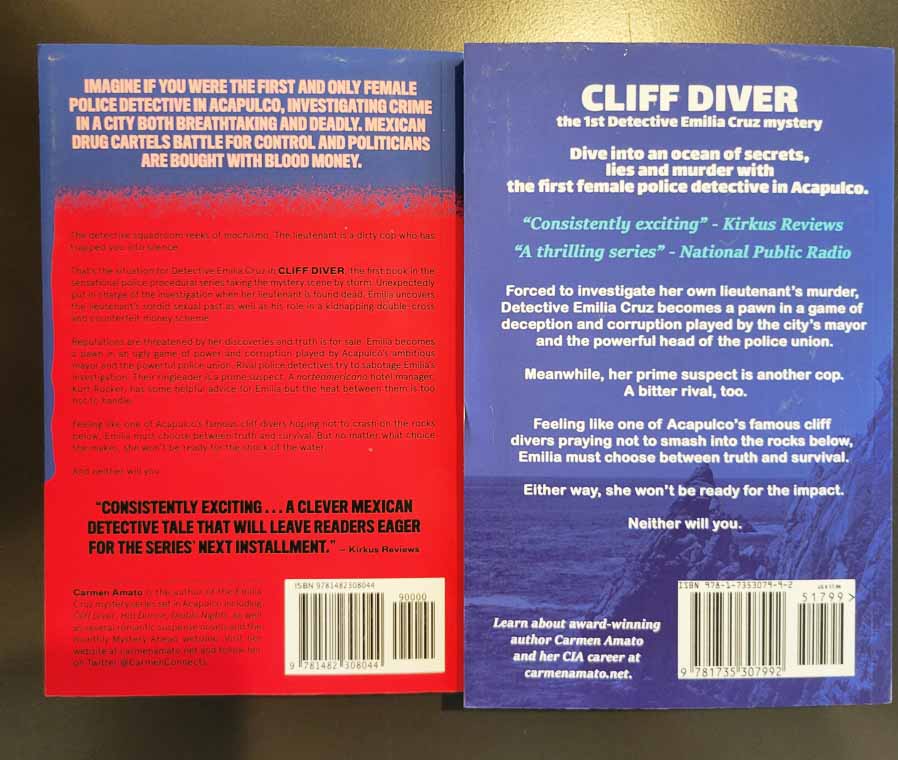
The back cover is a huge improvement over the old. Large font, better contrast, and a watermark of the cliffs at La Quebrada in Acapulco.
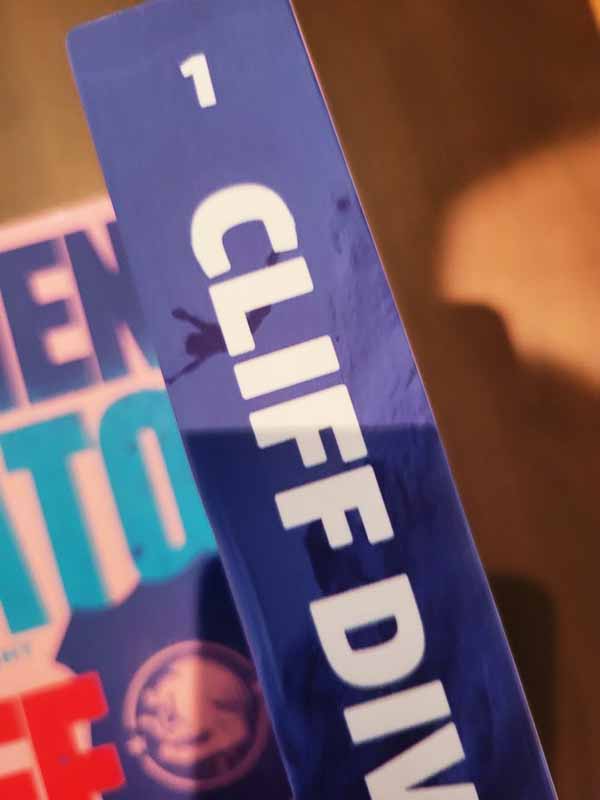
Can you find the diver on the spine? Love, love this tiny detail!
Jun 23, 2023 | #reviews
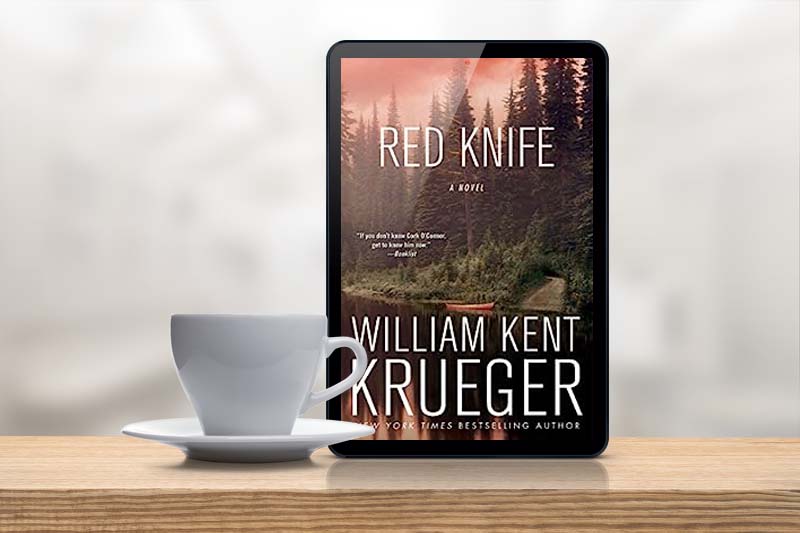
RED KNIFE by William Kent Krueger
This dramatic addition to the outstanding Cork O’Connor series has it all: a main character firmly grounded in both past and present, intriguing secondary characters, red herrings in abundance, and a central mystery that seems impossible to solve until it is.
This is the 9th book in the Cork O’Connor series but reads as a standalone. We get just enough backstory for context as we are swiftly immersed in setting and pivotal relationships.
No longer sheriff of rural Tamarack County, Minnesota, O’Connor is taking on private investigator jobs in his town of Aurora near the Ojibwe reservation. O’Connor is part Ojibwe and straddles the divide between those who live on the Native American reservation, where poverty runs rampant, and the rest of the county.
There’s a rapidly-growing militant Ojibwe gang called the Red Boyz on the reservation. O’Connor is surprised when leader Alex Kingbird asks for help.
When Kingbird and his wife are murdered shortly after speaking with O’Connor, the likely suspect is a rancher whose daughter died after using drugs provided by a member of the Red Boyz who is now on the run. The fugitive is another possible suspect. Kingbird knew the dealer’s location and considered handing him over to law enforcement.
O’Connor is roped into helping the sheriff and finds himself bouncing between the Ojibwe and his former colleagues in the sheriff’s department. His family is caught up in the drama, too, especially his daughter who is about to graduate from high school and is friends with Kingbird’s younger brother.
Lots of action, authentic portrayals of rural America, a rash of nasty surprises. Resolution across all the subplots that help to propel the mystery and a shocking climax full of clever devices and the kind of justice that brooks no further comment.
As intense and well-crafted as Craig Johnson’s Longmire series, but with more of a family angle.
Highly recommended.
Get RED KNIFE on Amazon.

Jun 20, 2023 | #booknews
Many years ago, my husband and I bought a single-engine Piper 180 airplane. He’d go out to the small airport 30 minutes from our house, expand his piloting skills and get a break from his high-pressure job as an intelligence officer.
Yes, it’s fairly expensive to own a small aircraft. Av-gas, maintenance, rental spot at the airport, etc. We decided to sell a half share in the plane to a friend who was also a private pilot. His check cleared and everybody was happy.
When work took us overseas, our friend bought our share of the plane, making him the sole owner.
About a year later, we were saddened to find out that the friend had crash-landed the plane. He was fine but the plane was a goner.
Fast forward 20 years
Now retired, my husband decided to buy another airplane and started looking at aviation websites.
He discovered a site where he could plug in the FAA tail number of an aircraft and see its history. On a whim he plugged in the Piper’s tail number.
Lo and behold, our sweet Piper 180 was alive and well, still wearing the same lovely coat of green and white paint. It had passed through several owners since our friend sold it and currently resides in the Midwest.
It never crashed. Our friend lied.
We’ll probably never know why.
Why can’t we spy a lie?
One of the reasons our friend got away with lying about the Piper was, in addition to being so far from the location of the alledged crash, we had no reason to suspect him of deceit.
All our previous interactions had been honest. We didn’t investigate any further.
But what if there had been a clue? Even a germ of suspicion?
Here are a few reasons why it’s so hard to answer those questions.
We don’t want to know
People do not believe lies because they have to, but because they want to. – Malcolm Muggeridge
Often, we don’t recognize a lie because it’s what we already want to be true. Deciding that the information is a lie means shedding existing beliefs, desires, bias or aspiration.
And nothing is harder than letting go of what you want to be true, especially if it aligns with a personal identity.
Basically, you can be swayed by what you want to believe rather than by objective assessment.
Nobody wants to believe as spouse is cheating, so the hotel receipt in the jacket pocket is rationalized as a business expense.
Nobody wants to believe their teen is running with a bad crowd, so the kid’s erratic and anti-social behavior is ignored.
Nobody wants to believe that a favorite politician is involved in scandal so the messenger is blamed.
In The Way of Integrity, Martha Beck writes “If we’re committed to integrity, we have to act like detectives on a case, testing every bit of evidence, seeing if it makes sense . . . In other words, we have to deliberately search for reasons that whatever we believe might not be accurate.”
Can you spy a lie even when it reinforces your own beliefs?
Yes, especially if there is a whiff of doubt. Find other sources of information on the same topic, examine the full story, and keep an open mind.
The niceness factor
Most of us are nice people who think other people are nice, too. You might think it’s paranoid to suspect someone of behaving deceitfully. You don’t want to be accused of being a conspiracy theorist or wind up in an argument.
So you ignore the deceit, effectively swallowing the lie.
That’s how liars exploit our tendency to be nice.
According to a 2021 university study in Sweden, nice people “risk being exploited in social situations,” because they can be perceived as “the proverbial doormat rather than as someone you’d be afraid to offend.”
A determined liar will exploit your instinct to be accommodating or avoid conflict. Liars may exploit our natural inclination to trust others, especially given how essential and universal trust is to healthy relationships.
They may use your reluctance to question or challenge their statements, knowing that you’d rather maintain peace and avoid hurt feelings—yours or theirs.
Can you spy a lie and still be nice?
Be pleasant but with a healthy dose of suspicion. Start from the premise that you don’t want to be taken advantage of. Trust, but verify, as they say in intelligence circles.
The repetition factor
The more you hear something, the more apt you are to believe it.
“Repetition is the mother of belief. What we repeat to ourselves, and what we hear repeated, sinks into our minds and becomes our reality.” – Tony Robbins
In Spy the Lie, a fascinating study by 3 former CIA officers, the authors use the term “referral statements” to define the repetition of a claim someone is making. “Each subsequent time the claim is made, it diminishes our resistance or disbelief, to the point where the door is opened to the possibility that the claim actually has credibility.”
Basically, the more something is repeated, the more believable it becomes.
Think of the barrage of political ads before an election, harping on negative traits of candidates. Many outlandish ads are repeated over and over, hoping that sheer repetition will convince us that each candidate is a combination of Atilla the Hun and Ivan the Terrible.
If those ads didn’t work, they wouldn’t be so prevalent.
Can you spy a lie when you hear it again and again touted as truth?
Yes, because you should recognize repetition as a pattern with an agenda. Ask yourself why this is being repeated over and over. Go beyond the obvious reasons. Maybe they are correct, but maybe not.
If nothing else, repetition is a cue to investigate.
Final thoughts
Liars can exploit our reluctance to accept something that calls our own beliefs into question, a natural inclination to be nice, and a natural tendency to believe what we hear over and over.
But knowing all this gives you a clear advantage over the liar—if you choose to act on it.
If there’s any doubt, dig for more information, balance niceness with healthy suspicion, and recognize repetition as a pattern that may be pushing a deceptive agenda.
Let’s not crash any more Pipers.

Jun 9, 2023 | #reviews
Need Father’s Day ideas? How about a couple of thrilling spy reads?
As a retired CIA officer, I can vouch for the authenticity of each book on this list. Well-crafted, spine-tingling action, authentic details that comes from a deep well of research and/or personal experience.
Fiction or non-fiction, take your pick. Each is a brilliant book you won’t want to miss.
Click each image to go to Amazon.com.
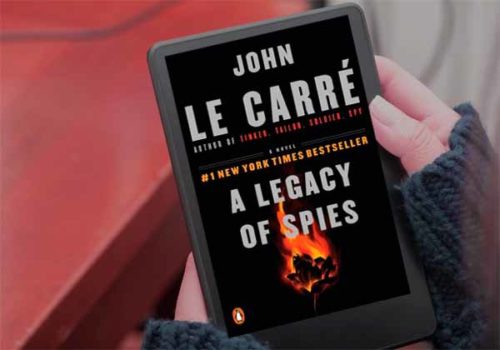
A LEGACY OF SPIES by John le Carré
fiction
To honor the late Queen Elizabeth II, here is a book by a quintessentially British author. A LEGACY OF SPIES is the long sought-after backstory of le Carré’s first bestseller, THE SPY WHO CAME IN FROM THE COLD (henceforth THE SPY), a slim volume that taught many readers how Britain fought the Cold War during Elizabeth’s monarchy.
To refresh your memory, in THE SPY, British intel officer Alex Leamas, a hard-drinking, hard-driving spymaster in Berlin, pretends to get fired and fall on hard times. It is a ruse, however, for Alex to be “recruited” by Soviet/East German intelligence so he can save an odious East German intel officer who is Britain’s greatest asset inside the Iron Curtain. To position himself to be pitched, Leamas develops a relationship with an unwitting librarian named Elizabeth Gold who brings him along as her plus-one when she attends a socialist conference in East Germany.
Every step is orchestrated behind the scenes by the brilliantly quiet George Smiley.
In A LEGACY OF SPIES, it is 50 years later. The offspring of Leamas and Gold sue the British government to find out how and why their parents disappeared. The new generation of British spooks, who want to make the lawsuit go away, find that the files on Leamas, as well as the East German agent codenamed Windfall, have been purged.
With no memory of the Cold War and no appetite for its justifications, they bring in Peter Guillam (BTW, Benedict Cumberbatch played him in the 2011 movie with Gary Oldman as George Smiley). No one can find Smiley; but as the infamous spycatcher’s right-hand-man, Guillam will do.
Guillam narrates the book, which moves across time. At first we are in the present when he is summoned to London, there to find that long-held secrets are on the verge of being exposed. Then through his memory, we are transported to a Cold War landscape. Spies sneak in and out of East Germany which is replete with Stasi brutality and Communist paranoia. There are shortages of everything, except informers.
The look into the past gives us the first case in which Smiley is led to believe there is a mole inside British intelligence and reveals how Windfall came to be recruited to the British side. These elements set in motion everything that happens in THE SPY.
A LEGACY OF SPIES is another le Carré espionage tour de force. Haunting writing, the sense of wheels-within-wheels. The back and forth across time is handled deftly, without confusion.
Subtle clues abound. Gather them carefully—le Carré is never obvious.
The book is a standalone, but will be a richer experience if you have at least read THE SPY WHO CAME IN FROM THE COLD (or saw the 1965 movie starring Richard Burton. FYI Dublin substituted for Berlin).
Other bestsellers featuring Smiley and his team, TINKER TAILOR SOLDIER SPY and SMILEY’S PEOPLE, are also referenced in A LEGACY OF SPIES. Peter Guillam was with Smiley through the entire Cold War, you see, and he has a long memory.
Related: Could AI Defeat a Spy?
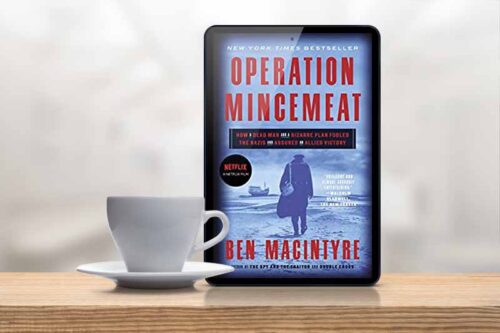
OPERATION MINCEMEAT by Ben Macintyre
Non-fiction
Eighty years ago, a dead British naval officer named Bill Martin washed up on a Spanish beach. He was a landing craft expert with a fiancée named Pam. They’d gone to the theater in London a few days before his plane crashed in the Atlantic with no survivors.
Based on the letters in a briefcase tethered to his waist, Martin had been carrying secret letters to a British general in North Africa.
The letters wound up in the hands of supposedly neutral Spanish authorities who shared them with representatives of Hitler’s Nazi government. Photographs of the letters were rushed to Berlin.
In this way, Hitler learned that the Allies planned to attack via Greece and the Balkans, with a false feint at Sicily and a minor diversion in Sardinia. Reports from other sources soon trickled in, verifying the Allied plan for Greece. In response, Hitler fortified forces there rather than Sicily.
But Bill Martin never existed
The body that washed ashore in Spain with top secret information was the product of Operation Mincemeat, a British naval intelligence operation designed to trick Germany into diverting military forces away from Sicily before the Allied invasion of the Italian island in July 1943.
The ruse worked.
Thousands of lives were saved when US and UK forces landed on the beaches of the Mediterranean island. Although the remaining German troops fought hard, the Allies successfully took Sicily and drove north up the boot of Italy. The Germans conducted a running retreat but the Italian army collapsed, taking Mussolini and the Pact of Steel between Rome and Berlin with it.
The body that became Bill Martin was that of Glyndwr Michael, a Welsh vagrant who’d died of accidental phosphorus poisoning. Michael’s body was preserved in a morgue, then dressed in a naval uniform, carried in a special capsule aboard a British submarine, and deposited on the Spanish coast at Huelva.
Ben Macintyre’s account details the months of painstaking research and preparation, the two officers who were instrumental in pulling it off and the amazing way multiple intelligence assets were used to reinforce the ruse. OPERATION MINCEMEAT is a fascinating account of a little-known intelligence success, written like an unputdownable thriller.
Note–Macintrye has written several other excellent non-fiction books about spies and espionage, including a profile of UK’s Kim Philby, Soviet defector Oleg Gordievsky, and more WWII spy operations. All superb.
Related: Get Carmen’s Top Secrets

THE BILLION-DOLLAR SPY by David E. Hoffman
Non-fiction
During the height of the Cold War, Adolf Tolkachev was a Soviet engineer working on advanced aviation radar system for MiG fighter planes and other platforms, in the highly secretive Scientific Research Institute for Radio Engineering, known as Phazotron.
He was also a CIA asset, codenamed CKSPHERE.
From 1977, when Tolkachev first attempted to make contact with the CIA in Moscow, to 1985, when he was arrested by the KGB, Tolkachev was committed to damaging the Soviet Union by passing technical secrets of the highest magnitude to the West. He was driven by revenge and the belief that the Soviet system was rotten to the core. His wife’s family had been destroyed by Stalin’s purges. He wanted to destroy the repressive system which had killed so many, leaving the rest struggling under ever-present brutal KGB scrutiny.
This is the definitive work on Tolkachev, from his personal story to the staggering amount of intelligence he passed to the United States over the course of so many years. Photographing documents that he smuggled out of his workplace and even snapping some in the restroom with miniature cameras, he provided a wealth of information on Russian airpower, technology, and radar, that saved the West billions in arms development costs.
The book is also a deep dive into what it was like to operate as an agent handler in Moscow, when the KGB constantly surveilled Western diplomats, had observation posts on street corners, and roving cars of KGB agents roamed the city’s streets. Informants abounded, as did so-called “militia” soldiers who provided more surveillance eyes and ears.
The CIA officers assigned to meet Tolkachev used elaborate disguises and subterfuges to evade KGB watchers and meet with him. Frankly, they had guts of iron because one wrong move on their part would expose him. What did Tolkachev want in return? Western music, books, art supplies for his son, and money that was a fraction of the value he gave to the US government.
The book is amazingly detailed yet reads like a thriller. Tolkachev remains a legend in spy circles and this book shows us why.
Related: Confessions of a Media Spy

TOWER OF SECRETS by Victor Sheymov
fiction based on true events
In 1980, Victor Sheymov was the head of worldwide cypher security for the KGB. A brilliant engineer and wily political operative, he rocketed through the ranks by a combination of blackmail and technical expertise and was one of the few senior KGB officers allowed to travel overseas.
But 1980 was also the year the CIA smuggled him out of the Soviet Union, together with his wife and daughter in an unprecedented and daring exfiltration operation. The CIA has never described the means used to get the Sheymovs out. All we know is that the operation led the Soviets to believe the family was dead, saving them from being hunted down.
In fact, Sheymov is mentioned in the Hoffman book about Tolkachev. His codename was CKUPTOPIA.
TOWER OF SECRETS (the title refers to the tower inside the original KGB headquarters in Lubyanka Prison) is Sheymov’s own account of his career, KGB power and paranoia, and escape. It’s a memoir disguised as a thriller and absolutely riveting.
Published in 1990 as the USSR crumbled–after the Sheymovs had been living in the US under false names for 10 years–TOWER OF SECRETS is written in the third person, a device that Sheymov explains in his intro as the best means of standing apart and viewing his decisions critically. It also allowed him to fudge still-classified details. FYI, the book’s fictional depiction of his escape is remarkably similar to the real-life exfiltration of Oleg Gordievsky from Moscow by the British in 1985.
With all that out of the way, let me tell you, TOWER OF SECRETS is page-turning. It opens with Sheymov meeting his future wife while suffering the effects of being poisoned by a brother-in-law trying to get a permit to live in Moscow. The event sets the stage perfectly for both his devotion to Olga and his cold-blooded approach to problems.
As a senior KGB officer, Sheymov lives in a cross between a mousetrap and a fishbowl. KGB surveillance is everywhere: roving unmarked cars, fixed observation posts, uniformed officers on street corners, and a network of informants. Along with this looming presence, there’s dire consequences for failure and rampant hypocrisy. Every day he experiences the hallmarks of a thoroughly corrupt system perpetuating itself through fear, blackmail, and favors.
Sheymov pulls you into this labyrinth of paranoia. Friends are assassinated for speaking out, owning the wrong books, or even being in the wrong hallway at the wrong time when the head of the KGB goes by. Family members protect each other with silence.
He realizes that someday he will make a misstep and be denounced by his 5-year-old daughter who is indoctrinated every day at school. Soon he and Olga plot their escape during evening walks away from their bugged apartment. Just when you don’t think the tension can ratchet up any higher, it does.
The tension is excruciating, matched only by the pace throughout the entire book. You will be in that time and place, without question, looking over your shoulder for the KGB watchers.
FYI, Victor Sheymov became a US citizen in 1985, was awarded the US Intelligence Medal, ran a computer security company, patented communications technology, and consulted for the National Security Agency. He died in 2019. He also sued the US to get money that was promised him and won.
The Father’s Day Kindle

Do you know a dad who needs a Kindle?
We got my husband the squarish Kindle Oasis last year for Father’s Day. Or maybe it was the Christmas before last. (Photo from newatlas.com)
He swears by the feature that serves him up the next book in a series. Thanks to his Kindle, he’s now read a million books by Griff Hosker!

Jun 1, 2023 | #noticed, #reviews
A hand-selected list of international mystery series that will take you around the world.
How many have you read?
AFRICA
1 Precious Ramotswe series by Alexander McCall Smith
Main character: Precious Ramotswe is the “traditionally built” proprietress of the Number 1 Ladies Detective Agency, in Gaborone, Botswana.
Have to start at the beginning? Yes, because the series continues in a linear fashion like a television soap opera, with major life changes for all the characters happening throughout.
Recommended favorite: Hard to name one, as they are all written with the same measured pace, engaging character development, love for Botswana, and cultural details.
Find on Amazon >>> NUMBER 1 LADIES DETECTIVE AGENCY
2 Tannie Maria mysteries by Sally Andrew
Main character: Maria van Harten is a widow living in South Africa’s Klein Karoo district who becomes the advice columnist, doling out wisdom and recipes suitable for the lovelorn and aggrieved while stumbling across murder and a certain handsome detective.
Have to start at the beginning? Yes, start with RECIPES FOR LOVE AND MURDER, in which Maria corresponds with a woman who seeks advice, then ends up dead, sending Maria--as well as her boss Hattie and the paper’s single investigative reporter Jessie--into a maze that includes a female lover, abusive husband, and strange doings at the local grocery store.
Recommended favorite: So far there are only 2 books in the series, RECIPES FOR LOVE AND MURDER and THE SATANIC MECHANIC, which together create a continuing storyline. Read, then wait breathlessly for the next in the series.
Find on Amazon >>> RECIPES FOR LOVE AND MURDER
3 Inspector Kubu series by Michael Stanley
Main character: Detective David “Kubu” Bengu of the Botswana Criminal Investigation Department is a hefty cop—his nickname “Kubu” means “hippo”--and family man who solves crimes rooted in his country’s culture and spiritual beliefs.
Have to start at the beginning? No. A CARRION DEATH is first in the series, but each book stands alone.
Recommended favorite: DEADLY HARVEST takes on the pervasive influence of witch doctors and their potions called muti that include human body parts.
Find on Amazon>>> A CARRION DEATH
AMERICAS
4 Detective Emilia Cruz series by Carmen Amato
Main character: Emilia Cruz is the first and only female detective on the Acapulco police force, taking on Mexico’s drug cartels, official corruption, and culture of machismo.
Have to start at the beginning? CLIFF DIVER is the first full-length novel in the series and sets up Emilia’s position as not only the only female in the squadroom, but as a relatively inexperienced detective who is forced by the police union to head the investigation into the murder of a dirty cop—her own lieutenant.
Recommended favorite: PACIFIC REAPER pits Emilia against an evangelical priest dedicated to Santa Muerte, Mexico’s forbidden saint of death, and begins a series arc that exposes Emilia’s shocking family secrets.
Find on Amazon >>> CLIFF DIVER
5 Inspector Armand Gamache series by Louise Penny
Main character: Gamache leads the Homicide Department of the Sûreté du Québec. His investigations, however, invariably lead him to the small village of Three Pines, where the unexpected always happens.
Have to start at the beginning? No, each book can stand on its own but details drip out about a series-spanning unsolved crime.
Recommended favorite: HOW THE LIGHT GETS IN is a study in personalities, with everyone subjected to Gamache’s careful scrutiny and probing questions. Plus, the usual dose of Tree Pines quirkiness.
Find on Amazon >>> HOW THE LIGHT GETS IN
6 Spenser series by Robert B. Parker and Ace Atkins
Main character: Spenser, whose first name we never learn, is an ageless private investigator in Boston, Massachusetts who deftly moves between the city’s finest restaurants and its darkest criminal underworld. Series dialogue is a lesson for all wannabe mystery writers.
Have to start at the beginning? No. There are many Spenser novels and they can all be read on their own but starting from the beginning reveals how the characters have evolved over time and allows the reader to catch references to past events in the most recent books.
Recommended favorite: HUGGER MUGGER, in which Spenser investigates crooked horse racing is great, but the series’ triumph is POTSHOT, in which all the crime stoppers Spenser has run into over the lifespan of the series come together to take on a cult.
Find on Amazon >>> HUGGER MUGGER
7 Inspector Lascano series by Ernesto Mallo
Main character: Inspector Perro Lascano is a police superintendent in turbulent Buenos Aires, Argentina, during the height of the right wing military junta’s rule (1976-83) when right and wrong are hideously intertwined.
Have to start at the beginning? Yes. NEEDLE IN A HAYSTACK sweeps us into a mix of crime and mystery, with multi-layered characters and a rich, intimate style.
Recommended favorite: As of this writing, there are only 2 novels in the series available in English, NEEDLE IN A HAYSTACK and SWEET MONEY. Grab them both and stay awake for the next few days.
Find on Amazon >>> NEEDLE IN A HAYSTACK
8 Chief Inspector Mario Silva series by Leighton Gage
Main character: With a stubborn and brooding demeanor, Chief Inspector Mario Silva of Brazil’s federal police has been described by Booklist as “South America’s Kurt Wallander.”
Have to start at the beginning? BLOOD OF THE WICKED sets up Silva as a good cop with a rag-tag but loyal band of underlings caught in Brazil’s pervasive corruption. The book also gives us Silva’s disturbing but important backstory.
Recommended favorite: Impossible to pick just one. Even as New York agents were claiming that books with Latino characters could not sell, this series was breaking down barriers with high quality writing and a insider’s view of a fascinating culture.
Find on Amazon >>> BLOOD OF THE WICKED
ASIA
9 China Thrillers by Peter May
Main character: Beijing detective Li Yan and American forensic pathologist Margaret Campbell solve crimes in modern China even as they carry on a tempestuous relationship. Tremendous sense of place.
Have to start at the beginning? No. Each book stands alone although the central romantic relationship evolves throughout the series, starting with THE FIREMAKER.
Recommended favorite: No favorites here. Each book is written with vast authenticity, from the pancake vendors on the street corner who trades riddles with Li Yan, to Margaret’s visa troubles.
Find on Amazon: >>> THE FIREMAKER
10 Hiro Hattori series by Susan Spann
Main character: Ninja-with-a-heart Hiro Hattori has sworn to protect a Jesuit priest in medieval Japan in this absorbing and beautifully researched series.
Have to start at the beginning? The first book, CLAWS OF THE CAT, immediately immerses us in the sights, sounds, norms and culture of medieval Japan.
Recommended favorite: In BETRAYAL AT IGA, as political rivalries threaten peace, trained shinobi assassin Hiro leads Father Mateo from danger in Kyoto to the false safety of Hiro’s clan of trained assassins in Iga. Japan has never been this lovely, this dangerous, or this exciting.
Find on Amazon >>> CLAWS OF THE CAT
11 Superintendent Chris Le Fanu series by Brian Stoddart
Main character: Le Fanu is a British police officer in 1920’s Madras who must navigate through a minefield of colonial intrigue and growing Indian restiveness.
Have to start at the beginning? Yes. The scene is set and historical issues explained in A MADRAS MIASMA.
Recommended favorite: No favorite here—the series simply gets better with each book, as the reader is plunged deeper and deeper into the danger posed by Britain’s unraveling colonial authority. A STRAITS SETTLEMENT was longlisted for the prestigious 2017 Ngaio Marsh Award.
Find on Amazon: >>> A MADRAS MIASMA
BRITAIN & IRELAND
12 DI John Rebus series by Ian Rankin
Main character: Rebus is a hard drinking loner cop in Edinburgh, with a nemesis from the city’s underworld and a female partner who grows a bit more like him every day.
Have to start at the beginning? No. While the later books bring back characters introduced before, there is enough context to follow without any trouble.
Recommended favorite: RESURRECTION MEN is a great novel in which Rebus, whose superiors are fed up with his maverick behavior, is shoved off to a cop charm school with other troublemakers to investigate an old crime that no one wants solved.
Find on Amazon >>> RESURRECTION MEN
13 Dublin Murder Squad by Tana French
Main character: Set in Dublin, Ireland, the books showcase a revolving door of cops rather than the typical mystery series built around one particular character.
Have to start at the beginning? No. Each book stands alone, with a different narrator, but most reference characters and events from other books.
Recommended favorite: IN THE WOODS is the first in the series, and sets a fast pace and unique narrative style. FAITHFUL PLACE was gritty perfection.
Find on Amazon >>> IN THE WOODS
14 George Smiley series by John LeCarré
Main character: George Smiley is a polite and self-effacing spymaster in Britain’s intel service known as “the Circus,” whose demeanor masks his cunning, ruthlessness, and brilliant tradecraft during the Cold War with Russia.
Have to start at the beginning? Although Smiley first surfaces in A PERFECT MURDER, start with TINKER TAILOR SOLDIER SPY.
Recommended favorite: SMILEY’S PEOPLE is a tour de force. Smiley finally matches wits against Karla, the Russian spymaster who recruited moles inside the Circus to bring down British intelligence.
Find on Amazon >>> TINKER TAILOR SOLDIER SPY
15 Shetland series by Ann Cleeves
Main character: Jimmy Perez is a Scottish police detective serving the stormy and remote Shetland islands between Scotland and Norway.
Have to start at the beginning? No, but I would. RAVEN BLACK starts the series with a shocking murder and a plunge into Perez’s personality, empathetic investigative techniques, and a wild and unique landscape.
Recommended favorite: Each one is a whodunit triumph, largely because Cleeves makes everyone a suspect by using quirky personalities and the restlessness of confined and gossipy island communities.
Find on Amazon >>> RAVEN BLACK
16 The Lewis Trilogy by Peter May
Main character: Raised on the Isle of Lewis in the remote Hebrides islands off Scotland’s Atlantic coast, Fin Macleod is a emotionally damaged Edinburgh detective who returns to investigate a copycat murder and stays.
Have to start at the beginning? Yes, read the three books in order, starting with THE BLACKHOUSE.
Recommended favorite: THE BLACKHOUSE is a gripping thriller that uses seemingly random flashbacks to tell Fin’s backstory; yet each memory is part of a puzzle that comes together in a brilliant and blindingly shocking climax.
Find on Amazon >>> THE BLACKHOUSE
FRANCE, ITALY & RUSSIA
17 Arkady Renko series by Martin Cruz Smith
Main character: Arkady Renko is an ageless Moscow cop who has survived the collapse of the Soviet Union and the rise of a Mafia-riddled Russia. The series is dense and absorbing, with rich descriptions of Russia, the Russian character, and decrepit Lada cars.
Have to start at the beginning? No. The first is GORKY PARK, but it’s a bit slow, especially the last 10%. The last two in the series are missable.
Recommended favorite: The second book, POLAR STAR, is a tour de force--all the action takes place on a rust bucket of a Soviet fishing vessel--but WOLVES EAT DOGS, set in the aftermath of the Chernobyl disaster, is hauntingly memorable.
Find on Amazon >>> POLAR STAR
18 Commissario Guido Brunetti series by Donna Leon
Main character: Guido Brunetti is a commissario of police, equivalent to a detective, in Venice, Italy. The city, with its mildew, high tides, lost aristocracy, immigrant populations, and decaying art and architecture, is a stunning backdrop to the series.
Have to start at the beginning? No, Leon does a good job of building every book as a stand-alone story. The first, DEATH AT LA FENICE, is a whodunit at Venice’s legendary opera.
Recommended favorite: Leon’s books are very consistent but a favorite is DRAWING CONCLUSIONS, which builds to a different style of ending than is her norm.
Find on Amazon >>> DEATH AT LA FENICE
19 Genevieve Lenard series by Estelle Ryan
Main character: Dr. Genevieve Lenard is the world’s leading authority on body language, a skill she developed as a way of dealing with her autism. She works for an elite insurance company in Strasbourg, France.
Have to start at the beginning? Strongly suggested. THE GAUGIN CONNECTION sets out Genevieve’s carefully ordered life and then demolishes it when she meets a reformed art thief.
Recommended favorite: The books link into one long narrative during which Genevieve joins a team of specialists working for the president of France to solve art crimes and catch international terrorists, relying heavily on cyber techniques.
Find on Amazon >>> THE GAUGIN CONNECTION
20 Commissario Salvo Montalbano series by Andrea Camilleri
Main character: Montalbano is a detective in Sicily, where the Mafia, loose women, and endemic corruption complicate every crime.
Have to start at the beginning? No, every one of the 24 books in the series stands alone with a clever cast of regulars and sinister newcomers.
Recommended favorite: All the books deal with significant issues in Italy such as illegal immigration, drug smuggling, prostitution, money laundering, but with a streak of humor that keeps our hero afloat.
Find on Amazon >>> TREASURE HUNT
21 Aimée Leduc murder mysteries by Cara Black
Main character: Aimee Leduc is a fashion-forward private detective in Paris juggling single motherhood, disappearing lovers, and a shadowy organization called The Hand. Her late father was a Paris cop killed by the group, while her super-spy American mother pops in and out of Aimée’s life.
Have to start at the beginning? No, each book stands alone, with preceding events put into context. MURDER IN THE MARAIS starts the series.
Recommended favorite: MURDER ON THE LEFT BANK, is a non-stop action roller coaster that leads us into the famed Gobelins tapestry weaving atelier.
Find on Amazon >>> MURDER IN THE MARAIS
NORDIC COUNTRIES
22 Harry Hole series by Jo Nesbo
Main character: Harry is a police detective in Oslo, Norway. His heavy drinking, some-time drug use, belligerent attitude, and maverick ways hurt him when it comes to personal relationships and other cops, yet often help solve crime.
Have to start at the beginning? Start with THE REDBREAST, which is actually Book 3. Skip the first book, THE BAT, as it neither takes place in Oslo nor is as well written as the rest.
Recommended favorite: POLICE was a tour-de-force, with virtually every chapter a cliff-hanger and secondary characters given fresh leading roles. Follow immediately with KNIFE.
Find on Amazon >>> THE REDBREAST
23 Kurt Wallander series by Henning Mankell
Main character: An over-the-hill, heavy drinking Swedish cop from the small town of Ystad, Wallander constantly struggles with alcohol, self-doubt, and the gray Swedish landscape. Kenneth Branagh played him in a pitch-perfect BBC series.
Have to start at the beginning? There are a lot of Wallander books. Start anywhere.
Recommended favorite: THE WHITE LIONNESS and THE DOGS OF RIGA are both excellent. The latter not only pulls you into multiple murders, but took Wallander to Riga, where Mankell does a fantastic job of viewing the Soviet-era Estonian city and its political corruption through neutral eyes.
Find on Amazon >>> THE WHITE LIONNESS
24 Department Q series by Jussi Adler-Olsen
Main Character: Copenhagen detective Carl Mörck heads up Department Q, a political invention of a cold case unit, with the help of a motley group of assistants, including Assad, a Syrian enigma.
Have to start at the beginning? Yes, THE KEEPER OF LOST CAUSES begins this fantastic series, showing us Carl’s complicated personal backstory, the origin of the unit, and how Assad became Carl’s crime-fighting wingman.
Recommended favorite: THE MARCO EFFECT is a favorite because of a clever young Gypsy boy who becomes a fugitive after witnessing a murder. Carl and Assad must follow his clues to solve the case.
Find on Amazon >>> THE KEEPER OF LOST CAUSES
25 Inspector Anita Sundström series by Torquil Macleod
Main character: Anita Sundström is a police detective in the Swedish city of Malmö, where she wrangles murder investigations, single motherhood, relationships with the wrong men, and snuss, the popular Swedish version of chewing tobacco.
Have to start at the beginning? Yes. MEET ME IN MALMO is a richly twisted story told from multiple points of view, with a jaw-dropping ending.
Recommended favorite: MISSING IN MALMO, the third book, hits the mark with multiple strings of danger and suspense all having to do with missing persons cases.
Find on Amazon >>> MEET ME IN MALMO
Download the PDF list as a reference to read your way around the world!

May 30, 2023 | #booknews
Eighty years ago, a dead British naval officer named Bill Martin washed up on a Spanish beach. He was a landing craft expert with a fiancée named Pam. They’d gone to the theater in London a few days before his plane crashed in the Atlantic with no survivors.
Based on the letters in a briefcase tethered to his waist, Martin had been carrying secret orders to a British general in North Africa.
The letters wound up in the hands of supposedly neutral Spanish authorities who shared them with representatives of Hitler’s Nazi government. Photographs of the letters were rushed to Berlin.
In this way, Hitler learned that the Allies planned to attack via Greece and the Balkans, with a false feint at Sicily and a minor diversion in Sardinia. Reports from other sources soon trickled in, verifying the Allied plan for Greece.
In response, Hitler fortified forces there rather than Sicily.
Fished in
Bill Martin never existed.
He wasn’t a naval officer. He didn’t have a fiancée named Pam. He never went to the theater in London.
The body that washed ashore in Spain with top secret information was the product of Operation Mincemeat, an intelligence operation designed to trick Germany into diverting military forces away from Sicily before the Allied invasion of the Italian island in July 1943.
The ruse worked.
Thousands of lives were saved when US and UK forces landed on the beaches of the Mediterranean island. Although the remaining German troops fought hard, the Allies successfully took Sicily and drove north up the boot of Italy. The Germans conducted a running retreat but the Italian army collapsed, taking Mussolini and the Pact of Steel between Rome and Berlin with it.
Operation Mincemeat
The body that became Bill Martin was that of Glyndwr Michael, a Welsh vagrant who’d died of accidental phosphorus poisoning. Michael’s body was preserved in a morgue, then dressed in a naval uniform, carried in a special capsule aboard a British submarine, and deposited on the Spanish coast at Huelva.
It was a daring and tricky concept that took months of painstaking research and preparation. The questions the planners faced were daunting.
For example, what if a good Spanish pathologist correctly determined the body had been dead for far longer than the date on the theater ticket stub? What if the operation was leaked and Hitler knew to expect a ruse? What if German spies inside Britain discovered that Bill Martin was a fake? If the letters were labelled as fake because London didn’t seem worried they were missing?
And so on.
How did they carry off such a stunning deception?
Attention to detail
Knowing that the Germans had eyes everywhere, Operation Mincemeat planners created and backstopped Bill Martin’s entire life. From birth certificate to Pam’s engagement ring, every detail had to hold up to the most diligent scrutiny. It was the ultimate CYA effort.
One unsupported fact and everything about Bill Martin, including the letters, would be suspect.
Authoritative voices
The more a lie is repeated by trusted voices, the more believable it becomes.
A key British double agent known as Agent Garbo was highly regarded by Berlin. Planners there thought he was running a network in spies inside England but each spy was a complete fiction; another amazing World War II deception.
His British handler instructed Garbo to inform his German handler that a plane with an important courier had gone down and that London was panicking. Garbo’s authoritative voice created a self-reinforcing echo chamber that “verified” the fake battle plan.
Know your audience
Thanks to ULTRA intercepts of German communications, the British had a significant amount of information on both Spanish and German officials in Spain. In part, this prompted the port of Huelva to be the drop zone, because the German representative there could be counted upon to take prompt action.
Bill Martin’s details could be primed to cater to these officials. For example, the names dropped in the letters had to be recognized in Berlin.
From Spain’s rocky status as a neutral, to the German High Command’s reluctance to challenge Hitler’s war planning, it was essential to understand how different actors would perceive the situation and cater to their motivations.
The lesson for us
Besides being a brilliant World War II deception that saved lives, Operation Mincemeat, is a universal lesson in what makes deception “stick.”
This includes getting the details right, reinforcing the lie with authoritative voices, and catering to the intended recipient’s weaknesses, vanities, vulnerabilities, beliefs and habits.
As in Operation Mincemeat, deception is often intended to make you take action.
Look around. These “best practices” in fomenting and perpetuating deception are still in use today.
This post is the first in my new #deception101 series in which I take a 360 look at deception, from the perspective of being both a mystery author a an ex-CIA intel officer.
Intrigued? Leave a comment!
For more, get OPERATION MINCEMEAT by Ben Macintyre
May 18, 2023 | #booknews
I took multiple polygraph tests during my 30-year career as an intelligence officer with the CIA. The theory behind the poly is that basic bodily functions (breathing, heart rate, etc) react if you lie.
Every test followed the same procedure. I sat in a comfortable chair, got hooked up to the machine, and answered all the examiner’s questions with a simple yes or no.
The test makes you dig into your subconscious to determine why you react to certain questions. You never know if you are really reacting or if the examiner is trying to psyche you out for reasons you don’t know.
Inevitably stressful.
Here’s a protip: Never drink coffee before taking a polygraph test. You don’t want to feel any more jittery than you already do or make your heart race for no other reason than a morning latte. No bathroom break, either.
Without so much as a molecule of caffeine, I blearily stumbled into my first polygraph test, the one that would determine if I was honest enough to be offered a job at CIA.
The chair was a giant cushy recliner. The polygraph instrument was a cross between a suitcase and an electrocardiogram machine.
After the first round of questions, the examiner left the room (normal procedure) leaving me hooked up and unable to get out of the recliner. There was a two-way mirror so somebody was watching me.
Meh. I closed my eyes.
The examiner woke me up about 20 minutes later.
I passed.
Years later, I yawned during a test. The examiner barked, “Why did you do that?”
“I’m tired,” I said truthfully. “I haven’t had any coffee today.”
After I passed, he told me that yawning is a technique to defeat the machine.
On to Aldrich Ames
Arrested in February 1994, Aldrich “Rick” Ames was a career CIA officer who spied for Moscow, selling out a raft of important agents helping the US understand the threat from a nuclear-powered Soviet Union. No ideological saint here; Ames sold secrets to support his drinking habit, lavish lifestyle and newish Colombian wife.

Aldrich Ames mugshot, Feb 1994. Source: FBI.gov
He was a “mole,” a spy within his own intelligence service. Currently serving a lifetime sentence for treason and fraud, he is responsible for the deaths of good people. Read the FBI report on him:
I am not impartial. I hope Ames is lonely and dejected and his prison food is noxious.
The years-long hunt for a traitor inside CIA was documented in CIRCLE OF TREASON by CIA officers Sandra Grimes and Jeanne Vertefeuille. I highly recommend it.
The point which I am taking too long to make is that Aldrich Ames was polygraphed as a possible suspect during the hunt. He passed. Twice.
When asked about his inexplicable wealth, he claimed that his money came from his wealthy in-laws, who were giving him a “free ride.” His claim was fact-checked, and yes, his in-laws were rich.
When asked about foreign contacts, “Rick explained that he had been introduced to numerous people in Colombia when he and his wife visited her family. He added that he had no idea whether any of them were employed by Colombian security services, and suggested to the polygrapher that this might explain his reaction to the question. The polygrapher accepted this explanation.”
He never defeated the polygraph machine, he defeated the examiners.
Interestingly, Ames was dumbfounded when he was finally arrested. He was sure he had outsmarted the mole hunters.
AI as lie detector
Artificial Intelligence (AI) seems to be able to do everything from coding a website to drive a car and write a novel. (I’m investing as soon as it can do laundry and clean toilets)
It can spot deception, too.
Lemonade Insurance depends on its “AI Jim” claims bot to spot fraud. The company’s blog tells how AI Jim flagged a fraudster who submitted multiple claims using fake accounts and even disguises. “AI Jim caught him red handed” and information was turned over to law enforcement. https://www.lemonade.com/blog/the-sixth-sense/
According to researchers in Israel, a new technology that measures “the movement of facial muscles is 73% accurate at detecting when a person is telling a lie.” https://neurosciencenews.com/lie-detection-neurotech-19679/
The technology assesses the tiny involuntary twitches that LIESPOTTING author and expert Pamela Meyer calls “emotional leakage.” She writes “The problem (for liars, anyway) is that much of the time we can’t anticipate our feelings—our emotions catch us by surprise.”
What about voices assessed by AI? Changes in tone, inflection, speed of speech, etc. All these minute vocal changes can be giveaways, too.
IMHO
If the counterintelligence team hunting for a mole inside CIA had had AI lie detection tools back then, they almost certainly would have identified Ames as the mole long before his arrest in 1994. Ames wouldn’t be able to control his “emotional leakage.” That would be enough to intensify interest in him and reassess his polygraph tests.
Moreover, the team could have narrowed the scope of the hunt sooner, too, as other suspects were crossed off the list more swiftly.
Last words
In the future, will AI lie detection be so reliable that it has the final say, instead of a human as was the case when Ames passed his polygraphs?
That could be a slippery slope.
As AI deception detection tools go mainstream, I hope we treat them just as that—tools. We can’t become wholly dependent on them. Let’s not surrender the human critical thinking skills that ultimately caught traitor and spy Aldrich Ames.
May 8, 2023 | #authorlife, #truestory
As fallout over the firing of Fox New anchor Tucker Carlson and CNN’s Don Lemon continues to percolate, I recall the Cold War techniques to decode the news used by the Central Intelligence Agency.
The CIA was never solely about spies meeting in dark alleys. Consider the technical side—from spy planes to listening devices—where I spent the majority of my 30-year career.
But to learn how to decode the news, you have to look at OSINT. That’s shorthand for intelligence gleaned from openly available sources.
First, some background
Open source intelligence collection and analysis got its start in 1941 before Pearl Harbor when the Foreign Broadcast Monitoring Service was created to monitor Axis short-wave radio transmissions and analyze implications.
The new organization, known unofficially as “the Screwball Division,” recruited top linguists, engineers and social scientists. An early headquarters was TEMPO Y, one of the war-time temporary buildings erected on the Mall in Washington DC.
After the war, the renamed Foreign Broadcast Information Service–later the Foreign Broadcast Intelligence Service (FBIS)–was folded into the newly-formed CIA in 1947.
During the Cold War, FBIS primarily focused on state-controlled media in the Soviet Union, East Europe, China, North Korea, Cuba, and other “closed” countries. Its flagship product was the Daily Report, a daily collection of critical translations for each country or region. A news magazine called Trends, came out weekly.
A media analyst for FBIS
Early in my CIA career, I got the chance to write for Trends about messages hidden in state-controlled Chinese media.
During the Cold War, critical messages were hidden in plain sight in the news coming out of communist countries. News for the domestic audience could be different (remember, there was little other information getting to folks inside the country) than what was broadcast to the foreign audience.
If you dug into the content, and knew who mattered in their media organizations—the state-controlled media equivalents of Don and Tucker–you could essentially decode the message.
If certain buzzwords appeared in an official briefing or news outlet known to be a leadership mouthpiece, it carried certain significance. On the other hand, it they were published in something further from the seat of power, say in a Chinese-owned Hong Kong newspaper prior to the takeover, it was more likely to be testing the waters.
Some of those buzzwords are still around. If a Chinese media outlet refers to “sovereignty,” they’re talking about Taiwan with an implicit warning that no one declare it independent or try to defend it.
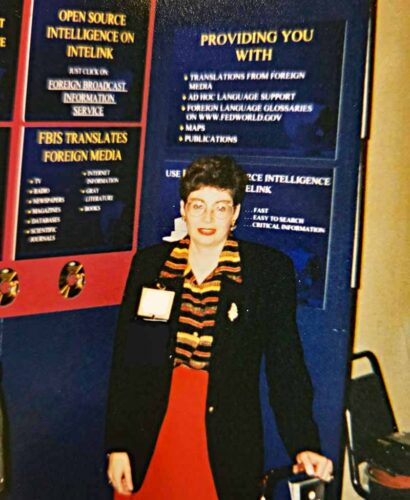
Talking OSINT at a DoD event in the late 1980s, a time also known as the Era of Big Glasses.
Beijing’s new foreign minister, Qin Gang, recently told US Ambassador to China Nicholas Burns that US-China relations needed to “stabilize” after a series of Washington’s “erroneous words and deeds.”
“The agenda of dialogue and cooperation agreed by the two sides has been disrupted, and the relationship between the two countries has once again encountered cold ice.” https://www.nbcnews.com/news/world/china-imperative-stabilize-us-relations-meeting-ambassador-rcna83293
If I was an FBIS media analyst now, I’d be frantically combing the archives to find the last time a senior Chinese official referred to “cold ice.” What actions did the Chinese take in the wake of those words? An economic move? Military?
US policymakers should anticipate a similar action now.
Related: My CIA “Coup Kit”
Cold War remake
OSINT methodology is more than code words, but also about intentional or selective media behavior.
In the past few years, Western media outlets have adopted characteristics of closed media that we studied so rigorously. CNN, Fox News, MSNBC, Breitbart, the New York Times, Epoch Times etc, etc, cater to certain agendas, repeat specific terminology, self-define “newsworthy” to refrain from reporting certain stories, and so on.
Look for these indicators
- Media reports are slanted or shaded a certain way,
- Context or pivotal details are left out (how much and for how long),
- Headlines are vaguely misleading (i.e. clickbait),
- Facts that do not align with the article’s intended slant are buried at the bottom or in long and dull paragraphs,
- Phrasing of the intended message is lively, impactful and emotional; rival concepts are portrayed as dull, dangerous or otherwise unappealing,
- Minor news stories are piled on to obscure/deflect attention from potentially troublesome reporting,
- Multiple news outlets use the same exact terminology to report/downplay/heighten an event.
- Absence of reporting—if certain media outlets completely fail to report on a story or offer only a partial report.
- Imagery is selected to shape opinions—for example, certain politicians are consistently shown as grim by one news outlet and smiling by another.
Your decoder ring
You can effectively “decode” the news by using 5 critical thinking techniques:
- Go beyond information silos.
Search for a breadth of perspectives on a single topic. Read across party and political lines. Seek out sources you normally would not.
Hunt for contradictions. Compare past and present. Look for repetition of specific words and phrases. Probably not coincidental.
Is important real news hidden behind distracting entertainment? Released at midnight on Friday after the weekly news cycle is over? Buried at the bottom?
- Question vague language & statistics.
Don’t be suckered by vague claims like 35% better! Better than what? How was that number achieved?
- Recognize Problem, Agitate, Solve.
This blog/marketing formula is everywhere. As media slides into infotainment and is ad revenue-dependent, look for news reports to use this formula, too.
Last thoughts
No Cold War methodology can beat the best technique of all.
Slow down. Be open-minded. Ask hard questions.
Is this true? How do I absolutely know that? What if I’m wrong? Whose agenda benefits from this piece of information and the way it is presented?
The first day that I walked into CIA Headquarters, I was greeted by a quote etched into the lobby wall: “And ye shall know the truth and the truth shall make you free.”
Still relevant today.
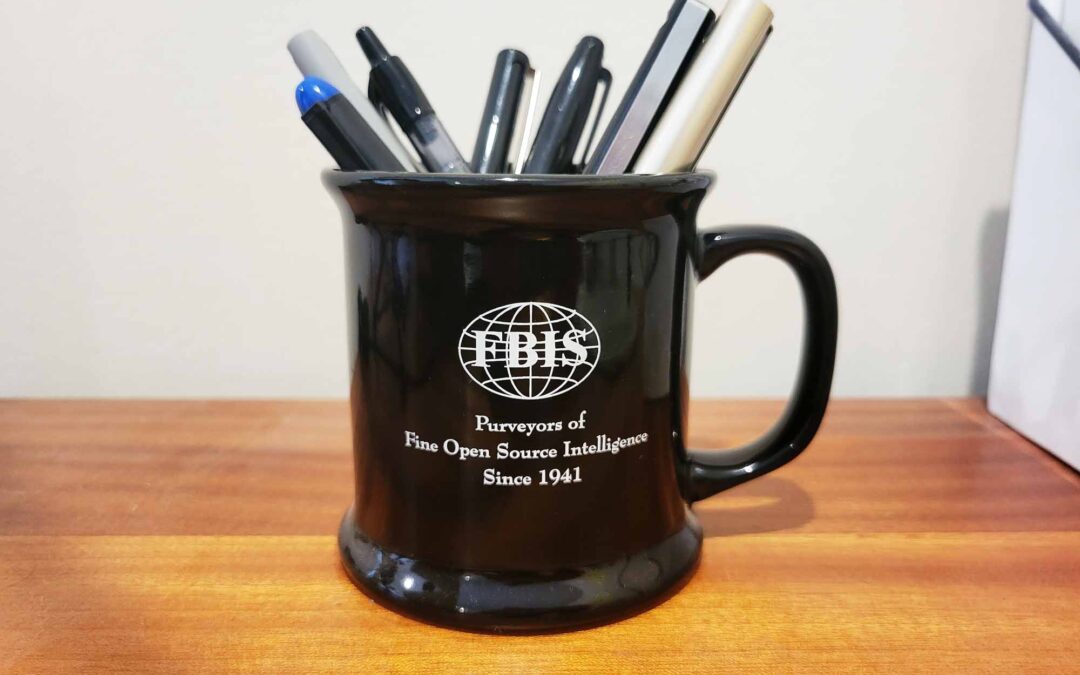
Note: Yes, that’s my old FBIS mug sitting on my desk.

May 5, 2023 | #reviews
This Portland, Maine mystery has it all—a wounded, complicated heroine, a multi-faceted investigation with save-the-world implications, and oodles of atmosphere. Best of all, this is just the first in what promises to be a great new mystery series.
Dee Rommel is a Portland cop on extended leave after losing her leg in a fall off a building while chasing a criminal. She now works for an old family friend who runs a private detective agency. Dee wants to keep her head down and be the bookkeeper as she ponders her future, but neither her personality nor the business are going to give Dee what she thinks she wants.
The boss is out of town donating a kidney when Philip Claren walks in. Claren is a mashup of Elon Musk and Mark Zuckerberg who wants the agency to find his adult daughter before she marries a potential gold-digger. Taking after him in the brains department, the genius daughter recently left her laboratory and sent him a note about the pending nuptials with the family safe word in it.
Feeling unequal to the task, Dee reluctantly takes on the job and heads to Chebeaque Island via ferry. Not only is it the wedding destination, but Chebeague is also the safe word.
As the tale unfolds, Claren and his daughter are involved in research that connects artificial intelligence with bionic technology. Is the pending marriage an attempt to steal world-changing tech secrets? The reveal presages the open letter recently signed by Elon Musk and other leading tech notables expressing concern over the unregulated rise of AI and calling for a 6-month development moratorium.
Just wow.
Beyond the Claren family, the cast of characters includes Gordy, Dee’s irascible but generous boss; Abshir, a Somali student with a talent for surveillance; and Robbie Donato, a smart cop who sees through Dee’s often prickly exterior and would like to know her much better.
The prose is swift and punchy. The setting is so real you can almost smell the ocean breeze on the boat to Chebeaque. Dee narrates with an inner voice that is tough yet appealing, making this mystery a great mix of exciting plot and colorful personalities.
Highly recommended.
Get 10 DAYS on AMAZON

Want to write book reviews but don’t think you have the time? Download my fast and easy 5-Sentence Book Review Cheatsheet. It makes reviews a breeze!

May 2, 2023 | #authorlife, #truestory
We sometimes learn–or relearn–life lessons in unexpected places.
I recently joined 14 women creatives at a gathering hosted by award-winning writer and filmmaker Rebekah Iliff at Free Dreaming Farm in Springfield, TN. The gathering followed the tragic shooting in March at Covenant School in Nashville. In addition to healing, the purpose was to foster connections and creative collaborations.
A natural introvert, I was there with a dozen strangers. I knew Rebekah but no one else.
Luckily, the conversation went swiftly from basic introductions to deep sharing and robust engagement, with lots of laughter along the way. This was a no-judgement zone. Support was spontaneous and genuine.
I left musing on 3 life lessons:
Community = good energy
When I left Free Dreaming Farm, I felt lighter, more buoyant, more supported. Those few hours of community interaction were an emotional tonic.
We didn’t change the world but we generated some seriously positive energy shared by all.
Pointing out the crucial need for community and a sense of belonging, marketing guru Mark Schaefer wrote that “People have a deep need to belong, but there is a belonging gap in the world, a profound unmet human need, a need that is escalating to crisis proportions.” https://businessesgrow.com/2020/09/28/customer-community/
The New York Times offers statistics to demonstrate rising rates of loneliness and depression. https://www.nytimes.com/2018/04/16/opinion/facebook-social-wealth.html
Basically, when we don’t connect to community, we suffer.
There is power in transition
Many of us were on the way to or in the middle of or finding our way and taking it one day at a time. I’d just wrapped a 2-year research and writing project, the Galliano Club historical fiction series, and admittedly felt adrift. One woman was recovering from breast cancer, another was building a career as a musician, still another just opened a gallery and performance space, etc.
No life is static. Basically everyone was experiencing some measure of transition.
And excited about it, once we got past the nervous notion that we aren’t there yet.
As the conversation went on, it was clear that there is power in transition. It’s the time to gather information and assess options. Transition means not being locked in. We have freedom to revise and restart and explore.
Being on the way is a good thing.
We can learn to be resilient
The word “triggered” got tossed out a few times, which made me put on my ex-CIA intelligence officer hat and make an observation.
“If you can be triggered,” I said. “Then you can also be manipulated. Someone just has to know what triggers you into losing your self-control, then use it against you.”
A great conversation ensued about being self-aware, the popularity of fake victimhood, and not handing over your power.
The bottom line is that if you know what triggers you and develop coping techniques to stay in control, you’re Teflon. You now hold the upper hand in the relationship. Also, no embarrassing knee-jerk reactions, no belated regrets over words you can’t take back. Don’t indulge in the over-hyped martyrdom of being triggered.
We all have the power to be resilient.

What to see these Life Lessons in action? Download a #free copy of the Detective Emilia Cruz Starter Library. She’s the first female police detective in Acapulco. Survivor is her middle name.

Apr 28, 2023 | #reviews
This police procedural offers the best first sentence that I’ve read lately. The overall pace and plotting meet that high bar, making this a fast page-turner.
Sheriff Francis Hood of Huhman County, Missouri, is a savvy and compassionate lawman but also a recovering alcoholic wondering if he can manage the “recovering” bit. His alcohol abuse got so bad that his wife and daughter have moved out.
As the book begins, Hood finds ex-con Jacob Grace passed out drunk on a country road with an ear cut off.
Grace can’t identify his attacker.
Thirty years ago, Grace stabbed and killed his wife and two sons. A daughter survived but was disfigured. Now he’s out of prison and working as a farm hand not far from the scene of the crime.
Hood’s investigation of the ear-cutting assault leads to the daughter who lives in the house where the crime took place. She’s a reclusive artist and intriguing interlocutor as Jacob is attacked again.
This time, his nose is cut off.
The assaults are bizarre and random . . . Until they make perfect sense. At the same time, two minor criminals are on a spree, robbing church functions. They don’t seem to have any connection to the troubled Grace family . . . At first.
Alcoholism as a character’s Fatal Flaw is a well-trodden path for fictional crimefighters, but SENSE OF GRACE manages to approach it in a different way. Throughout the book Hood mulls his new identity as a recovering alcoholic, the need for spiritual support, and what to do about a deputy heading out of control.
You can’t help but root for Hood, a decent guy getting through one day at a time. I love the way he always introduces himself, “I’m your sheriff, Francis Hood.” It’s great insight into a character who’d do well on the silver screen.
Highly recommended.
Get SENSE OF GRACE for your #Kindle
If you want to write book reviews like this but don’t know where to start, download my 5-Sentence Cheatsheet. It will show you how to write fast and meaningful reviews.

Apr 27, 2023 | #authorlife, #GallianoClub
While chatting with fellow author Shelley Blanton-Stroud (grab her free book, COPY BOY) for an upcoming episode of Mystery Crew Reviews, she asked if my villainous great-grandfather was the impetus for my love of mystery.
“No,” I replied, because I was well into my second career as an author by the time the family found out about his crime. (FYI-in 1912, my great-grandfather shot and killed his wife and another man, evaded a police manhunt, and was never seen again.)
Related: The Amato Family Murder Mystery
Instead, perhaps the award for encouraging my love of mystery goes to the murderer’s son-in-law, my maternal grandfather, Joseph Sestito. Apart from his stories about being a deputy sheriff during Prohibition, which inspired the Galliano Club historical fiction thriller series, he once put me in jail.
For many years he was City Marshal of Rome, NY, meaning that he delivered summonses to appear in court, claims notices, and liens on wages and property, all of which he recorded in ledgers I now have.
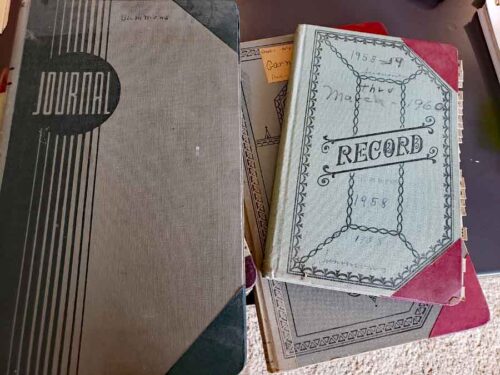
My grandfather’s ledgers, kept while City Marshal of Rome, NY.
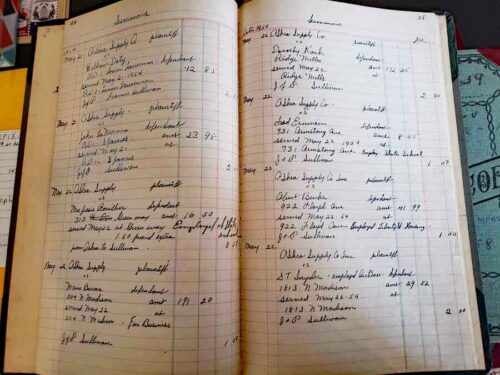
Every transaction was recorded, along with the fee he earned. The heading reads “Summons” which meant a summons to appear in city court.

My grandparents Ann and Joe, about the time he was City Marshal of Rome, NY.
I was 4 or 5 when he brought me to Rome’s brand-new police station, parked me in a cell, and locked me in. He and his cop buddies had a chuckle at the curly-haired tyke behind bars before turning to business.
I recall investigating the spartan cell and getting bored. But I also recall the positive impression made by my grandfather and his law enforcement colleagues. Badges. Camaraderie. A sense of purpose. Problem-solving.
Well, they’d certainly solved the problem of babysitting.
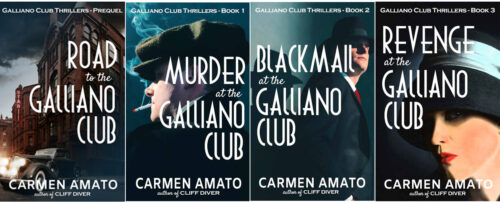
P.S. All of the Galliano Club books are now available! A heartfelt thank you to reviewers like fellow mystery author Suzanne Baginski who wrote, “Brilliantly crafted, I highly recommend this gritty historical thriller. From the first page to the last, Murder at the Galliano Club is one terrific read.”
Click to order on Amazon