On his radio show National Security This Week, thriller author and former US military intel officer Jon Olson asked me why I’d specialized in Western Hemisphere issues as an intelligence officer.
As I told one senior manager during a career development talk, I like to build things and I like to fix things. That was sort of the theme of my career, especially in the last half.
The Western Hemisphere appealed. I grew up Italian and Catholic and easily embraced local traditions of family, church, and holidays in Mexico and Central America.
So the Western Hemisphere gave me the opportunity to combine problem solving with a cultural fit.
I can tell you the exact minute my fate was sealed.
I was sitting at my desk in the office eating lunch and surfing around online. Came across a video posted by the Blog del Narco website.(I tried to link but my anti-virus software advised against it.)
For those who aren’t familiar, this uncensored site posts graphic content of narco activities in Mexico, much of which is created by the cartels and gangs themselves. It’s a “look what we’re up against” kind of site that has ebbed and flowed over the years. As you can imagine, staff is continually targeted by cartels.
So this particular video shows a clearing in the woods. There’s a dead man in the foreground, wearing nothing but a pair of shorts. The video is kind of grainy, but he’s definitely dead.
There’s another guy, fully dressed, and he’s got an axe and he’s trying to chop off the dead guy’s arm at the bicep.
But either the axe is dull or the dead guy has bones like concrete because our woodsman is chopping and chopping and getting nowhere.
Meanwhile, off camera, male voices are hooting and hollering at the guy with the axe, yelling advice, questioning his strength and technique.
My bite of sandwich literally fell out of my mouth. It was such a visceral lesson in what was happening in Mexico.
You know, I remember that video in black and white. But I am not sure that it wasn’t in color.
The moment lasted
The Agency is a fairly flexible organization that wants well-rounded officers. If you have transferable skills, an understanding of how the intelligence community works, and how the different intelligence mission areas support each other, you can move across the organization.
It’s not common. Most folks, stay in a single mission area for their entire career. I was very lucky to have been able to work across all 3 major mission area: analysis, operations, and S&T, largely because I had transferable skills that could be applied to a variety of positions that focused on or were in the Western Hemisphere.
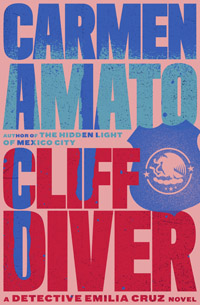
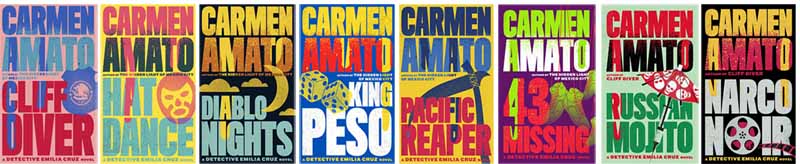
What is Detective Emilia Cruz’s origin story? How was the mystery series invented?
Well, it started with poinsettias.
Many, many poinsettias.
The following is from the Author’s Note in the new edition of CLIFF DIVER, the first book in the Detective Emilia Cruz mystery series.
Where it started
The little church in Mexico City was decorated for Christmas with 100 red poinsettias. Every pew was filled, many with sleepy but excited children, for a special Christmas Eve midnight Mass.
Father Richard was leading us in the Prayer of the Faithful when an armed man staggered up the center aisle, his limbs jerking as he alternately murmured and shouted incomprehensible words. We all shrank back as he made his way towards the altar, an unexpected and volatile presence.
As the congregation looked on in growing panic, the man accosted Father Richard. The priest didn’t move or stop the prayer, just dug through his robes for a pocket. He pulled out a few pesos and pressed them into the man’s hand.
By that time several of the male congregants had come onto the altar as well and they gently disarmed and propelled the drug-addled man through the church to the rear door.
Christmas Mass continued. The addict remained nameless to the shaken congregation. But he stayed with all of us, evidence that Mexico’s own problems were growing as more and more drugs transited the country en route to the insatiable United States.
Growing Violence
We were an American family in Mexico City, embracing a new culture, exploring a vibrant city, and meeting people who were to impact our lives for years to come. But we always knew that the bubble was fragile and as if to prove it, Mexico’s news grew worse in the new year: shootouts in major cities, multiple drug seizures, rising numbers of dead and missing, the murders of mayors, governors and journalists.
I carried my memories of Mexico with me when we left. I poured them into a new novel, bringing a fast-paced contemporary style to a Cinderella story set against the backdrop of political corruption and cartel violence. The result was the 2012 political thriller The Hidden Light of Mexico City, a story from the heart that took on both Mexico’s rigid social system and the corruption that flows from huge drug profits. The reviews made me sure that contemporary fiction could ignite popular interest in what was happening in Mexico better than the news could.
Detective Emilia Cruz, the first female police detective in Acapulco, followed soon after.
She lives in a beautiful pressure cooker
Once one of the most glamorous tourist destinations in the world, Acapulco has fallen on hard times, thanks to the drug trade. With one of the highest homicide rates in the Western Hemisphere, Acapulco is a prize being fought over by rival drug cartels.
Tourism continues to be the city’s lifeblood but Acapulco has two faces; one of luxury and one of poverty. Both claw at Emilia and force her to survive between them.
The series is as authentic as the Mexico I experienced and the drug war I fought as a US intelligence officer.
Emilia and I are in it for the long haul. We’ll see if a mystery series can raise awareness of what’s going on in Mexico, with plot elements straight out of the headlines, an authentic dive into one of the most beautiful settings on earth, and a little salsa fresca from my own years living in Mexico and Central America.
Part of the proceeds from sales of the Detective Emilia Cruz series support children’s cancer research, global water inequality, and US military veterans and first responders.
The drug addict unknowingly gave a gift that Christmas. The Emilia Cruz series will pay it forward.
Held last month outside Nashville, TN, Killer Nashville is a 4-day event full of opportunities to connect polish your craft and engage with writers at all stages of their careers.
Most of all, it’s a hefty dose of inspiration, most of which comes from fellow writers who share their expertise and experiences on panels with such great themes as “Creating Characters Readers Can’t Forget” or “Writing Detective and Police Procedurals.”
Writing International Mystery and Crime Fiction
I was honored to chair the only panel dedicated to the challenges of writing about people and places around the world: “Beyond Our Borders: Writing International Mystery & Crime.” I’m immersed in this genre day and night so it was a thrill to see how many others are, too.
“Beyond Our Borders” was one of the biggest panels of the conference, with 7 authors dedicated to writing suspense with an international flair:
Here’s a (sort of) instant replay of the questions that sparked the most discussion between panelists and with the audience:
What are the top 3 things an author needs to get right about an international setting?
Culture was the top answer from all panel members. Authentic details about the culture are essential to ground the reader in the setting and make it believable. Savvy readers will know when you don’t get it right.
Other things an author needs to get right included a sense of the foreign language, the social strata of the foreign location, physical attributes like architecture/street signs/automobiles, etc. and conveying a deep sense of place using all five senses.
What resources do you use to research a setting?
The best research is actually being there and experiencing the place as a local, not a tourist. Get a reputable tour guide from your hotel, talk to people as if you plan to move there, and keep a detailed trip journal. Authentic details matter but are also the easiest things to get wrong, like a one-way street.
If you can’t travel everywhere, research like crazy, using Google Earth, YouTube videos, memoirs, and translations of local newspapers. Google Translate is your friend. Not everything is on Wikipedia.
How do you convey to your readers that your characters are speaking a foreign language?
Panelist agreed that the best way was to sprinkle in foreign language words in a way that their meaning is easily understood. It is common practice for foreign words to be written in italics. Foreign language words should be spelled as they exist in that language, not spelled phonetically in English.
Are your plots unique to the setting? Could they only take place there?
The answer was a resounding Yes.
Either elements of the culturedrive plot and motive, true events create a framework, or the specific location contributes a unique twist or complication.
(Author note: Do all three and it’s a hat trick. You also have my undying admiration.)
Thank you, Killer Nashville
I tackle these questions with each Detective Emilia Cruz mystery set in Acapulco. Thanks to Killer Nashville, I got a boost from hearing how other authors deal with them, too.
More importantly, the panel tried to give our audience tips for adding authenticity and deepening the reader’s curiosity.
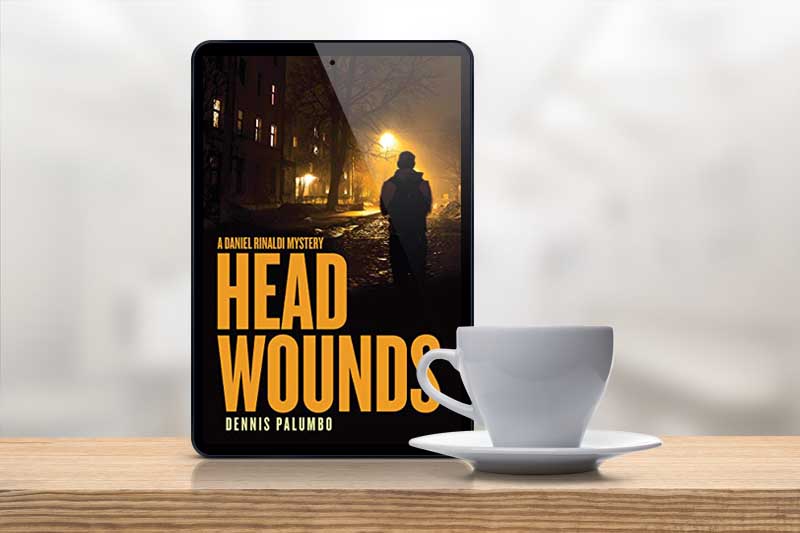
HEAD WOUNDS is the most recent entry in the action-filled Dr. Daniel Rinaldi thriller series by Dennis Palumbo. Dr. Rinaldi is a Pittsburgh-based psychologist and police consultant with a few rough edges and a remorseless, deranged enemy.
The combination is an absolute page-turner.
The premise
Dan Rinaldi lost his wife Barbara 12 years ago in an unsolved mugging gone bad. As he reads a recently obtained dossier on the crime, a bullet smashes his living room window.
Outside, a gun-toting neighbor is angry and drunk. When the police arrive, the wife admits to having told her husband in a fit of pique that she’s having an affair with Dan.
She’s found dead not long after.
Other seemingly random incidents touch Dan’s life. In a shocking twist, Barbara’s killer is responsible.
The villain
Brilliant but unstable, Sebastian Maddox was obsessed with Barbara in college. Just released from prison for an unrelated crime, he wants to punish Dan for “stealing” Barbara by torturing Dan’s nearest and dearest before finally killing Dan in Hannibal Lector-worthy fashion.
A terrifying villain with an easily understood motive who had more than a decade to grow progressively more delusional and macabre, Maddox taps into Dan’s phone, laptop, and car GPS. Remote access to Dan’s digital devices gives Maddox personal details about his victims, which he puts to cunning and horrific use.
The two men play a heart-pounding scavenger hunt across Pittsburgh. Maddox meters out clues as to who the next victim will be and Dan races against time to try and save them. Warned by Maddox that more innocents will die if the police are involved, Dan is aided only by a female FBI agent (and soon-to-be love interest) and a retired FBI profiler. On the run from Maddox’s surveillance and exhausted from the endless tension, the trio nonetheless manage to dig up pivotal background material on the killer.
The entire book is written from Dan’s point of view and we’re in this with him every step of the way. We like his grit and the fact that he’s not some academic lightweight you can knock over with a feather. A former boxer with a bad temper and mean right hook, Rinaldi is a true son of Pittsburgh. A medical professional but not too polished, not too far from his blue collar roots.
The style
The last half of the book is a speeding train. The non-stop pace, brash characters, and roller coaster events have a cinematic quality. I was reminded of the Lethal Weapon movies as well as Speed, The Silence of the Lambs and Harrison Ford’s The Fugitive.
It’s no surprise, then, to find out that author Dennis Palumbo is not only a practicing psychotherapist, but also a former screenwriter. His credits include the feature film My Favorite Year, which starred Peter O’Toole and has been one of my Top 10 favorite movies since forever.
The next Dr. Daniel Rinaldi book, PANIC ATTACK, is out next month.
Andrew Hallam recently profiled Carmen Amato’s author journey in an article about book publishing for AssetBuilder.com.
Entitled “How to Publish a Book: Three Options Instead of One,” the article examines today’s publishing choices–traditional, self-publishing, and hybrid publishing–drawing on the experiences of several contemporary authors.
Andrew Hallam is the international best-selling author of Millionaire Teacher, The Nine Rules of Wealth You Should Have Learned in School and Millionaire Expat: How To Build Wealth Living Overseas. Profiled on such media as CNBC, and The Wall Street Journal, he’s also the first person to have a #1 selling finance book on Amazon USA, Amazon Canada and Amazon UAE. He has written columns for The Globe and Mail, Canadian Business, MoneySense, Internaxx and AssetBuilder.
THE SEPTEMBER SOCIETY is one of the early novels in the Charles Lenox historical mystery series, which is my new obsession. Imagine Victorian London through the eyes of an upper-class private detective, with great descriptions, 3-D characters and details out of a Dickens novel. As an added delight, there are sly references to iconic British authors like P.G. Wodehouse.
In short, the Charles Lenox mystery series is absorbing, authentic, and quite sophisticated.
The premise
Lenox is a bachelor in love with his London neighbor, Lady Jane, a wealthy widow whom he’s known since childhood. Asking for her hand in marriage requires courage, although Lenox is accustomed to not only solving gruesome crimes but the rigors of London society and the opinions of those who believe that an Oxford-educated man should do something more impressive with his talents. Be in Parliament, perhaps, like his older brother and many friends.
Independently wealthy, Lenox persists in his role as amateur detective. In THE SEPTEMBER SOCIETY, a woman needs his help to find her son, missing from college at Oxford. Pleased to revisit old haunts, Lenox finds a connection to a London club called the September Society.
Only a handful of men belong to the club, which is exclusive to the point of anonymity. All members have links to the Army and to an obscure battle that provides a lesson into British colonial history.
Note on style
The descriptions of both London and Oxford are brilliant. The architecture, traditions, and landscape of Oxford is particularly well done as we explore the alleys and greens. Weathered stone and damp grass are underfoot, while wavy windows and spires rise above. Student life ranges between tutors, taverns, and games.
The plot races along as Lenox chases clues. The climax is a very satisfying surprise.
Bottom line
At this point, I’ve read 7 out of 14 Charles Lenox mysteries, which are best read in order. Lenox’s evolving life—marriage, children, a stint in Parliament, his own detective agency—features prominently. The books are fairly long and immersive, reminding me in style and tone of Anne Perry’s early William Monk historical mysteries.
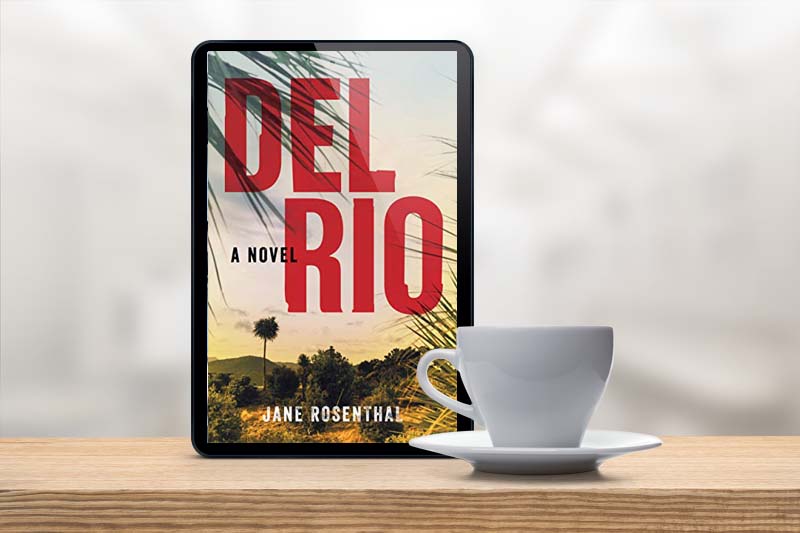
Jane Rosenthal joins the small but vital community of authors using fiction to reveal the complexity and heartbreak of the US-Mexico relationship. DEL RIO confronts the issues of human trafficking and migrant labor and delivers a compelling story rooted in empathy and authenticity.
The premise
Del Rio, California, has fallen on hard times, thanks to cartels on the other wide of the US-Mexico border. Hometown girl Callie McCall is now the local district attorney, a tough cookie aiming for higher political office.
A dismembered teen is found on the edge of a citrus grove. It’s on Callie’s watch and she shoulders the responsibility. The case sends Callie deep into Mexico, pursuing facts no one wants exposed, least of all her own landowning family and devious ex-husband.
She’ll get unexpected help from Nathan, a widower who has been tricked into working as a tour guide to provide cover for a cartel boss. Together, they survive a gruesome “warning” in the form of mangled bodies and begin to unravel a complex tangle of money and crime.
Note on style
The thriller moves between Callie’s first-person point of view and Nathan’s narrative, allowing the intricate plot to unfold without confusion. Callie’s family is a big part of the trouble and having her chapters tell it directly is a clever device.
I really liked the character development throughout the book. Both Callie and Nathan learn troubling but impactful lessons about themselves. Callie’s ambition and Nathan’s self-pity are cast off as they encounter drugs, murder, and human smuggling and we like them all the better for it. A supporting cast of secondary characters pop with authentic descriptions and plot-twisting tricks.
Bottom line
The scope of the story, breadth of character motives, and clever narrative style resonate long after the last page is turned. This is such a timely book.
An entry in the Gamache mystery series that doesn’t take place in Three Pines? What is the world coming to??
Paris.
The premise
Armand Gamache is once again head of Homicide for the Sureté de Quebec. He is on vacation in Paris to visit his grown children and await the birth of his newest grandchild. His billionaire godfather Stephen is there, too, making for a happy family reunion. That is, until Stephen is critically injured by a hit-and-run driver.
Witness to the accident, Gamache and his wife know this was no random accident but attempted murder.
Aided by his son-in-law Jean-Guy Beauvoir, until recently Gamache’s second-in-command and now working for a Paris-based multinational engineering firm, Gamache is determined to find out who wanted to kill his godfather. Together, they will uncover a string of mysteries, including a dead body in Stephen’s lux pied-a-terre and questionable links to the French Resistance during World War II, plus funny business at the engineering firm.
The action ranges across Paris, giving us an armchair tour through rainy arrondisements. We are swept across the city, from the legendary Georges V hotel to the wounded Notre Dame cathedral to the Luxembourg Gardens and dozens of points in between. Secrets and the unexplained nip at our heels.
Note on Style
The style is often staccato, with short, sharp sentences to heighten emotional impact.
She grabbed him to her again, and they held on to each other.
Weeping for Stephen.
For themselves.
A little of that goes a long way for me and I wish it was used more sparingly, but this technique keeps the drama high.
The plot of ALL THE DEVILS ARE HERE, the 16th Gamache mystery, is solid. The climax was wholly believable and connected all the dots, especially when it comes to character development.
Bottom line
I loved the way the ending became a happy turning point for the Gamache narrative. My guess is that subsequent books will enjoy the original atmosphere and framework which underpin the success of the series.
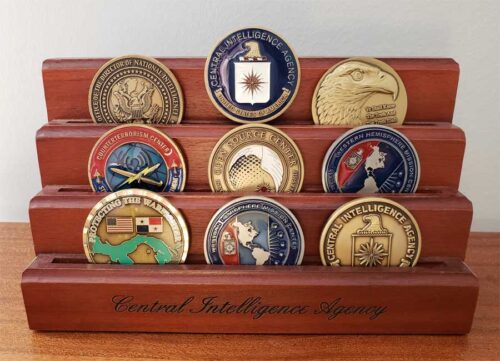
I had a retirement photo opportunity with then-CIA Director John Brennan. He greeted me with a CIA keepsake coin and a firm handshake. We posed for the photographer and chatted for a minute about favorite assignments over my 30 year career.
Front and back of Director Brennan’s keepsake challenge coin
Before retiring, I took a seminar about transitioning to the private sector. All the students were fellow CIA intelligence officers.
At one point, somebody raised a hand and said what everybody was thinking: “I’ve been an intelligence officer my entire professional career. It’s a very unique job. Who would want to hire someone with my skills?”
The instructor gave a laugh. “How many problems did you solve as an intelligence officer? Really, hard problems?”
“More than I can count,” the student replied.
“Every employer wants a problem solver,” the instructor said. “CIA officers know how to solve problems. In the private sector, that can be a rare commodity.”
The instructor’s words really resonated. Intelligence work is about answering the hard questions in support of US national security, like “Where is Osama Bin Laden?” or “What will the Soviet Union do if Germany reunifies?” or “What will motivate Kim Jong Un to give up his nuclear ambitions?”
The answers are not found in the New York Times or the Washington Post.
A CIA career means solving the problem of how to get those answers.
Whenever I’m asked, “What did you do in the CIA?” I’m a bit stuck.
There’s no good snappy answer. I did a variety of things, many of which can’t be defined in layman’s terms.
One of the reasons for such a varied career was that I was balancing work and family. The Central Intelligence Agency might not seem like an employer who accommodates such a balance, but by being flexible and honing transferable skills like communication and decisonmaking, I was able to have it all.
Taking a helicopter view, I was an analyst for the first 7 years and an intelligence collector for the next 23.
Thirty years is a long time, but I can honestly say I was rarely bored during my CIA career. Many colleagues became life-long friends. I have good memories and some great souvenirs.
Challenge coins from the CIA and other intelligence agencies.
Unlike most officers who remain in one “mission” area for the entirety of their Central Intelligence Agency CIA career, I was lucky enough to work in all mission areas:
analysis,
operations,
science and technology,
digital innovation.
Nove 2016, on the CIA seal with my Career Intelligence Medal.
I also worked in three collection disciplines.
HUMINT: information provided by human sources,
SIGINT: information gleaned from electronic signals and systems used by foreign targets, such as communications systems, radars, and weapons systems, and,
OSINT: information gleaned from publicly available sources.
Playing Favorites
Looking back, my favorite positions were all in the intelligence collection arena. As a collector, I felt the greatest sense of purpose, accomplishment, excitement, and job satisfaction.
There is nothing like being faced with a key intelligence question, especially during a crisis, and knowing that a major national security decision could hinge on some nugget of information you ferret out.
Yes, lives could be at stake. Outcomes mattered.
What you did made a difference. Sometimes you knew that, other times you didn’t.
It’s all about the People
I had the best bosses in those jobs, too. People who were dedicated to results. They understood the dangerous consequences of doing a job with indifference.
They kept indifference at bay by creating inclusive work environments that kept us motivated.
I had some terrific colleagues, too.
The CIA attracts a very high caliber of employee. Unique skills and talents are required, as well as the willingness to adapt to swiftly changing events and requirements. A unity of purpose quickly develops when you work with someone on matters of critical national security.
Several years ago, my husband got his private pilot’s license and we owned a small Piper aircraft. Our son was in kindergarten and promptly fell in love with all things aviation.
This rubbed off on me. Our family was soon immersed in flying stories, books about airplanes, model airplanes, and innumerable trips to the Smithsonian’s Air and Space Museum to see among, other aircraft, the SR-71 Blackbird spyplane.
I even wrote an aviation adventure story for my son, entitled THE SECRET BLACKBIRD. It was the start of a Hardy-Boys-meets-Dale-Brown middle grade fiction series. The second book in the series was entitled THE PACIFIC GHOST.
Both books remain on a floppy drive (!) in some desk drawer and were never published.
The real secret Blackbird
Work gave me another reason to be enthralled with the SR-71.
In the 1950’s, as the Cold War ramped up, the CIA wanted a way to peer down at the Soviet Union to determine military capabilities and such. The U-2, built by Lockheed’s “Skunk Works,” was doing the job, but was slow enough to be shot down, as happened to pilot Gary Francis Powers.
Lockheed built a new plane for the CIA. The new aircraft was designed to defeat Soviet air defenses by flying higher and faster than anything else in the world. This meant a whole host of innovations, materials, designs, etc.
The single seat A-12 OXCART emerged after 2 years of development. The overall design and titanium construction was the basis for the more well-known SR-71, the Air Force variant. The two-seat SR-71 was slightly larger and carried a different camera and sensor load.
Comparing the SR-71 and the A-12, courtesy cia.gov
After flying 29 missions in Southeast Asia During the Vietnam War, the OXCART program was shut down. The SR-71 Blackbird continued to fly and became infinitely more famous.
A scale model of the A-12 hangs from the ceiling of the atrium connecting the two main buildings of the CIA Headquarters compound. I have a paper model created for the CIA’s 50th anniversary.
What happened to the A-12?
Eight are in museums. One stands guard over the CIA Headquarters compound.
Encounter of a distant kind
I drove onto the compound one sunny day shortly after the A-12 OXCART was installed on a special platform with two stars carved into the marble to remember the CIA crew members who died in the line of duty.
Now, general parking at CIA HQ is a bit like Disneyworld. You have to remember which parking lot and which row.
But that day, there was no need to memorize my parking space. The nose of the A-12 OXCART was pointing right at my car. Perfect line of sight.
When I was ready to leave, I just had to follow the trajectory to my spot.
I was in awe of the enormous sleek black aircraft, a reminder of our intelligence heritage. I crossed the parking lot to the massive titanium plane and read the information display before heading inside.
The day passed. When I was ready to head home I took another walk around the A-12 before following its nose to my car.
Except like a portrait whose eyes follow you, the A-12’s nose pointed at all the cars in the parking lot. Acres of cars.
For the next hour, no matter where I walked in that $%&$# parking lot, every time I turned around there was the A-12 in the distance, pointing straight at me.
I eventually found my car.
But now I know why they call it a spyplane.
See the aircraft on the CIA compound in this short video from the National Air and Space Museum:
A 30-year veteran of the CIA, Carmen Amato is the award-winning author of the Detective Emilia Cruz police series, the Galliano Club historical fiction thrillers and standalone suspense.