Mar 10, 2015 | #booknews, #noticed
If you read this blog with any regularity you know the following;
- I am a mystery author
- I drink too much coffee
- I love Pinterest and Twitter
- I find inspiration in unlikely places
Talavera Pottery
The latest thing to jog my imagination is talavera, the beautiful and colorful Mexican pottery. The only authentic talavera comes from Puebla and the surrounding villages “because of the quality of the natural clay found there and the tradition of production which goes back to the 16th century.”

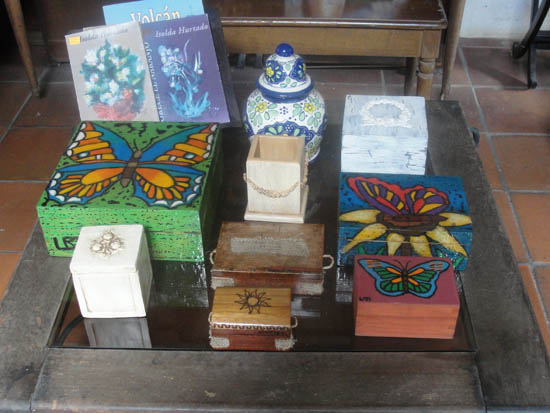
Traditional talavera pieces. The store owner eyed me suspiciously when I took the picture but was less suspicious when ringing up my purchases.

Talavera pottery pops against a yellow wall at Alter Eco
You can buy talavera online at La Fuente and Direct from Mexico.
Tasty Writing
Talavera was featured in THE HIDDEN LIGHT OF MEXICO CITY. The main protagonist, Eddo Cortez Castillo, is from Puebla. His family runs one of the oldest and wealthiest talavera companies.
“Talavera,” Tomás said. “The Cortez family owns Marca Cortez, half of Puebla, and the land the new Volkswagen factory is on. Eddo is still the family’s legal advisor and sits on the board of directors. Don’t know how he finds the time. It helps that he never sleeps.”
Eddo is rich. Richer than the Vegas, even richer than the Portillos. “Puebla,” Luz said. “The city or the state?”
“Both.”
Phenomenally rich.
Real talavera is relatively expensive, although when I lived in Mexico City it was popular to go to Puebla and order service for 8 of a particular pattern. I knew of one family in Mexico City that refused to let their domestic help eat off of their talavera plates, prompting this intense scene in HIDDEN LIGHT.
Luz blinked at her sister. Lupe’s bottom lip was trembling. “Okay,” Luz said, drawing it out. A tiny white lie could put this awkward conversation to rest and Maria could be told the truth later. Luz took a deep breath as if embarrassed. “I . . . uh . . . broke a dish.”
“Six hundred fifty pesos for a dish?” Tío shouted. Everyone jumped. Someone’s spoon clattered to the floor.
Luz shrugged. “It was talavera.”
Tío’s hand hit Luz’s cheekbone with a stinging smack. Her head snapped back, her eyes watered, the room sparkled with vertigo and she tasted blood.
Through a curtain of dizziness, Luz watched Juan Pablo rise up and throw a wide looping punch across the table. He put his weight behind it, his chair spurting out behind him, his feet nearly coming off the floor. Fist connected with jaw and Tío spilled to the floor.
“Don’t you touch my sister!” Juan Pablo yelled furiously.
“She’s a stupid girl,” Tío roared, scrambling to his feet. “Breaking dishes when her family needs the money.”
“So you can drink it?” Juan Pablo was barely in control.
“Lupe is pregnant,” Tío shouted.
“If you’re so worried, why don’t you get a job?”
Tío threw a counterpunch across the table but Juan Pablo was younger and faster and sober. He jerked back to avoid the blow, then lunged forward, and suddenly they were snarling and grappling like two wild dogs, hands locked in each other’s shirts. The table between them rocked wildly as they wrestled over the dishes and the tortillas and the clay cazuela full of rice and seafood, ready to kill each other in the small cramped kitchen with everyone else sitting like shocked statues. Plastic glasses spun crazily and tipped over, flatware clattered to the floor, and Luz’s plate slid onto her lap.
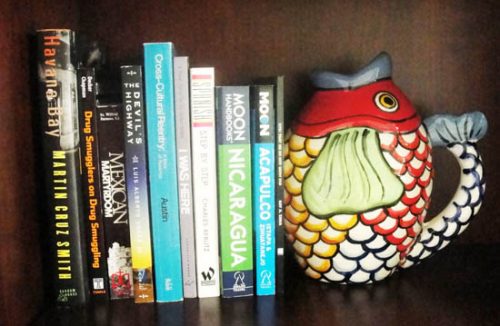
I have a few pieces of talavera and this fishy pitcher is my favorite.

My talavera pottery fish serves a noble purpose
Feb 24, 2015 | #EmiliaCruz, #noticed
I’ve been thinking about visual inspiration lately, as I tackle KING PESO, the 4th Emilia Cruz mystery. Thankfully, Mexico is replete with visual cues to creativity, from large (the Basilica of Guadalupe, Mexico City’s Zocalo, assorted volcanoes) to small (shots of tequila, Chupa Pops, silver milagros).
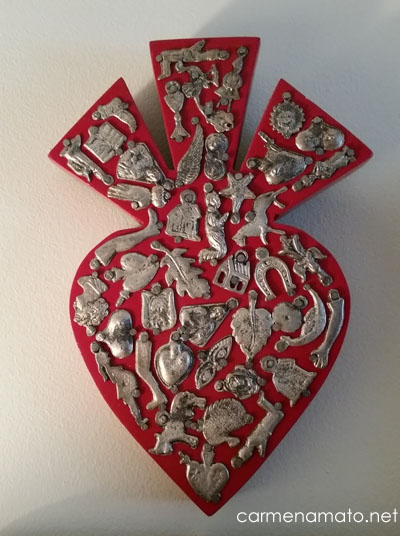
The word milagro means "miracle." Milagros are small charms, typically silver or tin, that represent an intention. The Zanzibar art website, which carries folk art from around the world, talks about milagros on its page devoted to Mexico.
The bearer typically is asking a saint to intercede on their behalf. They may be asking for health after an injury or illness, a successful romance, or the survival of their livestock. The charms are in the shape of an item related to the request, such as arms, legs, hearts, animals, etc.
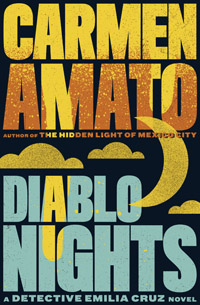
The requestor leaves the milagro at the shrine of the saint that they are asking to intercede on their behalf. Mexico is full of statues and crosses covered with the silver charms, including those pinned to ribbons or threads adorning a statue. In many cases, the milagros are pinned to clothing worn by a statue. A milagro can also be carried for protection and good luck, in the way Detective Emilia Cruz carried her rosary with her in DIABLO NIGHTS, the 3rd Emilia Cruz mystery.
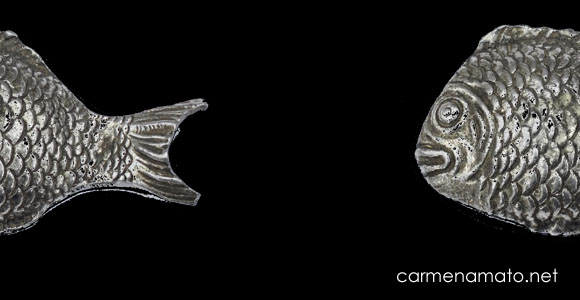
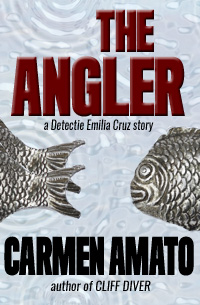
I used a milagro as visual inspiration in The Angler, a stand-alone short story that takes place before the books in the Emilia Cruz mystery series.
When I left Mexico, I took some milagros with me, in the form of this crucifix and a shape known as a Sacred Heart.

I’m writing in the room where they hang. KING PESO is coming together, albeit slowly.
Not that I’m praying for an intercession, mind you.
But visual inspiration that turns into faster typing wouldn’t hurt.
Feb 3, 2015 | #booknews, #thrillers
One of the most often-asked questions for a mystery and thriller author is "Where does your inspiration come from?" Political thriller THE HIDDEN LIGHT OF MEXICO CITY had quite the auspicious beginning . . .

Fateful dinner party
We were invited to a dinner party at the home of another expatriate family in Mexico City. I'd met the mom, Amanda, at a school function. Amanda was a writer and we both participated in an English-speaking writer's group. Her boys were close enough in age to my kids for them to play together.
A dozen guests sipped cocktails on the patio, then went into a dining room glowing with fine crystal and china. A lovely gazpacho started the meal, prepared and served by the family's new maid. Itzel was about 18, wearing a stiffly starched uniform and a nervous smile.
We waited quite a long time after the soup for the main course. Amanda excused herself and went into the kitchen. A few minutes later she asked me to come with her.
The main course was fish but it was still raw. Amanda looked close to tears as she contemplated the ruin of her dinner party. She didn't understand Itzel's frantic explanation.
But I did. Itzel had turned on the heat and put the pan of fish in the broiler. Nothing had happened, she wailed, and began to cry.
I nearly laughed. She'd put the fish into the storage drawer under the oven, thinking it was the broiler.
We found a frying pan and some butter. Ten minutes later the guests were eating trout almondine while Itzel recovered in the kitchen.
Itzel and I talked after that. This was her first job as a maid. Itzel was from a small town near Veracruz and had never lived with electric appliances, air conditioning, or flush toilets. The young girl went home every other weekend and supported her mother and siblings.
Itzel's story became that of Luz de Maria Alba Mora, the central female character in THE HIDDEN LIGHT OF MEXICO CITY. I left out the part about the oven, however.
Gotta save something for the next book.
Related: Read Chapters 1 and 2 of THE HIDDEN LIGHT OF MEXICO CITY
Inspiring reads
Itzel's story was only one source of inspiration. Two books also guided the narrative.
Ken Follett's THE KEY TO REBECCA has always been a favorite, for its characterizations, pacing, and points of view. I wanted HIDDEN LIGHT to have that same sense of developing danger--whether from the drug cartels or Luz's risks--and for readers to have the same insight into the hero as the villain. Set against the backdrop of WWII and the British campaign in north Africa, it is probably the best thriller I've ever read.
The other book which provided inspiration was THE EAGLE'S THRONE by Carlos Fuentes. In this novel, Mexico's power players are forced to conduct their political intrigues via letters. The result is a tribute to cunning craftsmanship. But more importantly, from my optic, the book perfectly captured the tone of Mexico's politics. I wanted to portray the same sense of mistrust, intrigue, and constant one-upmanship.
Musical Interlude
Many authors talk about music they play as they write. I like silence--my head is always crowded with dialogue so things are noisy enough as they are. But I like to match music with characters.
Herb Alpert and the Tijuana Brass was one of the first Latino music superstars. The Lonely Bull is one of my favorite albums. If HIDDEN LIGHT is ever made into a movie, that title song will be the theme of the main male character Eduardo Cortez Castillo.
Putting it All Together
Pinterest is where all my inspiration for THE HIDDEN LIGHT OF MEXICO CITY comes together. There's a board called "Inspiration for a Thriller," with tons of pictures and videos that reflect the book and the elements that inspired it. If you're on Pinterest, please follow along! https://www.pinterest.com/carmenconnects/inspiration-for-a-thriller/
Jan 27, 2015 | #giving
In 2014, I donated $1 from the sale of Kindle books to Water.org, the charity co-founded by Matt Damon to bring clean and safe water to communities worldwide. The goal was to provide clean water for life to 25 persons. The year-long campaign was called Writing for Water.
How The Fundraiser Worked
Every month in 2014 I tracked sales using Amazon’s KDP author dashboard and calculated how many Kindle ebooks I sold. I did not count giveaways, freebies, or print sales. In some months, when I ran a sale on a Kindle edition, the net profit on a Kindle edition could be less than $1. Didn’t matter. A sale was a sale and equated to $1 in donations.
I created fundraiser pages at Water.org’s website to explain what I was doing, showcase other authors who were participating, and submit my donations via credit card. At first I’d hoped to create a 12 month fundraiser on the site, which would have been a handy link to promote, but Water.org only lets you do it for 90 days at a time.
I also created a Writing for Water page on my website to explain what I was doing, plus a monthly blog post to track progress and hold myself accountable.
The Results
Enough money was donated to Water.org to provide 25 people with clean water for life by August 2014. Sales slowed after that, due to changes in Amazon’s distribution streams. Overall, the year ended with 31 people able to gain access to clean water for life.
Lessons Learned
- It Took a LOT of Effort to Track and Promote
I didn’t realize how much time and effort it was going to take to promote other authors, promote the effort, promote our progress, and try to grow participation. I should have done some research about how the best fundraisers are promoted and planned out the effort before January 2014.
Beyond social media, the most useful thing I did was to send out a free press release which garnered a nice exchange with the folks at Water.org. I also mentioned the effort in a couple of different author interviews. But I should have had a list of things to do and been more consistent and focused.
- Run a Tighter Calendar
An unexpected complicating factor was that Water.org only creates 90-day fundraisers when I wanted the fundraiser to last 365 days. This meant that I had to track when a fundraiser ended, change all the links on my pages, and create new ones. Then I ran into problems when I unwittingly created one fundraiser using my Facebook profile and another using my Twitter profile. In short, it was a structural problem that added to the workload. It could have been partially mitigated by using a dedicated campaign calendar, much like a blog calendar.
- Expect an Opt Out Rate
When I asked other authors to join me, six pledged to help. Three followed through and we cross-promoted each other in a mutual effort to boost sales. The other three were never heard from again.
A 50% opt-out rate is disappointing but probably not surprising given today’s overcommitted world. But it would have been nice to at least get a note saying they weren’t going to participate after all.
The non-participating authors had responded to a call I posted in a Facebook or Goodreads author group. We didn’t have a personal connection beforehand. Maybe that is the point.
The three authors who responded were terrific: Norm Hamilton, author of BY THINE OWN WELL; Jerry Last, author of the Roger and Suzanne mysteries; and Sharon Lee Johnson, author of a string of ebooks including the ME VS ZOMBIES stories.
- Charity Doesn’t Equal Marketing
Subaru uses charitable donations as a means of building its brand and making purchasers feel good about the car they buy. I wasn’t sure if the same should/would apply to books and why readers purchase them.
Bottom line, I don’t think my donations to Water.org made a difference to book buyers. Nor did readers flock to this blog to hear how the campaign was going. I met the goal, with a little help from friends, but didn’t sell in numbers big enough to warrant a Big Event or even a new Water.org YouTube video.
Was the campaign too low key? Maybe. But it felt strange to be all promotion-y.
What’s Ahead in 2015
I’ll continue to support Water.org, because it’s a critical mission. But I know that if I want to finish the next Emilia Cruz novel, as well as a couple of other writerly projects, I can’t do a big campaign again.
Instead, I’ll contribute on my own schedule, without using Water.org fundraiser pages. I also won’t use Kindle sales as the yardstick. I’ll be expanding distribution beyond Amazon in 2015 so my income and accounting are in for some changes.
But no matter how much I’m able to donate, it will make a difference. Whether they know it or not, so will my readers.
Jan 20, 2015 | #noticed
Three places I love are bleeding and all I can do is watch and pray.
Mexico
As many readers know, my years in Mexico and Central America provided the impetus for my mystery and thriller novels and part of my heart will always be in Mexico. But the country has been rocked by the horrific story of the September 2014 disappearance of 43 students from the rural teacher training college in Ayotzinapa, “a college with a tradition of left-wing political activism,” according to BBC reporting.
Authorities in Mexico City say the students were rounded up by police “allegedly on the orders of the mayor of the nearby town of Iguala, “who wanted to prevent them from disrupting a speech his wife was giving at a public event that evening.” The students were then handed over to a gang known for violence. Gang members killed the students, burned the bodies, and discarded the remains in trash bags. One student has been identified from the remains. No closure for the other 42 families as of yet, despite more arrests.
Gang members, the mayor, his wife, and the police chief have all been arrested. Now there is a call for an investigation into the army. Meanwhile, the hashtag #YaMeCanse (I am tired) has become a rallying cry against Mexico’s drug violence and the mounting numbers of missing.
Related post: Entitlement, Mexico Style

If all this wasn’t enough, as federal investigators were combing the hillsides of the state of Guerrero (where the Emilia Cruz mystery series is set) they kept finding other mass graves. How much is too much!?
Surely there will be an end to the violence someday. In the meantime, I’m praying for answers.
Greece
I also have wonderful memories of living in Greece and regularly correspond with friends who are still there. In fact, Greece is where I wrote the first, 800-page (!) draft of The Hidden Light of Mexico City. We treated the crazy Greek bureaucracy, radical protests, and garbage strikes with humor. But in time we realized these events reflected systemic failure.
This coming Sunday, Greeks will take to the polls in yet another drama related to the country’s ongoing financial crisis and overwrought political scene. Riding high is Alexis Tsipras, from the far radical left Syriza Party which would do away with the austerity measures Greece was forced to adopt in order to get billions in bailout money from the EU. The Wall Street Journal reported that the already beseiged Greek economy is in a tailspin over a potential Syriza win at the polls.
Should Tsipras win and make good on his promises to walk away from Greece’s promises to the EU, it would mean an epic financial crisis. But maybe he’s got support because austerity has simply exhausted the Greek spirit. The Economist reports that “Although the economy is now growing again, Greek voters remain understandably enraged that GDP should have shrunk by almost 20% since 2010 and that unemployment is still as high as 26%.” According to UK newspaper The Guardian, “Many Greeks will be inclined to vote for the insurgents as much out of hopelessness as helplessness.”
No matter what the outcome, I’m praying for restraint.
France
I went to college for a year in Paris, long before there were euros and the internet. My best friend and I lived in the 17th Arondissment–the high rent district. It was a year of important life experiences, set against the backdrop of the City of Lights.
But the news coming out of Paris this month has been nothing like that. Terrorist rampages, manhunts, sleeper cells, mass shootings. Like so many others, I’ve been glued to the news, remembering locations and events that brought me so much joy, and shocked by what today’s journalists are reporting.
I’ve been tinkering with a memoir, based on my letters, of my year in Paris. “Girl Meets Paris” captures all the joy and excitement of discovering Paris.
Maybe publishing could be part of the healing process, because I’m praying for recovery.