How do you work through self-doubts and fear? This is a really tough question because I rarely have self-doubts or fear. If you read my first book Blue Water & Me, Tall Tales of Adventures With My Father, you will see that Papa exorcised fear and self-doubt from me at an early age.
I’m kind of like the bumble bee. Scientist have proven mathematically that a bumble bee can’t fly. Someone just forgot to tell the bumble bee. I don’t know what I can’t do, so I just go ahead and do it.
What’s your most embarrassing moment of your life? You’re going to have to sit down and get yourself a drink for this story. It may take a while.
When I was in grad school, our final project was to write a business plan for a new business. We worked in groups and wrote a masterpiece.
This was during the dot com boom. The school invited a group of venture capitalist to attend our presentations. They said that if any of our business plans looked good to them, they would fund them.
My group nominated me to make our presentation. I had just started taking a medication that made my mouth dry.
I got up and started talking. My mouth got drier and drier. Finally, my tongue swelled up and I had a hard time articulating. Then my tongue stuck to the top of my mouth and I couldn’t speak.
I had to dash from the room to find a water fountain. Then I returned and finished the presentation.
In case you’re wondering, our group did not get funded.
What scares you the most? Dogs. I can honestly say that the only thing in the world that I have ever been afraid of is dogs. When I was three years old I was attacked by two German Shepherds. To this day, the sight of a German Shepherd makes my blood run cold.
This is particularly important since Dawn, my significant other, had two Great Danes when I met her. Like everything else in my life, I swallowed my fear and just plunged ahead.
What makes you happiest? Wow! There are so many things that make me happy it’s really hard to choose. Sailing on a downwind reach off the coast of Baja California with just Dawn on my boat was one of the best experiences of my life.
How could you ask for more? The temperatures were in the eighties, we had about a fifteen knot wind on our quarter, there wasn’t a cloud in the sky. Pods of dolphin and whale played with us for days. We were off shore far enough that we couldn’t see land. We had the world to ourselves.
What’s your greatest character strength? Honesty. I value honesty and loyalty above all other traits. When I meet a person, I assume that they are honest. I give them the benefit of the doubt until they prove otherwise. Once a person has been dishonest with me, I can never trust them again.
I have been told by employers that my honesty is a flaw. They said that I was too honest for my own good. They wanted me to lie for them and I wouldn’t. I also did not spend many more years at that job.
What’s your weakest character trait? Self-control. I know I have a problem with food. I’ve been fighting my weight most of my life. For me, food is like a drug. I’m hooked. Even though I know I shouldn’t be eating that greasy bacon for breakfast, if it is there, I take it.
What are you most proud of in your personal life? My daughters. They have grown into fine young women. They are strong, brave and independent, just like their mother.
What other jobs have you had in your life? I have been a restaurateur. That includes everything from mopping floors and washing dishes to owning two of my own restaurants.
Then I took a major career detour and became a software engineer. I have also been a project manager and a business analyst.
If you could have a dinner party and invite anyone dead or alive, who would you ask? Sofia Vargara, Selma Hyak and maybe Catherine Zeta Jones. To make sure you realize I’m an equal opportunity letch, I’d invite Rebecca Romijn too. To heck with the dinner, let’s go straight to the drinks.
When you are not writing, how do you like to relax? Sailing is my passion. We sailed down the West Coast from Seattle to Mexico and back to San Diego. I expect to head south again soon.
Other than that, I love to cook and read. I am a world-class Mexican chef. You want to be invited to my boat for dinner.
On reading and writing
What books did you love growing up? Edgar Rice Burroughs. The Mars series, Tarzan of the Apes. Much of my writing today is influenced by his style. I also loved Jules Verne and H.G. Wells.
Who is your favorite author? Larry McMurtry. He is fantastic. I think Gus McRae is the greatest single character in American Literature. I envy Larry’s ability and only wish I could write like him.
What book genre of books do you adore? My favorites are thrillers. However, I love good historical fiction as well. The Aubrey-Maturin series by Patrick O’Brien and the Sharpe series by Bernard Cornwell are my favorites.
Related post: See Bernard Cornwell’s comments in 25 Authors on the Future of Bookstores
What book should everybody read at least once? Lonesome Dove. It’s my absolute favorite. Everyone should have the opportunity to meet Gus McRae.
Is there any book you really don’t enjoy? I hate to be a wet blanket and I don’t want to disparage any other authors, but I really didn’t enjoy Fifty Shades of Grey. The story just didn’t interest me. I couldn’t understand why she would willingly submit herself to such abuse.
How did you develop your writing? By making every mistake in the book. I knew instinctively that I was a literary genius. I sat down and started writing. When I finished my masterpiece, I hired a good editor, just on the off-chance that I missed something.
She tore me to pieces. Actually, she tore my book to pieces. After I nursed my wounds and got over the sting, I cut more than a hundred pages from my manuscript and started over. Her second pass through the manuscript was a much more pleasant process.
I also joined a writers group. It took me several tries to find the right group, but eventually I ended up with a group of writers who were better than me. By working with them every other week, I gradually improved my writing.
Why do you write? Because I have to. My mind is overflowing with stories. I just have to get them down on paper (or on a hard drive).
I write a beat sheet, character sketches and a fifteen to twenty page outline before I begin writing the book. Then I sit down to write. By this time, my sub-conscious knows the story and the characters and the words just flow from my fingers. I almost never think about what I’m writing.
I’m as enraptured as any reader as I see the story unfold in front of me. Sometimes it surprises me.
In The Inside Passage, I thought that Meagan was a certain kind of person, but as the story unfolded in front of me, she refused to be pigeon holed. She evolved and changed into a whole different person by the end of the book.
How has your upbringing influenced your writing? How could it not? My father was a communist who taught us to question everything. He never went to college, but was the most educated person I ever met.
He was a stickler for English grammar. It kills me when I hear someone say “where’s it at?” or “Me and Sally.” If you see bad grammar in my books, it is because the character talks that way, not because I don’t know better.
I think I look at the world a little differently than your common garden variety author. I am very liberal and open minded. I’m willing to accept things in people that others might question. This allows me to see and write about these people without being judgmental.
Do you recall how your interest in writing originated? My father was a frustrated writer. He wrote a book about the tuna fishing industry that he tried to get published for fifty years. I grew up in a writer’s house. It just seemed natural.
When and why did you begin writing? I had surgery and was out of work and going out of my mind. I had been thinking about writing my father’s story for twenty-five years. One day, while I was laying in bed recovering, I asked my wife to bring me my laptop and the rest is history.
Have you always enjoyed writing? Yes. When I was in the sixth grade the teacher gave us an assignment to write “How I Spent My Summer Vacation.” I wrote 30 pages.
What motivates you to write? Ego. I have all of these stories that need to be told and I have enough ego to think that somebody might like to read them.
What writing are you most proud of? I think that I am growing and improving as a writer with everything I write. I think that The Mexican Connection is my best work yet, but I’m the most proud of Blue Water & Me, Tall Tales of Adventures With My Father.
Blue Water is a tribute to my father and it may not be as polished as my later works, but it will probably always be my favorite.
What do you consider the most challenging about writing a novel, or about writing in general? Finding an audience. After you’ve written your masterpiece, the cards are stacked against you for ever getting it published.
I am more and more feeling that finding a publisher is mostly a matter of luck. I have seen some really good manuscripts get rejected time after time and I’ve read some really bad books that get published.
But once you have made the hurdle and have your book in print, you have to find a way to let the world know it exists. You could find the cure for cancer, but if no one knows about it, it will do no good.
I know that there is an audience out there who would enjoy my books. I just need to find a way to let them know I exist.
My first thriller, The Inside Passage, was a compelling story, but it started out too slowly. I had several agents tell me that I needed to just jump into the story, then go back and fill the reader in on what they needed to know. They even questioned whether the reader needed to know that stuff.
It took some serious re-writing to get The Inside Passage ready for publication.
I didn’t make that mistake in Hacker for Hire. I decided to start with the action and let the reader stay in the dark for a while, trying to figure out who were the good guys and who were the bad guys. I hope that when the reader gets to the end of the book, they will reconsider who is who one more time.
Where do you get your inspiration from? The headlines. Read the newspaper. I could never make up stories as bizarre as I see in the news every day.
What is hardest – getting published, writing or marketing? Marketing. I suffered through the writing process. I endured the fight to get published. Now I am struggling with marketing my works. If no one knows about your book, you could write Gone With the Wind, and no one will read it.
I work daily to find my market. I’ve tried everything I can think of and have made very little progress. I hear that it’s about a five year process to get your books out there and known.
What marketing works for you? BookBub is by far the most effective tool that I’ve found. I pay about $275 for an ad and usually make that back by noon. The problem is that they’re very picky about what books they feature. I’ve submitted to them six times and only have been selected three times.
As with everything in life, there are no short cuts. I believe that you have to put in the work every day, day in and day out, if you want to succeed at anything. I think that writing is the same. If you want to sell your books, it is not enough to write a masterpiece. You must spend effort every day marketing it.
Do you find it hard to share your work? Not at all. I put my work out there all the time. I know that some people won’t like it, but I hope to find an audience that will. I also am very receptive to criticism.
That doesn’t mean that I’m going to change something just because it has been criticized. It means I will listen and consider the suggestion.
I just got a review by a woman who said that my writing was too obsessed by breasts and legs. My characters are two men in their early twenties. Of course they are obsessed with breasts and legs. If she does not realize or like that, then I guess she is not in my target audience. I seriously considered her criticism, but in the end, I am not going to change my characters’ points of view. That’s who they are.
Is your family supportive? Do your friends support you? Yes. Dawn, my significant other, listens to everything I write and gives me her criticisms. Sometimes she likes what I’ve done, other times she has creative suggestions.
My best friend, Susie, has edited everything I’ve written since grad school. My other friends are very supportive. Some actually read my work, but they’re all positive.
Do you plan to publish more books? Does a bear . . . no, seriously though, of course. I have written four of the Ted Higuera novels and am in the editing process for the fifth. I have the plots for two more books in that series. Catrina Flaherty has spun off a series of her own. The next book on my list is about Catrina tackling a serial rapist.
I would also like to write some historical fiction. I have a civil war story just begging to be told.
But here’s my biggie: I discovered that people love dogs. If you want to write a best-seller, put a dog in it. So . . . in Bikini Baristas and the new The Cartel Strikes Back, Maria has a Great Dane for protection.
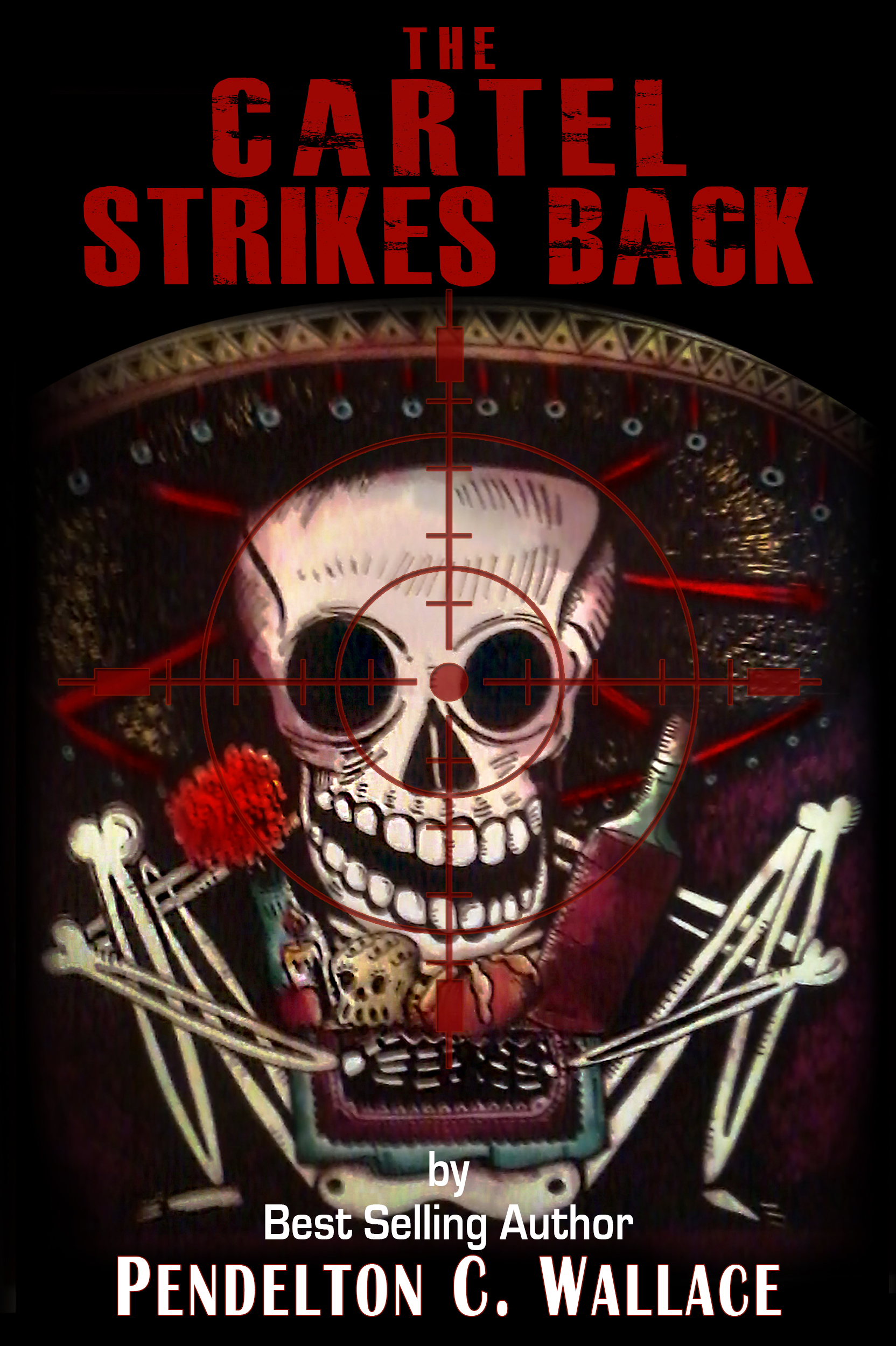
Tell us about your new book? What’s it about and why did you write it? The latest Ted Higuera thriller is The Cartel Strikes Back.
In the Mexican Connection, Ted, Cat and friends were responsible for the death of one drug lord and the capture and imprisonment of another, El Pozolero.
In The Cartel Strikes Back, El Pozolero escapes from prison and causes all sorts of trouble for Ted. Ted has no choice but to go to Mexico and when things get too hot for him to handle, he calls Catrina, Chris and Hope to come to his aid.
SPOILER ALERT: I will tell you that Ted proposed to Maria in this book, I just won’t tell you her answer. I hope that you will be blown away by the ending.
Have you developed a specific writing style? I hope so. I like to have short, action filled scenes, parallel plot lines and cliff hanging scene endings. Hopefully, that will make the reader want to turn the page to see what happens next.
Of course, it all depends on the story. You have to have “good bones” to hang your meat on.
What is your greatest strength as a writer? I can accept criticism. I take my work to writers groups, I ask beta readers for their opinions. In the Ted Higuera series, Ted originally talked about himself in third person (“Ted really likes that.” As opposed to “I really like that.”). I got so much negative feedback that I changed it, even though I loved that part of his quirky character.
Every writer has their own idea of what a successful career in writing is, what does success in writing look like to you? The adulation of millions. Not being able to go anywhere without the paparazzi following me around. No, seriously though, I would like to be able to sell enough books to subsidize my travels and live comfortably on my retirement income.
I’m not thirsting for a million-seller. I would like to be able to tell my stories and have people read and appreciate them. But if I wrote a million seller, I wouldn’t object.
Do you have an organized process or tips for writing well? Do you have a schedule? Everyone writes differently. Before I start writing, I do my research. This could take a month or more to learn everything I need to know about my story. Once I’m comfortable with the story,
I write a beat sheet.
The beat sheet is a three to five page document that outlines the plot, the characters and the story line. When that is done, I know who the characters are, so I write character sketches for the major players in my book. As new characters develop, I go back and write character sketches for them. I want to know who they are and how they will react in situations before I start writing.
Then I write the outline for the book. It is usually fifteen to twenty pages long and describes most of the scenes in the book.
After I’ve done my homework, I start writing. By this time I know the characters and story so well that I don’t really think about what I’m writing. The words just flow from my finger tips.
At this point, I’m always discovering new scenes that I hadn’t planned on or new twists to my characters personalities. It’s a journey of discovery. The neatest thing about my process is that when I’m writing, I’m like a reader. I get the same thrills and pleasure the reader will get as the story unfolds.
I try to write every morning. That is my most creative time. I like to get up and write before the house (or boat in my case) is awake. That way I don’t have any distractions.
Sometimes it’s so hard to keep at it – What keeps you going? I’m just stubborn. When I start a project, I plunge head long into it and keep going until it’s finished. I don’t allow distractions to tear me away. I am determined to finish.
Have you met any people in the industry who have really helped you? Jinx Schwartz comes to mind. I met Jinx in La Paz, Mexico, and she was kind enough to spend a couple of hours with me discussing her marketing process. It was a great help and I took what worked for me in her process and continue to build on it.
What do you hope people will take away from your writing? I just want to entertain people. I’m not trying to change their lives or provide some great hidden truth. I want them to relax and forget the world for a few minutes and just enjoy the story.
Is there anyone you’d like to acknowledge and thank for their support? Without a doubt, my mother. She hated the first draft of Blue Water & Me because she was in it and she is a very private person. After not talking to me for about three weeks, she finally gave me her permission to use the material she objected to.
Since then she has been 100% in my corner. I am most grateful for her support.
How did you come up with a title? I usually brainstorm the title. I make a list of possible candidates, nothing is too stupid to add to the list. Then I share it with my friends and ask for their ideas and input.
Once I have twenty or thirty possibilities, something usually suggests itself.
There was a comic book when I was a kid called Hero for Hire. Somehow, when I started writing Hacker for Hire that memory resurfaced in my mind.
Ted is a computer security analyst. Corporations hire him to try to hack into their systems to find vulnerabilities before the real hackers find them. To me, this was a Hacker for Hire.
Can you tell us about your main character? Ted Higuera is the son of Mexican immigrants. He grew up in the barrios of East LA and has a little of that hermano still in him.
He was fortunate enough to be physically gifted. He set scoring, touchdown and yardage records at Garfield High School in LA and won a football scholarship to the University of Washington where he met Chris Hardwick.
Chris is the kid born with a silver spoon in his mouth. His dad is the head of one of Seattle’s most prestigious law firms. Chris grew up in a million dollar estate overlooking Puget Sound.
Everything comes easy for Chris. He has an eidetic memory and finished first in his class. Ted has to scrape and claw for everything he’s earned in his life. The two come together to make a great crime fighting duo.
How did you develop your plot and characters? I don’t have to make this stuff up. I just read the newspaper. Hacker for Hire is a real life situation that happened in one of the Fortune 100 companies in this country. I have moved the story to Seattle, changed the company name and thrown in a murder or two, but the basic plot was already there.
I should say something about Catrina Flaherty. is a kick-ass private investigator.
I modeled her on a PI that I did some consulting work for a few years ago. I remember the sales guy asking me what I thought about her and I said “I wouldn’t cross her. She can kick both of our asses.” I love her character and decided she would make a great stand alone protagonist.
The Catrina Flaherty Mysteries consist of a short story called Mirror Image and a novella called Murder Strikes Twice. In her upcoming novel, she is on a mission to find a serial rapist who preys on undocumented aliens.
Who designed the cover? Brandi McCann has been designing my covers and I like them a lot. I am trying to keep a consistent look and feel to them. I just had her do a cover for a short story that I will publish shortly that is about one of the characters in the Ted Higuera series, but Ted and Chris aren’t in it. I wanted to keep the same feel without the trademark bullseye on the cover. She did a terrific job.
Who is your publisher? My first book, Blue Water & Me, Tall Tales of Adventures With My Father, was published by Aberdeen Bay Press. I will be eternally grateful that they took a chance on an unknown author.
However, I felt that they overpriced my book and it has not sold well. They also don’t give their authors any marketing support. Once the book is published, you are on your own.
I decided to take the plunge and publish my second book, Christmas Inc., myself, using Create Space and Kindle Direct Publishing. It hasn’t sold well either.
I will continue to publish my own books. I have heard that you need to have at least five books out before you can build an audience. This makes sense.
If a reader finds your book and really likes it, they immediately want another one of your books. If you don’t have one available, they will move on to another author and forget about you.
I did this with a young author in the 1970’s. I read his first two books and loved them, but he didn’t have anything else out yet. I promptly forgot about him for thirty years, until I re-discovered Patrick O’Brien who had about twenty-five books available for me to chain-read by then.
I also understand that if our books are in a series, it will make the marketing easier. People will fall in love with your characters and want to know what they are doing next.
Why did you choose to write this particular book? I didn’t have a choice. The newspapers, TV and the Internet were screaming out the plot. I couldn’t resist. It is such a current topic, I hope readers will flock to The Cartel Strikes Back.
What was the hardest part about writing this book? Finding a way to mix it in with a very full and complicated life. I started the book in January and finished the first draft by the end of February. I managed to get that writing shoe horned in around working on the boat, attending a writers conference and figuring out what the next step is in our lives.
I’m in the editing process now. I have to work that around getting ready to move and taking off on an adventure to Panama.
Did you learn anything from writing this book and what was it? I wanted to write a book that sucked you right in. I started with a compelling character (is he a good guy or a bad guy?) and dropped the reader into a situation that they don’t know what is going on. I wanted to show the readers what the situation in Mexico was like so they could understand the tale I was about to weave. Then I went back and introduced our main characters and gave the reader a little bit of insight into their angst.
Hopefully this formula will work. I hope that people will start the book and be so intrigued that they have to keep reading to find out what the heck is going on.
Will you write others in this same genre? Yes. I am already writing the fifth book in the series, The Cartel Strikes Back. I’ve already told you about that, but book the next Catrina Flaherty novel will be a kick to write.
Is there a message in your novel that you want readers to grasp? I don’t believe in Hollywood endings. Life isn’t that way. In The Inside Passage one of the major characters is killed at the end of the book. In Hacker for Hire the ending will surprise and chill you. I won’t give it away, but let’s just say that, in the end, justice prevails, despite our messed up court system. In The Mexican Connection one of the team gets killed in the big finale. I defy you to guess the ending to The Cartel Strikes Back.
But what I really want the readers to realize is how greedy these people are. They already have everything and are willing to go to extreme lengths to get more. How much do they need?
How much of the book is realistic? It’s happening right now. Pick up a newspaper. I won’t tell you who the characters are based on, but it shouldn’t be hard to figure out. I really didn’t need to make up anything to move the story along, it’s too bizarre to believe. Of course, I did imagine an ending for the story that had not yet played itself out.
Have you included a lot of your life experiences, even friends, in the plot? You betcha. I lived in La Paz for two years, so the geography is realistic. Some of the characters are people I met there. As I’ve already said, Cat is based on a real-life woman. Ted and Chris are also based on real people. Ted’s family is totally made up, but it’s not too far different from the family in which I grew up.
Maria and family are based on some very dear friends we met in Mexico. I hope they are not offended by the story I made up for them.
How important do you think villains are in a story? Villains are the story. Can you imagine The Silence of the Lambs without Hannibal Lecter? What about the Wizard of Oz without the Wicked Witch of the West?
In order for your hero to stand out, he/she must face a villain of at least equal ability. That’s why Doyle had to create Professor Moriarty, the Napoleon of Crime, to give Holmes an adversary that was worthy of him.
To build tension in your story, the villain must be able to manipulate and mislead your protagonist. He/she must appear to have the upper hand so that your hero can overcome the odds and everyone can live happily ever after.
By the way, I hate happily ever after. I despise Hollywood endings. I try to have my stories end on a more realistic note. The readers might not like it, but I feel it’s true to the world.
What contributes to making a writer successful? You have to be able to get your thoughts down on paper in a coherent way. You need to comply with the current reading habits of American readers. You have to have a story to tell, but most importantly, you need to be persistent.
I know many writers who want to write in their own style. That’s well and good, but they are severely limiting their audience. A few years ago, I would have said that it’s the kiss of death, because no agent would pick up an author who doesn’t write for current tastes. However, with electronic publishing, anyone can publish a book. Now you just need to find an audience that enjoys that style of writing.
I read my father’s work and it reminds me of 19th century writing. Charles Dickens comes to mind. It is a great story, but I don’t think a modern reader is going to slog through all of the purple prose.
The most important part of writing success is just showing up. Being there everyday. Writing. Working on publishing. Spending hours each day marketing your work.
I always ask people why they write. If they write because they love it, that’s fine. They may have a story that they just have to tell, that’s good too. To many of my friends, it’s a hobby. They have no intention of ever publishing their work.
I have other friends who are so caught up in the writing that they never look beyond that to what happens when their manuscript is complete.
Writing for a living is hard work. Don’t let anyone tell you otherwise. The book is about 50% of the job. Getting it published is another 50%. Then selling the finished work is the final 50%/
Wait a minute, that doesn’t add up. You can’t have more than 100%. That’s right. Writing is one of those jobs whose parts exceed the total of the sum.
If you could leave readers with one bit of wisdom, what would it be? In those immortal words of Winston Churchill, “Never give up.”
Thanks, Penn Wallace! You have given us a new series to investigate.
Find Penn’s books on Amazon. Start with THE INSIDE PASSAGE.


 Mérida weekends are all about fun. The Plaza Grande is huge and inviting. Flanked by the oldest cathedral on mainland America, it’s filled with covered stands selling the colorful embroidered clothing of the region, toys, and musical instruments. Food stands ring the edges. The people of this region are the friendliest in all Mexico. Sunday is the day for people to bloom. It begins with everyone headed to church in puffy jackets, since the temperature can plummet overnight to 72º Fahrenheit.
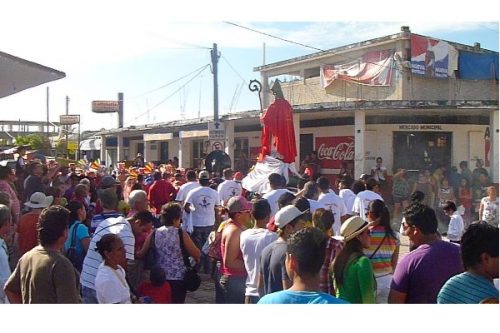 Named after the martyr St. Blaise, fourth century physician and Bishop of Sebastia, Armenia, San Blas celebrates its namesake Feast Day on February 3 each year with religious processions, a parade of floats and local children in native costume, dances in the plaza, and the old-style firework tower of screaming, smoking, whistling, whirring explosive madness that would cause strokes in State-side mothers and OSHA inspectors.
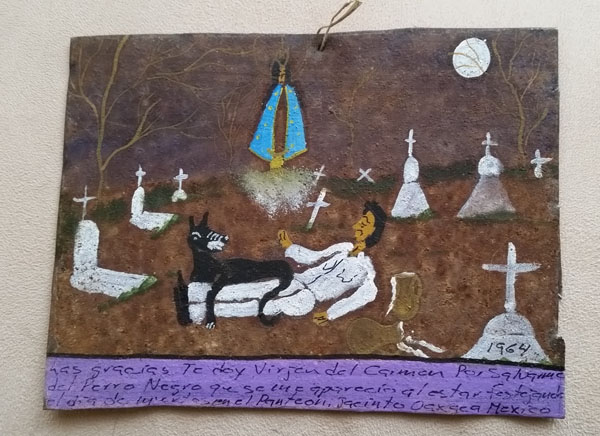
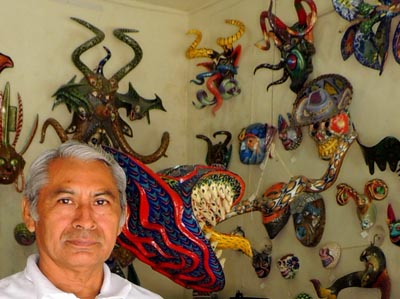
 True or not, this story is part of the lore that the creatures have as both scary and magical at the same time. Their allure in Mexico City and beyond has only grown over the decades and can be credited with saving cartonerìa. In 2007, the Popular Art Museum (Museo de Arte Popular) decided to challenge artisans to create “monster-sized” versions which have over the years exceeded over two meters in height and five meters in length. My husband and I have been fortunate to work with this innovative museum and receive special permission to cover this event and others for Wikipedia and my blog.


 2. CA: How do you create multi-dimensional fictional characters, including the terrorists? Where do you look for inspiration when creating characters?
 David’s bio:
  Chatting with mystery and thriller writers is almost as much fun as reading their books. If you love mysteries and thrillers as much as I do, you know how important book reviews are. But no time to write a review? Get my 5 Sentence Formila Cheatsheet now to start writing reviews that matter!




 On real life
 Why do you write? I like to tell tales. Some say I have a loose hold on the truth, so why not use it?


 What’s your next project? After the cartonería book, I want to do one on the La Catrina phenomenon in Mexico.
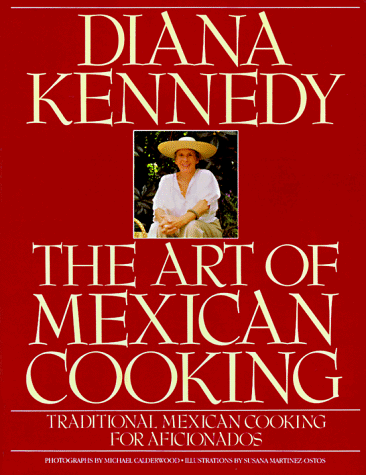 Who do you admire? Anthropologist and handcrafts researcher Marta Turok. I did her Wikipedia article. Second is food researcher Diana Kennedy.