Book review: AUNTIE POLDI AND THE SICILIAN LIONS

Book review: AUNTIE POLDI AND THE SICILIAN LIONS

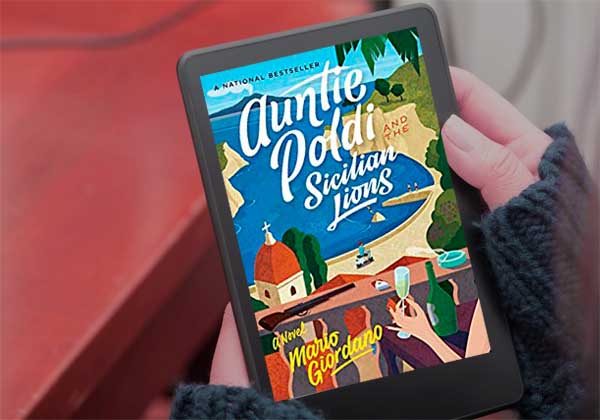
AUNTIE POLDI AND THE SICILIAN LIONS by Mario Giordino is a delicious whodunit, yet for this book review, it defies easy categorization. It’s one part Inspector Montalbano series by Andrea Camilleri and one part Don Camillo series by Giovanni Guareschi. Add a light sprinkle of AUNT JULIA  AND THE SCRIPTWRITER by Mario Vargas Llosa and you have a wickedly funny tale that is truly original.

Poldi is the nickname of Isolde Oberreiter, a 60-year-old German woman whose Sicilian husband recently passed away. Descriptions of her evoke Elizabeth Taylor in the 1970’s—caftans, bouffant black hair, imperious manner, lots of alcohol.

She takes a house in a small village in Sicily to be near her three sisters-in-law. Poldi, an ex-hippy, ex-costume designer, and the daughter of a German cop, plans to sit on her new rooftop terrace, look at the sea, and drink herself to death.

To refresh your memory, Sicily is the roughly trapezoidal island positioned at Italy’s toe, eternally waiting to be booted into the Mediterranean. A ferry trip across the Straits of Messina is a grand introduction to Sicily’s charms: almond and lemon groves, picturesque towns with cobbled streets, olde worlde trattorias where the locals meet for coffee, and pizza joints run by the Mafia. (Also creepy guys pestering women for phone numbers but, alas, I was 20 and this probably wouldn’t be an issue now.)

Related post: Book review: THE DOGS OF ROME

Poldi’s plans take a left turn when a young man who does odd jobs for her is murdered. As Sicilian law enforcement bumbles about, Poldi decides she will solve the crime herself.

Along the way, Poldi makes several enemies, runs into a poetry-spouting aristocrat and his Doberman, and is threatened by both a Mafia talisman and a dangerous intruder. She also becomes enamored of a detective who actually seems to know what he is doing.

In the end, Poldi unravels the case with the help of her sisters-in-law and the handsome detective, but the case nearly unravels her, too.

Related post:  2 Tickets to Venice

Part narrator and part Greek chorus, Poldi’s unnamed and unemployed German nephew shares her story with us. From his room in her attic, he’s perpetually writing the first chapter of a novel we know will be quite terrible.

It took great skill to craft a book this way and it shows. His narration never intrudes, but like the Vargas Llosa book, is a charming addition to the main plot. Descriptions are priceless, ranging from wryly humorous to laugh-out-loud funny. Dialogue deftly transitions from Poldi’s escapades to her brisk discussions with the nephew.

If you know a bit of Italian or simply love Italian food, you’ll appreciate AUNTIE POLDI AND THE SICILIAN LIONS all the more. The author doesn’t assume you are intimately familiar with Sicily, however, only that by the end of the book, you’ll never want to leave.

Thank goodness, Poldi’s second mystery, AUNTIE POLDI AND THE VINEYARDS OF ETNA, came out earlier this month.

You may also like

Book Review: le Carre’s A LEGACY OF SPIES

Book Review: le Carre’s A LEGACY OF SPIES

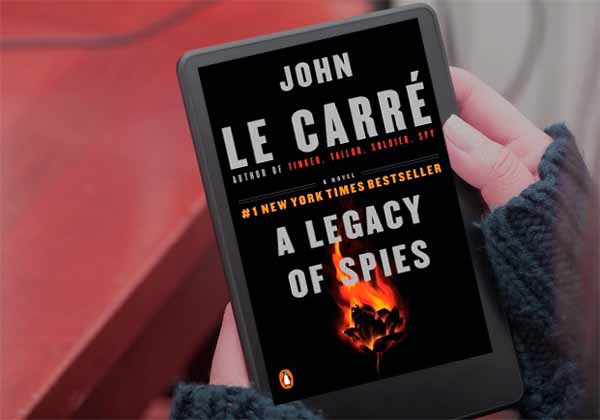
A LEGACY OF SPIES is the long sought-after backstory of le Carre’s first bestseller, THE SPY WHO CAME IN FROM THE COLD (henceforth THE SPY), a slim volume that taught many readers how the Cold War was fought. This week’s book review is all about connecting the oh-so-cold dots.

To refresh your memory, in THE SPY British intel officer Alex Leamas, a hard-drinking, hard-driving spymaster in Berlin, pretends to get fired and fall on hard times. It is a ruse, however, for Alex to be “recruited” by Soviet/East German intelligence so he can save an odious East German intel officer who is Britain’s greatest asset inside the Iron Curtain. To position himself to be pitched, Leamas develops a relationship with an unwitting librarian named Elizabeth Gold who brings him along as her plus one when she attends a socialist conference in East Germany—all orchestrated by the brilliantly quiet George Smiley.

Related post: Book review: RED SPARROW by Jason Matthews

In A LEGACY OF SPIES, it is 50 years later. The offspring of Leamas and Gold sue the British government to find out how and why their parents disappeared. The new generation of British spooks, who want to make the lawsuit go away, find that the files on Leamas, as well as the East German agent codenamed Windfall, have been purged.

With no memory of the Cold War and no appetite for its justifications, they bring in Peter Guillam (BTW, Benedict Cumberbatch played him in the 2011 movie with Gary Oldman as George Smiley). No one can find Smiley; but as the infamous spycatcher’s right-hand-man, Guillam will do.

Guillam narrates the book, which moves across time. At first we are in the present when he is summoned to London, there to find that long-held secrets are on the verge of being exposed. Then through his memory, we are transported to a Cold War landscape. London plots and directs. Spies sneak in and out of East Germany which is replete with Stasi brutality and Communist paranoia. There are shortages of everything, except informers.

The look into the past gives us the first case in which Smiley is led to believe there is a mole inside British intelligence and reveals how Windfall came to be recruited to the British side. These elements set in motion everything that happens in THE SPY.

A LEGACY OF SPIES is another le Carré espionage tour de force. Haunting writing, the sense of wheels-within-wheels. The back and forth across time is handled deftly, without confusion.

Subtle clues abound. Gather them carefully—le Carré is never obvious.

The book is a standalone, but will be a richer experience if you have at least read THE SPY WHO CAME IN FROM THE COLD (or saw the 1965 movie starring Richard Burton. FYI Dublin substituted for Berlin).

Other bestsellers featuring Smiley and his team, TINKER TAILOR SOLDIER SPY and SMILEY’S PEOPLE, are also referenced in A LEGACY OF SPIES. Peter Guillam was with Smiley through the entire Cold War, you see, and he has a long memory.

Highly recommended.

You may also like

Louise Penny’s KINGDOM OF THE BLIND

Louise Penny’s KINGDOM OF THE BLIND

In Loise Penny’s latest Armand Gamache mystery, KINGDOM OF THE BLIND, the Canadian crime fighter has been suspended from his job as head of the Sureté, the top law enforcement agency in Canada’s French-speaking Quebec province. The storyline is a continuation of the previous book, GLASS HOUSES, in which Gamache lets known shipments of drugs slip into Quebec in order to follow the trail of a major drug kingpin.

Truth be told, as someone who writes about drug smuggling and cartel kingpins, I found the premise of GLASS HOUSES ludicrous and the ending painfully naïve. Most of the previous Gamache novels focused on art-related crime with deep dives into relationships, motive and psychology. KINGDOM OF THE BLIND returns to that winning formula, but cleans up the mess left by GLASS HOUSES.

Thank goodness.

Related post: Department Q and THE KEEPER OF LOST CAUSES

Gamache, awaiting the results of an official inquiry into his failed counterdrug actions,  is surprised to find out he’s been named executor of the estate of a woman he never met. Myrna, his neighbor in the tiny village of Three Pines, is also an executor as is a young builder from Montreal.  The unknown deceased was a cleaning lady who liked to be called “the Baroness.”  Her three children are surprised to have three strangers enter their lives in connection with their late mother’s will.

DUAL plotlines

As Gamache pokes into the Baroness’s background, KINGDOM OF THE BLIND branches out in multiple page-turning directions. The Baroness was a descendant of a European industrialist whose fortune has been tied up in courts for more than a century. Who knew? Was it possible she was going to inherit? Gamache is sent spinning in yet another direction when the Baroness’s house collapses and one of her sons is found murdered.

At the same time, Gamache is tracking a cadet who was kicked out of the Sureté training academy for allegedly dealing drugs. The girl was once a crackhead and she immediately hits the streets in search of the carfentanil shipment which slipped through Gamache’s fingers in GLASS HOUSES. While Penny wants us to believe she’s gone back to her old ways, it wasn’t hard to guess that she is undercover.

Character-driven

While the drug scene excerpts were more believable this time around, the Three Pines cast of characters is what makes KINGDOM OF THE BLIND another Gamache winner. There are several epic meals, with everyone chiming in around the table in the bistro or someone’s home in the village, all talking over each other as they puzzle out murder, mayhem, and the strange legacy of the Baroness’s ancestors.

This is perfect “chorus of voices” writing. The dialogue crackles with insider jokes; each comment perfectly pitched to the speaker. The various personalities shine through, laced with humor and empathy. These scenes contain the best group dialogue I’ve ever read.

Someone asked a Facebook mystery group to name their favorite book setting and the response was a near unanimous “Three Pines.” Readers wanted to curl up in Olivier’s Bistro with a hot chocolate in the evening or enjoy café au lait and pancakes in the morning. KINGDOM OF THE BLIND does a wonderful and much-needed job of bringing us back to Three Pines for another memorable Gamache story.

You may also like

Two awards

Two awards

The first quarter of 2019 has been an exciting time. Two recognitions have come my way, for which I am both surprised and grateful.

CrimeMasters of America

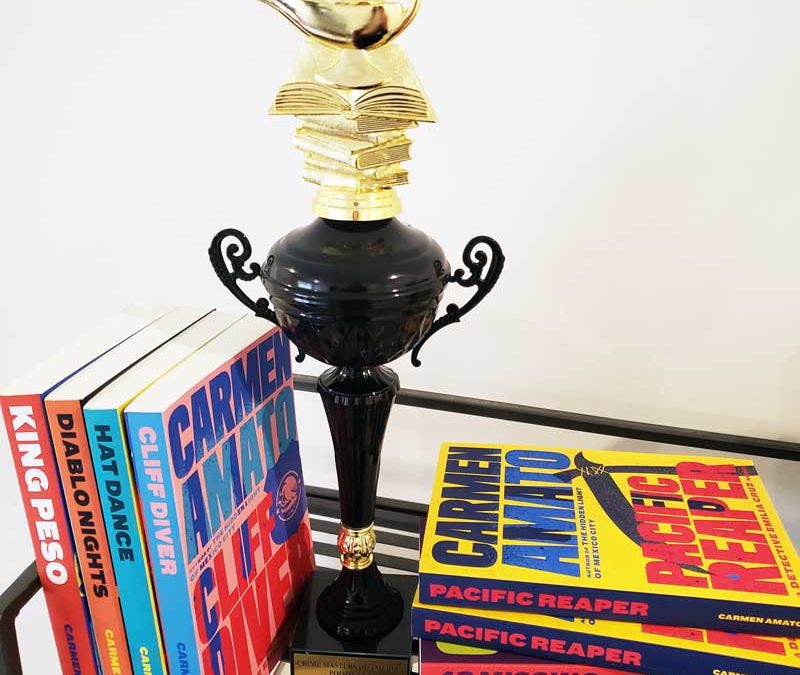
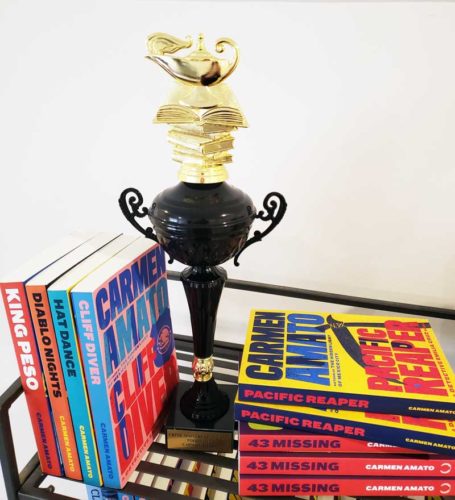
The Detective Emilia Cruz series won the Poison Cup award from CrimeMasters. I was quite overwhelmed when the Poison Cup arrived in an enormous FedEx box and revealed itself to be an impressive trophy.

Cup winners included categories for standalone suspense, mystery series, true crime, and blogs. This is a peer-based award, which makes it doubly precious.

Hall of FAME

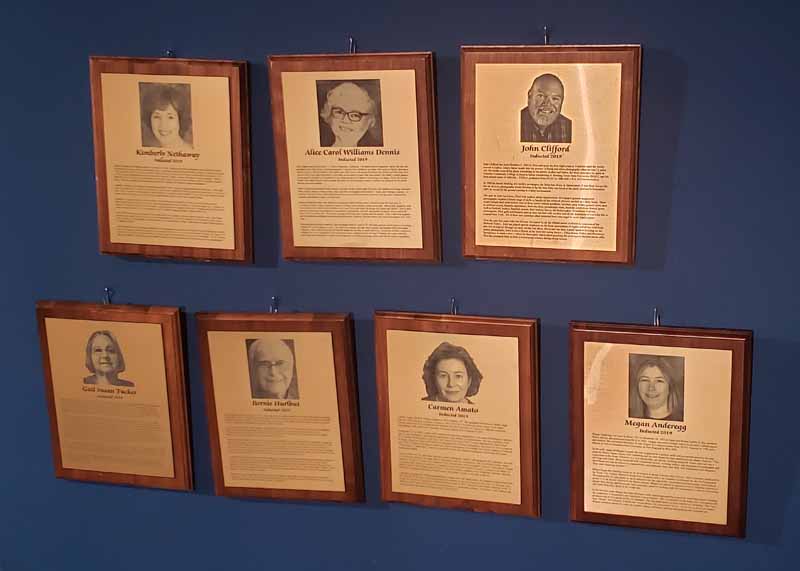
On 28 April, I’ll join 6 others as inductees into the Arts Hall of Fame of my hometown of Rome, NY. Every year, people who are from Rome or who have contributed to the arts life of the city, are inducted with a ceremony. There is a display of accomplishments for each inductee as well. Read the press release: https://romesentinel.com/stories/seven-area-artists-to-be-inducted-into-rome-arts-hall-of-fame

I’m working on the display right now, which will include book covers images, quotes from reviewers, and  an excerpt.

REFLECTION

I’m coming up on my 7th anniversary of being a published author. It all started with THE HIDDEN LIGHT OF MEXICO CITY, the book I wrote because I wanted to say something about Mexico’s rigid social structure.

Who expected awards!? I was thrilled if I sold a book each month.

To be honest, my goals have been small and fairly selfish:

  • Write books that aren’t the usual.
  • Challenge yourself to create puzzles and tangles that stretch your brain.
  • Meet fellow wordsmiths.
  • Catch moments of “flow” that leave you charged with adrenaline and feeling like you are growing your skills.

Thank you, CrimeMasters and the Arts Hall of Fame, for the honors.

Criminal Element Features Joint Examination of Narco Noir Genre

Criminal Element Features Joint Examination of Narco Noir Genre

February 27, 2019

Criminal Element, one of the leading sites devoted to crime fiction, published “The Ascent of Narco Noir: A Literary Game Changer,” co-written by thriller writers Carmen Amato and Jeanine Kitchel. Find it here: https://www.criminalelement.com/ascent-narco-noir/

The article dives into the narco noir genre of crime fiction inspired by drug cartel activities in Mexico and Central America. Including Amato and Kitchel, authors writing in the narco noir genre include Don Winslow, Sam Hawkins, Guillermo Paxton, and others. The genre has its roots in non-fiction, creating a body of work and blurred lines that crosses from the page to the screen and back again.

“Narco noir fiction is a by-product of the drug war that has irrevocably altered the political and societal landscape in Mexico, Colombia, and Central America. With a few exceptions, narco noir authors walked the walk themselves as federal agents, cops, or journalists at the front lines of the drug war.

“The result is a compelling mix of fiction, reporting, and exposé, as well as memorable characters on both sides of the law, painted in shades of gray. And blood red.”

About the Authors:

Members of the dynamic Mexico Writers group on Facebook, Carmen Amato and Jeanine Kitchel first collaborated on the travel essay collection The Insider’s Guide to the Best of Mexico. They write crime fiction, however, from opposite ends of the cops-and-cartel spectrum.

Following a 30 year career with the Central Intelligence Agency, Carmen Amato created the Detective Emilia Cruz mystery series, which pits the first female police detective in Acapulco against Mexico’s cartels, corruption, and culture of machismo. The series was recently awarded the Poisoned Cup for Outstanding Series by the CrimeMasters of America. 43 Missing, the latest book in the series, was a 2018 Silver Falchion Award finalist for Best Procedural. Visit Carmen’s website at CarmenAmato.net to get a free copy of the Detective Emilia Cruz Starter Library.

Jeanine Kitchel’s love of Mexico led her to a fishing village on the Mexican Caribbean coast where she bought land, built a house, and opened a bookstore. A former journalist, she wrote travel articles for newspapers and Mexico websites before branching into fiction.

In Wheels Up—A Novel of Drugs, Cartels and Survival, Latina protagonist Layla Navarro rises to the top of Mexico’s most powerful cartel after her drug lord uncle is recaptured. Challenged by enemies from without and within, she’s determined to retain her dominant position in Mexico’s criminal world—if she can stay alive. Book two in the trilogy, Layla’s Law, is in the works. Check JeanineKitchel.com for details.


Book review: Sherlock Holmes, twice as nice

Book review: Sherlock Holmes, twice as nice

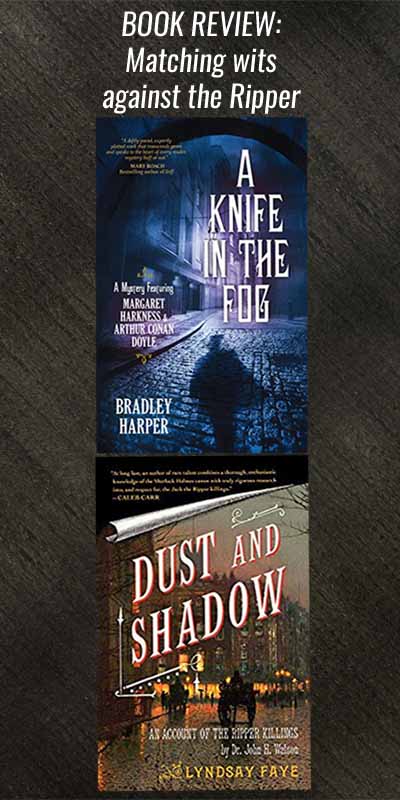
A KNIFE IN THE FOG and DUST AND SHADOW are both sensational thrillers. The two books have a few things in common, including exceptional historical research, an investigative trio, and a satisfying conclusion, yet each offers an original take on Victorian London’s most heinous true crime.

Sherlock Holmes vs Jack the Ripper

A KNIFE IN THE FOG by Bradley Harper goes beyond the familiar Sherlock Holmes construct with a truly unique set-up: all of the main characters are real-life historical figures who influenced Victorian society. The book rings with authenticity and the historical elements are executed faultlessly.​​​​​

The narrator is Arthur Conan Doyle himself.

In the summer of 1888, Doyle is a practicing doctor in  Portsmouth and has published A Study in Scarlett, the story which introduced Sherlock Holmes. His wife is pregnant with their first child and his future looks to be that of a general practitioner and family man, writing stories on the side to augment his income and amuse himself.

Doyle receives a summons to London from the office of former prime minister William Gladstone, whose secretary has read Doyle’s story and wishes him to become a paid consultant to find the killer terrorizing London’s East End.  Doyle agrees on condition that his former mentor, Professor Joseph Bell, joins the effort.  Bell, a Scottish surgeon and lecturer at the medical school of the University of Edinburgh and widely regarded as the real-life inspiration for the character of Sherlock Holmes, soon joins Doyle in London.

A third real-life figure joins Doyle and Bell. Margaret Harkness is an investigative journalist and social commentator whose writings expose London’s poverty and social injustices. Often using the pen name John Law and disguising herself as a man, Margaret will be an invaluable guide and ally.

By giving Doyle a voice of his own, author Harper has created a character as appealing as Holmes. Doyle is considerate and charming, with the formalities and vocabulary of the British gentleman of 1888. Doyle draws the reader into his confidence as the three develop a working relationship, navigate Victorian social rules as well as London’s dark and dangerous passageways, and encounter Jack the Ripper’s missives and victims. Margaret is tireless and Doyle’s growing feelings for her provide a quiet complication.

With deductive reasoning worthy of Sherlock Holmes, the three encounter danger and deceit on the way to identifying Jack the Ripper. The end is a heart-stopper.

DUST AND SHADOW by Lyndsay Faye delivers a more familiar construct in which Dr. John Watson narrates an investigation conducted by the famous detective Sherlock Holmes. Watson, as in the Conan Doyle stories, is the perfect everyman foil to his brilliant friend. Faye amps up the legendary Holmes formula, however, immersing the reader in the details of life with Holmes: his moodiness, restlessness, investigative prowess, the many trials of Mrs. Hudson the housekeeper. Holmes’s dialogue crackles with acerbic personality and sharp wit. I swear I heard Benedict Cumberbatch’s voice in my head.

An investigative trio is also formed in DUST AND SHADOW when Holmes hires Mary Ann Monk, the friend of one of the Ripper’s victims. The investigation initially turns on the whereabouts of an Army man supposedly seen with an early Riper victim.

Warned by his Baker Street Irregulars—the group of street urchins that provide Holmes with intelligence—Holmes and Watson are able to arrive first on more than one murder scene. When Holmes is stabbed in pursuit of the Ripper, the gutter press begins to question if he is the killer.  With his credibility strained and vigilantes out to get him, Holmes goes undercover to ferret out the Ripper. Mary Ann and Watson carry on until the three reunite for a stunning and wholly believable climax.

If you are a Sherlock Holmes fan or a student of the Ripper’s crimes, both A KNIFE IN THE FOG and DUST AND SHADOW are unmissable treats. The only spoiler I’ll reveal is that the identity of the Ripper is different in each book. Both are highly recommended.

You may also like

sherlock holmes

The lost chapter of THE HIDDEN LIGHT OF MEXICO CITY

The lost chapter of THE HIDDEN LIGHT OF MEXICO CITY

My “Simplify” theme for 2019 led to some housekeeping and that in turn led to the discovery of a lost chapter of THE HIDDEN LIGHT OF MEXICO CITY.

lost chapter

Backstory

The novel was originally an 800 page (Not. Kidding.) all written from the point of view of the female protagonist, Luz de Maria Alba Mora. 500 of those pages were other characters explaining things to her that had happned while she wasn’t around.

Ultimately, after 8 years of editing, THE HIDDEN LIGHT OF MEXICO CITY became a political thriller with a strong love interest in the style of Ken Follett’s books TRIPLE and THE KEY TO REBECCA. I always thought it would make a great movie, too.

Related: Read Chapters 1 and 2 of THE HIDDEN LIGHT OF MEXICO CITY

One of the issues in the book is the slow transformation of Luz de Maria from a housemaid with big dreams to a woman unafraid to reach higher on the social ladder. The scene below ended up being surplus but I always liked the way she figured out the problem and gained confidence because of it.

The setup is that she has fallen in love with a man from Mexico’s highest social class–Eduardo “Eddo” Cortez Castillo–and he has asked her to marry him. Her answer is pending. They are in a luxury hotel and will attend a party later; Luz figures if she can survive the party it will help make up her mind.

The number 314 is symbolic; it was her number when waiting to be interviewed for a US work visa.

The lost chapter

“It’s a deal,” Eddo said and kissed her cheek. “Let’s seal it with some food. You order us up some breakfast while I take a quick shower.”

He disappeared into the bathroom. Luz went into the living room and realized she didn’t have a clue how to order room service. Her bravery popped like a bubble.

The hotel binder was on the table next to Eddo’s laptop. She scooped it up and flipped through the pages. It listed the times they served various foods but there weren’t any instructions. Luz tossed the book onto the loveseat and went over to the phone by the chair. Attached to the phone was a small card with a listing of hotel services. Reception-10, Concierge-11, Housekeeping-12, Taxis-13, Room Service-14. That couldn’t be right. No telephone number was only two digits. And every number in Mexico City started with 5.

He would just have to explain how this worked. Luz went into the bedroom and knocked on the bathroom door. The water was going. Eddo was singing Miguel Bosé’s Sólo Pienso en Ti. He didn’t hear her.

Luz sagged against the doorframe, torn between hopelessness and determination. Order us up some breakfast. She’d told herself she would let the despedida decide but maybe that had been a hollow promise. She could hardly marry Eddo if she couldn’t get food in his world.

Eddo started ringing out “Poco á poco” from the refrain. Luz shoved herself away from the doorway, thinking furiously. She went back into the living room, and hit ‘0’ on the telephone keypad. She would call the Telmex operator and ask if two digit telephone numbers were possible.

“Palacio Suites. How may I direct your call?”

“Is this still the hotel?” Luz blurted.

“Yes, señora. Were you trying to get an outside line?”

“I want to order breakfast,” Luz said.

“I’ll put you through to room service or you can dial 14 from your room phone.”

“Just ‘1’ and ‘4’? That’s not enough numbers.”

“That’s just when you’re inside the hotel, señora.” The operator paused. “Would you like me to put you through to Room Service now?”

“Yes, thank you,” Luz said.

There was a ring, then a woman’s voice. “Room Service. May I help you?”

Luz hiccupped in astonishment. It had really worked. “I’d like to order some breakfast,” she managed.

“Certainly. What is your room number, please?”

“Oh.” Luz had no idea. Who called to have food sent to their room and didn’t know what room they were in? It was good the person on the other end of the connection couldn’t see her face. “Hold please,” she said, just as Señora Vega had taught her. She looked around for a piece of paper with the room number on it but there was nothing. Even the card Eddo used to open the door, on the table with his car keys and cell phone, just had the name of the hotel on it. He was still singing in the bathroom as she flung open the door to the suite and looked outside.

Luz darted back to the phone as the door swung shut. “It’s 314,” she said breathlessly into the phone.

“Señor Cortez’s suite,” the woman verified. “El señor let us know you were coming, señora. I hope you are enjoying your stay with us.”

“Yes,” Luz said, taken aback. Did everyone in the hotel know that she was an unmarried woman sleeping with an unmarried man?

“What can we send up, señora?”

“What?”

“You wished to order breakfast, señora?”

Madre de Dios, she hadn’t even thought of what food to eat. Luz smacked herself in the forehead with her hand, feeling rushed and idiotic and embarrassed. The hotel staff was going to think Eddo’s unmarried señora was dull-witted.

Luz snatched up the room service binder and flipped it open to the breakfast page. “Two omelets with mushrooms and cheese,” she decided swiftly, deliberately not looking at the prices. “A fruit plate.” Eddo always ate fruit. “And coffee.”

“For two?”

“Yes.”

“Bacon or ham with the omelets?”

The choice paralyzed her for a second. Her mind jumped around, trying to remember the things she’d seen Eddo eat in San Miguel. He’d had both. Luz exhaled. “Ham.”

“Cream with the coffee?”

“Yes, thank you.”

“And does el señor want his usual newspapers included with that?”

Luz closed her eyes. She had no idea what she was doing or how much this was all going to cost. “Yes.”

“It’ll be up to you in about 20 minutes.”

“Wait,” Luz gulped. Eddo liked spicy food. “Can you send some salsa roja with that?”

“Of course, señora.”

“Wait,” Luz said again. “Is it made fresh?”

“It’s made fresh daily right on the premises.”

“Thank you.” Luz hung up the phone and sank nerveless onto the loveseat. She dropped the binder and started giggling, on the edge of hysteria just for ordering some food.

Of course it wasn’t there yet. A waiter would bring the food on another little skirted trolley. An entirely new hurdle loomed as Luz realized she’d have to sign for the food, just like Eddo had done last night. And she’d have to give the waiter a tip. Nobody in Mexico performed a service without getting a propina.

Luz ran into the bedroom and pulled her purse out of the closet drawer. No doubt she had enough small bills in her wallet to give the waiter a tip. But the wallet was completely empty.

Luz dumped the contents of her purse onto the bed. Lipstick, compact, hairbrush, tissues, rosaries, cell phone, and the milky quartz stone fell out. She searched the empty purse, running her hand inside it, checking the zippered inside pocket, trying not to panic, sure that her money had to be somewhere. She opened the wallet again, frantically digging in the bill compartment, the coin purse, and in the slots for the credit cards she didn’t have. From the little slot she never used she pulled out the invalidated check for the first paintings she’d sold at el Jardin del Arte.

She sank down on the rumpled comforter, breakfast suddenly forgotten. As she unfolded the check, the humiliation and despair of that day in the bank rose up.

Chingate,” Luz said loudly.

“Did you say something?”

Luz jerked around to see Eddo coming out of the bathroom wearing a towel.

“I think I have water in my ear.” He rubbed his head then indicated the check in her hand. “What’s that?”

“Nothing.” Luz crumpled up the check. “Trash out of my wallet.”

Eddo moved over to the closet. He took out clean briefs and put them on, then walked back into the bathroom to hang up the towel. “Your clothes are still on the floor in here and mine aren’t,” he called smugly. “Just letting you know.”

“Oh!” Luz rushed into the bathroom, gave Eddo a big noisy kiss on the mouth, then pushed him back into the bedroom. “Put some pants on. Breakfast will be here any minute.”

She shut the bathroom door behind her. Her money and identity card were still in the right front pocket of her white jeans.

Luz tore the check into tiny bits and flushed it down the toilet. She had to pull the handle twice before every piece disappeared, swirling and gurgling down the bowl and into the sewer and far away.

Eddo was still buttoning his shirt in the bedroom as she signed the room service check. She had 50 pesos in her hand but didn’t need it. There was a line to write the propina. She mentally calculated ten percent.

Everything she’d ordered was there. Luz turned over the cups and poured them each some coffee.

“Omelets. Wonderful.” Eddo sat down next to her. “Thank you.”

Luz took the top off the condiment bowl. “Salsa roja?”

“Yes, please.” He beamed and spooned a large portion onto his plate. “Very nice. They usually just send up a little bit on the side.”

“Oh, yes,” Luz said airily. “I asked for them to send extra. And made sure it was fresh.”

She was quite sure it was the best breakfast ever.

You can get THE HIDDEN LIGHT OF MEXICO CITY on Amazon:

lost chapter

lost chapter

Open Letter to 2019

Open Letter to 2019

Dear 2019,

With the benefit of having lived through your younger brother known as 2018, you will find me a bit changed. Older, wiser, and a bit more cunning.  

Love, Carmen

From 2018, with love

Every year, instead of a list of easily-forgotten resolutions, I choose a theme for my year. This year it’s “Simplify.”

Last year was a year of big change for me. New state, new house, new community. New challenges trying to transform a house with mud brown walls into a loveable, livable, and light-filled farmhouse while also writing a book, this blog, and growing the Mystery Ahead newsletter all at the same time. Oh, and trying to keep up with social media. And marketing. And book reviewing. 

Things got messy.

Basically, I was doing FAR too many things and spending FAR too much time in the weeds doing time consuming things that didn’t take me where I wanted to go as an author. Too much time was going down the rabbit hole instead of being used for what I wanted to do–write compelling books about the things that intrigue me.

In short, I have always been susceptible to the alluring yet deadly disease called Shiny Object Syndrome. In 2018 this translated into an epic time management fail:

  • I over processed simple tasks, creating more work than necessary.
  • I chased after activities that weren’t aligned with my priorities.
  • I left opportunities on the table.
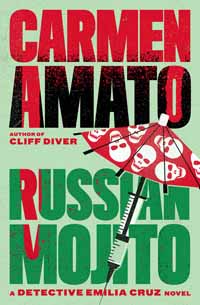
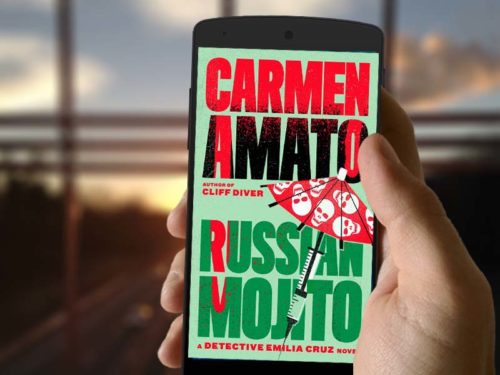
  • RUSSIAN MOJITO, Detective Emilia Cruz Book 7 simply wasn’t getting finished.

Theme for 2019: “Simplify”

After a hard look at where my energies were going, and some hard questions to myself, I knew I needed to simplify, streamline, and get back to my top priorities.

Here is how that will look:

Simpler newsletter: Each edition of Mystery Ahead will have my latest #booknews, exclusive #excerpts, and a mystery #review of a book I think you’ll love. This eliminates the author interviews (simply too time consuming to continue) and the protips (not relevant to my readership). Bonus for me–by sharing excerpts, I’ll be motivated to finish works in progress.

Simpler website: I firmly believe that every professional author needs a professional website. It is the hub of your platform. Social media platforms, book sales pages, etc. are the spokes. That being said, I was still learning the all-powerful Divi theme for WordPress last year and experimented with many of its features. (A particularly virulent case of Shiny Object Syndrome) As a result, blog posts looked uneven and the navigation got unwieldy. After a week of updates, the site is refreshed and easier to navigate. All my books are listed on one page and there is a sub-menu so anyone who wants to know everything about the Detective Emilia Cruz series can find it. Coming soon: better opt-in pages.

Which brings us to social media. A free way to introduce readers to a new author vs an echoing, time-eating cavern with occasional toxic sinkholes. Facebook will be my primary social media outlet in 2019, followed closely by Pinterest. I created a cheatsheet so posting is fun, not a chore. Twitter is off the radar. 

What’s ahead in 2019

The word Simplify has allowed me to clear my head, assess priorities, and make an GREAT action list that doesn’t include the kitchen sink. Here’s the plan:

New books: RUSSIAN MOJITO, Detective Emilia Cruz Book 7 and NARCO NOIR, Book 8, plus updated book descriptions across sales platforms.

Boxed sets: Detective Emilia Cruz Greatest Hits: Vol 1 (CLIFF DIVER, HAT DANCE, DIABLO NIGHTS) and Vol 2 (KING PESO, PACIFIC REAPER, 43 MISSING).

Articles: Guest post collaboration with Jeanine Kitchel, exploring issues from the viewpoint of two female thriller authors.

New project: Preliminary research into the mystery series I’ll start in 2020, which takes place in Norway during WWII.

Outreach: Collaborations to promote the Mystery Ahead newsletter. 

AND a secret project I hope to be able to share mid-year. (Mystery Ahead subscribers will get the news first so sign up now).

What’s your theme for 2019?

Let’s help each other do great things in 2019!

What’s your one word theme for the year?

theme for 2019

The mystery of the disappearing home office

The mystery of the disappearing home office

As 2019 approaches, many of us (self included) look to see the progress made over the past year. For many of us (self included) it was a year of transition.

We moved to a new house in a new state. The Dream House, in a place with lots of creative energy and a friendly community.

Related: Saga of the koi pond

In the 6.5 years since my first book was published, we’ve moved 4 times. Each house offered different places for me to write and I found that environment shaped my writing routine.

This house is no different, but it has taken me longer to figure that out.

Where she writes, take 1

When we moved into the Dream House with an open concept blueprint, we switched up how the rooms were used. The cavernous family room would be our Banquet Hall. The previous owner’s formal dining room–essentially an extension of the front hallway–would become my combo work and home office.

In our previous house, my writing desk was in the former living room. For as long as we lived there, I swore my next office would have a door.

But being a bear of very little brain . . .

I took out the chair rail, slathered the mud-brown walls with Benjamin Moore’s Heaven, hung buffalo plaid curtains, and replaced the chandelier with a sputnik fixture from Sazerac Stitches in New Orleans. Gorgeous.

Rainbox chandelier Sazerac Stitches

I plunked down a bed for the dog, tacked up my outline for Detective Emilia Cruz #7, and got to work.

Sort of.

The open concept guaranteed interruption. No, let me rephrase that.

Fostered interruption.

Front door, television, kitchen, laundry room. Everything within reach and making noise. Family members talking to me because, hey, I’m basically sitting in the middle of a hallway everyone passes through on the way to everywhere else.

Compounding the mistake, I created a mashup of office purposes. Now, if you have ever moved to a new place and had to get a new driver’s license, car registration, accounts for gas, electric, water, etc, you know how it goes. Moreover, after nearly 3 decades of blissful ignorance, we found that our marriage certificate was incorrect!

Bottom line, lots of distractions. Minimal progress on the novel, despite a knockout outline and complete mental mastery of the entwining plot lines.

(Yes. Mental mastery. Having a good day.)

Aaaand, take 2

Fast forward a few months. I’ve declared defeat at the hands of the open concept house and commandeered an upstairs bedroom for my new writing lair. Home office stuff stays downstairs.

It’s a bare bones situation so far, but I’m already feeling more productive. (Witness “mental mastery” line above.)

A few overdue lessons learned, too, which might be helpful to fellow creatives:

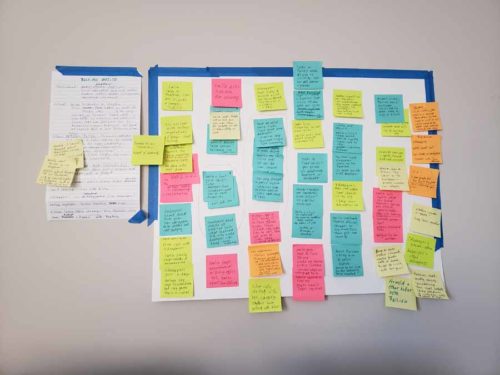
  1. If I can’t see it, I won’t do it. This applies to outlines, social media updates, etc. Things need to go up on the wall and be visual reminders.
  2. I need to assign specific tasks to different days of the week. For years, I have paid bills on Mondays. The newsletter goes out every other Sunday. I’ve fallen off the wagon when it comes to social media and blogging, but these need to be scheduled.
  3. If I write down 3 goals for the next day every night, I won’t waste time idly surfing Pinterest the next day.

So now here I am, with a secluded but bland beige new work space. Time to tape up the outline  and the big map of Acapulco, and get to work on RUSSIAN MOJITO, Emilia #7.

novel outline

Office décor suggestions much appreciated.

home office

Welcome to the opioid crisis

Welcome to the opioid crisis

I spent 30 years with the CIA. My official resume says things like “distinguished record of solutions-driven leadership across multiple mission areas,” and “led program responsible for collection, translation, and analysis of breaking events,” and “oversaw work of employees in multiple locations across Western Hemisphere.”

Hidden in those phrases are the risks, relationships, and experiences that I have funneled into the Detective Emilia Cruz series set in Acapulco. Every day, Emilia faces down violent cartels and official corruption stemming from drug money.

But for all my work, and the work of thousands of others in the intelligence and law enforcement communities, the drug war rages on.

Right in my back yard.

Hello, I’m Marnie and I’m here to introduce you to the opioid crisis

She was our waitress at a national burger restaurant. My daughter and I were exploring our new neighborhood in Tennessee and had stopped there for lunch.

Marnie was a slender brunette in her early twenties in jeans and a tee shirt and plenty of restaurant-provided flair. She bounced over to our booth, tray in hand, and without preamble began telling us how busy she’d been that morning and hoped we didn’t mind the rain and the sweet potato fries were her favorite and did we want some sweet tea and was there anything else she could get for us.

As she spoke, she lowered herself until her elbows were on our table, putting her head on the same level as my shoulder, so that she had to look up at us. With her butt in the air, she hooked one foot around the other ankle, bent her knees, and jiggled up and down as she finally took our order.

I thought at first that she was nervous, then that she had to pee.

Marnie brought our meal in fits and starts, forgot the sweet potato fries, but refilled our tea, once again adopting her curious jiggling bent-over pose.

When she smiled, I saw that her teeth had eroded into small brown stalagmites.

The distinctive rot of a habitual user.

More like Marnie

In contrast to other places I’ve lived, the drug crisis is very much in evidence here. Every day, I see people with the same tell-tale look: twitchy, vaguely confused, thin to the point of skeletal.

There’s both a sadness and an unpredictability about them that is unsettling.

According to the World Economic Forum, “A sharp increase in prescribed opioid-based painkillers and the rise of illegal fentanyl – which is up to 50 times stronger than heroin – has unleashed the worst public health crisis in American history . . . In 2017, there were over 11 million “opioid misusers” in the United States. To put that number in perspective, that’s equivalent to the entire population of Ohio.” https://www.weforum.org/agenda/2018/10/the-numbers-behind-america-s-opioid-epidemic

Closer to home, the governor’s office of Tennessee has this to say: “Each day in Tennessee, at least three people die from an opioid-related overdose, which is more than the number of daily traffic fatalities.” The electronic billboard over Route 40 told me yesterday that 832 had died so far in traffic accidents in the state. https://www.tn.gov/governor/2018-legislative-priorities/tn-together.html

The state’s opioid website gave these statistics for 2017:

  • Overdose deaths: 1772
  • Nonfatal overdose outpatient visits: 15,001
  • Painkiller prescriptions: 6,879,698

The population of the state is 6.17 million.

Do the math. More painkiller prescriptions than people.

Elections and the opioid crisis

The Tennessee matchup between Marsha Blackburn and Phil Bredesen is one of the most hotly contested U.S. Senate races. Marsha is a popular member of Congress. Phil is a popular former governor.

Control of the Senate is at stake, with all that implies. But as the saying goes, all politics are local. And for Tennessee, that means the opioid crisis.

We’ve been treated to a barrage of radio and television ads blaming both candidates for the opioid crisis.

If Phil is to be believed, Marsha singlehandedly prevented the DEA from cracking down on opioid exports into the US and is a paid creature of Big Pharma.

If Marsha is to be believed, Phil is heavily invested in Big Pharma and as governor did nothing to prevent opioids from ruining Tennessee lives.

State Senator Ferrell Haile, a Blackburn supporter, nonetheless hit the nail on the head when he recently wrote in The Tennessean: “Finger pointing and name calling will not solve the opioid epidemic, and every minute spent politicizing it is a minute wasted.” https://www.tennessean.com/story/opinion/2018/09/29/marsha-blackburn-helping-fight-opioid-epidemic/1440487002/

You may also like

opioid crisis

Wounded warriors and the making of AWAKENING MACBETH

Wounded warriors and the making of AWAKENING MACBETH

My great-uncle Nicky was the second-to-the-youngest of my grandfather’s five brothers. He was missing most of his right index finger.

During WWII, while my grandfather turned out copper ship hulls as a foreman at the Revere Copper and Brass rolling mill, Nicky and four other brothers were GIs. I think Nicky was the only one to see combat.

What’s ANZIO?

“Uncle Nicky was at Anzio,” my mother confided. “And the South Pacific.”

As a child, I had no real idea what she was talking about, although Anzio was a cool and somehow romantic word. I used to say it to myself as I waited to fall asleep. Anzio, Anzio. I pictured Uncle Nicky as a fierce soldier dressed like my cousin’s GI Joe action figure, with a gun that blew up, taking his trigger finger with it.

It was only much later that I found Anzio on a map and learned about the bloody and pivotal battle that took place there in the first six months of 1944. Uncle Nicky saw hell in Italy, then was sent to help mop up the Japanese. As if this wasn’t enough for him to handle, Nicky’s young wife died shortly after the war.

Despite his experiences, when I knew him, Uncle Nicky was a lively, wiry, and good-natured man who occasionally visited my grandparents. It was many years later that I learned that he hadn’t been wounded in the war but lost his finger as a kid in a kitchen accident.

VETERANS and WARRIORS

Uncle Nicky may have encouraged my love of history and geography but many veterans have impacted my life. When my parents met, my father was an Air Force meteorologist at a Strategic Air Command base.. My uncle served in Vietnam as a Navy chaplain. A good friend parachuted into the first Iraq War and later taught my son how to be an altar server. A close friend’s husband served in Afghanistan. He survived multiple IED attacks only to face an indifferent and inefficient VA system.

The courage and strength of our vets have moved me, especially when I see wounded warriors rebuild their lives and go beyond what most of us could do. If like me, you are a fan of Dancing With The Stars, you saw double amputee Noah Galloway compete a few seasons ago. His resilience and determination resonated with millions.The same with BT Urruela, a combat wounded amputee, purple heart recipient, contemporary author and veteran activist. Photographs of BT by photographer Michael Stokes captured the character of veteran and amputee Joe Birnam in the thriller  AWAKENING MACBETH.

BT Urella by Michael Stokes

Indeed, I pay tribute to our veterans in the character of Joe Birnam in the thriller AWAKENING MACBETH. In the story, Joe is a Marine Corps vet who lost a leg in Iraq. When we meet him, he has retired from the military and rebuilt his life. Almost.

THE PRIZE

Not to give the plot of AWAKENING MACBETH away, but a centuries old game is being played every night as we sleep in which the devil steals souls that wander in search of answers.

In history professor Brodie Macbeth’s nightmares, Joe’s soul is the prize.

Why this particular soul?

The would-be thief—call him evil or a demon or what you will—knows that a warrior’s soul is special. Hence he answer.

“After all, the soul of a warrior is the biggest prize in the game. Warriors’ souls get insulated by pride and patriotism and discipline. Dedication to duty. They’re hard to come by.”

But can your soul truly be stolen? Read AWAKENING MACBETH and find out . . .

Awakening Macbeth

Find AWAKENING MACBETH on Amazon. #FREE for Kindle Unlimited readers!

You may also like

warriors

The Ayotzinapa tragedy 4 years later

The Ayotzinapa tragedy 4 years later

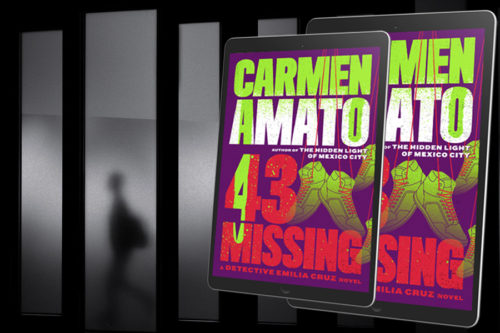
My most recent book, 43 MISSING: Detective Emilia Cruz Book 6, was inspired by the events of September 2014 when 43 students from a teacher’s college in the town of Ayotzinapa, near Acapulco in Mexico’s state of Guerrero, disappeared in the nearby town of Iguala. The book was a finalist for the Silver Falchion award for Best Procedural of 2017 from the Killer Nashville International Mystery Writer’s Conference.

43 MIssing
To mark the 4 year anniversary of the Ayotzinapa tragedy, I will donate $1.00 to the National Center for Missing and Exploited Children for every review posted on the book’s Amazon site during September-October 2018.

In addition, the Kindle edition of the book will be on sale 21-30 September; just $0.99 for Kindle.

Four years ago this month, the crowd of students from Ayotzinapa were looking to commandeer buses to take them to an annual student rally in Mexico City which commemorates a deadly student-police clash there in 1968. The young men were probably loud and rowdy as they begged on the streets for tuition and gas money.

They found some buses and headed out of town, but the buses were attacked by local police. The students were seized. Some ran away and were hunted down. Very few escaped.

Forty-three of those students were never seen again.

Related: The real story behind 43 MISSING

Over the past four years, arrests have been made, so-called confessions obtained, and multiple motives have been offered. One of the most believable explanations is that the police were working with a regional drug gang. The students had unknowingly taken the buses used to transport drugs. 43 MISSING veers toward this answer, but takes it a step further.

Many now believe that the police handed the students to a notorious drug gang which killed all the young men, chopped up their bodies, burned the parts, then threw the remains into a remote gully.

Incidentally, the police chief of Iguala went into hiding and was arrested two years after the crime. He was found–where else–in Iguala.

As the countryside around Iguala was searched over and over for the bodies of the 43 students, over 200 unidentified bodies were found, relics of Mexico’s drug cartel violence. They did not belong to any of the 43 missing students.

The Ayotzinapa tragedy might not be the worst thing that has ever happened in Mexico. But as a writer and a mother I can’t let it go.

The uncertainty of being a parent and not knowing what happened to your child eats at my heart. I think about the horrible images going through the parents’ minds as information dribbles out about what might have happened. The dawning realization that their children died in pain and fear and that their bodies were brutally desecrated. Official blundering and obfustication to the point that little the government says about the tragedy is credible. For these parents, there is little recourse besides prayers, rallies, and protest marches. What influence does a poor rural family have when even the Organization of American States threw up its hands?

Researching the Ayotzinapa tragedy as I wrote 43 MISSING led me to the plight of other families dealing with a missing child. This fundraiser for the National Center for Missing and Exploited Children aims to use the power of one small book to help.

Please write a short review of 43 MISSING. Remember, I will donate $1.00 for every review posted through 31 October. Let’s help find the missing.

I will be announcing the result to readers of Mystery Ahead newsletter on 11 November. If you would like to subscribe to Mystery Ahead, you can do so here: http://carmenamato.net/mystery-ahead/

Ayotzinapa

Pin It on Pinterest