Swimming lessons, or how he got into a thriller

Swimming lessons, or how he got into a thriller

I’ve always liked to be in the water, but by no stretch of the imagination can I call myself a strong swimmer.

I didn’t take swimming lessons until I was in 5th grade, when I learned to do a passable crawl and a backstroke that always sent me into the next lane over. Years later, I got my scuba certification and travelled the Pacific with my gear in tow.

My husband is a swimmer, too. He competed on his high school swim team and still likes to swim laps to keep fit. Our best vacations have been on the shores of Adirondack lakes.

We lived in Mexico when our kids were ready to learn to swim. The American school had an enormous pool used for regional competitions, with football stadium-style bleachers running along one side of the modern pool house.

Lessons were held after school when a legion of mothers, maids, and chauffeurs invaded the locker rooms to get the elementary students ready. The mothers wore stiletto heels, skinny pants, and pounds of jewelry, along with the obligatory sleek ponytail. Maids were limited to navy, black, or gray dresses with white cotton trim. A few pinks stood out, indication of a dedicated nanny. Chauffeurs always wore suits and ties.

Once the children were chivvied to the pool, mothers, maids, and chauffeurs took to the stands, although not together. The mothers sat in a tight clique on the lower benches, with their employees scattered above. Most maids used the time to do the children’s homework.

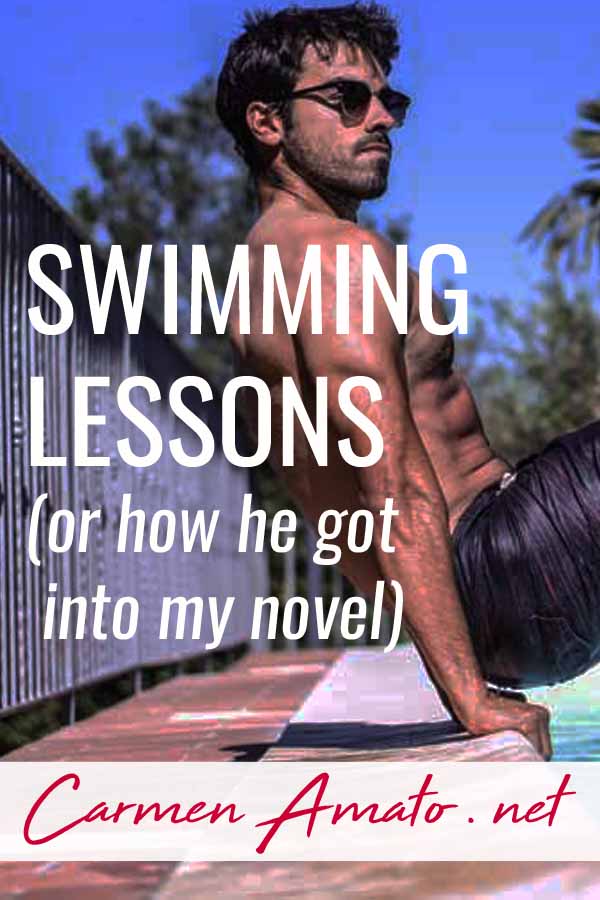
The swim coach was a handsome young man who strode up and down the pool deck in sweatpants and a coral necklace. The rumor was that he was a former Olympic athlete.

He never got in the pool, but merely called out instruction to the flailing kids. No one seemed to care. I got the feeling, as he preened around the pool, that being a swim coach wasn’t his only source of income.

After the lesson, the locker rooms filled again. Most of the children left the school grounds in pajamas and bathrobe, some carried across campus to the cars by the chauffeur.

My kids survived having neither maid nor chauffeur and figured out the swimming process on their own. My son was a lifeguard through high school. My daughter got her scuba certification when she was 14.

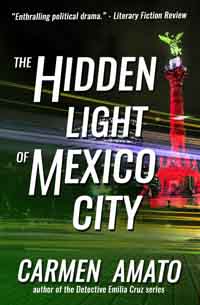
But the Mexican swim coach lives on in fiction. He anchored a memorable moment in THE HIDDEN LIGHT OF MEXICO CITY:

Hector took Luz to the Colegio Americano for Victoria’s swimming lesson. Luz met the little girl at the school’s aquatic facility, got her suited up, then carried Victoria’s towel and backpack to the bleachers.

The little girl scampered over to her class. The swimming teacher was Coach Carlos, a muscular young man who taught the children by walking along the edge of the pool in tight warm-up pants and no shirt, flexing his biceps. Most of the mothers sitting in the bleachers during swim lessons couldn’t keep their eyes off him. There were far more maids than mother in the bleachers, however, all staring at the Coach Carlos show. Luz usually looked, too, although he was cocky and arrogant and way out of her league.

Coach Carlos said something to Victoria. He lifted her into the water, the muscles in his back rippling as he bent. He probably has lots of parent-teacher conferences, Luz thought. She pulled her eyes away and opened Victoria’s backpack. English homework again.

When the lesson was over Victoria ran back to Luz to be dried off. They went into the locker room and Luz dressed Victoria in pajamas and robe for the ride home and an early bedtime.

They were walking toward the front gate of the school, where Hector waited with the Suburban, when Luz heard the click of high heels on pavement. A hand tapped her on the shoulder.

It was Señora Portillo, with her son whining next to her and the Portillo’s chauffeur walking behind with the boy’s backpack and swim bag. Señora Vega and Señora Portillo were friends, part of a circle of beautiful coffee-drinking women who met regularly at the upscale Café O on Monte Libano in Lomas Virreyes.

“Luz de Maria, are you free to work for me the Saturday after next?” Señora Portillo asked. “I need some extra hands for Enrique’s birthday party and Selena said you can sometimes be helpful.”

“Saturday after next?” Luz verified.

“Yes.”

Luz was off again that weekend. If she worked for Señora Portillo on Saturday it meant she could not go home. But it also meant another 200 pesos and that was a real windfall so Luz said yes.

“Alberto can pick you up.” Señora Portillo indicated the chauffeur. She extended a piece of paper to Luz with the date, time, and address on it. Her attention immediately refocused on a high-heeled mother strolling by who was obviously a friend.

The chauffeur nodded at Luz as his employer chattered to her friend. He was a blunt-faced tank of a man poured into a sharkskin suit. Almost certainly a former boxer. “I am Alberto Gonzalez Ruiz,” he said.

He spoke formally, but his diction was sloppy. Luz had the sudden silly thought that he probably had gotten hit in the head a lot during his boxing career.

She gave him a weak half-smile.

“I shall be pleased to see you that day,” he said meaningfully. Señora Portillo ended her other conversation and Gonzalez Ruiz followed her out of the school gate.

Luz watched him go, her mouth dry. Chauffeurs made lots of money. Lots.


swimming lessons

“Rivetingly dramatic tale of politics and corruption, and a man and a woman from opposite ends of the social spectrum who fall in love.” — Literary Fiction Review

Get THE HIDDEN LIGHT OF MEXICO CITY on Amazon

You may also like

swimming lessons

Mystery author Sandra Nikolai: Poisons, pressure, and everyday heroes

Mystery author Sandra Nikolai: Poisons, pressure, and everyday heroes

Canadian mystery author Sandra Nikolai writes the excellent Megan Scott/Michael Elliott series featuring a ghostwriter and an investigative journalist. Sandra and I have watched each other’s series grow book-by-book, while indulging in a shared love of chocolate almonds.

1. Carmen Amato: Sandra, thanks so much for stopping by. Your series set in Canada drew me in from the start because it was different than the norm with two main characters—a ghostwriter and a reporter. Why did you go in this direction instead of a police procedural or private detective series?

Sandra NikolaiSandra Nikolai: Happy to be here, Carmen. There’s something intriguing about a hero that everyone admires, whether it’s a feisty female cop (winks) or a shrewd private detective. Because I liked the notion of everyday people helping to solve crime, I created my heroes based on the premise of ordinary characters facing terrifying situations. No one represents the everyday hero better than ghostwriter Megan Scott, a young woman with high ethical standards whose sheltered world is turned upside down when she is accused of murdering her husband and sets out to clear her name. Add investigative reporter Michael Elliott, a daring young risk-taker who pursues justice despite dangerous and unpredictable circumstances, and you have the creation of an interesting duo.

The difference between Megan and Michael is their approach to investigating a crime. Where Michael is cool and trusts his instincts, Megan is cautious and analytical. Her interest in his sleuthing activities and her aptitude to decipher the tiniest details convince him to take her along on some of his ventures. For Megan, a covert outing provides an exciting break from her “boring” job as ghostwriter of non-fiction material, but it fulfills another purpose. It enables her to pull Michael back from the brink of death when necessary. Megan’s curiosity occasionally lands her in trouble too, so it works both ways.

2. CA: How do you create multi-dimensional fictional characters, including your lead characters Megan Scott and Michael Elliott? Where do you look for inspiration when creating characters?

SN: For each of my lead characters, I create a chart that includes their family and work history, physical appearance, personality traits, and behaviors. To produce well-rounded characters, I also describe their fears and aspirations, likes and dislikes, and preferences for food, clothes, and music. I go through a similar routine—though not as elaborate—for secondary characters. I might add information to the charts as the main characters develop from book to book in the series.

Inspiration for my characters comes many sources—the news, movies, crime case studies. I do a lot of research to find tidbits of information that I can develop and weave into my stories to make the characters and their actions credible.

3. CA: Poison figures in more than one of your novels, in crafty ways. How much research do you do and how do you keep it organized?

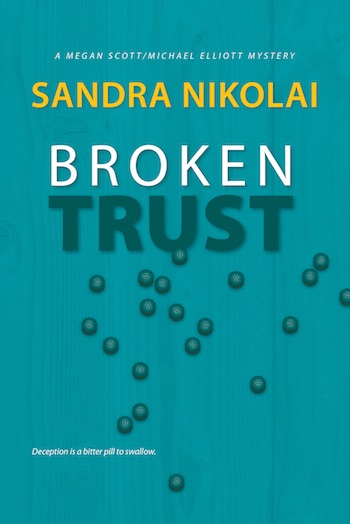
SN: I can thank Shakespeare for inspiring the poison scenes! (laughs) Okay, on a more serious note, once I research the poison or drug I want to use in the story, I keep the relative website links, notes, and photos in a computer folder so I can easily refer to them. For my novel Broken Trust, a mystery that highlights the current fentanyl overdose crisis, I researched how the medical community and law enforcement dealt with people affected by the drug. I read personal stories about youths who unwittingly took fentanyl-laced street drugs and died, and about other users who lived but suffered devastating physical and mental consequences. The research process dug up a lot of disturbing information, but I wanted to accurately depict the growing dilemma that first responders face today as one of the elements in the story.

4. CA: Your characters are rooted in Montreal, but your novels travel beyond to other parts of Canada. Why is Canada a good setting for a mystery? How do you use setting to create and build suspense?

Sandra nikolaiSN: Canada is a vast country with settings ranging from small towns to large cosmopolitan cities—much like the United States. The weather can vary immensely from coast to coast and temperatures can fluctuate widely, even within a twenty-four hour period. Having lived in Montreal for decades, I used that city as the setting for my first book, False Impressions. When I decided to continue the series, I varied the settings for subsequent stories. I also ensured each new story occurred in a consecutive season and used the weather to heighten suspense when possible. For example, False Impressions takes place in Montreal during a sizzling summer; Fatal Whispers in Portland, Maine in the cool fall; Icy Silence in a suburban college school during a winter ice storm, and so on. I don’t have a title for book #6 yet, but a rainy autumn is the season of choice.

5. CA: You can invite any author, living or dead, to dinner at your home. What are you serving and what will the conversation be about?

SN: I’d invite Louise Penny, Canadian author of the Chief Inspector Armand Gamache series set in the fictitious village of Three Pines, Quebec. Still Life, her first book in the series, won multiple awards including best first crime novel in Canada and the United States.

We’d enjoy French onion soup topped with cheese toasts, steak frites with a glass of red wine, and a slice of sugar pie for dessert—menu selections mentioned in her detective series. We’d chat about her insightful Inspector Gamache and the artsy, quirky, and sociable inhabitants of Three Pines. On a personal level, we’d compare notes on our experience living in La Belle Province of Quebec and discuss how it influenced our choice of characters, plots, and settings. It would be magnifique!

6. CA: Can you leave us with a quote, a place, or a concept from a book that inspired you?

SN: “Writing is its own reward.” – Henry Miller

Thank you for inviting me, Carmen!

Sandra weaves ordinary characters into extraordinary, life-threatening situations, using the premise that evil often lurks in familiar places. Her popular, fast-paced mystery series featuring ghostwriter Megan Scott and investigative reporter Michael Elliott has earned rave reviews internationally from fans who love the challenge of solving heart-pounding whodunits. Visit www.sandranikolai.com to find out more.

You may also like

Sandra nikolai

El Cid: A literary hero’s literary hero

El Cid: A literary hero’s literary hero

Everybody has heard of Don Quixote. The image of the fictional tilter-at-windmills is everywhere in Mexico, which has long adopted Spanish literature and legends as its own. But when I went looking for the literary hero for my fictional Mexican hero in THE HIDDEN LIGHT OF MEXICO CITY, I needed someone more, ahem, successful than Don Quixote.

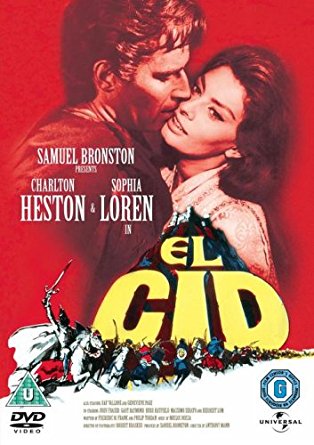
El Cid movie posterMovie star

El Cid was a character I’d seen mentioned by Mexican authors. With little more context than the Charleton Heston movie, I assumed he was a fictional creation like Don Quixote.

But I was wrong. It only took a little digging to find El Cantar de Mio Cid, or The Poem of the Cid, the only surviving epic poem from medieval Spain. The poem, similar in form to The Song of Roland, recounts the adventures of the real Spanish warlord and nobleman Rodrigo Diaz de Vivar. He was called El Cid Campeador, a title that reflected the esteem in which he was held by both the Moors and the Spanish. “El cid” was derived from the Moorish al-sidi, meaning sir or lord, while “campeador” means champion in Spanish.

El Cantar de Mio Cid is a dramatic retelling of daring deeds with a heroic figure, facing down enemies with courage and his sword. A continued refrain in the poem is that El Cid, with zest for the fight, was born in a fortunate time.

Historic figure

El Cid had already made a name for himself fighting the Moors for King Ferdinand when the king died. The lands Ferdinand had ruled were divided among his five children. They immediately started fighting each other. Sancho, the son who’d inherited Castile, named El Cid commander of his armies. When Sancho was assassinated, his brother King Alfonso was the chief suspect. El Cid made Alfonso publicly proclaim his innocence. Angered, Alfonso forced El Cid into exile alone, in effect holding his daughters and beloved wife Jimena hostage.

literary heroOn his warhorse Babieca and brandishing his sword Tizona, El Cid became a mercenary, mainly fighting the Moors but not being too fussy in his choice of employer. Eventually he managed to squeeze Alfonso into relenting on the exile and was reunited with his family. Aligned once again with Alfonso, El Cid conquered Valencia where he and Jimena ruled in Alfonso’s name until El Cid died in 1099. His daughters became queens of Aragon and Navarre. His sword is preserved in Spain’s Museum of the Army.

Role model

El Cantar de Mio Cid is as much about leadership as anything else. Surprising for his time, El Cid often “took counsel,” asked his men for input, and actually listened to their advice. As a result, his men were fiercely loyal to him; 115 knights spurned King Alfonso, went into exile with El Cid, and fought by his side as mercenaries.

This was the perfect role model I’d been looking for as my fiction hero, Eduardo Cortez Castillo, leads a brotherhood of cops sworn to be incorruptible. In THE HIDDEN LIGHT OF MEXICO CITY, “Los Hierros,” the Iron Ones, will take on not just police corruption but a scheme to allow Mexico’s most notorious drug cartel to buy political power through the Mexican presidential elections.

El Cid’s relationship with his beloved wife Jimena gave the role model an extra dimension. Like El Cid, Eduardo falls in love, although with a woman who by the unspoken laws of Mexico’s rigid class structure, cannot stand by his side. Yet Eduardo tells Luz de Maria about his role model and references to El Cid become a secret code between the two lovers.

I hope you check out THE HIDDEN LIGHT OF MEXICO CITY and find the clues to El Cid.

But most of all, may you, like El Cid, live in a fortunate time.

You may also like

literary hero

The worst writing advice ever. Not kidding.

The worst writing advice ever. Not kidding.

“But the novel is set in Mexico,” she said. “All the characters are Mexican.”

“That’s right,” I replied. “Lives of the people fighting the drug cartels. And Mexico’s class structure.”

More than 5 years ago, I was speaking on the phone to a well-known American author about potential agents and publishers for  THE HIDDEN LIGHT OF MEXICO CITY. She was enthusiastic about the quality of my writing but we kept circling around an undefined problem.

“New York will never touch it,” she said finally. “And a New York agent is the only kind worth having. New York agents are looking for the next Sex and the City. Glossy. High heels. New York.”

“This is a political thriller,” I countered. “Makes the real Mexico accessible to the American audience the way Martin Cruz Smith’s Arkady Renko series did for Russia.”

GORKY PARK, RED SQUARE and the other Arkady Renko novels were ground-breaking, taking us inside a crumbling Soviet Union and then a mafia-riddled Russia.

My book took the reader inside the real Mexico. How was it any different?

New York won’t buy a book with all Mexican characters

The famous author didn’t care. Her sniff was audible.

writing advice

“New York won’t buy a book with all Mexican characters,” she said.And your main character is a maid. At least couldn’t you make her American?”

I made a gurgling sound.

“You know,” the author blithely went on. “A college girl from Pittsburgh named Susan or Tess who goes to Mexico on a cultural exchange program to work as a maid for a semester. Something like that.”

I could have tossed off a barbed remark about how it would cost an American in Pittsburgh more to get to Mexico than they would earn as a maid in three months, but I was too busy being appalled.

This was a book about Mexico’s drug war, the people fighting it, and their chances of survival. It was also a Cinderella story taking on Mexico’s unspoken caste system. Sue and Tess were not part of that narrative.

Related: Read Chapters 1 & 2

Was she right?

Most of the New York agents I queried never replied. The few that did were only taking on a few select projects. One agency well known for representing fiction and thrillers said they didn’t take on my specific “genre.”

Ahem, I was pitching a political thriller.

Related post: How to Solve Hollywood’s Lack of Latino Roles

Trend or snub?

The question became unavoidable. Was this the classic snub of a new author by the New York cognoscenti? Or a mainstream publishing industry bias against Hispanic-themed popular fiction?

I don’t have any empirical evidence either way, as I update this in 2018. But in 2014 I wrote:

“If this is a trend, then it is a trend that runs counter to both population demographics and marketing statistics. According to the Pew Hispanic Center, Hispanics made up 16% of the US population in 2010 and that rate is projected to rise to 29% in 2050. This group has significant buying power.

The Latino buying power will be $1.5 trillion and steadily increasing by 2015, as asserted by The Nielsen Company in its early 2012 report “State of the Hispanic Consumer.” Meanwhile, ever alert to trends, Amazon introduced a bilingual English-Spanish Kindle e-reader.”

To play devil’s advocate, the lack of response to my queries is to be expected for most authors who try to break into traditional publishing. Some time later, an agent told me they couldn’t publish the first Detective Emilia Cruz because “I don’t know anyone who knows you.”

There are many more would-be authors knocking on agent and editor doors than there is interest in offering a contract to an unknown. But I think the message in that author’s suggestion to change the nationality of the main character speaks for itself.

Update

Drug violence on America’s border is constantly in the news and the US national debate over immigration is acute.  Fiction can help to socialize these issues and give them an understanding, a face, and an immediacy that often the news cannot.

Meanwhile, THE HIDDEN LIGHT OF MEXICO CITY, with all of its Mexican characters, is available on Amazon in print and ebook formats. It is rated 4.8 out of 5 stars with comments like:

It’s a perfect blend of action, suspense and romance. The action keeps you turning the pages as the author portrays the gritty reality of the city. Amato captures the complexity of life in one of the world’s largest cities, expertly depicting the sleazy politicians, the drug lords, their violent lieutenants and the common Mexicans who are victimized by them. Her characters are sharply drawn and totally believable.”

Read the book and you will learn something about the drug wars cost and the people who are determined to end the corruption. You’ll learn about the class system that divides the Mexican culture. Amato fills the pages with three-dimensional characters that you care about. You will be thrilled with the way Amato shares the dinner between Eduardo and Luz. I wanted to read that whole scene out loud to my wife.”

And this from the Literary Fiction Review: “The Hidden Light of Mexico City by Carmen Amato is a rivetingly dramatic tale of politics and corruption, and a man and a woman from opposite ends of the social spectrum who fall in love.” 

The most viewed page on this website is the dreamcast of Latino actors who I think should star in any movie adaptation.

My sniff is audible.

You may also like

writing advice

The creative process according to Tolkien (and me)

The creative process according to Tolkien (and me)

Last week I sat down with fantasy author Vee James to talk about the creative process. He’s the author of NECCABASHAR, the tale of a young demon climbing the corporate ladder in Hell with hilarious results. (Comedy Channel, take note. This is your next breakout franchise.)

The question

Both Vee and I are often asked the time-honored question of “Where do you get your ideas?” I’ve especially been pinged with questions about the penultimate scene in PACIFIC REAPER, the 5th Detective Emilia Cruz novel. No spoilers, but think desert and double-cross.

The answer

Our conversation turned to J.R.R. Tolkien’s explanation for the source of literary inspiration. Writing for the Plumfield and Paideia website, Sara Masarik offered this quote from fellow creative Jonathan Rogers:

“Tolkien talks about the leaf-mould of the mind–those stories and ideas that go into your head and decompose into rich soil from which new stories grow. We don’t always know what has influenced us.” http://www.plumfieldandpaideia.com/something-like-tolkiens-leaf-mould/

That’s exactly how it happens. Small details accumulate like fallen leaves on the forest floor, the input of everything we experience, learn, read, hear, touch, smell, and see. Details are stored away in the back of our minds, more added all the time, without us really conscious of this great gift of accumulated awareness.

Related post: 10 Tips to amp up your creativity

Specifically

I think a writer best uses the “leaf mould” that comes out of the process of accumulation by having an “open mind,” not only in terms of  what we absorb, but how we process.

An open mind allows us to pair disparate details to end up with something new. Random connections. Mix and match.

For example, I paired my own experience teaching in a prison (yes, you read that right) with a nervous stroll through a bad neighborhood in Mexico to create the pivotal scene in KING PESO in which Emilia visits her incarcerated partner Franco Silvio.

Sometimes pairing disparate details comes naturally. Other times we have to grab and smash them together to have a story bigger than the separate bits.

Creative process?

Creative power.

You may also like

creative process

Book Review: Blue Light Yokohama by Nicolás Obregón

Book Review: Blue Light Yokohama by Nicolás Obregón

BLUE LIGHT YOKOHAMA by Nicolás Obregón is a dense and layered police procedural set in contemporary Japan. The title is that of a song which keeps playing in the mind of the main character; like the song, the book is one I won’t soon forget because of evocative descriptions, dramatic character flaws, and the double twist ending.

Inspector Iwata is a youngish but experienced detective reassigned to Tokyo after an extended leave. The reason for the break in his professional life isn’t revealed right away and is one of the elements that keep us guessing.

Iwata quickly runs into a cranky boss, abusive coworkers, and a junior partner with a chip on her shoulder. He is assigned to a murder case previously handled by a cop who committed suicide.

The case might be a random killing but Iwata discovers a clue in the form of a symbol of a black sun. Days later, the sun is seen at a second crime scene. The symbol is an eerie reminder of the book’s prologue, in which the soon-to-be-dead cop sees it tattooed on a woman as she jumps to her death.

More clues to the murder cases flicker by in subtle and elegant fashion as Iwata grapples with his personal misery and the lyrics to the title song play in the background of his inner voice. Iwata’s mystique is further reinforced by scenes that call into question his current sexual preference and reason for his inner turmoil. His backstory unfolds in a series of flashbacks in a style reminiscent of Peter May’s THE BLACKHOUSE. These tragic vignettes slowly put his current actions into perspective.

In what becomes a “last man standing” device, the black sun investigation is hamstrung by Iwata’s fellow detectives and his partner’s truculent attitude. When Iwata is finally able to corral some help, the climax delivers surprises I never saw coming.

BLUE LIGHT YOKOHAMA is a moody, poetic, and immersive read with a deeply troubled hero whose sanity is challenged even before a police investigation leads him into dark places. Obregón has a lyrical yet unflinching writing style, and the ability to twist a mystery plot in upon itself.

In short, BLUE LIGHT YOKOHAMA is an intriguing start to a new and unusual Japanese noir police series.

You may also like

blue light yokohama

5 Excellent Phrases to Sound Busy and Important

5 Excellent Phrases to Sound Busy and Important

Some time ago, I took a break from mysteries and read BRIDGET JONES: MAD ABOUT THE BOY by Helen Fielding. It was time for some mind candy and Bridget Jones–books or movies–always delivers.

The book was written in the same diary/inner dialogue familiar from the first two Bridget books, but with a bit more emotional heft. Bridget is now a widow with two small kids, trying to get her life back together and date again.

Fielding reuses some of her best lines from the first movie (she was one of the screenwriters) to reestablish Bridget’s voice and the tone of the characters’ interactions. For example, Daniel Cleaver’s first set of dialogue in the book is virtually lifted from the silver screen and Bridget is again wonderfully airy about looking “busy and important.” In fact, the phrase “busy and important” is repeated several times and is clearly a Bridget/Helen favorite. And it should be, because it helps to set and maintain the character’s voice throughout the book.

Phrases like that occasionally stay with me long after I’ve finished reading or heard someone utter the words. A clever phrase can evoke an image, establish a character in a way that resonates, or lets me form a mental picture.

Although I’m very busy and important today, here are 5 favorite phrases that sing:

Attractively damaged man

This phrase was included in a magazine article about 30 things you should do before you are 30, including coin a phrase. Regrettably, I have lost the magazine and the author’s name but it was a very funny article and the phrase seemed to perfectly describe far too many men I met in my 20’s.

Structural tension

This is a phrase I’ve heard bandied about in relation to government agencies that don’t perform well and businesses that go under. It seems to be a neat way to blame poor decisions on a wiring diagram.

And I meant it to sting

The books of British humorist P.G. Wodehouse are a treasure trove of wonderful expressions and this is a delicious riposte that works even when you’ve said something inane and the target has left the room. Attributed to Wodehouse’s iconic character Bertie Wooster.

A face like late Picasso

Can there be a better description of what someone looks like? This is from one of the Harry Hole mystery novels by Norwegian author Jo Nesbo on the occasion of Harry looking at himself in the mirror after one of his drinking/drugging binges.

And trouble ensued

There’s a musical folly called Spaghetti Western Swing on Brad Paisley’s Mud on the Tires album that combines dialogue and music into a story about cowboys and bad guys in the Old West. The voice actors are famed musicians from the Grand Ole Opry. The whole thing is pretty funny—there’s laughter in the background so you know they were having a good time taping this—and at one point before the guitar swings into high gear someone says this phrase, creating the perfect imagery.

Well, time to be off doing something busy and important.

And trouble ensued.

You may also like

Bridget Jones

The Postman Always Rings Twice

The Postman Always Rings Twice

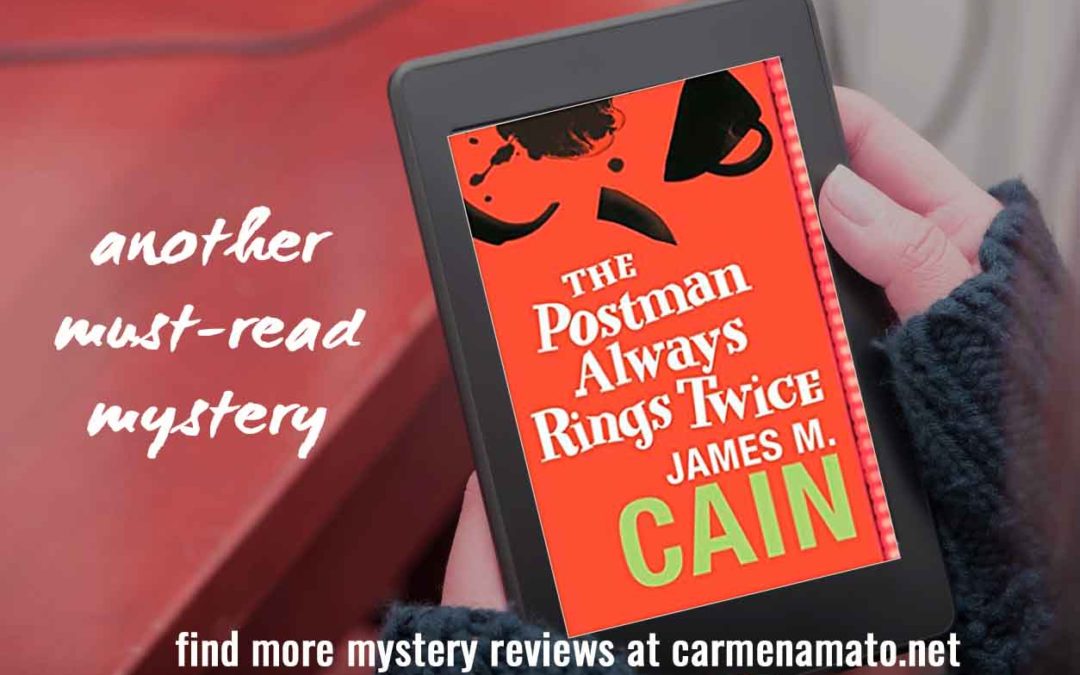
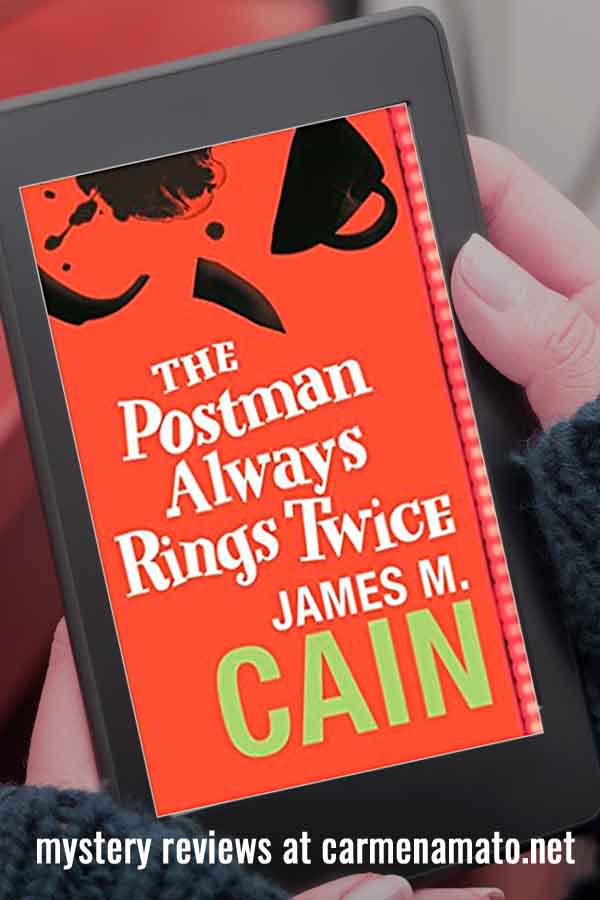
THE POSTMAN ALWAYS RINGS TWICE by James M. Cain is a noir classic from 1934. I stumbled on a copy in a used bookstore and realized I’d never read it. I didn’t know what I’d been missing all these years.

Frank Chambers is a drifter, roaming around the American Southwest with empty pockets and clenched fists. He’s been in and out of Mexico and in and out of jail, only to wind up at a dumpy truck stop in southern California run by Nick, a Greek immigrant, and wife Cora.

Soon Frank and Cora are steaming up the windows and plotting to run away together. But they have to get rid of Nick first.

And get away with it.

Frank narrates the book. He’s a restless type, always ready to hit the road and see where it takes him. We don’t like him but at least he’s honest about it.

Even as the lovers plot to kill Nick, and deal with the aftermath, neither Frank nor Cora fully trust the other. Will one double-cross or kill the other?

And then there’s the crooked lawyer, who in 1930’s slang, “flimflammed” them.

The writing is sparse and lacks dialogue tags, no “said” for Cain, which occasionally leads to confusion as to which character is speaking. Yet the swiftness and sparseness works for the noir genre; there’s nothing to weigh down the growing sense of unease or the final impact. The characters, especially Frank and Nick, are expertly drawn. Every scene is a visual filled with restless and scheming people under the hot California sun. No doubt this is why it has been made into a movie at least twice, the first in 1946 with heartthrob John Garfield and pinup girl Lana Tirner.

In the end, punishment is meted out to the guilty. Bottom line? This tautly written novel packs a hefty literary sucker punch.

Oh and if you are wondering about the title, I think “postman” is a euphemism for accountability. If you don’t pay the price of your crime the first time, the postman will come by again to make sure you do.

note: carmenamato.net uses Amazon Affiliate links

You may also like

mystery review

Sally Andrew’s deadly and delicious Tannie Maria mysteries

Sally Andrew’s deadly and delicious Tannie Maria mysteries

I’ve never been to South Africa and the only thing I know about the Afrikaans language is that it is derived from Dutch. But in the Tannie Maria mysteries, RECIPES FOR LOVE AND MURDER and THE SATANIC MECHANIC, author Sally Andrew weaves a spell to reveal both country and language.

Recipes for Love and MurderMaria van Harten is a widowed foodie living in South Africa’s Klein Karoo region. With an English father and an Afrikaans mother, she straddles two of the many ethnic groups that form South Africa’s history and culture. As with many women of a certain age, she’s referred to as Tannie Maria, or Aunty Maria.

Maria lives out of town, with chickens to keep her company as she sits on her stoep (porch). She drives a blue bakkie (truck), and is at peace with the kudu, springbok, and other wildlife that stray into the action. More importantly, she’s either cooking, planning to cook, or thinking up recipes. Tantalizing treats with Afrikaans names, like potjie, meat and vegetables baked in a fire—the South African version of a luau—or dessert dumplings called botterkluitjies, grace nearly every page.

We first meet her in RECIPES FOR LOVE AND MURDER, in which Maria becomes the advice columnist at the Klein Karoo Gazette in the town of Ladismith, answering letters and emails with wisdom and recipes suitable for the lovelorn and aggrieved. A correspondence with a women who seeks advice, then later ends up dead, sends Maria–as well as her boss Hattie and the paper’s single investigative reporter Jessie–into a maze that includes the dead woman’s female lover, a cruel husband, and strange doings at the local grocery store.

Maria ends up in perilous danger. Not to mention the risk of losing her heart to a dashing detective with a chestnut moustache who owns a lamb named Kosie.

THE SATANIC MECHANIC draws us even more deeply into both the South African bush and Tannie Maria’s backstory. Her late husband was abusive and his memory is getting in the way of Maria’s new romance with detective Henk Kennemayer of the chestnut moustache.

As her friend Jessie interviews Slimkat, a Bushman tribal leader celebrating a major lawsuit against a diamond company for the rights to traditional land, Maria joins a PTSD therapy group led by a mechanic who once dabbled in the satanic arts. When Slimkat is fatally poisoned in front of Maria, Henk investigates, but her therapy group becomes an additional focus of attention when a member is killed during an outdoor session.

Could the two murders be linked? Is the satanic mechanic a killer as well as a healer? What will Maria bake for the group when it’s her turn to bring dessert?

Andrew has a beautiful writing style that effortlessly draws us into this rough, yet exotic setting. South Africa’s troubled past and unsettled society play pivotal roles, but the poetry found in Maria’s Klein Karoo will captivate you.

Maria and Henk’s relationship is tender and authentic. Plants, birds, animals, and food become real experiences for us as much as for Maria. The books are peppered with Afrikaans terms, which are not italicized as is usual with a foreign language. The format suggests that English and Afrikaans are so entwined as to be impossible to separate.

I love unique mysteries in which the setting is integral to the plot to the extent the story simply could not take place anywhere else. The Tannie Maria novels are perfect examples and I can’t wait for the next. Highly recommended.

Note: carmenamato.net uses Amazon Affiliate links.

You may also like

Sally Andrew

On Edisto Island with mystery author C. Hope Clark

On Edisto Island with mystery author C. Hope Clark

C. Hope Clark authors the Edisto Island mystery series as well as FundsforWriters.com, an award-winning resource for career writers. She lives on a lake where she spins mysteries with her ex-federal agent husband. Edisto Stranger is her latest tale, the fourth in the Edisto Island Mysteries, about an ex-Boston detective fighting loss and gin in paradise while solving the death of a retired FBI agent on a cold case hunt. See more at  www.chopeclark.com

1 Carmen Amato: Hope, thanks so much for stopping by. Many of my fellow authors probably know you from your essential Funds for Writers newsletter, but you’re also a mystery author! I especially want to talk about your series set on South Carolina’s Edisto Island, southwest of Charleston. Tell us how you came to write the absorbing Edisto series.

Hope Clark: Thanks for having me! Yes, Funds for Writers usually opens the door of writing conferences and such, but I am extremely proud and in love with my mysteries. Weird enough, the Edisto series was actually force-fed to me. After publishing three books in my original Carolina Slade mystery series, my publisher asked me to diversify.

Hope Clark

I’d planned on being the Sue Grafton of South Carolina mysteries, spending my career in one series. But my publisher pushed on and gave me three parameters: a woman in law enforcement, good old Southern family angst, and a South Carolina setting that could last through a series. The family angst was easy enough. I would walk and talk that one! LOL A woman in law enforcement was manageable since I was married to a federal agent.

But the setting took me a while. One single place that could prove romantic, striking, and luring. Then it hit me . . . Edisto Beach. It’s my favorite SC beach and where I escape to clear my head. From there the story came together, and I’m so thankful my publisher pushed so hard. I grew up in this state, have worked it from border to border in my previous federal job, and I understood its soul. Edisto was a different flavor from the Charleston, Myrtle Beach and Hilton Head areas most outsiders know. And I wanted to capitalize on its mystique. God, I love that place.

2 CA: Your lead character Callie Jean Morgan is a widowed single mom in law enforcement, with a love-hate relationship with gin. She often has a personal connection to the mystery. Tell us about creating Callie and how she has evolved over the course of the series.

CHC:  Faced with a new series and the creation of a fresh character, I had to come up someone totally unlike my other protagonist in the other series, Carolina Slade. Callie Jean Morgan is more serious, more professional, but also more damaged and flawed. I wanted to write a character who made me angry, and made me cry. I’ve done it all though her while writing in the wee hours of the morning. I gave her pneumonia when I had bronchitis, so I could feel the suffocation. I’ve even written her after I’ve had a few drinks, to sense her frustration with gin.

When my publisher asked for family angst and issues, I gave it to them in spades via Callie. Her demons are many from the loss of a husband to the loss of her career, with her constantly fighting to maintain self-respect and the respect of those around her. She rides that line when it comes to alcoholism.

C Hope Clark

I didn’t want this series to be a cozy, and I wanted the reader to feel her pain. She slowly evolved in the series from being completely broken to gradually finding her footing, not that I don’t knock her feet out from under her every few chapters. She is growing; you can feel it. Inch by inch she is rebuilding who she is, and it isn’t what she was when she was at the height of her detective career with the perfect US Marshal husband back in Boston.

She’s constantly humbled, but while she doesn’t admit it, she’s garnered a support system on Edisto Beach and a developed a different internal compass. We see her coming back into law enforcement, back into the real world, back into a little romance, as she decides she can’t stay down forever. But she’ll never be like she was, and that unsteadiness knocks her off her game a lot.

3 CA: Why Edisto Island? How do you use setting to create and build suspense?

CHC: No other beach in South Carolina is like Edisto Beach, on Edisto Island. The township fights like hell to keep it family-oriented and non-commercial. No franchises, no neon, no motels. Lights out at dusk between May and October in order to protect the loggerhead turtles. You rent houses, and on this small, thin beach, every house is a very short walk to the surf.

The saying is that you leave your troubles and “other” life on the other side of the big McKinley Washington bridge that you cross to reach the island, and it’s so true. So many year-round natives there (around 600) have assumed lives completely different from the ones they had before relocating to Edisto.

I used that feel to the place to create and build Callie. She indeed is leaving a lot on the other side of the bridge, and yet once she decides to reenter law enforcement, she realizes it’s her responsibility to allow these people to help maintain that feeling for everyone. But with that responsibility comes the realization that she weathers those troubles for them, and it takes a toll.

But I cherish books that utilize setting as character, and these books infuse the island atmosphere throughout. I use real businesses, restaurants, streets, and landmarks. Edisto loves it. The mayor is a big fan, and the chief of police lets me poke fun at his department. The residents rush to the lone bookstore on the island each time a book is released, and the fact that it’s a tourist retreat means that each week new faces appear in the bookstore wanting anything Edisto.

But Edisto is special to me. I retreat there to renourish myself. I own a lot there, bought on a whim and a wish to build a second home and absorb more the area that Callie lives in. Haven’t pulled the trigger yet on that one, but just the fact I own a piece of dirt on Edisto fuels me.

But as far as building suspense, weather changes involving humidity, heat, brine, surf, the ecology and dangers of the sea all play into mystery so well. When I need an obstacle, there’s always the setting, from someone drowning in a marsh to a protagonist drawing the heroine out into some dank, dark, moss-laden jungle. The setting is just too rich not to use when deepening plot or antagonizing the protagonist.

4 CA: What is your best protip? Tell us about a writing habit, technique, or philosophy that keeps your writing sharp.

CHC:  I fight to write daily, even if only 500 words. And I don’t believe you can over-edit. I read my genre religiously, and I am not a fan of reading all genres across the board. I want to concentrate on my mystery talents, not dilute them, so I focus on reading quality mysteries. My favorite, of course, is Raymond Chandler.

5 CA: You can invite any author, living or dead, to dinner at your home. What are you serving and what will the conversation be about?

CHC: Harper Lee. She’s so Southern, and her writing so vibrant and wise. I hadn’t read To Kill a Mockingbird in decades, forgotten how good she was until Go Set a Watchman came out. I ignored all the brouhaha and bought the book for its Southern characters. I was blown away by the story and how she unwound such a controversial subject. Just loved it!

As a Southern girl myself, I would want to pick her brain, listen to her tell how she fleshed out characters, how she feels about storytelling in general, and of course, what suggestions she’d have for my South Carolina stories.

What would we eat? Since I’d be picking her brain about my characters, in my setting, I’d probably choose shrimp and grits with maybe she-crab soup . . . with a simple vanilla pound cake since the entrée is so rich. Sweet tea, of course, but right after we’d darn sure have to pull out the bourbon, and like her, I occasionally like half a cigar on the porch with my drink, while overlooking the lake where I live. Yeah, that visit would be lovely.

6 CA: Can you leave us with a quote, a place, or a concept from a book that inspired you?

CHC: “In writing a novel, when in doubt, have two guys come through the door with guns.” ― Raymond Chandler

While we can’t all write about guys with guns, the point sticks in my head. Remember action and always keep the story moving forward. Which also goes along with this one:

“The faster I write the better my output. If I’m going slow, I’m in trouble. It means I’m pushing the words instead of being pulled by them.” ― Raymond Chandler

Forget craft . . . write the darn story.

Thank you, Hope! Find her Edisto Island series on Amazon.

Note: carmenamato.net uses Amazon affiliate links.

You may also like

Hope Clark

Hard-core hard-boiled with mystery author Jim Nesbitt

Hard-core hard-boiled with mystery author Jim Nesbitt

A warm welcome to Jim Nesbitt, author of the hard-core hard-boiled Ed Earl Burch private investigator series. Ed Earl Burch is a not-quite washed up Texas cop turned PI with a notch collection on his bedpost and bad knees. Ed’s world is crude and rude and he punches through it with a pack of Lucky Strikes and a glass of Kentucky bourbon. A brisk pace, sliding points of view, shades of gray crooks, and dialogue spit out of the corners of everybody’s mouth make this series a real gem for hardboiled genre fiction fans.

mystery author jim NesbittJim books are collecting awards. THE SECOND LAST CHANCE was a finalist for the IPPY, Forewords INDIE and Killer Nashville Silver Falchion awards last year. It was also a Top Pick and finalist for Novel of The Year for Underground Book Reviews (UBR) and won a best hard-boiled mystery award from the Independent Crime Master Authors group. THE RIGHT WRONG NUMBER is a UBR Top Pick this year and is in the running for Novel of the Year for 2018.

1.Carmen Amato: Jim thanks so much for stopping by. Your Ed Earl Burch mysteries caught my eye because of the great tagline: “Nobody’s hero. Nobody’s fool.” Tell us about Ed Earl’s backstory and what makes him tick.

Jim Nesbitt: I think Ed Earl is a bit of an Everyman with whom folks can readily identify. He’s been smacked around by life and carries the guilt of a dead partner he couldn’t keep from getting killed, a couple of ex-wives and the loss of his gold shield, largely because of his own actions. Getting booted from the force in Dallas denies him the source of pride and recognition for the one thing he does best in life, tracking down bad guys and making them pay.

Burch is deeply flawed. Besides being angst-ridden, he drinks too much, he’s fatally attracted to women who leave him an emotional train wreck, and he’s a terminal smartass who never knows when to shut up. He’s also a guy with a code he sometimes forgets until the chips are down. He’s not super-smart like Sam Spade or Philip Marlowe and he sure isn’t super-cool like Steve McQueen in Bullitt. He’s got bad knees, a beard and balding pate, a belly and an empty bank account. He also comes across like he might not be the sharpest knife in the drawer. He’s Columbo without the caricature and people have a bad habit of underestimating him. He makes them pay for that — either with handcuffs or a bullet. Doesn’t matter to him — however they want to deal the play.

At his core, he’s smart, tough, profane and reckless and has been described as a classic American anti-hero. I’ll buy that.

2. CA: Where do you find inspiration for your often damaged and dangerous characters?

JN: My hillbilly cousins and all the journalists I helled around with for four decades. We’re a rude and intemperate lot. I also ran across a lot of colorful characters chasing politicians, crooks, cops, cowboys, loggers, miners and just plain folks while roving the country as a national correspondent out of Atlanta and Washington, D.C.

I’ve always had a good ear for dialogue and an eye for detail that lets me create a keen sense of place. The people I met along the way as a journalist gave me a helluva head start on creating the rogue’s gallery of characters you meet in my novels. So did those hillbilly cousins.

3. CA: How do yJim Nesbittou use setting to create and build suspense? Tell us about a favorite location that you used in a book.

JN:  I think it’s essential for a writer to create a keen sense of place and too many fail to do what you do so well in your Emilia Cruz series. I come from a long line of hillbilly storytellers who instilled in me the strong tie between family and the land we come from — both were steeped in the stories they told about my ancestors, my uncles and aunts, my cousins and my mom and dad when they were young and growing up in the North Carolina mountains. I tried to capture that as a journalist and it was natural that this would carry over to my novels.

I knew I was going to write very stark and violent tales of revenge and redemption. And none of the characters in my novels are nice people, not even Burch — they’re all fairly nasty and violent folk. I wasn’t born in Texas, but I lived there for a while and I spent a lot of time wandering the border between Texas and Mexico and flat fell in love with the harsh beauty of the desert mountains of the Big Bend Country that rise out of Mexico. The mountains there clash and collide in a way that makes it seems like the very bones of the earth are there for you to touch.

What better setting for the tales I was trying to tell? But I was gunning for more than just a backdrop — I think the interplay between people and the land where they live is endlessly fascinating. And I wanted to capture how a place shapes a people and how the land becomes a character unto itself in their story, inseparable from who they are. Texas — particularly the harsh and brooding beauty of West Texas — is more than a backdrop or framework for my novels. It’s a character that adds its own relentless element of foreboding and impending violence and is a big influence on the people in my novels and what they do.

4. CA: You can invite any author, living or dead, to dinner at your home. What are you serving and what will the conversation be about?

JN: The late, great and vastly underappreciated James Crumley whose novels Dancing Bear and The Last Good Kiss taught me it was okay to let it rip with frank descriptions of sex and violence instead of euphemisms that I think insult the reader. And it was okay to drop f-bombs and other profane and earthy phrases. Both of his main characters, Milo Milodragovitch and C.W. ‘Sonny’ Sughrue, are deeply flawed PIs who drink and drug too much and chase the bad girls. Neither one toes the line or gives much of a damn about the law, but both have a code they might stray from but always return to in the end. His books also have raucously funny passages where the joke is often on the main character.

All that impressed me because those guys are vastly different from Sam Spade and Philip Marlowe, two guys who might bend the rules, but kept to their code and used brains rather than brawn and a gun. And the joke was never on Sam or Phil. Crumley gave me license to NOT lace Ed Earl up in the strait jacket of the hard-boiled detective template.

So, what’s for dinner? Deep whiskeys before and after the main course, which will probably be thick ribeyes served with mashed potatoes swimming in butter. Or maybe something more primal — backstrap venison or elk steaks. Since we’re both good ole’ boys, I imagine we’ll sit at the kitchen table with the bottle between us, smoking cigarettes and talking about family, the places that stole our hearts and the women who left us flattened like three-day-old roadkill.

I’d ask him about that interplay between people and the land, the sense of family and place we carry even in a rootless and highly mobile society like the one we live in. Did he deliberately set out to make the sense of place so strong in his novels that it became a character unto itself or did that naturally spill out because he was raised on the same type of stories I heard from my family? My bet is, he’ll say something like: “Hell, bud, I just rared back and let it rip.”

5. CA: What is your best protip? Tell us about a writing habit, technique, or philosophy that keeps your writing sharp.

JN: Well, you and I both know there’s no silver bullet to writing — you just keep your butt in the chair, open a vein and bleed into your computer. Yeah, I poached a Hemingway line there and tarted it up — so, sue me, Papa. What I can tell you is something I learned a long time ago as a cub reporter — facts are your friends and the more facts you have, the firmer the foundation you can build for your writing and the surer and more authoritative and authentic your story will be.

It seems counter-intuitive since we’re writing fiction, but the firm foundation of facts frees up your writing and really allows it to fly. The horrible cliché told to young writers is to write what you know. What you know is only the starting point — and a poor one at that.

Do some research — if your books are set in the late 1980s and early 1990s like mine are, you better gather up all the facts you can about that time. Were laptops and cellphone in use back then? Who was president or governor? What were the political scandals of the day? Was that building you put in Chapter 12 even there back then? You’re not writing sepia-toned history, but you want to get these facts right to give your story authenticity. If your characters carry guns, you better get that right. You’re not going to use all these facts in your story, but they’ll be there underneath your writing.

If you get those details wrong, you run the risk of undermining your story because believe me, somebody will catch it or Google it and call you out. Or just drop your book, walk away and never think of you again. Best of all, if you have the time and the money, go walk the ground of where your story takes place. Most of the scenes in my two novels are set in places I went to as a journalist and that proved invaluable to creating a strong sense of place.

Thank you!

More about Jim Nesbitt:

Jim Nesbitt writes hard-boiled crime thrillers set in Texas and northern Mexico that featured a defrocked Dallas vice and homicide detective named Ed Earl Burch. Nesbitt is a former roving correspondent whose assignments included stories on both sides of the border and his novels — The Last Second Chance and The Right Wrong Number — are laced with the sights, sounds and people he encountered while wandering that rugged country. To learn more about Jim’s work, visit his website at https://jimnesbittbooks.com.

You may also like

Jim Nesbitt

Steal away with mystery author Lynda Lock

Steal away with mystery author Lynda Lock

Canadian mystery author and blogger Lynda L. Lock transports us to the fabled island of Isla Mujeres on Mexico’s Atlantic coast not far from Cancun. First known for her popular blog from Isla Mujeres, Lynda’s new mystery series is a charming slice-of-island-life with a mystery twist featuring authentic island life and an ensemble cast that hangs out at a restaurant called the Loco Lobo.

mystery authorLynda and I met through the dynamic Mexico Writers group on Facebook and I can’t wait for her next book!

Carmen Amato: Lynda, thanks so much for stopping by. We’re both members of the incomparable Mexico Writers group on Facebook and you were one of the contributors to The Insider’s Guide to the Best of Mexico. I love your blog about life on Mexico’s Isla Mujeres, but you also write mysteries! Tell us how your writing career has evolved.

Lynda Lock: Hi Carmen, and thank you for the invite and for including me in The Insider’s Guide to the Best of Mexico. My writing career started with a Christmas story I wrote in grade five. It ended in a complete disaster as I nervously shredded the paper while trying to read what I thought was a hilariously funny story to my stone-faced classmates.

Over the years I wrote hundreds of stories for my own entertainment.  Eventually I was offered a position as a contributing writer for an American magazine, while at the same time I managed our bed and breakfast and worked in our micro-brewery. When my husband and I retired to Mexico I rediscovered the desire to write books. I started with a bilingual book for children and then progressed to novels. The Adventures of Thomas the Cat / Las Aventuras de Tomás el Gato won a silver award at the International Latino Book Awards in LA for Best Picture Book Bilingual in 2016.

mystery authorCA: Your mysteries, TREASURE ISLA and TROUBLE ISLA, capture life on Isla Mujeres down to the smallest detail, including the impact of its relative remoteness. How does setting influence your mystery plots?

LL: I enjoy the Mexican culture, but living on an island is entertaining, no matter where the island is located. The people who inhabit islands are typically self-sufficient, resilient individuals, with quirky personalities that make great characters for novels. We lived on a similarly sized island in British Columbia Canada for 17 years. One day I intend to write a series of novels based on that experience.

CA: One thing I love about the Isla books is the wonderful cast of continuing characters and the touch of romance. The population of Isla Mujeres is quite a mix–Mexicans, expatriates, vacationers, etc. How did this inspire you?

LL:  I am fascinated by pirates; their history, their stories, and their personalities. A few years ago our well-respected local historian, Fidel Villanueva Madrid, wrote an interesting account about the pirates that had visited and at times inhabited the Isla Mujeres.

Another islander, Ronda Winn Roberts, enjoys translating articles from Spanish to English and posting the translations on her blog to give English speaking newcomers have a sense of the island’s history. That’s how I first discovered the story of the blonde-haired Dutch pirate, Captain Laurens Cornelis Boudewijn de Graaf.

The possibility of the handsome, charming and apparently well-educated de Graaf, nicknamed the Scourge of the West, visiting Isla over 300 years ago was the spark for TREASURE ISLA. He reportedly sailed to Isla Mujerea in 1683 after the siege of Veracruz and buried his plunder here on the island. According to all accounts de Graaf never returned to the island but was killed in another battle. Alright then, let’s go find that treasure.

Another pirate, who is better known to islanders, Captain Fermin Mundaca lived on Isla in the mid-1800s. His empty tomb really is located in the cemetery in Centro, and his hacienda covers a large part of the center of the island.

mystery authorThe second book, TROUBLE ISLA begins with a kidnapping of one of the main characters from Treasure Isla. It seems that the pirate’s horde is just bad luck for everyone. The story is more about the present day characters; their interactions, friendships and love affairs and less about the historical characters of Mundaca and de Graaf.

The third book continue to explore relationships between the characters while they deal with murder, mayhem and a hurricane.

I enjoy researching and writing stories that have a historical basis. Digging out the bits and pieces and trying to reconstruct an era is fascinating. Fortunately for me there are a number of webpages and blogs with interesting tidbits of information about pirates and the items have been found over the years.

The interactions and reactions are a never ending source of material for the novels, too. Everyone has an opinion on how the island should be managed and many discussions start with, “my little Isla …” There is an amusing rivalry between the born-on-the-island locals and foreign residents, between the home owners who live here six months of the year and the visitors who have been vacationing every year for 30 years, but everyone picks on the dreaded day-trippers arriving in hoards from the Cancun hotels.

CA: I wouldn’t call your books cozy mysteries, but neither are they hard-boiled crime fiction. How do you categorize them?

LL: I think they are humorous-adventure-mysteries. Is there a category for that?

CA: What is next for you as a blogger and a mystery writer?

LL: Book #3 TORMENTA ISLA is scheduled to be released in February 2018. The cast of characters still have a few more stories to tell. Meanwhile, the blog is a weekly labor of love and both my husband and I contribute articles. It’s a good vehicle to congratulate volunteers, to introduce old-time islanders to the newbies, to express our quirky humor, and to just generally get to know other people who love Isla Mujeres.

CA: You can invite any author, living or dead, to dinner at your home. What are you serving and what will the conversation be about?

LL:  Oh my, so many choices. I read a novel a day and have many favorite authors, but I will have to say Ken Follett would be my first choice. I am a huge fan of his Kingsbridge Series; Pillars of the Earth, World Without End, and the newest one just released A Column of Fire. His attention to historical detail, his characters, and his descriptions are breathtaking.

I have read the first two books three times each and still discover things I missed in the previous readings. As for dinner, we are very basic cooks. We live on the edge of the ocean with sand drifting through our patio doors and the turquoise sea to enjoy. Our meals are basic and easy, giving us more time to soak up the beauty of our view.

Assuming Mr. Follett isn’t a vegetarian, we would probably grill steaks and an assortment of vegetables like peppers, onions, baby carrots and broccoli, then make a crispy salad, and set everything on the table with a couple of bottles of good wine. If we were lucky the grocery store might have a freshly made baguette – not quite but almost as good as the baguettes in France. The fresh bread would go nicely with our stash of imported New Zealand butter. (Good butter is a rare find on the island! When a supply comes in we buy lots and stash it in the freezer.)

CA: Can you leave us with a quote, a place, or a concept from a book that inspired you?

LL: “No regrets. No bad memories.” It’s a favorite saying we picked up from two friends who are slightly older than us and also on second marriages. What it means to me is enjoy life, learn a new skill, be open to new adventures and don’t worry about the past. Life is short, savor your time.

Thank you!

Facebook Lynda L Lock

Twitter Isla Mysteries

Intragram Isla Mysteries

Amazon Lynda L Lock

Bookbubs Lynda L Lock

Goodreads Lynda L Lock

BLOG: Notes from Paradise, Isla Mujeres

You may also like

mystery author

Pin It on Pinterest