The Art of Casco Viejo

The Art of Casco Viejo

Panama’s old city, known as Casco Viejo, is located on a small peninsula that juts into the Pacific. It is a UNESCO World Heritage site with a warren of narrow streets and old buildings that were once the elegant homes of Spanish conquistadors. Over the years, the area was wracked by the sea and poverty and much of it became a slum. More recently, Casco Viejo has undergone a renaissance. A few shops and restaurants and boutique hotels have opened and most of the historic buildings are being renovated.

Corrugated iron barriers surround renovation sites and become the canvas for ugly grafitti. Except for the corner that turned construction barriers into an art installation. Here is some wonderful street art from a very unexpected place  All photos copyright Carmen Amato, April 2012.

Casco Viejo

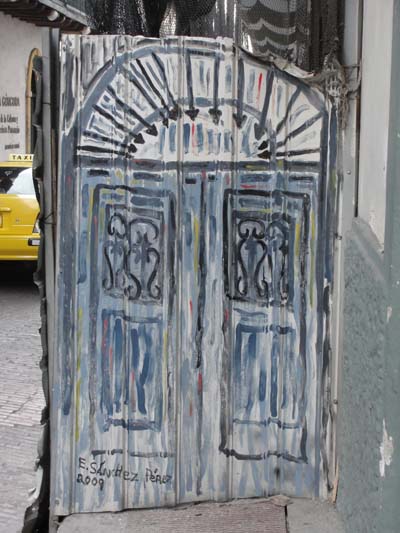
Construction artwork signed by E. Sanchez Perez


Casco Viejo

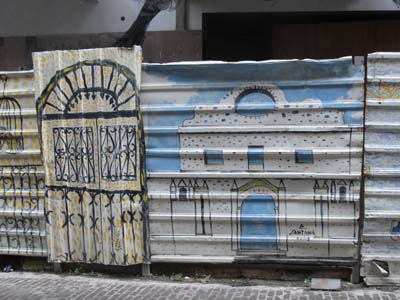
Dooorways painted on construction barriers signed by B. Santana


Casco Viejo

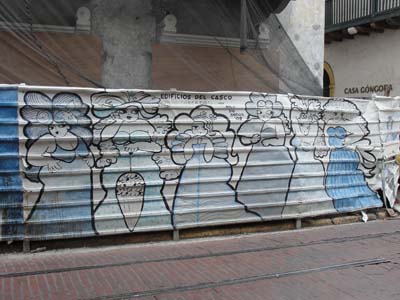
Painting on construction barrier entitled Edificios del Casco


Casco Viejo

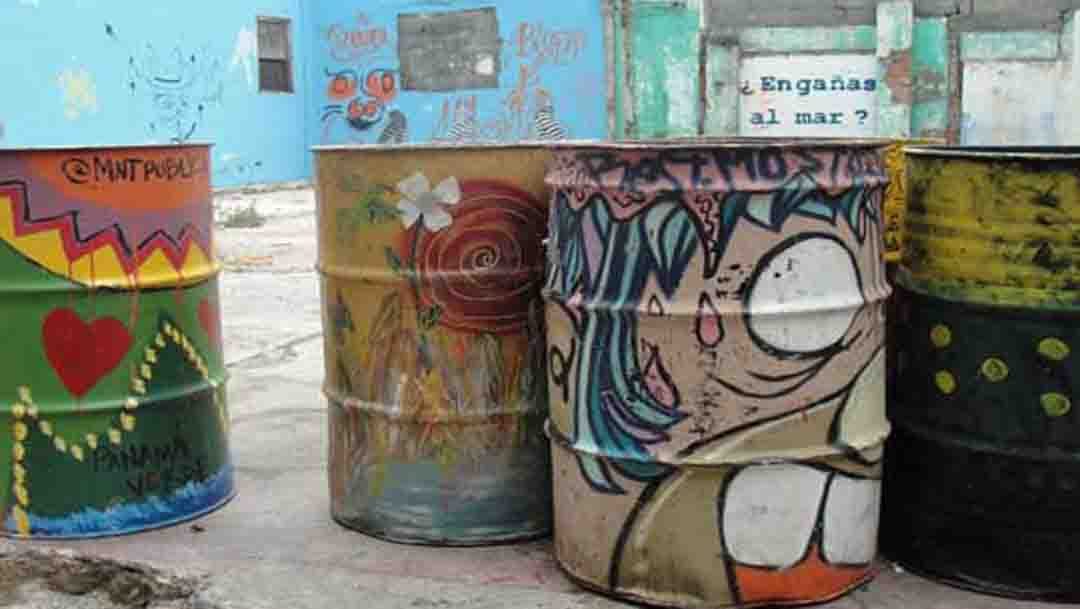
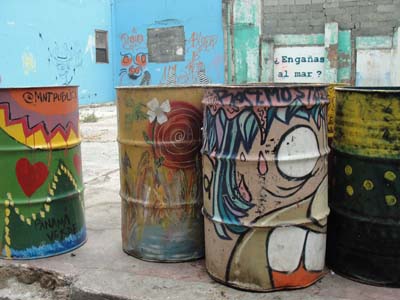
Painted trash cans near construction site in Casco Viejo


Casco Viejo

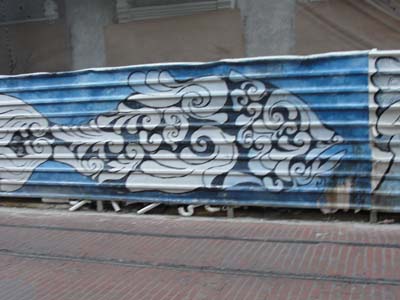
Giant fish painted on construction barrier hides plumbing materials

Casco Viejo

Padre Ricardo and the Sacristy of Santa Clara

Padre Ricardo and the Sacristy of Santa Clara

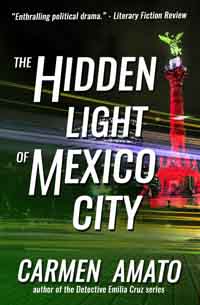
The Hidden Light of Mexico City contains a number of references from my own experiences in Mexico City.  I’ve already written about the  class struggle of simply standing in a line but also wanted to share a sadder, more compelling event that helped shape the book’s narrative through the character of Father Santiago.

Related: Read HIDDEN LIGHT’S First 2 Chapters

Father Richard

Father Richard Junius–or Padre Ricardo–was the pastor at St. Patrick’s Catholic Church in Mexico City when I lived there.  He was an Oblate Missionary who had been in Mexico for years, ministering mostly to the rural poor.  St. Patrick’s was a sizeable urban parish  in a fairly tough neighborhood. It was the only designated English-speaking church in the city.
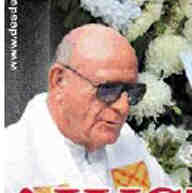
Fr Richard Junius

Years ago the church had sold off the school building next door. Funds from the sale  were held in escrow by the diocese for maintenance of the church and attached rectory.  The previous pastor had been removed due to a number of misconducts; when Father Richard arrived we were all cautiously hopeful that the new priest would set things right.

St. Patrick’s sacristy was a place I came to know well; the ladies of the parish cleaned it up for the incoming priest, removing layers of grime and polishing the few silver items the church possessed. My son was an altar server and I remade and cleaned all of the altar server vestments, hanging them in the room’s small closet.  The description of the sacristy of the church of Santa Clara in The Hidden Light of Mexico City is based on St. Patrick’s.


Father Richard was old and patient and tireless in his efforts to reach out to the local community and deal with their family issues. He made his new English-speaking congregation aware of prison irregularities in Mexico and didn’t flinch when an armed drug addict, stoned out of his mind, walked through the church and accosted him on the altar during midnight Mass.  He spent nothing on his clothing, wearing threadbare corduroy pants and sweaters that became the fictional Father Santiago’s wardrobe. 

Controversy

Father Richard had spent most of his time in Mexico in rural areas. Now in Mexico City, he seemed naive in the midst of Mexico’s spiraling crime and drug war. 

Twice he was assaulted and robbed while alone in the church counting  the Sunday collection. When parishioners insisted that the funds be handled differently, he disagreed, adamant that church funds were solely his responsibility and that he would not close the church at any time. 

He lent a substantial amount from the maintenance funds to an unscrupulous businessman man who never repaid the loan. Father Richard contracted for the bathroom repair without consulting with the parish council. Again, funds disappeared. The job was left half done and toilets didn’t flush.

Never afraid of controversy, he petitioned the bishop to change the church’s status from English-speaking to multi-lingual. The move angered some of the original congregation, but was welcomed by local families.

Much of the English-speaking congregation moved on, angered by his financial floundering. Several years later I was to learn that he’d been murdered.

A violent death

In August 2007, Father Richard was found stripped, tortured, bound and strangled to death in his bedroom in the rectory of Our Lady of Guadalupe Church in Mexico City.  His body was found the morning after a fire had broken out in the basement of the church late at night.  Initial Mexican news reports speculated that the death was a result of “sexual misconduct,” and downplayed the fire as well as the theft of several items from the church.  The charges were heatedly denied by Catholic Church officials in Mexico, thousands of faithful, and the  Oblates, according to the Catholic News Agency.

Other reports of his death noted that he’d been in conflict with the owner of  a bar near the church whom Father Richard had publicly called out for serving alcohol to minors. The Oblate website reported that “many believe that the brutal crime was in retaliation for Fr. Ricardo’s efforts to impede the drug traffic and the sale of alcohol to minors in the neighborhood. He had reported to the police that such activities were taking place in a building near the corner of the parish church.”

From the family

Fr. Richard’s cousin got in touch with me in April 2016 as a result of this blog post. In an exchange of emails, she related how she was informed by the Oblate Provincial in Belleville, Illinois that Fr. Richard was murdered:

“After I explained my connection, the Provincial began hesitantly stating, “I don’t even know how to say this.” When I asked what he needed to say, he responded that Father Richard had been murdered between the Saturday night Mass of Anticipation and the early Sunday morning Mass. I later heard that his sister expected his body to be returned to Eagle Pass for burial near the grave of his cousin, my uncle Father Bernard C. Junius, OMI. Sadly, the Mexican authorities buried the body quickly in Mexico City.
 
Prior to his death, Father Richard had written a lengthy letter to my uncle Paul explaining all of the activities he was involved in – a thrift store, a radio show, marrying Spanish and Anglo couples. His passion for service and love of those he served threaded through the letter. His death seemed like the waste of a true servant of the people.”
 

Catching his killer

Father Richard was 79 at the time of his death and only a month away from celebrating his 50th anniversary as a priest.  To my knowledge, his murderer has never been brought to justice and the official record remains death by misadventure.
 
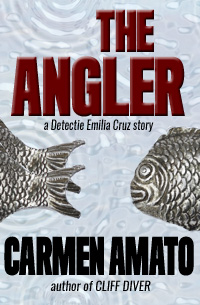
Not content with that, I wrote “The Angler,” a novella based on the murder of Father Richard. In “The Angler,” Detective Emilia Cruz, the first female police detective in Acapulco, faces a similar crime. This time, the murder is solved.

 

The Angler by Carmen Amato


You may also like

sacristy

Why Read a Book About Mexico Now

Reading about Mexico now is a mix of highs and lows. Fiction can’t substitute for facts but it can lead us to become interested enough in an issue to find out what is really going on.  That is the impact I hope The Hidden Light of Mexico City can have.

The press release says:

 The classic Cinderella story moves to Mexico against a backdrop of government corruption, drug cartel violence, and pending presidential elections.  The Hidden Light of Mexico City’s raw exposé of Mexico’s rigid class society makes this political thriller a must-read before America’s next debate over immigration.

Why is this important

What’s happening today is Mexico is fairly staggering.  As reported by The New York Times, based on Mexican Government statistics released in January, over 47,000 people have been killed in the country’s crackdown against the cartels.  It’s common knowledge that many are dead as the result of competition between rival cartels. Other dead are those who were transiting cartel territory as they tried to immigrate and were pressed into service to the cartels and then killed.  Stories of the “disappeared” and mass graves remind me of news reports of Cambodia back in the day, of “The Killing Fields” movie.

The killing fields are spilling over onto America’s doorstep. Last September the New York Times published an interactive map showing Mexican drug cartel reach across the border and a map of US drug seizures from Mexican cartel shipments to the US.  Disturbing, hardhitting.

CNN’s  recent series is even more compelling. The reporting takes us from a walk through a cemetary in drug kingpin El Chapo’s home state of Sinaloa, to a cold hard look at the numbers, to the search for those missing amid the violence.

Mexico’s drug war isn’t just about the fight between the cartels and the military, about political will to stamp out evil or even about guns and agents moving across the US-Mexican border. More than anything, it is about a people and a culture under attack.

This is where fiction can help tell a vital story, by imagining the lives of those living through the struggle, making them breathe and love and cry and fight. Fiction can hold attention and provoke emotion in a way that the news might not.

Update 2016

The numbers of those missing or known dead in Mexico continues to rise. The re-arrest of El Chapo kept the various cartels at each others’ throats in the quest to dominate drug routes into the ever-voracious US, and violence continues in many parts of Mexico.

Whatever the US presidential election holds for us, the US-Mexico relationship is back on the agenda after having been eclipsed for quite some time by the Middle East. The southern border, immigration, and undocumented folks are likely to be addressed one way or another. If fiction can help focus attention on improving relations between these critical neighbors, so much the better.

You may also like

Mexico now

A tale of Mexico: the school bus and the thriller

A tale of Mexico: the school bus and the thriller

THE HIDDEN LIGHT OF MEXICO CITY is a political thriller, with characters based on many people I met in Mexico City.

And a bus.

The setting

Let me set this up for you.

Our house was at the start of the school bus route going home. My children had a 10 minute ride. In the morning; they’d be the last to be picked up for a short ride through Chapultepec Park to the American School. To give you an idea of the student body, one of the other students was the son of a Mexican diputado. His bodyguards rode in an unmarked follow car. We never saw the bodyguards in the afternoon; I presume the chauffeur picked up the child like so many other children who attended that school.

One afternoon, a late model sedan parked near our house. A woman got out of the back seat, wearing a stylish dress, heels and ropes of gold chain. She introduced herself as Marit and said that her children rode the same school bus as my children.

They lived at the end of the bus line, she explained, and while she wanted her son and daughter to have the experience of riding on a school bus, it took too long.  In future her children would get off at our house and be driven home by the chauffeur.

Related: Reads Chapters 1 & 2 of THE HIDDEN LIGHT OF MEXICO CITY

A tenuous friendship

We spoke a number of times after that, me in my jeans on the stoop and she in her designer clothes from the window of the car.  When she learned I was new to Mexico City she took it upon herself to give me a tour of the best shops and restaurants in our neighborhood. The children and I were invited to a midday meal with her husband and children.  The event included lunch at their house–about 15 minutes away–and a stop in the kitchen to view the 5 uniformed staff and present my compliments to the cook in her white jacket.

Related post: Swimming lessons or how he wound up in a thriller

Soon after, Marit came over for coffee before meeting the bus. Our housekeeper, a wonderful young woman whom we did not require to wear a uniform, met us in the living room.  I introduced them as I would any two people, using full names.  To my surprise Marit immediately addressed the housekeeper using a common nickname rather than the housekeeper’s actual name. The grilling about work hours came next. It was an effective and not very subtle message: the housekeeper was getting above herself using her full name, not wearing a uniform, and leaving the kitchen instead of waiting to be assigned her work.

Related post: Itzel’s story or how she came to be in my novel

Marit also called me the next day and took me to task for not making the housekeeper work more hours–a day maid should show up to work at 7:00 am at least. By asking the housekeeper to come at 10:00 I was only encouraging her to become lazy.  I should note here that my husband generally referred to the housekeeper as the “Mexican Tornado” for her amazing work ethic. Marit’s words told me that there’s a caste system in Mexico that bottles up more people than just the Mexican Tornado.  So escape it, people will mule drugs or risk an illegal crossing into the United States.  Or both.

Be careful, I’m a writer

There were no more coffee or lunches after that but the final break came when Marit called to ask if, as an American, I could get her maid a visa. The family wanted to go to Disneyworld and take their maid to look after the children in the evenings.

The visa process took too much time, Marit said.  If the maid had to stand in line at the US Embassy she’d miss work.

I replied that I had no ability to obtain a visa for her maid and I never heard from Marit again. The car no longer stopped in front of my house to pick up her children.

But I had stored up enough from her tone, mannerisms, and home tour to cast Marit as Selena de Vega and transpose her home and servants into the Vega home. There are some differences to be sure, but the social ladder that Marit showed me became the impossible mountain that fictional maid Luz de Maria must climb in THE HIDDEN LIGHT OF MEXICO CITY.

You may also like

Mexico

Remembering Resistance

Remembering Resistance

In my travels, it has struck me that a culture reveals its true strength by what it chooses to remember and preserve.  Often that means museums, but it also means UNESCO World Heritage Sites, preserved or excated sites like Jordan’s Petra or Italy’s Pompeii, the music and folksongs and linguistic ideocyncracies that are gifts from one generation to another.

Sixty-five years after the end of WWII, here are a few thoughts on the way two countries have chosen to remember and preserve their resistance to Nazi occupation.

Norway

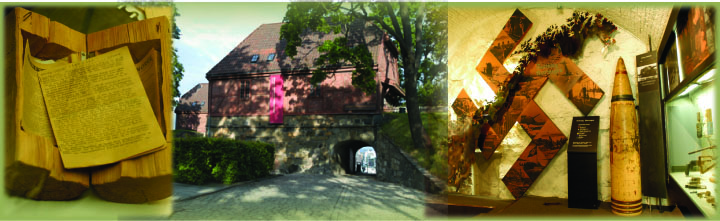
Norway’s Hjemmefrontmuseum, located in Akershus Castle in Oslo, is a world-class museum that lays out the history of the April 1940 German invasion of Norway, the Norwegian military’s spirited but overmatched defense, and the king’s narrow escape to London where he established the legitimate Norwegian government in exile while the Quisling government ruled in Hitler’s name.

In Norway, the shock of occupation  quickly gave way to anger and to an organized armed resistance effort. The British provided training, supplies, weapons, and clandestine transportation that became known as the Shetland Bus. Norwegian Resistance cells carried out commando raids and sabotage (the most famous actions being the destruction of the production capability of the Norsky Hydro heavy water plant–immortalized in the Kirk Douglas classic movie The Heroes of Telemark–that deprived the Nazi nuclear weapons development program of a vital component.)

The Norwegians’ ability to survive in the country’s wilderness areas and ski away from pursuit helped them survive to fight another day, but the death toll was high. The Germans retaliated with relentless hunts to find Resistance members and executed civilians in response to Resistance raids and destruction.

Resistance

What the museum revealed

The museum, in addition to being located in an impressive historic castle guarding the Oslo Fjord, wins major points for display, authenticity, and heart, with an excellent collection of everything related to the Resistance, from clandestine newspapers to hidden radios to the log-shaped containers used to drop supplies to Resistance cells in remote locations.

Every display was eye-catching and well explained, with many personal accounts woven into the factual information.  The museum belongs to the Norwegian Defense Forces and the Resistance is a proud part of Norway’s military heritage.

As I wandered through the museum,  I found myself writing down bits and pieces of this fascinating national story and since have sought out memoirs of Resistance members, like Two Eggs on My Plate by Oluf Reid Olsen and We Die Alone by David Howarth. Touring the entire place took me over three hours both times that I have visited, not counting time spent in the bookshop.

Netherlands

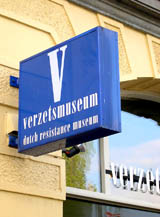
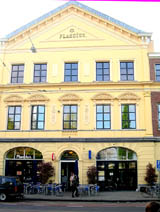
In the Netherlands, the Dutch Resistance Museum, the Verzetsmuseum, was a different experience, reflecting that country’s different wartime situation. The museum is located in a rowhouse in a busy Amsterdam commercial district. It is a small, modern gem which has won several awards. But the nature of the resistance in the Netherlands was mostly a nonviolent movement, with small cells operating independently. Some sabotage and counterintelligence activities took place late in the war, as the Allied invasion of Europe loomed.

What the museum revealed

The museum’s permanent collection focused on how people endured the occupation. It took pains to point out the state of the country in the late 1930’s and I was struck by the high percentage of Dutch who lived below the poverty line at the beginning of the war. Needless to say, things only got worse during the occupation.

ResistanceResistanceAs I paid my admission fee I was told that it would take at least 2 hours to tour.  But 20 minutes later, I had seen all the exhibits and was wondering if I’d missed a  door to the rest of the place.

But mostly I was struck by the feeling that the museum had hidden an apology. Despite the exhibits of life during the war, the nameless but courageous couriers, and the gut-wrenching stories of those who had to kill informants in order to save the members of their resistance cells, there was a sense of sadness rather than the daring and triumph of the museum in Oslo.

It was as if the Verzetsmuseum acknowledged that it lives in the shadow of the Anne Frank House, just a few miles away and stunningly and comprehensively preserved.  That is the definitive story of Dutch resistance, a resistance of the heart and mind.

I wonder if there will be a National Resistance Museum of Syria.

You may also like

Resistance

The Kitchen UN

The Kitchen UN

Oslo in June is a wonderful place. Clouds scud across a cobalt sky and the harbor is thronged with boats, tourists, and the smell of lilacs. After months of Arctic winter grey, the city is stretching itself awake in the midnight sun. You stay up long after sunset at 11pm, wrapped in a blanket at a harborside cafe.

And there in a shop window, was the perfect souvenir–a row of blue and white spice jars with names of spices in Norwegian, looking like an Italian-worded set that my grandmother had. I imagined them in a row on my counter at home, their blue letters proclaiming my adventurousness. Every time I’d look at them I’d remember both Oslo in June and my grandmother’s kitchen.

kitchen

But mostly I’d be looking at pottery shards in a soft-sided suitcase.

So I passed them up and I’m still kicking myself. Those little jars captured what Norway meant: the bluest sky in the world, the freshness of energy of a reborn place, an unexpected reminder of my grandmother.  And my kitchen really needed that final touch; something to go with the salad tongs from Kenya, coffee mugs from England, corkscrew from Australia, the framed menu from my Paris student days, the olive cutting board from Greece, and a truly antique Delft tile I couldn’t afford, another from the tram stop at Binnenwatersloot where for once I wasn’t lost, a tiny ceramic square from Rome inscribed with the blessing Pace e Bene.

A fourth tile hangs on the wall. Hardly a prized antique, it’s a mass-produced tile with a color picture of a woman and child walking next to a walled village with “Rothenburg ob der Tauber” written on the bottom. I got it in an antiques shop in Virginia, in a box labelled “odd cups.”

It took me back to the medieval village of Rothenburg, to a 1981 trip my mother and I took to West Germany and Austria. We embraced the beverages, the food, the architecture, the people, and the fine bed-and-breakfast establishments recommended by the publishers of Let’s Go Europe. We climbed an Alp. rode a cable car, listened to Mozart in Salzburg, sang in the biergartens, and mourned at Dachau. And bought not one sourvenir.

So years later, I found myself paying the outrageous price of $12 for a chipped tile and exulting over such a bargain. Of couse I called my mother and she laughed as we remembered the beer, the wursts, and the rest of the trip. I smile every time I see that tile, knowing what a bond it represents.

The kitchen is the heart of the home. Maybe that’s why so much of my kitchen tools are souvenirs from my travels.

Bene e Pace

You may also like

kitchen

Land of the Unexpected

Land of the Unexpected

Once upon a time, I took a trip with a similarly adventurous-minded girlfriend to Papua New Guinea, which bills itself as “The Land of the Unexpected.”  I doubt it has changed much since then; it is a wild, mountainous place where the wheel was never invented.

Civilization burst upon Papua New Guinea as World War II rocked the South Pacific. Geographically, it is part of the Solomon Islands chain (think Guadalcanal) and WWII turned the deep waters around it a graveyard for American and Japanese ships and planes.

In the capital of Port Moresby, we tasted crocodile in the hotel restaurant, did a little shopping for tortoise shell bracelets and a breastplate-sized kina shell to be worn as a necklace, and bought beer glasses at the South Pacific Lager brewery (I actually prefered the Fiji Bitters beer I’d had in that country, but that’s another story.)

We also learned about the wartime Coastwatchers, the group of valiant locals that watched Japanese ships and planes and reported back to the Allies.

Into the Wild

From Port Moresby we headed to the Highlands in a puddle jumper plane and found ourselves in Goroka, a settlement carved out of the wilderness that occasionally shivers from volcanic aftershocks. It’s home to the now sadly commercialized Goroka mudmen tribe and some of the strongest, most flavorful coffee in the world.

Goroka was victim to a terrifying social cycle. About 10pm every night drunken customers spilled out of the pool halls and bars and proceeded to rampage through the streets destroying whatever got in their way. Each morning everyone put the town back together again.

Overall, the country had a rape statistic of 1 in 4 women being the victim of sexual assault, a situation that was probably underreported. We were stuck in a motel which had long given up concerns about security. In all of the rooms that the manager offered, either the door or the window locked but never both.

We blocked the door with the dresser and stayed up nights watching a grainy cable station from Australia and listening to the commotion outside.  We were prepared to fight and fight hard if our room was invaded. Luckily, it never came to that.

Where a souvenir is all about you

Despite the nightly rampages, we got out and about and presently found ourselves with a translator at a local market.  There were wonderful wooden carvings for sale, fanciful animals and platters and bowls and puzzles. There were baskets coiled into shapes both practical and fantastic.

We were charmed.

An array of wooden crocodiles and seahorses caught my eye. Pointing to the largest croc, I asked how much it was. The translator queried the woodworker, a grizzled older man chewing betel nut which had painted the inside of his mouth bright red. He wore shorts and a dark shirt with the sleeves cut off and his dusty bare feet were  the size and shape of a large dinner plate.  He replied to the translator who then turned to me. “He wants to know if you’ll pay the first, second or third price.”

“What?”

“You pay the first price, the highest, if you’re a Big Man,” the translator explained. A Big Man was someone of Importance in the tribe, a person who paid a price commensurate with the respect that was to be accorded them. The lesser second price was paid by those who either weren’t quite a Big Man in terms of respect or didn’t have a Big Man’s means. The third price, the lowest amount of money, was paid by those who were of no account. 

Basically, it was a system of paying in accordance with how important you were rather than how valuable the item was.

Pay your own price

True confession . . . I paid the second price.

I wasn’t in a Big Man category. But I didn’t consider myself to be a nobody, either. A therapist might have a field day with this, but I walked away feeling like I’d acquitted myself well enough.

The crocodile I bought that day is still around, as is a tall seahorse and the kina shell I never turned into a necklace.

And oddly enough, I think that Highlands adventure taught me quite a bit about geo-politics and current events.

MY BACKSTORY— I learned a few things about danger, deception and resilience during a 30-year career with the CIA focusing on counterdrug efforts and technical collection. Now a mystery author, those lessons play out on the page, especially in the Detective Emilia Cruz mystery series set in Acapulco. Starting with Cliff Diver, the series is a back-to-back winner of the Poison Cup Award for Outstanding Series from CrimeMasters of America. I’ve also written historical and political thrillers, essays about the craft of crime fiction, and live with a very large white dog named Bear.

You may also like

land of the unexpected

At the End of the Line

At the End of the Line

Let’s set the scene

Luz filled out a form to cash the check at a mahogany counter then went to the end of the line.

            It moved very slowly and grew very long. Luz had ample time to look around. The bank was an elegant place of glass and darkly veined marble where people had hushed conversations. The business being transacted was too venerable for a normal tone of voice.

            Luz was only about eight customers away from the teller windows when a man wearing a beautifully tailored dark suit walked into the bank. In the midst of the rough looking laborers, he stood out, tall and good looking.

            He consulted his jeweled Rolex and eased into the line directly in front of Luz. No one he passed reacted at all. The security guards on either side of the line appeared not to notice.

            Luz stared at the finely stitched wool in front of her. Maybe it was the boldness of knowing Eddo or the check that said she was a real artist or the fear that Marisol would punish her for taking such a long time, but she tapped him on the shoulder.  “Excuse me,” she said. “The end of the line is back there.”

            The soft murmur of banking conversations abruptly ceased.

            The man turned around. He was younger than Luz, maybe in his early twenties. He looked her up and down, taking in the gray uniform, old sweater, short socks, scuffed shoes, high cheekbones, and flat hair tucked behind her ears. Luz tried not to wilt.

           “What the fuck?” he said and sniffed as if she smelled bad. Then he turned around and walked ahead of the next three people in line. They all stepped to the side to let him pass.

end of the line

Write what you know

Unfortunately this fictional scene from The Hidden Light of Mexico City is based on a real event.  Like Luz, I was in a big bank in Mexico City.  As I stood in line and watched the well-dressed young man cut in, I actually gasped at his rudeness.

No one else reacted. The laborers, maids, and others whose work attire betrayed their social class just numbly accepted that he should be ahead of them and avoid their long wait. I spent the next few minutes alternately fuming at the lack of reaction and convincing myself that this wasn’t my fight.

But the gasp had attracted attention. My check was invalidated by the teller.

My revenge was to capture what had happened in a novel.

I met alot of people like that rude young man in Mexico City.  They enjoyed the heritage of old money and were accustomed–and wedded to–to the priviledges of the ruling class and the subservience of those on the social scale far below.  The latter, in turn, appeared resigned to their status and to the economic limbo it implied.

Noticed

Happily, I’m not the only one who has noticed and stronger voices than mine are talking about inequality in Latin America and its impact on development.  The RAND website offers a great recap of a talk given last month by UN Assistant Secretary General and Regional Director for Latin America and the Caribbean at the UNDP Heraldo Muňoz based on the UNDP’s recent report “Acting on the Future: Breaking the Intergenerational Cycle of Inequality.”

According to Muñoz, “features of inequality have been an inheritance for hundreds of years. Inequality is very significant, very profound, very persistent, and very difficult to break. Inequality in income, education, and health pass from one generation to another.”

Although Latin America is not the world’s poorest region, it is the most unequal one, said Muñoz. It has 10 of the 15 most unequal countries in the world, when measured by household per-capita income. “Latin America is 65 percent more unequal than high-income countries, 36 percent more unequal than East Asia, and 18 percent more unequal than even the average for sub-Saharan Africa.”

The solutions aren’t easy and they won’t be fast.  But the dialogue has started.

You may also like

end of the line

Celebrate Greek Culture Now More Than Ever

Celebrate Greek Culture Now More Than Ever

Greece has overspent itself to the brink of destruction and angry citizens are showing their contempt for further austerity measures by firebombing downtown Athens.  Talk continues of defaults and the downfall of a country and the entire eurozone as well.

But even if the country’s national institutions wobble, Greek culture will survive the current unpleasantness in Athens. Here are some reasons why:

1.  The Mediterranean Diet   The heart-healthy Greek menu emphasizes fish, olive oil, fresh fruits and vegetables and a splash of wine for good measure.  According to the Mayo Clinic “most if not all major scientific organizations encourage healthy adults to adapt a style of eating like that of the Mediterranean diet for prevention of major chronic diseases.” Read the full article about the benefits of eating Greek here.

2.  Kiosks   There’s a tiny outdoor convenience store every few blocks in Athens where you can buy snacks,  newspapers, bus tickets, an emergency bottle of olive oil, etc.  The kids can be sent down the street with a few euros to buy an ice cream bar and Dad can stop for a small bottle of whiskey to soothe a bad day at the office.  Friends can meet for a quick chat, read the headlines and get a sports drink when the heat roasts marble buildings to a sparkling white and all the fresh oranges and eggplants you bought at the neighborhood laiki open air market start getting heavy on the walk home.  Maybe now isn’t the time to open that designer dress shop in Kolonaki but the kiosks will still be a central part of life this time next year, too.

3.  The lemonade at the base of the Acropolis   You came to see the famous Parthenon, step in Socrates’s footsteps at the Pnyx, imagine the chariot races and salute Hadrian’s arch.  But how did democracy thrive in this heat! The antidote is the amazingly crisp, fresh lemonade sold at the ordinary-looking concession stand at the base of the Acropolis. Buy one–at whatever today’s cost–after your trek up to the Parthenon. And be careful on the way down. There aren’t safety rails and Greece probably doesn’t have the money to install them now.

4.  Storytellers  Writing and storytelling are quintessential aspects of Greek culture. This proud heritage is being carried on by the Aegean Arts Circle. Writer, sculptor and all-around Renaissance woman Amalia Melis runs the Circle which hosts an annual writer’s workshop series on the island of Andros.  Workshops are led by notable authors who help both experienced and novice writers polish fiction manuscripts. This summer’s workshop will be led by Pulitzer Prize winner Robert Olen Butler whose “. . . workshop will focus on the fundamentals of the creative process for any fiction writers, beginning or advanced, who aspire to create enduring literature.”

5.  The Greek alphabet   Fraternities, sororities, astronomers, interior designers, and the electronics industry (Coming Soon! The beta version!) are among the notables who all embrace the timeless quality of the Greek alphabet.

6.  This. Is. Sparta.  Okay, okay. Yes, it’s an internet meme and King Leonidas kept slipping in an accent that suggested he’d been thrown out of his fair share of pubs, but Hollywood loves Greek history. Think Troy.  Alexander the Great.  Beautiful scenery, low budget costumes and pre-written plots.  And then there is the fabulously genuine Nia Vardarlos who singlehandedly brought Greek traditions of family, food, and loud arguments to the silver screen.  And made us laugh.

7.  Ohi Day  There is a Greek resilience best illustrated by a unique holiday which celebrates the day in 1940 that Greek Prime Minister Metaxas refused to allow Axis forces to enter Greek territory and occupy certain unspecified “strategic locations.” The ultimatum was delivered by the Italian ambassador on behalf of Germany and urban legend has it that Metaxas answered with just the word “ohi,” or “no” in Greek. The Axis forces invaded shortly thereafter. Forced to the brink of starvation, Greece barely survived the rest of World War II and its chaotic political aftermath, best captured in My Brother Michael by Leon Uris.

So tonight, I’m celebrating with My Life In Ruins, and some feta and olives. I’ll watch the news tomorrow.

You may also like

A Walk in Her Shoes

A Walk in Her Shoes

I recently was on a plane heading from Central America to the United States. I had the aisle seat. Next to me, in the middle seat, was a middle-aged woman who was obviously new to airline travel.  The flight attendant rapped out directions how to buckle the seatbelt and stow carryons and continued to the next row. The woman looked panicked and I helped her get situated. We introduced ourselves. She was Maria from Colombia, this was only the second flight she’d never been on, and she only spoke Spanish.

A smooth takeoff turned into one of the bumpiest flights I’d ever been on. Maria and I held onto our complimentary dinners and said reassuring things to each other. We noted that each wore a small cross.

As we approached the US, the flight attendant handed out immigration forms. Maria stared at it blankly. I asked if she had the address of where she was going in the United States. She took out a well-worn address book, pressed it into my hand and asked me to fill out her form.

Maria was starting a whole new life in Tennessee with her niece’s family. She asked me if the winters there were cold; she wasn’t sure she could live in a cold place.

When her form was completed I explained as best as I could the immigration process and how she’d need to collect her suitcase before going through customs and finding her connecting flight to Tennessee. She kept nodding but I’d never had to describe such a process in Spanish and couldn’t seem to find the right words. But once in Houston I went into the line for US Citizens and pointed her toward the line for Visitors. Last seen, she was waiting patiently for her turn to show her passport to the uniformed official.

I wondered if I’d see her at the baggage carousel but the place was awash with people. The giant tote board showed nearly 40 arriving international flights. I’d just found the correct carousel for my flight when another woman, also about Maria’s age, addressed me in German.

I don’t speak German, just a few tourist bits from my travels like bier and weiner. But it was clear she didn’t understand how to get her luggage. The airport didn’t seem to have enough signs and few were in other languages besides English. And this was in the international arrivals area. I steered her back to the tote board and started reading off the city names. When I said Hamburg she nodded vigorously.

Baggage from the Hamburg flight was slated for carousel two. I held up two fingers and pointed the way. She saw the giant number hanging over the carousel and said “Thank you” in English. We laughed when I replied “Danke.” She gave me a hug and then went to get her bags.

I met up with her again in the Customs line. Through a series of gestures and a mix of languages I learned that her name was Marta and she was going to visit her daughter in Minnesota who was a teacher. When we parted at her gate I wished I knew how to say “good luck” in German.

As I waited for my own connecting flight, I mulled over my newfound role as a traveller’s aid society. A day in Maria and Marta’s shoes had been hard, full of incomprehensible directions and unfamiliar environments. I wondered how they would look back on their first experience of the big unruly culture of the US. They’d kept smiling and trying and hoping, because there was nothing else to be done, but underneath there had been fear of the unknown.

Every experience with a new culture is like that and putting on their shoes for a day was a good reminder. The world is smaller now than ever, and more connected, but it still takes courage to explore it.

Besos, Carmen

You may also like

walk in her shoes

Pin It on Pinterest