Film Rights to Acapulco Mystery Series Acquired by Screenwriter

Film Rights to Acapulco Mystery Series Acquired by Screenwriter

I am thrilled to announce, after weeks of negotiations between lawyers, that a contract for the film rights to the Emilia Cruz mystery series has been inked. Screenwriter and director Emily Skopov (ever hear of a little series called Xena, Warrior Princess?) released the news yesterday:

PITTSBURGH, May 18, 2015 /PRNewswire/ — Screenwriter and director Emily Skopov is pleased to announce the acquisition of film and television rights to the Detective Emilia Cruz series by mystery author Carmen Amato. The series, which includes the novels CLIFF DIVER, HAT DANCE, and DIABLO NIGHTS, as well as a collection of short stories, features Emilia Cruz as the first and only female police detective in Acapulco. Physically tough yet emotionally vulnerable, Cruz must be her own moral compass as police investigations pit her against Mexico’s drug cartel violence, government corruption, and gender bias against a woman in a traditionally male occupation. A relationship with an American man in a high-profile position further complicates Cruz’s life.

Read the rest of the press release here: http://www.prnewswire.com/news-releases/writerdirector-acquires-rights-to-groundbreaking-emilia-cruz-detective-novels-300084734.html

Join me in a virtual margerita! Hollywood, here we come.

You may also like

film rights

Intention versus Reaction

Intention versus Reaction

“Persistence is the master virtue.”

The quote is attributed to the great thinker Anonymous. As I plug away at the 4th Detective Emilia Cruz mystery, KING PESO, it really resonates. But along with persistence, a few other key words have been useful lately.

A friend is a student of human behavior and has broadened my everyday vocabulary with words like “intentional” and “threading.” Not only have these words led me to consider how I plot mysteries but also how my characters behave.

And me, too.

Related: The Emilia Cruz series character bios

Intention

To act with intention, or be “intentional” is a positive I-will-own-this-outcome concept. In contrast, by not acting with intention, we are willing to be reactive. That means possibly ending up owning  someone else’s agenda.

That’s not to say that acting with intention means you’ll always get your way. But to risk another quote from Anonymous: “If you aim at nothing you will surely hit it.”

Threading

Threading is another great term. When I’m threading, I’m carrying my intention through a series of actions. We talk about the “thread of a conversation,” often in the context of losing it. What if we kept the thread, unspooling it via multiple intentional interactions? Wouldn’t that improve the odds of getting what we intended?

Huh. I think that’s called persistence.

You may also like

Intention

The Elusive Charms of Productivity

The Elusive Charms of Productivity

I’ve been reading the blog of James Clear, a life coach and productivity expert. While I mostly agree that productivity is all about Me, I also think it’s all about Them.

Where for art thou, Productivity?

Clear gives great advice on how to live a richer life and enjoy the ride as you journey toward your goals, which I soak up like a sponge. As a mystery author, it is easy to lose sight of why I started writing in the first place and instead focus on sales numbers, useless comparisons with other (invariably more clever and successful) authors, and what I’m doing wrong (no marketing acumen) instead of what I’m doing right (creating memorable characters and stories that resonate and entertain).

Clear’s advice on productivity is thoughtful and practical. But he’s not the only one. There are oodles of tips for authors looking to maximize their time: write 1000 words a day, use these writing prompts, set a timer to take a break every 45 minutes because you’ll work like the dickens before the break.

But progress on the next Emilia Cruz novel, KING PESO, is merely crawling along. With all this great advice out there, why isn’t my productivity through the roof?

Maybe it’s not about me at all.

The Therapy Chair

For years, I wrote in the spare bedroom. The room featured a desk, a computer, and a pull out sofa. The kids were small and my writing time was limited to weekend mornings when Dad kept them busy.

When we moved, the new guest room featured two twin beds. The bed closest to my desk was a magnet for the kids as they made their way through elementary, then middle school. They’d lay back and talk about everything; teachers and homework and dogs.  They jokingly called it “the therapy bed.”

Another move and I gained a proper writing office, albeit with only enough space for an extra chair. It was promptly dubbed “the therapy chair.”

Over the years, I spent hours at the computer, hands in my lap, mystery plots replaced by conversations about teen romances, crazed teachers, and American TV shows the kids were missing because we lived overseas. The doctor was in.

Of course I don’t begrudge that time with my kids, and think those conversations helped them both to be the college honor students they are today. Could I have written more without that therapy chair? Possibly. But I would have missed the important stuff.

The most fascinating person in the world

Sometimes it is hard to be productive because you’re just too fascinating. Everybody wants to be with you. Talk to you. Have some of your glitter rub off on them.

Fellow scribbler Deb Nam-Krane wrote a short but brilliant list of why productivity can be so elusive and gave me permission to reprint it here:

1. If you want to convert Night Owls to Morning People, just start waking up really early (like 4:30 AM early) so you can work out, wash the dishes and get some writing in. This will ensure that everyone else will start waking up early, too, no matter how quiet you are. Because you are the most fascinating person ever.
2. Take advantage of every second of Adult Alone Time you have if you’re trying to be productive in ways that require concentration; otherwise you’ll be trying to get things done while two of your children are chatting in your room. Never mind that Every. Other. Room. in the house is unoccupied. Because, again, you are the most fascinating person ever.
3. The best way to get people to stop complaining about things you do and decisions you make is to put them in your shoes. It might take a long time, but it works.
4. Laundry is always there for you, just like the dishes.
5. Don’t waste energy resenting that you have to clean up after people who technically should be able to clean up after themselves. Just do it for your own survival– and then start throwing away anything of theirs you find in a place you disapprove of.

You can read more of Deb’s clever observations on life and writing on her blog: http://writtenbydeb.blogspot.com/

Productivity goes to the dogs

The therapy chair was semi-retired when the kids went to college.

But then we got a puppy.

A killer attack voodoo puppy. Or for the layman, a Belgian Malinois from a breeder who sells to Navy Seals.

While we lived in Mexico, our big dogs thwarted more than one robbery. When it was time for another dog, we knew we wanted one that could keep our home safe no matter where we live.

Well, the home is now safer than Fort Knox. The dog is slowly becoming a good citizen, as long as you aren’t the pizza delivery guy, the mailman, or other intruder with evil intent. Training takes time. Plus there are toys to destroy, endless trips to the back yard to investigate the woodpile, walks to get used to her new urban setting, and an insatiable need for belly rubs.

Hmm. Maybe productivity is overrated.

2016 update

The killer voodoo puppy passed away and we now have a charming lab-shepherd-beagle-boxer mix. The kitchen sink could be in his bloodline, too. He has become my faithful companion, snoozing on my feet as I write. With him around, we’ll never need a therapy chair again.


You may also like

productivity

Visiting Norway, Mystery Author Style

Visiting Norway, Mystery Author Style

Can a mystery author who writes about sunny Mexico really love cold places?

Yep. Besides Mexico, where my mystery series is set, my favorite country (except for home) is Norway. Not only does the country have superb natural vistas of mountains and fjords, but Norway’s history is likewise fairly amazing, if little known. Yes, Virginia, there’s more to Norway than Vikings, Voss water, and fellow mystery author Jo Nesbo.

Spectacular moments and singular people

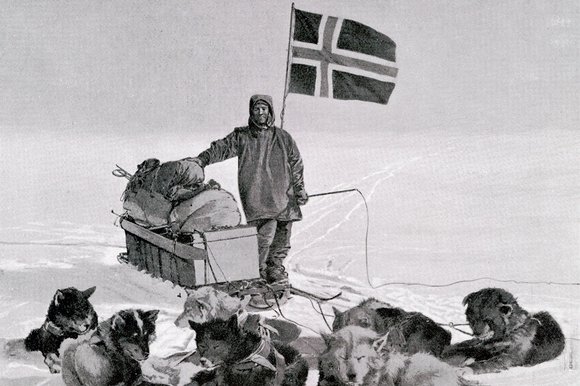
Amundsen with dogsled and flag

Picture of Roald Amundsen courtesy The Sunday Times, UK

  • Norwegian Roald Amundsen led the first expedition to the South Pole, beating out British explorer Robert Scott
Nansen passport

Picture courtesy World Digital Library

  • Norwegian explorer and statesman Fritjof Nansen’s Nansen Passport enabled WWI refugees to remake their lives
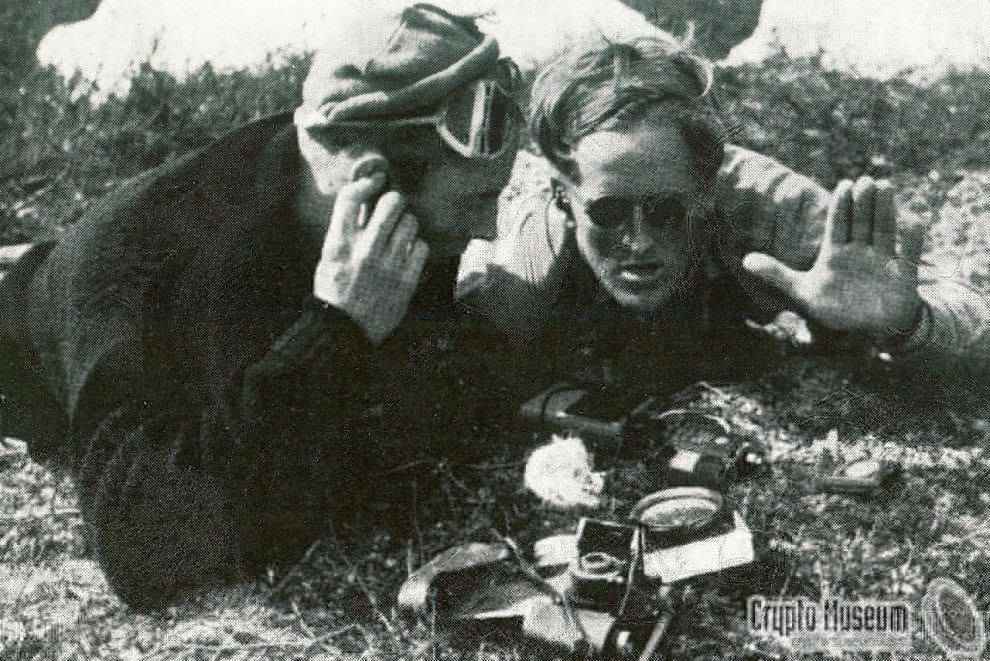
Norwegian resistance fighters

Picture courtesy cryptomuseum.com

  • The Norwegian Resistance fought during WWII  with courage and distinction

Related post: Remembering Resistance 

  • The nation of Rohan in the Lord of the Rings movie trilogy looked eerily like Norway’s traditional architecture. Okay, so this is the fabled battle scene when the Rohirrim ride against the orcs, not anything architectural. But a great bit of film and you should watch it.

Museums

Stave Church

Stave Church

I’ve been lucky to visit Norway twice and fell in love with the cobalt blue sky, crystal clear water, excellent (albeit pricey) shopping, and terrific museums. The Fram Museum houses the specially built polar ship that carried Nansen north and Amundsen south. The Folk Museum, where the Stave Church is located–the interior of which was very dark and smelled like bacon–is an immense meadow outside of Oslo filled with period homes.

Related post: The Kitchen UN
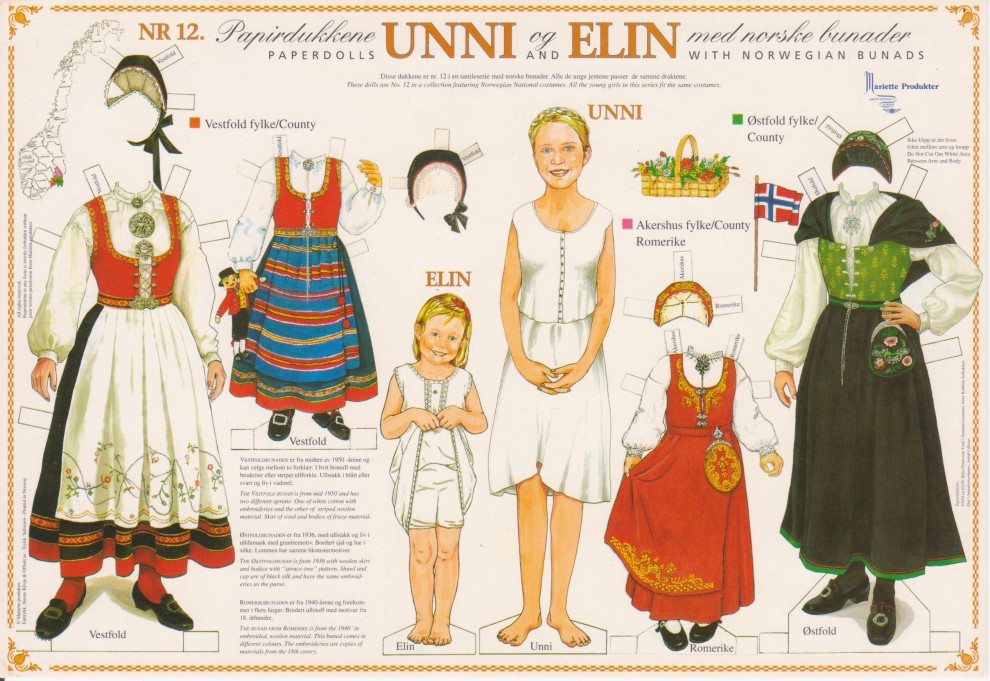
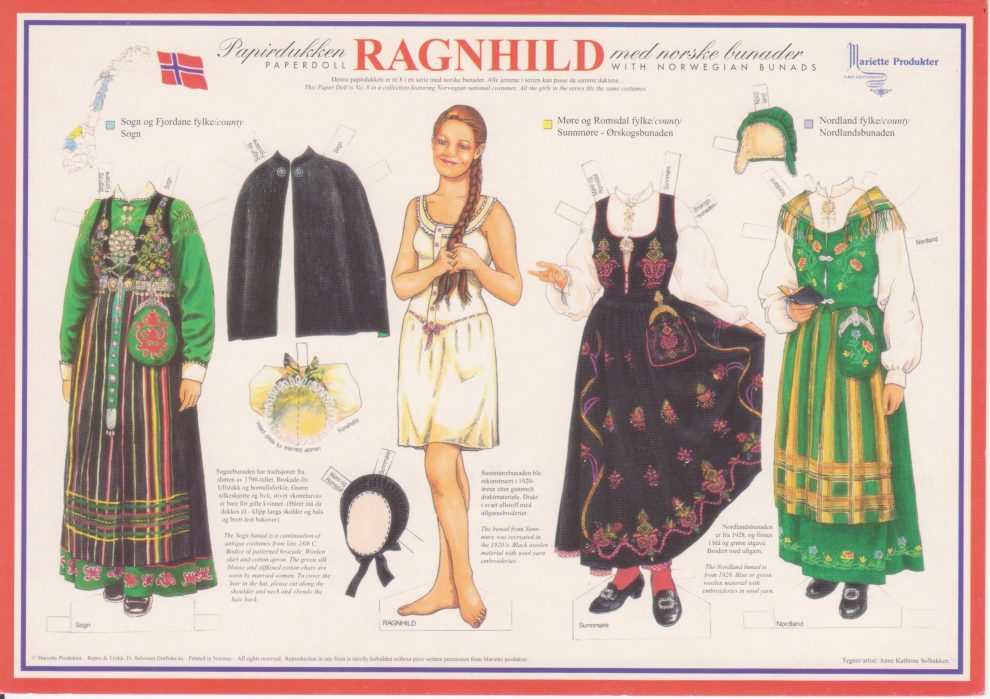
It was at the Folk Museum that I learned the Norwegian words for King (Konge) and Queen (Dronning) when I bought a huge paper doll poster. Awkward to carry home, I had notions of framing it. I still do.

King, Queen, and costumes

If cut out, Konge and Dronning would be bigger than Barbie and Ken. Each doll has several different costumes, just like these smaller paper doll postcards of Norwegian folk costumes also purchased at the Folk Museum.Unni and Elin paper dollspaper doll from Norwaytraditional Norwegian paper dollsAllied costumes

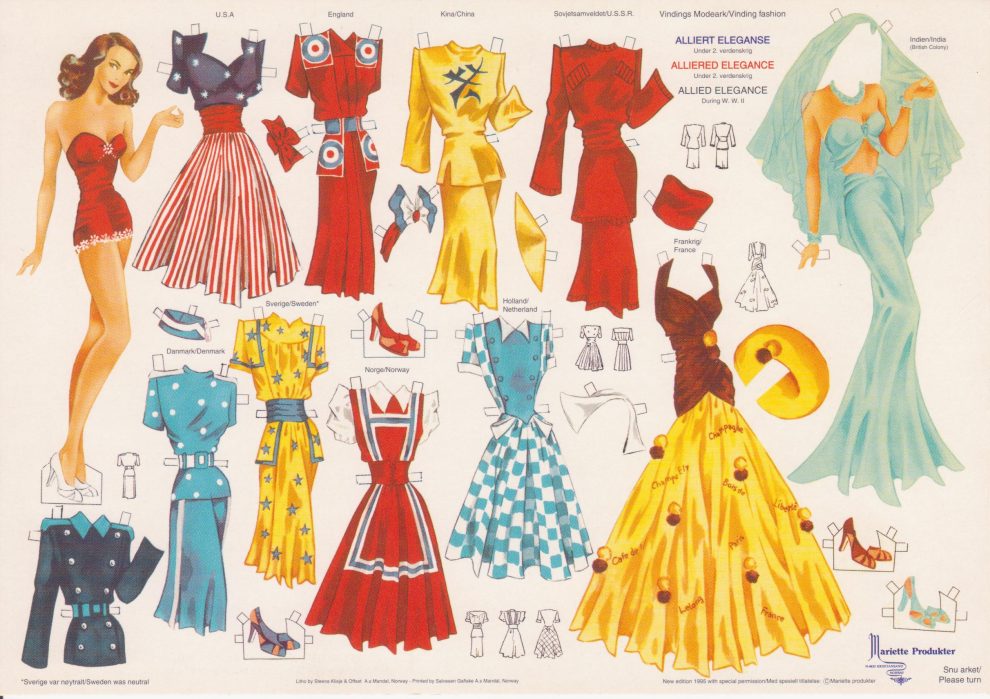
The last paper doll postcard is the most interesting of all, as it looks like 1940’s fashions. Norway struggled under German occupation 1940-1945. When reading accounts of those days it doesn’t seem that many women were wearing ball gowns or fancy dresses.

Another mystery?

For a couple of years, I’ve been gathering notes for a thriller set in Oslo during WWII. It is loosely inspired by OSLO INTRIGUE, the real-life account of Helen Astrup, a British woman who worked for the Norwegian Resistance during the war.

I don’t know when I’ll write the thriller. Maybe after I finish the latest Detective Emilia Cruz.

You may also like

mystery author

Thrillers are Tastier on Talavera Pottery

Thrillers are Tastier on Talavera Pottery

If you read this blog with any regularity you know the following;

  • I am a mystery author
  • I drink too much coffee
  • I love Pinterest and Twitter
  • I find inspiration in unlikely places

Talavera Pottery

The latest thing to jog my imagination is talavera, the beautiful and colorful Mexican pottery. The only authentic talavera comes from Puebla and the surrounding villages “because of the quality of the natural clay found there and the tradition of production which goes back to the 16th century.

talavera

Traditional talavera pieces. The store owner eyed me suspiciously when I took the picture but was less suspicious when ringing up my purchases.

Talavera pottery pops against a yellow wall at Alter Eco

Talavera pottery pops against a yellow wall at Alter Eco

You can buy talavera online at La Fuente and Direct from Mexico.

Tasty Writing

Talavera was featured in THE HIDDEN LIGHT OF MEXICO CITY. The main protagonist, Eddo Cortez Castillo, is from Puebla. His family runs one of the oldest and wealthiest talavera companies.

Talavera,” Tomás said. “The Cortez family owns Marca Cortez, half of Puebla, and the land the new Volkswagen factory is on. Eddo is still the family’s legal advisor and sits on the board of directors. Don’t know how he finds the time. It helps that he never sleeps.”

Eddo is rich. Richer than the Vegas, even richer than the Portillos. “Puebla,” Luz said. “The city or the state?”

“Both.”

Phenomenally rich.

Real talavera is relatively expensive, although when I lived in Mexico City it was popular to go to Puebla and order service for 8 of a particular pattern. I knew of one family in Mexico City that refused to let their domestic help eat off of their talavera plates, prompting this intense scene in HIDDEN LIGHT.

Luz blinked at her sister. Lupe’s bottom lip was trembling. “Okay,” Luz said, drawing it out. A tiny white lie could put this awkward conversation to rest and Maria could be told the truth later. Luz took a deep breath as if embarrassed. “I . . . uh . . . broke a dish.”

“Six hundred fifty pesos for a dish?” Tío shouted. Everyone jumped. Someone’s spoon clattered to the floor.

Luz shrugged. “It was talavera.

Tío’s hand hit Luz’s cheekbone with a stinging smack. Her head snapped back, her eyes watered, the room sparkled with vertigo and she tasted blood.

Through a curtain of dizziness, Luz watched Juan Pablo rise up and throw a wide looping punch across the table. He put his weight behind it, his chair spurting out behind him, his feet nearly coming off the floor. Fist connected with jaw and Tío spilled to the floor.

“Don’t you touch my sister!” Juan Pablo yelled furiously.

“She’s a stupid girl,” Tío roared, scrambling to his feet. “Breaking dishes when her family needs the money.”

“So you can drink it?” Juan Pablo was barely in control.

“Lupe is pregnant,” Tío shouted.

“If you’re so worried, why don’t you get a job?”

Tío threw a counterpunch across the table but Juan Pablo was younger and faster and sober. He jerked back to avoid the blow, then lunged forward, and suddenly they were snarling and grappling like two wild dogs, hands locked in each other’s shirts. The table between them rocked wildly as they wrestled over the dishes and the tortillas and the clay cazuela full of rice and seafood, ready to kill each other in the small cramped kitchen with everyone else sitting like shocked statues. Plastic glasses spun crazily and tipped over, flatware clattered to the floor, and Luz’s plate slid onto her lap.

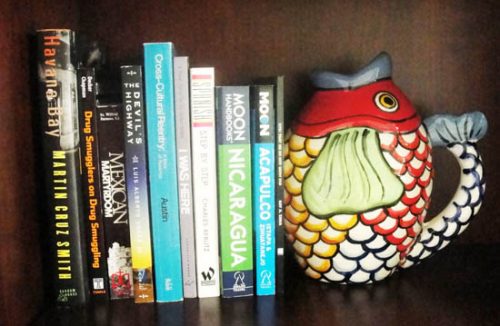
I have a few pieces of talavera and this fishy pitcher is my favorite.

Carmen Amato bookshelf

My talavera pottery fish serves a noble purpose


You may also like

talavera pottery

Mexican Retablos: Prayers on Steel

Mexican Retablos: Prayers on Steel

After a few bites of the cake Raul seemed to realize that she was waiting. “He read about the United States and wanted to go. He tried to cross the desert but the Virgin abandoned him because what he was doing was wrong. He got lost and died in the sun.”

“I’m so sorry, Raul,” Luz said.

“His mother had a retablo made for the Virgin to have pity on his soul.”

“I’m sure his soul rests in peace.”

“When his mother died I had the retablo buried with her.” Raul continued to eat.

They sat in silence for a few minutes, Luz’s heart twisting in sadness. Retablos were primitive paintings of a scene of something that happened in a person’s life for which they were giving thanks to the Virgin. But not this time. The son had died trying to get to El Norte and the mother had probably died of a broken heart. (THE HIDDEN LIGHT OF MEXICO CITY)

I’ve been giving alot of thought to visual inspiration as I tackle KING PESO, the 4th novel in the Acapulco Detective Emilia Cruz mystery series. The quote above isn’t from one of the Emilia Cruz books, but from romantic thriller THE HIDDEN LIGHT OF MEXICO CITY, which drew on many visual cues such as  Mexico’s architecture and food, as well as Mexico’s fine art.

Related: Art Stories from the Insider’s Guide to the Best of Mexico

The Catholic Church is a strong cultural and artistic influence in Mexico, and my books reflect that. Retablos are part of Mexico’s tradition combining art and faith, made all the more interesting to me because they are rustic folk art meant to capure a moment in time for which someone is giving thanks to God.

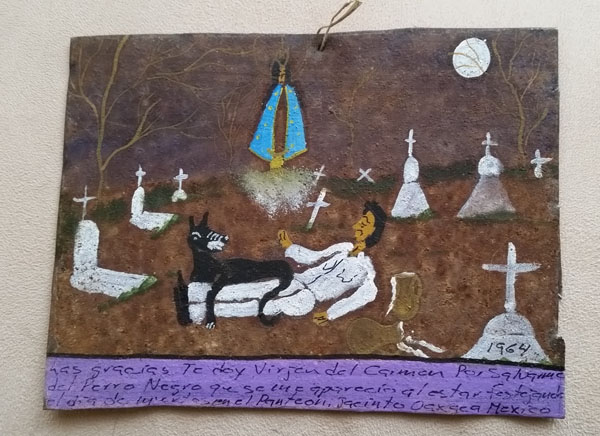
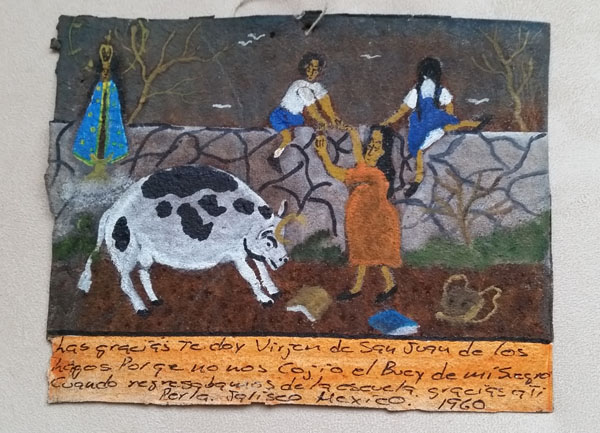
I bought these two retablos in a small shop in Mexico City’s  Zona Rosa a couple of years ago. They are each about 5×7 inches, and painted on rusted steel. The edges are sharp. My guess they were cut from a barrel and done by the same person.Retablo as visual inspiration

In this retablo, thanks are given to the Virgin of Saint John of the Lakes for saving the school children from the ox (el buey) in Jalisco.religious retablo inspires a mystey series

This retablo depicts the Virgin appearing and saving Jacinto from the black dog which appeared in the cemetary in Oaxaca. I don’t know if this should be taken literally or is a reference to illness or the devil.

I wonder at the journey these retablos took from Perla and Jacinto, who were giving thanks to God some 50 years ago, all the way to that shop in Mexico City. Now they are part of my writing journey. Just like you.

THE HIDDEN LIGHT OF MEXICO CITY

“A multilayered novel of love and drama” — Literary Fiction Review

You may also like

giving thanks to god

Little Silver Miracles

Little Silver Miracles

I’ve been thinking about visual inspiration lately, as I tackle KING PESO, the 4th Emilia Cruz mystery. Thankfully, Mexico is replete with visual cues to creativity, from large (the Basilica of Guadalupe, Mexico City’s Zocalo, assorted volcanoes) to small (shots of tequila, Chupa Pops, silver milagros).

The word milagro means “miracle.” Milagros are small charms, typically silver or tin, that represent an intention. The Zanzibar art website, which carries folk art from around the world, talks about milagros on its page devoted to Mexico.

The bearer typically is asking a saint to intercede on their behalf. They may be asking for health after an injury or illness, a successful romance, or the survival of their livestock. The charms are in the shape of an item related to the request, such as arms, legs, hearts, animals, etc.

The requestor leaves the milagro at the shrine of the saint that they are asking to intercede on their behalf. Mexico is full of statues and crosses covered with the silver charms, including those pinned to ribbons or threads adorning a statue. In many cases, the milagros are pinned to clothing worn by a statue. A milagro can also be carried for protection and good luck, in the way Detective Emilia Cruz carried her rosary with her in DIABLO NIGHTS, the 3rd Emilia Cruz mystery.

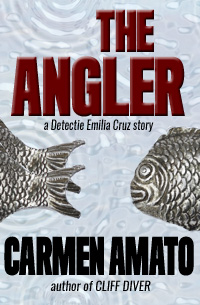
I used a milagro as visual inspiration in The Angler, a stand-alone short story that takes place before the books in the Emilia Cruz mystery series.

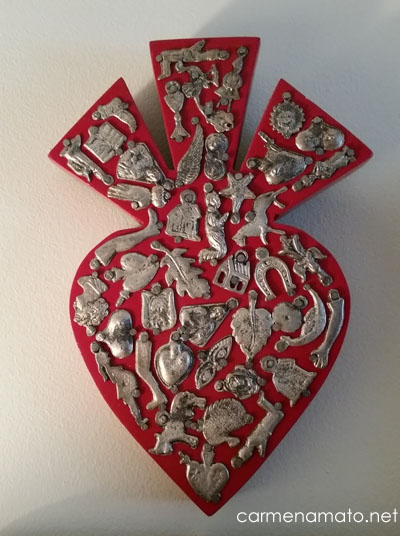
When I left Mexico, I took some milagros with me, in the form of this crucifix and a shape known as a Sacred Heart.silver charms adorn a purple cross

Mexican milagros charms

I’m writing in the room where they hang. KING PESO is coming together, albeit slowly.

Not that I’m praying for an intercession, mind you.

But visual inspiration that turns into faster typing wouldn’t hurt.

You may also like

visual inspiration

A Box, a Mystery Series, and Some Lacquer

A Box, a Mystery Series, and Some Lacquer

She came back a moment later with a box decorated in the traditional rayada carved lacquer technique. It was the size of a loaf of bread and the bottom was fitted with a small drawer with a tiny gold knob.

This is a most special and precious item,” Tifani said as she moved the other items aside and spread a velvet cloth over the glass-topped counter. Lupita placed the box reverently on the fabric. “A relic of the most holy martyr Padre Pro.”

Emilia’s breath caught in her throat. “Really? Padre Pro?”

“Who’s that?” Kurt asked.

“Padre Pro,” Emilia said, as her heart thumped. She was glad she was already sitting down. The rayada box was lacquered in blue and black with an etched design of crosses rather than the usual animal motifs. “He was a priest. A martyr of the Cristero War.”  (DIABLO NIGHTS)

As I start work on the 4th Emilia Cruz mystery, KING PESO,  I’ve been collecting (at least mentally) the unique Mexican influences that will underpin the story. Visual inspiration is important to me, as readers of this blog might have guessed by now, and I’ve done the same for all of the books in the Emilia Cruz mystery series.

Related post: Acapulco: Locating the Emilia Cruz Series

The quote above from the first chapter of DIABLO NIGHTS, the 3rd book in the mystery series, narrowed the country’s turbulent religious history down to a riveting moment in a Catholic shop. But my favorite detail was about the box containing a purported relic from Padre Pro, the real-life Catholic martyr.

In DIABLO NIGHTS, the relic is housed in a rayada box. Rayada is the Mexican technique of carving lacquer. Markets in Mexico are never without trays, boxes, and even gourds decorated with this painstaking technique. When we lived in Mexico City, I was picky, always looking for the right shade of red or bypassing pieces that weren’t as finely made.

Related post: How to Find Love at Mexico City’s Markets

I now wish I’d bought more besides the two below. The red box, with its exceptionally detailed lacquer carving, has long contained my desk supplies and directly inspired Padre Pro’s relic box. The small tray functions as a coaster for my coffee mug.red rayada laquer box from mystery serieslacquer box from Emilia Cruz mystery seriesrayada technique tray from mystery series author Carmen Amato

I never knew just how much effort went into these little artistic gems, until I read ta description from worldexperience.com. Possibly as much time as it took me to write DIABLO NIGHTS, if you don’t count the time I spent rearranging sticky notes on the master outline, pretending to be both characters during Emilia-Silvio argument scenes, and drinking coffee.

Diablo Nights by Carmen AmatoSo what happens in DIABLO NIGHTS after the infamous rayada box is opened?

Tifani slid the drawer closed and opened the lid of the box. She took out two pieces of styrofoam and set them aside. She reached back inside the box and drew out a small rectangular display case. Lupita whisked aside the now-empty enamel box and Tifani set the glass case on the velvet pad and turned it so that the front faced Emilia and Kurt.

The sides and top of the display case were made of clear glass. The wooden base was stained a dark mahogany and bore a small brass plaque with an inscription that read A Relic of the Most Holy Martyr Blessed Padre Miguel Pro Juarez, S.J. 1891-1927.

The back was decorated with a color picture of a priest in a bloody cassock lying with arms outstretched at the feet of an officer holding a sword and wearing a garish Napoleon-style uniform.

But it was the object inside the display case that took Emilia’s breath away. A long-lost relic of Padre Pro. Her life had come full circle.


You may also like

mystery series

Book Review: The Orphan Uprising

Book Review: The Orphan Uprising

The Orphan Uprising is the riveting last book in the Orphan Trilogy by the father-and-son writing duo of Lance and James Morcan from New Zealand. I hear they are making a movie based on the books and if so, it ought to be a blockbuster.

The first two books, The Ninth Orphan and The Orphan Factory, lay the groundwork: the shadowy Omega group is bent on world-wide domination and through genetic testing has evolved a group of people with super mental and physical capabilities. They have been raised with numbers for names, based on their birth order, and raised in a secret orphanage where they learned to be uber-intelligence agents to help Omega get rid of enemies and solidify members in positions of global power and influence.

But Orphan Nine, the best yet not the most ruthless, wants out. And so the saga begins.

The books move like Hollywood action scripts, combining elements from The Boys from Brazil with YA action akin to Divergent. Part sci-fi, part political thriller, all of the books are great fun but Uprising is the best. Nine has successfully broken from Omega and lives with his son and pregnant wife in French Polynesia. But Omega has somehow learned of his offspring—who would be valuable from a genetic testing standpoint—and kidnaps him. Nine has a heart attack at the crucial moment. Barely recovered, he goes after the boy, into Omega controlled territory including a string of genetic testing laboratories. The trail leads Nine around the world in 80 breathless days of action, drama, and well described unique locations including Greenland and the Congo. It’s a page-turner right to the end and a hefty read to boot. The Morcans don’t skimp on the action, making this an excellent entertainment value.

As a mystery and thriller author, I look for plot twists and turns, engaging characters, and balanced construction that makes a book review a pleasure. The Orphan Uprising delivers on all counts.

Love book reviews but find writing them hard? Get the free cheatsheet for writing a Book Review that Matters!

book review

How to write a political thriller

How to write a political thriller

One of the most often-asked questions for a mystery and thriller author is “Where does your inspiration come from?” Political thriller THE HIDDEN LIGHT OF MEXICO CITY had quite the auspicious beginning . . .

inspiration for a thriller

Fateful dinner party

We were invited to a dinner party at the home of another expatriate family in Mexico City. I’d met the mom, Amanda, at a school function. Amanda was a writer and we both participated in an English-speaking writer’s group. Her boys were close enough in age to my kids for them to play together.

A dozen guests sipped cocktails on the patio, then went into a dining room glowing with fine crystal and china. A lovely gazpacho started the meal, prepared and served by the family’s new maid. Itzel was about 18, wearing a stiffly starched uniform and a nervous smile.

We waited quite a long time after the soup for the main course. Amanda excused herself and went into the kitchen. A few minutes later she asked me to come with her.

The main course was fish but it was still raw. Amanda looked close to tears as she contemplated the ruin of her dinner party. She didn’t understand Itzel’s frantic explanation.

But I did. Itzel had turned on the heat and put the pan of fish in the broiler. Nothing had happened, she wailed, and began to cry.

I nearly laughed. She’d put the fish into the storage drawer under the oven, thinking it was the broiler.

We found a frying pan and some butter. Ten minutes later the guests were eating trout almondine while Itzel recovered in the kitchen.

Itzel and I talked after that. This was her first job as a maid. Itzel was from a small town near Veracruz and had never lived with electric appliances, air conditioning, or flush toilets. The young girl went home every other weekend and supported her mother and siblings.

Itzel’s story became that of Luz de Maria Alba Mora, the central female character in THE HIDDEN LIGHT OF MEXICO CITY. I left out the part about the oven, however.

Gotta save something for the next book.

Related: Read Chapters 1 and 2 of THE HIDDEN LIGHT OF MEXICO CITY

Inspiring reads

Itzel’s story was only one source of inspiration. Two books also guided the narrative.

Ken Follett’s THE KEY TO REBECCA has always been a favorite, for its characterizations, pacing, and points of view. I wanted HIDDEN LIGHT to have that same sense of developing danger–whether from the drug cartels or Luz’s risks–and for readers to have the same insight into the hero as the villain. Set against the backdrop of WWII and the British campaign in north Africa, it is probably the best thriller I’ve ever read.

The other book which provided inspiration was THE EAGLE’S THRONE by Carlos Fuentes. In this novel, Mexico’s power players are forced to conduct their political intrigues via letters. The result is a tribute to cunning craftsmanship. But more importantly, from my optic, the book perfectly captured the tone of Mexico’s politics. I wanted to portray the same sense of mistrust, intrigue, and constant one-upmanship.

Musical Interlude

Many authors talk about music they play as they write. I like silence–my head is always crowded with dialogue so things are noisy enough as they are. But I like to match music with characters.

Herb Alpert and the Tijuana Brass was one of the first Latino music superstars. The Lonely Bull is one of my favorite albums. If HIDDEN LIGHT is ever made into a movie, that title song will be the theme of the main male character Eduardo Cortez Castillo.

Putting it All Together

Pinterest is where all my inspiration for THE HIDDEN LIGHT OF MEXICO CITY comes together. There’s a board called “Inspiration for a Thriller,” with tons of pictures and videos that reflect the book and the elements that inspired it. If you’re on Pinterest, please follow along! https://www.pinterest.com/carmenconnects/inspiration-for-a-thriller/

You may also like

inspiration for a thriller

Book Review: Smokescreen, a thriller

Book Review: Smokescreen, a thriller

Smokescreen by Khaled Talib is a thriller for today’s audience. It’s got a politically driven plot based on current events, an everyman hero, and enough double-dealing and deranged killers to keep the reader flipping pages and skipping meals.

What makes Smokescreen such a contemporary stand-out, however, is that unlike most popular thrillers, the hero is neither American nor British. Imagine that! Nor does the action originate in  either Washington or London. Instead, our hero is a mixed-race citizen of Singapore, but with a lifestyle and motivations that have universal appeal. The Asian nation of Singapore, portrayed in the novel as an international espionage crossroads, is a surprisingly terrific setting for a thriller. I started checking on flights just to go follow the novel’s path and see the sights.

Related: Book review: Weapons of Mass Deception

Jethro “Jet” West is a pampered local journalist of mixed descent who writes a society column, takes martial arts classes, and is sleeping his way through the ladies of Singapore’s upper crust. But he also plans to edit a new independent newspaper, a move which gets him some unwanted attention. He’s identified to be the convenient fall guy in a plot to assassinate the Israeli Prime Minister by radical members of the Israeli military—aided by a sympathetic Singaporean official and his hired guns–when the PM visits Singapore. Seems the PM is going soft on Palestine and has offered up one too many concessions for the hard right wingers in Israel. They know how to fix things, although a spy within their midst passes on the information and the scene is set.

In order for the plot to work, West must be regarded as a plausible evil-doer with a criminal past. So the radicals will give him one. When the PM bites it, their logic runs, no one will be surprised that West is the culprit as he’ll have a “past” that fits his newly minted profile as a killer run amok. Talib does a good job of keeping West confused and angry by what is happening, yet figuring out how to survive and close down the plot. In the end, it’s West’s talents as a journalist that will be the key.

The book has the thriller’s edge of a Ludlum. West’s comfortable world suddenly implodes and he finds himself on the run. A shadowy American ambassador-cum-spymaster is his only help. Yet that man has his own agenda, questionable contacts, and reasons for helping. More characters are gray rather than wholly bad, yet the plot stays linear and the reader isn’t confused, which is an improvement over most Ludlum novels.

I would have liked the big climax to have circled back to the Israeli PM’s visit. But the right things happened and there’s potential for Jet West to make a repeat appearance. If he does, I hope he’s still in Singapore. Sights, sounds, and smells are on full display in the book, ensuring that the setting provides stiff competition to the action.

As a mystery and thriller author, I am always on the lookout for books with the elements most important to me: a great setting that draws me onto the streets and into intereesting palces, twists and turns in the plot, and multi-dimensional characters. Smokescreen has it all.  Highly recommended.

Khaled Talib visited this blog last year, letting readers know his favorite books. Check out what he’s serving for dinner, too.

Love reading reviews but worried that writing them is hard? Unleash your power as a reviewer with my simple cheatsheet for writing a Review that Matters.

Smokescreen

The Year We Made a Difference for Water.org

The Year We Made a Difference for Water.org

In 2014, I donated $1 from the sale of Kindle books to Water.org, the charity co-founded by Matt Damon to bring clean and safe water to communities worldwide. The goal was to provide clean water for life to 25 persons. The year-long campaign was called Writing for Water.

How The Fundraiser Worked

Every month in 2014 I tracked sales using Amazon’s KDP author dashboard and calculated how many Kindle ebooks I sold. I did not count giveaways, freebies, or print sales. In some months, when I ran a sale on a Kindle edition, the net profit on a Kindle edition could be less than $1. Didn’t matter. A sale was a sale and equated to $1 in donations.

I created fundraiser pages at Water.org’s website to explain what I was doing, showcase other authors who were participating, and submit my donations via credit card. At first I’d hoped to create a 12 month fundraiser on the site, which would have been a handy link to promote, but Water.org only lets you do it for 90 days at a time.

I also created a Writing for Water page on my website to explain what I was doing, plus a monthly blog post to track progress and hold myself accountable.

The Results

Writing for Water graphicEnough money was donated to Water.org to provide 25 people with clean water for life by August 2014. Sales slowed after that, due to changes in Amazon’s distribution streams. Overall, the year ended with 31 people able to gain access to clean water for life.

Lessons Learned

  1. It Took a LOT of Effort to Track and Promote

I didn’t realize how much time and effort it was going to take to promote other authors, promote the effort, promote our progress, and try to grow participation. I should have done some research about how the best fundraisers are promoted and planned out the effort before January 2014.

Beyond social media, the most useful thing I did was to send out a free press release which garnered a nice exchange with the folks at Water.org. I also mentioned the effort in a couple of different author interviews. But I should have had a list of things to do and been more consistent and focused.

  1. Run a Tighter Calendar

An unexpected complicating factor was that Water.org only creates 90-day fundraisers when I wanted the fundraiser to last 365 days. This meant that I had to track when a fundraiser ended, change all the links on my pages, and create new ones. Then I ran into problems when I unwittingly created one fundraiser using my Facebook profile and another using my Twitter profile. In short, it was a structural problem that added to the workload. It could have been partially mitigated by using a dedicated campaign calendar, much like a blog calendar.

  1. Expect an Opt Out Rate

When I asked other authors to join me, six pledged to help. Three followed through and we cross-promoted each other in a mutual effort to boost sales. The other three were never heard from again.

A 50% opt-out rate is disappointing but probably not surprising given today’s overcommitted world. But it would have been nice to at least get a note saying they weren’t going to participate after all.

The non-participating authors had responded to a call I posted in a Facebook or Goodreads author group. We didn’t have a personal connection beforehand. Maybe that is the point.

The three authors who responded were terrific: Norm Hamilton, author of BY THINE OWN WELL; Jerry Last, author of the Roger and Suzanne mysteries; and Sharon Lee Johnson, author of a string of ebooks including the ME VS ZOMBIES stories.

  1. Charity Doesn’t Equal Marketing

Subaru uses charitable donations as a means of building its brand and making purchasers feel good about the car they buy. I wasn’t sure if the same should/would apply to books and why readers purchase them.

Bottom line, I don’t think my donations to Water.org made a difference to book buyers. Nor did readers flock to this blog to hear how the campaign was going. I met the goal, with a little help from friends, but didn’t sell in numbers big enough to warrant a Big Event or even a new Water.org YouTube video.

Was the campaign too low key? Maybe. But it felt strange to be all promotion-y.

What’s Ahead in 2015

I’ll continue to support Water.org, because it’s a critical mission. But I know that if I want to finish the next Emilia Cruz novel, as well as a couple of other writerly projects, I can’t do a big campaign again.

Instead, I’ll contribute on my own schedule, without using Water.org fundraiser pages. I also won’t use Kindle sales as the yardstick. I’ll be expanding distribution beyond Amazon in 2015 so my income and accounting are in for some changes.

But no matter how much I’m able to donate, it will make a difference. Whether they know it or not, so will my readers.

Pin It on Pinterest