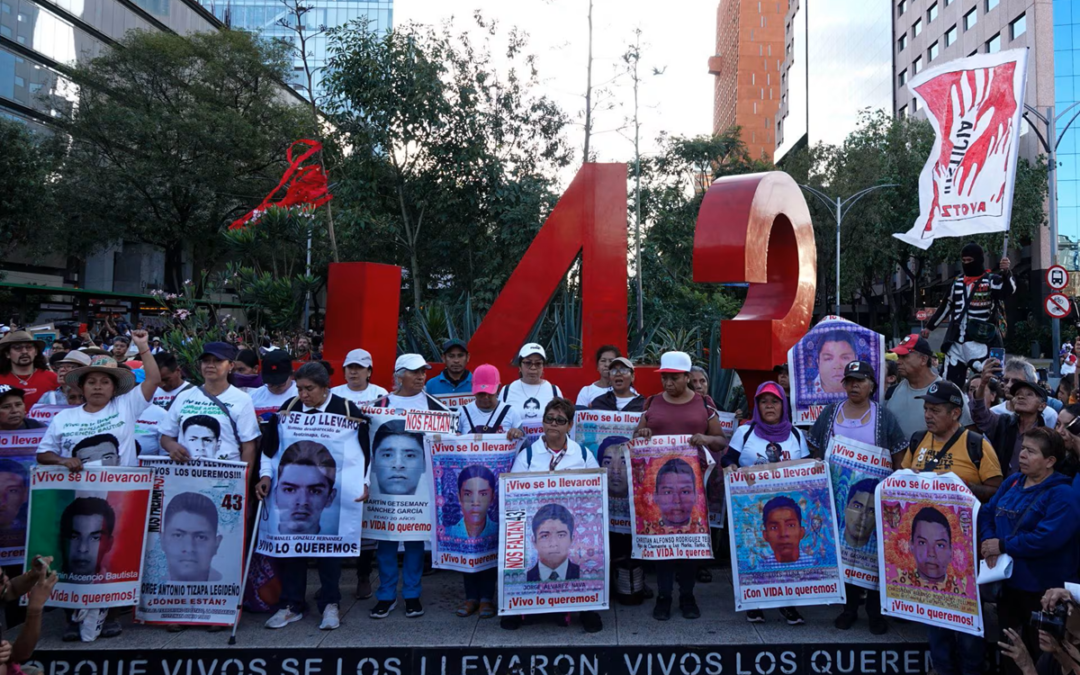
To refresh your memory, on the night of 26 Sept 2014 students from the Ayotzinapa rural teaching college commandeered buses in Iguala, Guerrero for a joyride to Mexico City. The buses got stopped and the students were kidnapped, never to be seen again.
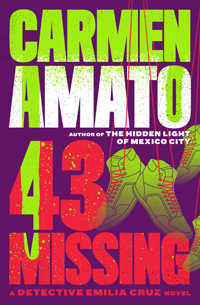
As the initial investigations turned into clown shows, I wrote 43 MISSING, a book with a similar crime that reviewers have called “Haunting . . .a real pageturner” (Nightstand Reviews) and “Brilliantly plotted and magnetic” (Readers’ Favorite). My goal was to show what might have happened and also to raise awareness of the real crime.
The federal government tried to pin the blame for the disappearance on a local drug gang but so many others had to be involved that the so-called “historical truth” story fell apart fast. Now it appears that local police, narcos, civil and judicial authorities, and the Mexican Army were all involved in either the initial crime and/or the cover-up that followed.
President Claudia Sheinbaum has released a new report that outlines the investigation going forward. Her administration is apparently taking a scientific approach, looking at whatever factual and scientific evidence exists to try and close the case, but also to “Identify those who benefited from unsupported narratives during earlier stages of the process.”
ICYMI: Here are my research notes behind the book 43 MISSING and the Ayotzinapa tragedy
Leading up to the announcement, this happened
20 previously “overlooked” trash bags containing human remains from a funeral home in Iguala are now of interest. The bags were on the premises of a funeral home with 3 crematorium ovens.
The former governor of the state of Guerrero, Ángel Aguirre, was arrested last month on charges that he ordered security camera footage related to the case to be destroyed. Aguirre resigned in 2014 a month after the mass disappearance. Last year a judge in Guerrero was arrested for the same reason.
In June of this year, US immigration authorities in California arrested fugitive Enrique Martínez Chávez, a former Mexican Army soldier wanted in Mexico for his role in disappearing the 43 students.
In March, a federal judge in Mexico ruled the Mexican Army must make public 853 documents related to the Ayotzinapa case. The military fought hard to avoid having to produce the files, claiming that they are missing, never existed, etc. Still waiting to see if this actually happens.
Four new focus areas
As outlined in the new government report released 28 September, 12 days and 2 days after the mass disappearance, the federal investigation is focusing on 4 areas:
1. Analysis of calls and locations indicate that students’ phones were used by the owner of funeral homes and a crematorium in Iguala days after the disappearance. This led to 17 more “targets” i.e. people involved in doing away with the students including members of the Guerreros Unidos cartel, municipal and state police, officials, and people related to the funeral sector.
2. Initial searches of the funeral home premises netted human bones, weapons and a previously undocumented crematorium. Additional searches between March and June 2026, turned up hundreds of bone fragments, dental prostheses, biological remains, cartridges, casings, and documents, all of which are being analyzed.
3. Three phones owned by missing students were used by local officials, including a municipal police officer. Tracing also led to pinpointing a student phone in a local police station, suggesting that the students were in custody in the police station before disappearing. This line of investigation led to a witness who was a minor–aged 14–at the time.
4. Footage from security cameras of the Superior Court of Justice of Guerrero from the night of September 26 and the early morning of September 27, 2024 may have captured action. While the footage itself may have been destroyed, court and municipal officials almost certainly are guilty of colluding to keep the footage secret. So far, the former president of the Court and the former inspector of the judicial body have both been arrested. Now they need to talk.
New Lies and Old Clues
A friend jokingly said that it was easier for me to write contemporary police procedurals set in Mexico than if I was writing the same genre set in the US. He was right.
The Mexican law enforcement landscape isn’t particularly troubled by crime, or so it seems, because there are more favors to be gained and money to be made by going along with corrupt civil authority and their narco partners. For the most part criminal behavior has been protected.
Writing 43 MISSING, a fictionalized account of a troubled investigation into a crime that mirrored the Ayotzinapa tragedy, allowed me to create closure for a crime that may never actually have one in real life. As an audiobook, it has an even impact, as you puzzle out the crime listening to Detective Emilia Cruz’s inner thoughts.
I applaud President Sheinbaum’s approach, bringing technical tools to bear but it also feels like too little, too late. Nibbling around the edges of a sprawling coverup.
Anyone involved has had 12 years to dream up new lies and argue that old clues are too timeworn to be relevant.
Featured image credit: Graciela López Herrera / Cuartoscuro, via sdpnoticias.com