When I was growing up, embroidery was a common craft. Everyone knew the basics: chain stitch, blanket stitch, satin stitch. My mother made cocktail napkins decorated with tiny daisies and embroidered geometric designs on clothing and hand towels.
When preppy fashion was was all the rage in the mid-80’s, I cross-stitched a cover for a much-coveted Bermuda bag with wooden handles.
Embroidery was charming, creative, fashionable.
How times have changed.
New use for old stitches
At least 120,000 people are missing in Mexico amid the country’s drug wars. That’s a best guess. Record-keeping there is spotty to say the least.
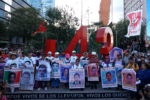
The Mexican social movement Bordando por la Paz y la Memoria (Embroidery for Peace and Remembrance) has held a weekly embroidery meetup in Mexico City since 2012. The group embroiders banners, patches and wearables with the name and likeness of the missing to keep memories alive but also serve as a tool to protest government inaction and denial.
Pippa Cooper, a PhD student at the School of Languages, Cultures and Societies, University of London, documented the group, calling it “a voice of needle and thread that won’t be silenced.”
Last year for the 10th anniversary of the forced disappearance of 43 students from a training college in Ayotzinapa that inspired the Detective Emilia Cruz novel 43 MISSING, members embroidered portraits of each student, along with name and personal details for marchers to wear.
Stitch her name
Between January and June this year, 1,420 women were killed across Mexico. As drug-related violence rises, so does femicide.
Ahead of the International Women’s Day in March in 2020, artist María Antonieta De la Rosa gathered two friends, their mothers and grandmothers in a former women’s shelter in the city of Cuernavaca and began embroidering patches with names.

Embroidery meetup in Cuernavaca, August 2025, courtesy of drivemexicomagazine.com
The effort grew into the We Name Them by Embroidering collective, which creates quilts to honor the dead and raise awareness. The quilts are carried at funerals and displayed in public places.

Ana Vásquez and quilt, courtesy of drivemexicomagazine.com
“We’re not going to change the world with this,” says Ana Vázquez, a community advocate. “But at least we’re making noise. At least people are looking at us, at least people are talking about these femicides. They’re not just numbers in a database . . .”
“I can’t stop thinking that my name is going to be up there some day . . . One of the other women is going to be embroidering me.”
I write the Detective Emilia Cruz series because these issues matter to me as a mother, daughter, sister, and friend. I hope that shining a light on them through fiction will touch people in a way that the news does not.
A question for you
Have you ever read something in fiction that made you aware of a real world issue?
MY BACKSTORY— I learned a few things about danger, deception and resilience during a 30-year career with the CIA focusing on counterdrug efforts and technical collection. Now a mystery author, those lessons play out on the page, especially in the Detective Emilia Cruz mystery series set in Acapulco. Starting with Cliff Diver, the series is a back-to-back winner of the Poison Cup Award for Outstanding Series from CrimeMasters of America. I’ve also written historical and political thrillers, essays about the craft of crime fiction, and live with a very large white dog named Bear.