Once upon a time, I took a trip with a similarly adventurous-minded girlfriend to Papua New Guinea, which bills itself as “The Land of the Unexpected.” I doubt it has changed much since then; it is a wild, mountainous place where the wheel was never invented.
Civilization burst upon Papua New Guinea as World War II rocked the South Pacific. Geographically, it is part of the Solomon Islands chain (think Guadalcanal) and WWII turned the deep waters around it a graveyard for American and Japanese ships and planes.
In the capital of Port Moresby, we tasted crocodile in the hotel restaurant, did a little shopping for tortoise shell bracelets and a breastplate-sized kina shell to be worn as a necklace, and bought beer glasses at the South Pacific Lager brewery (I actually prefered the Fiji Bitters beer I’d had in that country, but that’s another story.)
We also learned about the wartime Coastwatchers, the group of valiant locals that watched Japanese ships and planes and reported back to the Allies.
Into the Wild
From Port Moresby we headed to the Highlands in a puddle jumper plane and found ourselves in Goroka, a settlement carved out of the wilderness that occasionally shivers from volcanic aftershocks. It’s home to the now sadly commercialized Goroka mudmen tribe and some of the strongest, most flavorful coffee in the world.
Goroka was victim to a terrifying social cycle. About 10pm every night drunken customers spilled out of the pool halls and bars and proceeded to rampage through the streets destroying whatever got in their way. Each morning everyone put the town back together again.
Overall, the country had a rape statistic of 1 in 4 women being the victim of sexual assault, a situation that was probably underreported. We were stuck in a motel which had long given up concerns about security. In all of the rooms that the manager offered, either the door or the window locked but never both.
We blocked the door with the dresser and stayed up nights watching a grainy cable station from Australia and listening to the commotion outside. We were prepared to fight and fight hard if our room was invaded. Luckily, it never came to that.
Where a souvenir is all about you
Despite the nightly rampages, we got out and about and presently found ourselves with a translator at a local market. There were wonderful wooden carvings for sale, fanciful animals and platters and bowls and puzzles. There were baskets coiled into shapes both practical and fantastic.
We were charmed.
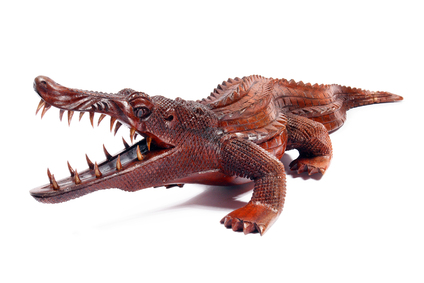
An array of wooden crocodiles and seahorses caught my eye. Pointing to the largest croc, I asked how much it was. The translator queried the woodworker, a grizzled older man chewing betel nut which had painted the inside of his mouth bright red. He wore shorts and a dark shirt with the sleeves cut off and his dusty bare feet were the size and shape of a large dinner plate. He replied to the translator who then turned to me. “He wants to know if you’ll pay the first, second or third price.”
“What?”
“You pay the first price, the highest, if you’re a Big Man,” the translator explained. A Big Man was someone of Importance in the tribe, a person who paid a price commensurate with the respect that was to be accorded them. The lesser second price was paid by those who either weren’t quite a Big Man in terms of respect or didn’t have a Big Man’s means. The third price, the lowest amount of money, was paid by those who were of no account.
Basically, it was a system of paying in accordance with how important you were rather than how valuable the item was.
Pay your own price
True confession . . . I paid the second price.
I wasn’t in a Big Man category. But I didn’t consider myself to be a nobody, either. A therapist might have a field day with this, but I walked away feeling like I’d acquitted myself well enough.
The crocodile I bought that day is still around, as is a tall seahorse and the kina shell I never turned into a necklace.
And oddly enough, I think that Highlands adventure taught me quite a bit about geo-politics and current events.
MY BACKSTORY— I learned a few things about danger, deception and resilience during a 30-year career with the CIA focusing on counterdrug efforts and technical collection. Now a mystery author, those lessons play out on the page, especially in the Detective Emilia Cruz mystery series set in Acapulco. Starting with Cliff Diver, the series is a back-to-back winner of the Poison Cup Award for Outstanding Series from CrimeMasters of America. I’ve also written historical and political thrillers, essays about the craft of crime fiction, and live with a very large white dog named Bear.